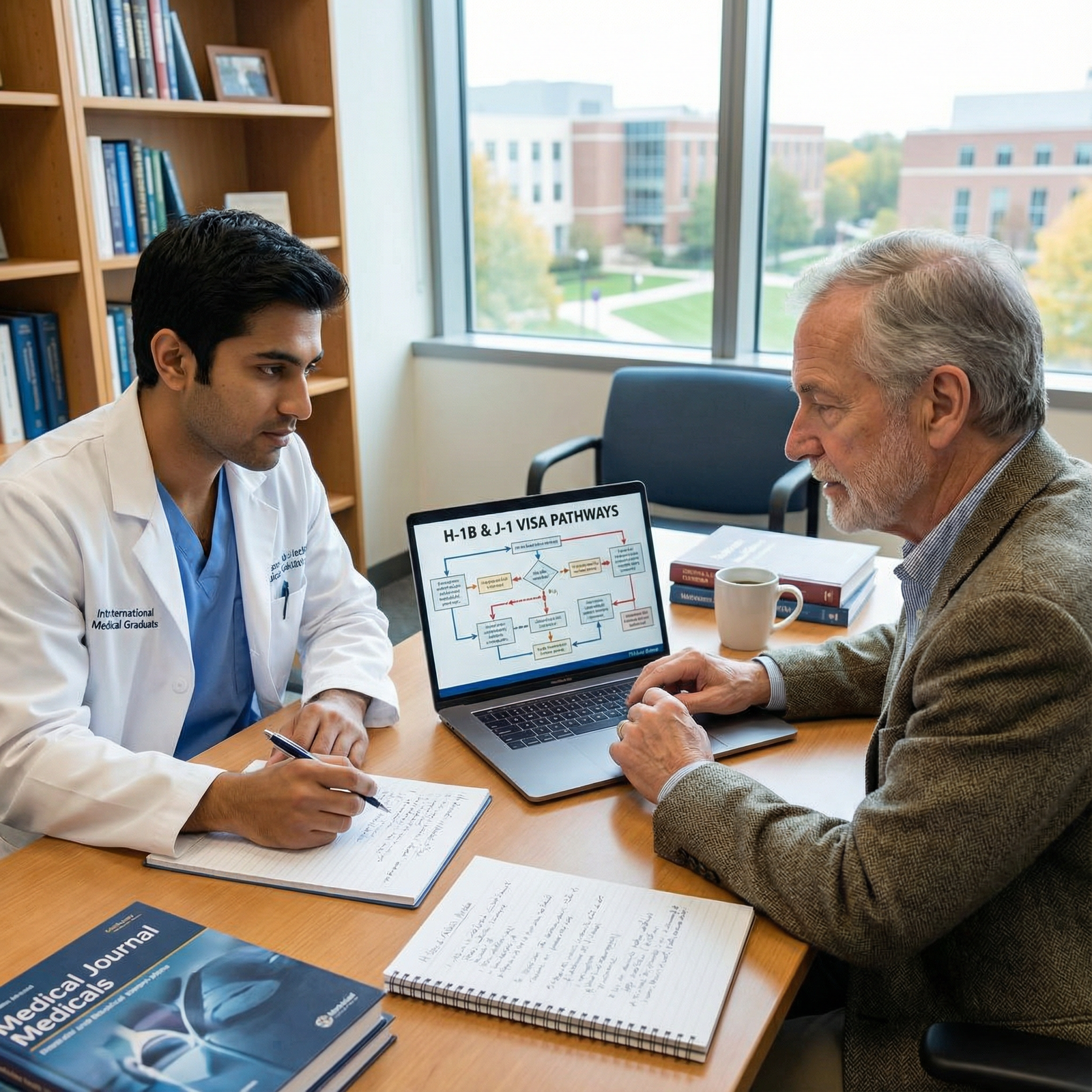
Understanding the Landscape: Why Visa Strategy Matters in Interventional Radiology
Interventional Radiology (IR) is one of the most competitive and rapidly evolving specialties in the United States. For international medical graduates (IMGs), the combination of a highly selective field and complex immigration rules makes visa planning absolutely critical.
Unlike some other specialties, interventional radiology residency pathways are more limited and more structured, which influences how programs view visa sponsorship and which visa types they are willing to support. A poorly planned visa strategy can:
- Limit the number of programs you can apply to
- Reduce your chances in the IR match
- Restrict fellowship and early-career job options after residency
- Delay or prevent board certification or independent practice
This guide focuses on visa navigation for residency in interventional radiology, with a special emphasis on:
- Direct Pathway: Integrated Interventional Radiology (IR/DR) residency
- Alternative Pathway: Diagnostic Radiology residency followed by Independent IR residency/fellowship
Throughout, we’ll cover how J-1 vs H-1B visa options affect each stage, what IMGs should prioritize, and how to align visa decisions with long-term IR career goals in the US.
Visa Basics for IMGs Entering Interventional Radiology
Before diving into IR-specific strategy, it’s essential to understand the core visa options for residency: J-1 and H-1B. Almost all IMGs in GME will be on one of these two.
Core Training Pathways in Interventional Radiology
Integrated IR Residency (IR/DR)
- 6-year program (PGY-1 to PGY-6)
- Combines diagnostic radiology and interventional radiology in a single match
- You enter via the IR residency match as a PGY-1 or PGY-2 (depending on program structure)
Diagnostic Radiology (DR) → Independent IR Residency (2 years)
- 4-year DR residency (PGY-2 to PGY-5) after intern year
- Followed by 2-year Independent IR program (PGY-6–7 or PGY-7–8)
- You may need two separate visas (one for DR, one for Independent IR) if you change institutions or visa categories
Your visa decision for residency can influence your ability to:
- Enter an Integrated IR program directly
- Transition from DR to Independent IR
- Fulfill post-training obligations (e.g., J-1 waiver service)
- Secure a long-term job in IR in the US
J-1 Visa for Residency: The Default Track for Most IMGs
The J-1 visa for physicians is a training visa sponsored by the Educational Commission for Foreign Medical Graduates (ECFMG). It’s the most widely used visa type for IMGs in US residency programs, including interventional radiology.
Key features of the J-1:
- Sponsored by ECFMG, not by individual programs (though programs must accept J-1 trainees)
- Designed specifically for graduate medical education (GME) and fellowship training
- Allows multiple sequential training programs (e.g., preliminary year → DR → IR), as long as each is approved and within limits
Important advantages:
- Widely accepted: Many IR and DR programs only sponsor J-1 visas
- Centralized process: ECFMG handles much of the administrative process
- Easier approval: Often less complex for programs than H-1B, making them more comfortable to accept IMGs
- Training continuity: You can train at multiple institutions under the J-1 as long as each is approved by ECFMG
Key limitations:
- Two-year home country physical presence requirement
- After completing all J-1 training, you must either:
- Return to your home country for 2 years or
- Obtain a J-1 waiver (commonly via service in an underserved or rural area for 3 years)
- After completing all J-1 training, you must either:
- Restricted moonlighting
- External moonlighting is usually prohibited
- Internal moonlighting is often limited and tightly regulated
- No “dual intent”
- J-1 is a non-immigrant visa; intent to immigrate permanently can create legal complexity, especially when applying for permanent residency (green card) later
- Time limits
- Total J-1 clinical training time is generally capped (commonly 7 years, with exception options), which must accommodate DR + IR if you take the long route
For interventional radiology residency, the J-1 is feasible for both IR/DR integrated and DR+Independent IR pathways, but the post-training obligation (waiver or home return) becomes a major career-planning factor.
H-1B Visa for Residency: Less Common, More Strategic
The H-1B is a temporary work visa for specialty occupations. In GME, it allows residents and fellows to work as employees of the hospital.
Key features of the H-1B:
- Sponsored by the residency program/hospital (not by ECFMG)
- Considered a “dual intent” visa (you can lawfully intend to immigrate)
- Often seen as more flexible for future green card processes
- Requires USMLE Step 3 passed before H-1B processing in most states/institutions
Advantages in the context of IR:
- No 2-year home return requirement
- Often easier to transition to a job or fellowship directly after training
- Can be advantageous later for academic or private practice IR jobs that also sponsor H-1B or green cards
- Allows full participation in GME while preserving options for long-term US immigration
Major limitations:
- Fewer programs support it
- Many IR and DR residencies will state “J-1 only” or “J-1 preferred”
- Step 3 requirement
- You must pass Step 3 early enough for visa processing before residency start (often by January–March of the match year)
- Cap and timing issues
- Some institutions are “cap-exempt” (university hospitals, non-profits), but transitions from training to non-academic jobs may require entering the H-1B lottery
- Program administrative burden
- Legal and processing costs are higher; some programs avoid this for residents
In interventional radiology, where competitiveness is high, insisting exclusively on H-1B can severely limit your program list and reduce your chances in the IR match.

J-1 vs H-1B in Interventional Radiology: Strategic Comparison
For IMGs targeting an interventional radiology residency, the choice between J-1 vs H-1B should be strategic, not purely preferential. Each visa pathway interacts differently with:
- The IR/DR integrated match
- DR + Independent IR route
- Post-training job prospects
- Long-term immigration plans
How Visa Type Affects Your IR Match Strategy
Program sponsorship patterns in IR:
- Many integrated IR programs are highly competitive academic centers that:
- Commonly accept J-1
- May have limited or no H-1B sponsorship for residents
- Many DR programs (which you might use as an alternative path to IR) similarly favor J-1
- Independent IR programs very often accept J-1, and many are at academic institutions with cap-exempt H-1B capability as well
As an IMG, your IR match strategy often involves:
- Applying broadly to IR/DR integrated programs
- Applying to DR programs with strong IR departments as a backup
- Planning for Independent IR if you don’t match IR/DR directly
If you restrict yourself to H-1B–only positions, you are likely to:
- Dramatically shrink your pool of IR and DR programs
- Reduce your odds of matching IR/DR in a competitive cycle
- Possibly exclude excellent academic IR centers that only use J-1 for residents
For most IMGs, a flexible approach—accepting J-1 for residency while planning for waiver service later—is far more practical.
Long-Term Implications: Training, Waivers, and Career Trajectory
When considering IMG visa options, interventional radiology adds specific complexity:
Total duration of training
- IR/DR: 6 years after medical school
- DR + Independent IR: often 7–8 years including intern year
- J-1 time limits must be monitored carefully if you use the DR + Independent IR route
Subspecialized nature of IR practice
- Many J-1 waivers (e.g., standard primary care or general specialty roles in underserved areas) may not align with advanced IR practice opportunities
- IR jobs that qualify for waiver sponsorship exist but are more limited geographically and often heavily competitive
H-1B and employment after training
- If you train entirely on J-1 and then move to an H-1B for employment, you will still need to resolve the 2-year home requirement first (e.g., via waiver)
- If you train on H-1B, you can transition more directly to H-1B or permanent residency without J-1 waiver complications
Because IR is highly procedural and technology intensive, many desirable positions are at larger centers in urban/metropolitan areas. These may be less likely to offer traditional J-1 waiver roles than primary-care heavy rural areas. This reality makes the J-1 vs H-1B decision more consequential for IR than for some other specialties.
Practical Pros/Cons Summary for IR Applicants
J-1 for IR Residency/DR Residency:
Pros
- Widely available and accepted by IR and DR programs
- Easier entry into the US training system
- Centralized ECFMG process
- Supports multiple sequential trainings (DR → IR)
Cons
- 2-year home rule or waiver requirement after all training
- Potential difficulty finding IR-specific waiver jobs in desired locations
- Time limits may become tight in DR + Independent IR pathway
H-1B for IR Residency/DR Residency:
Pros
- No home return requirement
- Better alignment with long-term US immigration (green card)
- Attractive for certain employers post-training
- More straightforward transition to non-training H-1B positions
Cons
- Fewer IR/DR and DR programs sponsor it
- Step 3 early is mandatory
- Administrative and legal hurdles for programs
- Overly focusing on H-1B may seriously reduce IR match chances
Actionable takeaway:
For most IMG applicants to interventional radiology, being open to J-1 is essential to remain competitive in the IR match. H-1B can be a valuable goal, but rarely should it be a strict requirement for residency training itself.
Planning Your Application: Visa-Savvy Strategy for the IR Match
Beyond understanding IMG visa options, you need a practical roadmap for integrating visa planning into your IR match process.
Step 1: Clarify Your IR Pathway (IR/DR vs DR → IR)
Decide early (ideally 12–18 months before applying):
- Will you apply primarily to integrated IR/DR programs?
- Are you also applying to Diagnostic Radiology programs with strong IR exposure and Independent IR slots?
Why this matters for visas:
- IR/DR programs: Often at large teaching hospitals that are comfortable with J-1, but may have stricter policies regarding H-1B
- DR programs feeding Independent IR: You may need to extend your visa (J-1) or obtain a new H-1B later for the Independent IR phase
If your goal is IR but you’re flexible about which path gets you there, you can:
- Apply broadly to IR/DR (with J-1 openness)
- Apply broadly to DR programs, prioritizing those:
- With a strong IR division
- That explicitly mention IR training, electives, or integrated IR faculty
- That have an affiliated Independent IR program
Step 2: Research Program Policies on Visa Sponsorship
This is critical for your IR match and general residency planning:
Use official program websites + FREIDA/ERAS
- Look for clear statements:
- “We sponsor J-1 visas only”
- “We sponsor J-1 and H-1B visas”
- “We are unable to sponsor visas”
- Look for clear statements:
Email programs when unclear
- Send concise, professional queries:
- Ask if they sponsor visas for interventional radiology residency or diagnostic radiology residency
- Clarify if they accept IMGs on J-1 and/or H-1B
- Confirm whether policies differ between IR/DR and DR tracks
- Send concise, professional queries:
Track programs in a spreadsheet
- Columns:
- Program name
- IR/DR or DR
- Visa types accepted (J-1, H-1B, both)
- Any specific notes (Step 3 requirement, previous IMGs, etc.)
- Columns:
Practical tip:
Do not rely solely on anecdotal reports from forums. Visa policies can change year to year; always verify with current program information.
Step 3: Align Your Exam Timeline With Visa Needs
For J-1, you need:
- USMLE Steps 1 and 2 CK passed
- ECFMG certification on time for ERAS/NRMP and visa sponsorship
For H-1B, you additionally need:
- USMLE Step 3 passed early (commonly by January–March in the match year)
- Sufficient time for H-1B petition approval before residency start date (July 1)
If you are an IMG who strongly prefers H-1B:
- Plan to take Step 3 before entering the match year
- Understand that even with Step 3, many IR/DR programs will still not offer H-1B
For most IR applicants, an efficient and timely Step 2 CK → ECFMG certification strategy is much more critical than pushing for Step 3 early, unless you already know you will be targeting H-1B-sponsoring programs only.
Step 4: Use Your Personal Statement and CV Strategically
Residency visa decisions are made mostly on institutional policy, not personality. However, for interventional radiology residency, certain factors may indirectly support visa sponsorship:
- Clear evidence of long-term commitment to IR (research, electives, observerships)
- Strong communication skills and adaptability—key for complex IR procedures and multidisciplinary care
- For J-1: willingness to contribute to global health or underserved regions may align well with future waiver service
You do not need to argue your visa preference in your personal statement. Instead:
- Focus 95% on your IR motivation, experiences, and future goals
- Briefly acknowledge you are an IMG and are aware of visa processes, if relevant, but avoid lengthy immigration discussions
Residency Visa Navigation During Training: J-1 and H-1B in Practice
Once you’re in residency (DR or IR/DR), visa navigation doesn’t stop. You must think ahead to:
- Subspecialty training (Independent IR)
- Employment
- Immigration trajectory (if you hope to stay in the US long-term)
Scenario 1: You Match Into Integrated IR/DR on a J-1
Training structure:
- PGY-1: Intern year (transitional/prelim or categorical)
- PGY-2–PGY-6: Integrated IR/DR at one institution
Visa considerations:
- ECFMG sponsors your J-1 continuously through all years
- You must ensure:
- Timely renewal each year
- Compliance with training plans submitted to ECFMG
- No additional visa change is needed for IR fellowship, because IR is integrated
Post-training:
- At completion, the 2-year home requirement is triggered
- To remain in the US without returning home, you typically need a J-1 waiver job in radiology/IR or related practice
- Waiver-friendly IR jobs exist but are often:
- In underserved or rural regions
- More limited than family medicine or general internal medicine positions
If your long-term goal is to stay in the US as an IR specialist, you will need to:
- Start exploring J-1 waiver strategies around your PGY-5 or PGY-6 year
- Be flexible about job location and practice structure (e.g., broader radiology + IR mix)
Scenario 2: DR Residency on J-1, Then Independent IR
Training structure:
- PGY-1: Intern year
- PGY-2–PGY-5: Diagnostic Radiology
- PGY-6–7 (or 7–8): Independent IR Residency
Visa considerations:
- Entire training may be on J-1, but:
- Your total J-1 clinical time must remain within ECFMG’s maximum (commonly around 7 years, with potential exceptions)
- If your DR and Independent IR programs are at different institutions:
- ECFMG will need to approve transfer and continuation of your J-1
- There must be continuity of purpose (specialty progression)
Practical tips:
- Discuss your IR plans early with your DR program’s GME and with potential Independent IR programs
- Confirm that your remaining J-1 years are sufficient for the Independent IR program
- Ensure that desired Independent IR programs accept J-1 visa trainees
Post-training:
- Same as above: you must address the 2-year home requirement after all training
- The length of your training (up to 7 or more years) may compress the timeframe in which you can find and begin a J-1 waiver job
Scenario 3: H-1B in DR, Then Transition to IR
Some IMGs enter Diagnostic Radiology on H-1B, then move to:
- An Integrated IR slot (rare mid-training)
- Independent IR residency
- Or directly into IR-heavy radiology practice
Key issues:
- The Independent IR program must be willing to:
- Sponsor a new H-1B (if different institution)
- Or amend/extend your current H-1B
- Your total time in H-1B status can’t exceed standard maximums (commonly 6 years, with exceptions for green card processing)
Advantages:
- No J-1 2-year home return or waiver necessary
- Potentially smoother immigration transition after training
Challenges:
- Fewer DR and IR programs offer H-1B
- You must pass USMLE Step 3 early
- Legal and timing complexity with each H-1B transition
For IMGs who already have a clear immigration pathway (e.g., family-sponsored or employment-based green card in process), H-1B for residency can be particularly attractive—but these cases are less common.
Common Pitfalls and How to Avoid Them
Interventional radiology candidates face unique challenges when combining a high-competition specialty with visa requirements. Avoid these frequent mistakes:
Pitfall 1: Over-focusing on H-1B and Shrinking Your IR Match Options
Some IMGs insist on H-1B only, believing it is the “better visa.” In IR, this often leads to:
- Very small lists of programs
- Missed opportunities at excellent J-1–sponsoring IR centers
- Lower match probability
Solution:
Unless you have a very strong reason otherwise, remain open to J-1 for IR training. Focus primarily on program quality and IR exposure, not solely on visa type.
Pitfall 2: Ignoring J-1 Time Limits in the DR → IR Path
If you plan a DR + Independent IR pathway on J-1, you must keep track of:
- Internship (1 year)
- DR (4 years)
- IR (2 years)
If total training plus any extensions approaches or exceeds J-1 limits, you may face:
- Denied extension requests
- Forced changes in training plans
Solution:
Talk to your program director and GME office early in DR residency, and coordinate with ECFMG and prospective Independent IR programs regarding total allowed J-1 duration.
Pitfall 3: Delaying Visa Conversations With Programs
Many IMGs avoid discussing visa issues with programs until late, fearing it will harm their application. In IR, delayed conversations can create:
- Surprises during contract issuance
- Last-minute visa incompatibility problems
- Failure to secure Independent IR training after DR
Solution:
While you don’t need to emphasize visas in your personal statement or interviews, you should:
- Check program policies early
- Politely clarify details by email after interviews, if needed
- Ask residents (especially IMGs in the program) about how visas are handled
Pitfall 4: Not Planning Early for Post-Training J-1 Waivers
If you are on a J-1 visa, the J-1 waiver is your main path to remaining in the US after completing IR training. Many residents:
- Start thinking about waiver jobs only in their final year
- Discover too late that relevant IR waiver positions are limited or geographically constrained
Solution:
- Start learning about waiver options (Conrad 30, federal programs, academic roles) by your second-to-last year of training
- Network with IR attendings, alumni, and professional societies to identify realistic J-1 waiver opportunities in IR or mixed IR/DR roles
- Be flexible about practice mix (general radiology plus IR) and location, especially rural or underserved areas
Frequently Asked Questions (FAQ)
1. Is it realistic to match into an integrated interventional radiology residency as an IMG on a visa?
Yes, but it is challenging. IR/DR is highly competitive, and many programs receive far more applications than they can interview. To be realistic as an IMG:
- Be open to J-1 sponsorship
- Build a strong academic record (USMLE scores, radiology/IR research, US clinical experience if possible)
- Apply broadly to IR/DR and also to Diagnostic Radiology programs with strong IR exposure as a backup
- Demonstrate sustained interest in IR through electives, publications, and mentorship
2. If I do Diagnostic Radiology first, will I have visa problems entering an Independent IR residency?
Not necessarily. Many Independent IR programs accept J-1 and/or H-1B. The key is planning:
- If you’re on J-1:
- Ensure your total duration of J-1 training fits within ECFMG limits
- Confirm that your Independent IR program accepts J-1 and that ECFMG approves your progression
- If you’re on H-1B:
- Confirm that the Independent IR program can sponsor H-1B or amend your status
- Watch your total H-1B time limit and any cap-exempt vs. cap-subject issues
3. Is H-1B always better than J-1 for interventional radiology?
No. H-1B has advantages (no 2-year home rule, dual intent), but it is not “always better.” For IR:
- J-1:
- More widely available
- Opens more program options, especially in academic IR centers
- H-1B:
- Better for long-term immigration, but fewer programs support it
Many successful IR-trained IMGs complete residency and IR fellowship on J-1, then secure a J-1 waiver position and ultimately a green card. The “best” visa depends on your priorities, timeline, and program availability.
4. When should I start planning my visa strategy if I want a US interventional radiology career?
Ideally 2–3 years before you apply:
- During medical school or early postgraduate years:
- Learn the differences between J-1 vs H-1B
- Understand IR/DR vs DR → IR pathways
- Prepare for and schedule USMLE exams strategically (including Step 3 if aiming for H-1B)
- During the year before the match:
- Research program visa policies
- Build an application portfolio that is attractive irrespective of visa type
- Be realistic and flexible: prioritize getting into a strong training environment first, then refine your long-term immigration plan
Visa navigation for residency in interventional radiology is complex but manageable with early planning, flexibility, and accurate information. By understanding how J-1 vs H-1B, residency visa policies, and IR training pathways interact, you can build a rational strategy that maximizes both your IR match chances and your long-term career options in the United States.