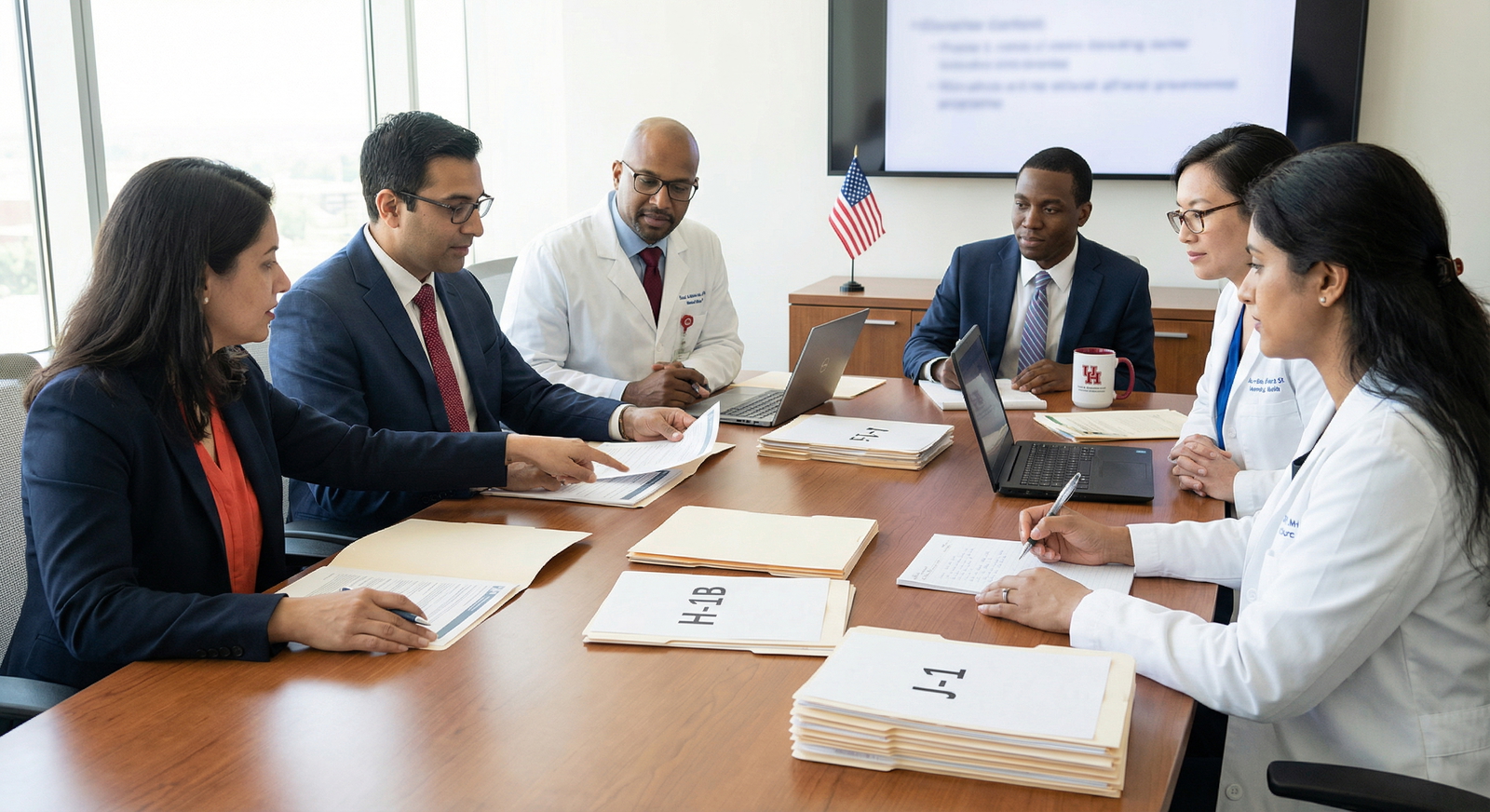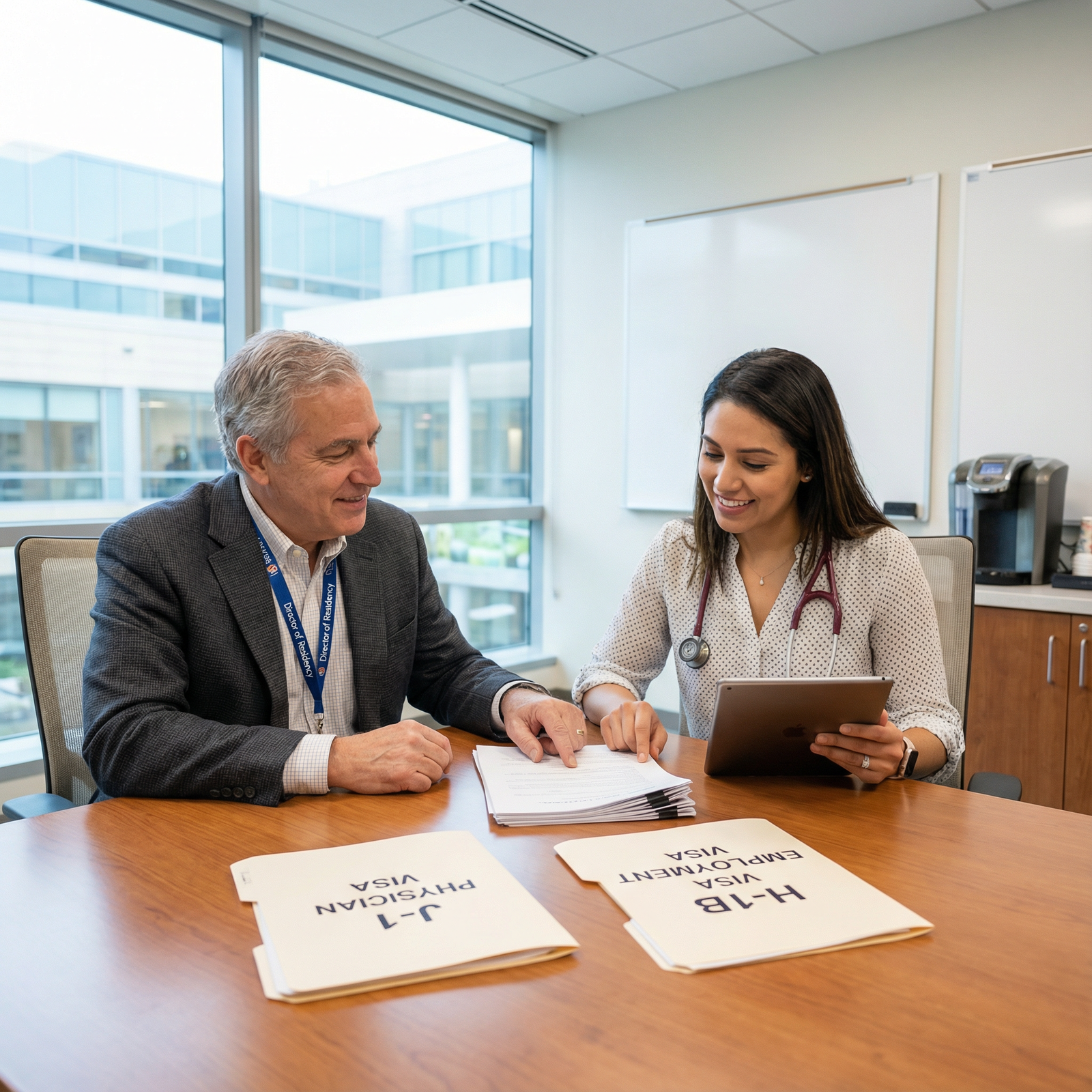
Understanding the Visa Landscape as a Non‑US Citizen IMG in Appalachia
Navigating residency visas as a non‑US citizen IMG is challenging anywhere—but the Appalachian region (especially West Virginia and eastern Kentucky) adds its own unique mix of opportunities and constraints. Many programs are smaller, community-focused, and deeply invested in serving underserved populations, but they may have limited experience or resources for complex visa sponsorship.
This article focuses on what a non‑US citizen IMG or foreign national medical graduate must know to successfully secure and complete residency training in Appalachia, with emphasis on West Virginia–Kentucky residency programs and surrounding Appalachian states.
You’ll learn:
- The main IMG visa options and how they affect your training and career
- J‑1 vs H‑1B in real-world residency scenarios
- Specific features of Appalachian residency programs that affect visa sponsorship
- How to research and choose visa-friendly programs in West Virginia, Kentucky, and neighboring Appalachian areas
- Step‑by‑step strategies to strengthen your application and avoid visa pitfalls
Core Visa Options for IMGs: What Really Matters for Residency
Before you look at specific Appalachian programs, you need a clear grasp of the primary residency visa categories used for graduate medical education in the United States.
1. The J‑1 Exchange Visitor Visa (ECFMG-Sponsored)
For most IMGs, the J‑1 visa is the default training visa, administered through ECFMG (Educational Commission for Foreign Medical Graduates).
Key features:
- Sponsor: ECFMG, not the hospital
- Eligible activities: Graduate medical education (residency and fellowship) only
- Duration: Length of training program (renewed yearly), maximum generally 7 years
- Two‑year home residency requirement (212(e)):
- After finishing all training, you must return to your home country (or country of last permanent residence) for a cumulative 2 years, unless you get a waiver
- You cannot change to H‑1B or most permanent resident categories until this is satisfied or waived
Pros for a non‑US citizen IMG in Appalachia:
- Widely accepted; many Appalachian residency programs only sponsor J‑1
- Less administrative burden on smaller or rural programs—ECFMG manages most compliance
- Typically easier and faster to implement than H‑1B for new trainees
- Standard path that faculty, GME offices, and state medical boards are very familiar with
Cons:
- The two‑year home requirement can complicate long-term plans
- Limited moonlighting options (depends on state and program policies)
- Changing programs mid‑residency is possible but more complex
- For some specialties, J‑1 waiver jobs may be geographically constrained
2. The H‑1B Temporary Worker Visa (Specialty Occupation)
The H‑1B visa is the main alternative clinical training visa. Not all programs sponsor it—this is especially true in smaller or more resource-limited Appalachian centers.
Key features:
- Sponsor: The residency or fellowship program (hospital/employer)
- Eligibility:
- Passed all required USMLE Steps (including Step 3, in most states and programs) before H‑1B filing
- Must meet state licensing requirements
- Duration: Up to 6 years total (sometimes extended in specific green card processes)
- No automatic home residency requirement
Pros for IMGs considering West Virginia–Kentucky residency:
- No 2‑year home-residency requirement
- Easier transition to employment and green card in the US after training
- In some cases, more flexibility for moonlighting or job changes post-residency (though training H‑1Bs are tied to the training institution)
Cons:
- Not commonly offered by smaller or community-based Appalachian residency programs
- Administrative and legal costs for the hospital; some GME offices refuse H‑1B across the board
- You usually need USMLE Step 3 completed before Match (or before visa processing)
- Subject to complex regulations, prevailing wage, and timing issues
3. Other Less-Common Paths: O‑1, Green Card, and More
While most foreign national medical graduates in Appalachia will be on J‑1 or H‑1B, you should at least know what else exists:
O‑1 (Extraordinary Ability):
- Very rare at the residency level
- More common for senior researchers or faculty with substantial publications and national/international recognition
Permanent Residence (Green Card) before Residency:
- If you are already a US permanent resident (through family, DV lottery, etc.), visa issues essentially disappear
- Some non‑US citizen IMGs may apply independently through employment or extraordinary ability categories, but this is more common after residency
Other Categories (F‑1 OPT, etc.):
- F‑1 with OPT is not a stable long-term option for residency training
- Most GME programs will require you to switch to J‑1 or H‑1B before the start date
J‑1 vs H‑1B in Appalachian Residency Programs
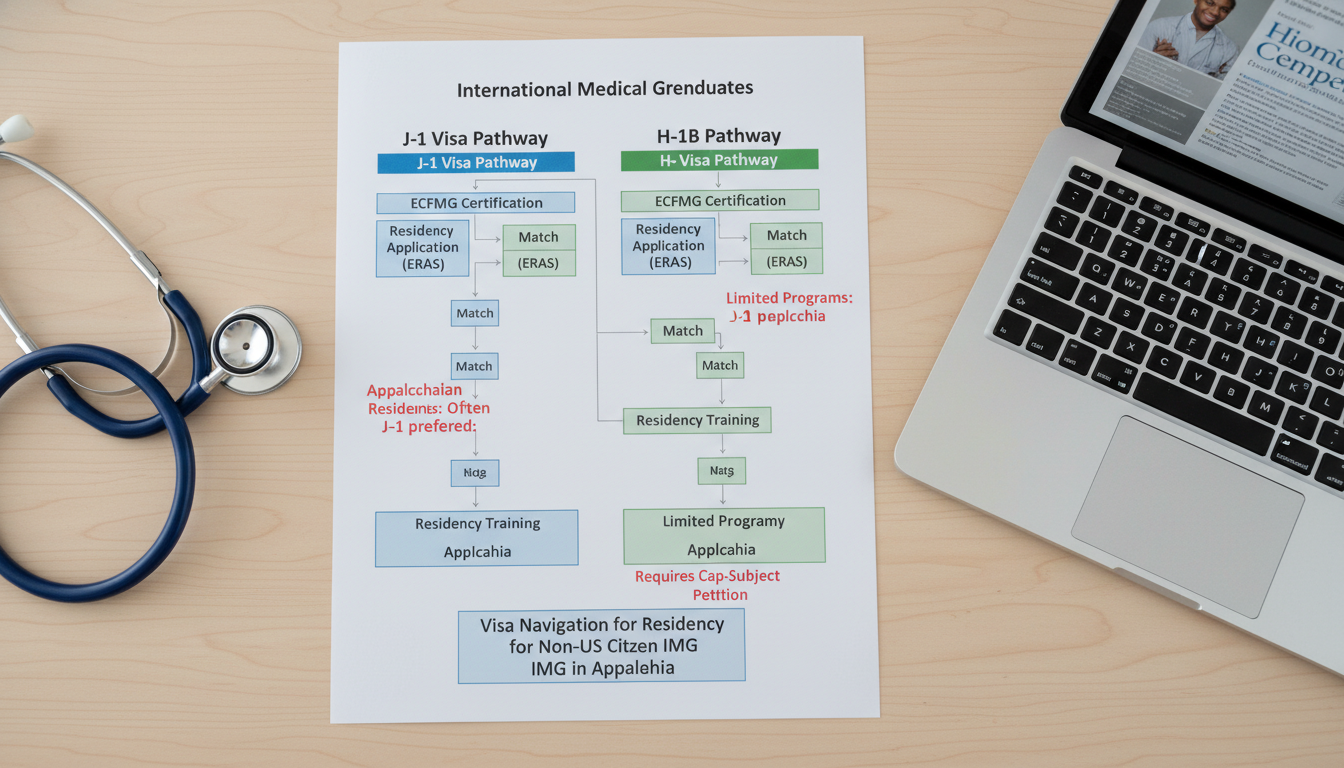
Understanding J‑1 vs H‑1B in the abstract is only half the problem. You must understand how these visa types play out in Appalachian residency institutions—especially in West Virginia and Kentucky.
How Appalachian Programs Typically Handle Visa Sponsorship
In Appalachia, you will encounter three broad types of programs regarding residency visa policies:
J‑1 Only Programs (Most Common)
- Often community-based or smaller university-affiliated hospitals
- Example: Internal medicine program in rural West Virginia that clearly states: “We sponsor J‑1 visas only”
- Rationale:
- Easy to administer via ECFMG
- Avoids legal costs and complexities of H‑1B
J‑1 + Limited H‑1B Sponsorship Programs
- More likely to be larger academic centers (e.g., big university hospitals in West Virginia or eastern Kentucky)
- May sponsor H‑1B only if:
- Applicant has passed USMLE Step 3
- There is a compelling need
- Program has internal legal support
No Visa Sponsorship Programs
- Some community hospitals in Appalachia may say “Must be US citizen or permanent resident; no visa sponsorship”
- Always check program websites and call/email to confirm before applying
Practical Comparison: J‑1 vs H‑1B for an Appalachian Career Path
Scenario 1: You Match on a J‑1 Visa in West Virginia Internal Medicine
- You complete 3 years of residency on J‑1
- You want to stay in Appalachia for practice after training
- Common path: seek a J‑1 waiver job in an underserved area, often through:
- Appalachian underserved hospitals, rural clinics, or community health centers
- State Conrad 30 programs (West Virginia and Kentucky both participate)
- After waiver job (usually 3 years), you can apply for H‑1B extensions and, often, permanent residence
Scenario 2: You Match on an H‑1B Visa in a Kentucky University Program
- You pass USMLE Step 3 before Match and secure a program willing to sponsor H‑1B
- You complete residency and potentially fellowship on H‑1B (staying under 6-year limit)
- You find a job in Appalachia:
- The new employer files an H‑1B transfer (cap-exempt if a nonprofit or academic institution, or cap-subject if private practice)
- You can proceed to employment-based green card without the J‑1 home residency restriction
Key Decision Points for a Non‑US Citizen IMG:
Do you absolutely need H‑1B?
- Example reasons: you cannot accept the J‑1 home residency requirement; you have a strategic long-term plan for US-based specialization that doesn’t fit the J‑1 timeline
- If yes, you must target the few West Virginia–Kentucky residency programs that explicitly offer H‑1B and be sure to pass Step 3 early
Are you flexible on geography and specialty?
- If your priority is to train in Appalachia (for example, in a West Virginia family medicine residency), accepting J‑1 may give you a wider range of programs
- Strategic compromise: J‑1 first, J‑1 waiver job next (also often in Appalachia), and then transition to long-term US status
Researching Appalachian Residency Programs as a Non‑US Citizen IMG
Your visa plan only works if you target programs that actually support your status. This is especially critical in Appalachia, where policies vary widely.
Step 1: Use Official Databases and Filters
Start with:
- FREIDA (AMA Residency & Fellowship Database):
- Filter for “IMG friendly” and then manually verify visa sponsorship for each
- Program Websites:
- Check “International Medical Graduates,” “Eligibility,” or “FAQ” sections for explicit statements:
- “We sponsor J‑1 visas only”
- “We sponsor J‑1 and H‑1B”
- “We do not sponsor visas”
- Check “International Medical Graduates,” “Eligibility,” or “FAQ” sections for explicit statements:
Focus on states and areas considered part of Appalachia:
- Core states for this article: West Virginia, Kentucky (especially eastern Kentucky)
- Also consider: parts of Pennsylvania, Ohio, Tennessee, Virginia, North Carolina, South Carolina, and Georgia with Appalachian counties or missions
Step 2: Verify Visa Policies Directly
Policies change frequently and websites can be outdated. For every promising program, send a short, professional email to confirm.
Sample email:
Subject: Visa Sponsorship Clarification for 2026 Match – Internal Medicine Residency
Dear Dr. [Program Director Last Name] / Residency Coordinator,
I am a non‑US citizen IMG planning to apply for the 2026 Match. I am very interested in your Internal Medicine residency program, particularly because of its focus on serving Appalachian communities.
Could you please confirm whether your program currently sponsors visas for foreign national medical graduates, and if so, which types (J‑1, H‑1B)? If H‑1B is an option, do you require USMLE Step 3 to be completed before ranking?
Thank you very much for your time and clarification.
Sincerely,
[Your Full Name]
[Medical School], [Country]
[USMLE Step Status]
Keep records in a spreadsheet:
- Program name & specialty
- State / city
- Visa policy (J‑1 only / J‑1 + H‑1B / no sponsorship)
- Requirements (Step 3, cutoffs, IMG experience)
- Contacts and answers from coordinators
Step 3: Prioritize Appalachian Programs Strategically
If your goal is specifically Appalachian residency training, balance:
- Visa flexibility (prefer programs that clearly accept IMGs and sponsor visas)
- Specialty goal (family medicine, internal medicine, psychiatry, general surgery, etc.)
- Long-term plans (do you aim to stay in Appalachia post-residency or move elsewhere?)
Example priorities for a non‑US citizen IMG targeting Appalachia:
- Rank 1–5: Large academic centers in West Virginia or Kentucky that sponsor J‑1 and possibly H‑1B
- Rank 6–15: Community-based Appalachian programs that reliably support J‑1 and have a history of matching IMGs
- Rank 16+: Broader US programs outside Appalachia that still fit your visa and specialty goals as backup

Application Strategy: Strengthening Your Profile as a Visa-Needing IMG
Because you require sponsorship, you must be objectively stronger than many competitors—especially for smaller Appalachian programs that feel cautious about immigration complexity.
1. Build a Profile That Offsets Visa Concerns
Focus on:
- USMLE Performance:
- High Step 2 CK score (Step 1 is pass/fail but still important for screening)
- Step 3 completed early if you plan to pursue H‑1B-only or H‑1B-friendly programs
- US Clinical Experience (USCE):
- Aim for hands-on observerships or externships, ideally in Appalachian or rural settings
- Highlight any work with underserved or low-income communities
- Letters of Recommendation:
- At least 2–3 strong US-based letters from faculty familiar with residency training standards
- Letters from Appalachian or rural preceptors can be especially persuasive to local programs
2. Tailor Your Personal Statement to Appalachia and Visa Reality
Program directors know that non‑US citizen IMGs come with administrative complexity. Use your personal statement to:
- Emphasize long-term commitment to serving underserved populations
- Explain any previous visas or gaps clearly and honestly
- Demonstrate understanding of Appalachian health challenges:
- High rates of chronic disease
- Substance use disorders (especially opioid epidemic)
- Limited healthcare access in rural areas
- Clearly state your genuine interest in training and possibly practicing long-term in the region
Example positioning:
“Growing up in a rural region with limited access to healthcare, I have a deep appreciation for the challenges faced by communities in Appalachia. My goal is to complete my internal medicine training in a setting that combines rigorous clinical education with a mission to care for underserved populations…”
3. Be Transparent About Visa Needs in Interviews
In interviews with West Virginia–Kentucky residency programs, you will almost certainly be asked about your visa status.
Approach:
- Be concise and honest:
- “I am a non‑US citizen IMG requiring visa sponsorship. I am eligible for J‑1 through ECFMG and am also open to H‑1B if your institution supports it.”
- Avoid sounding demanding or inflexible
- If they only sponsor J‑1, reassure them you understand the J‑1 requirements, including the home residency rule and the likelihood of doing a J‑1 waiver position after training
- For programs offering H‑1B:
- Mention your Step 3 status and any prior US visa history to show you have done your homework
After the Match: Practical Visa Steps and Long-Term Planning
Once you match into an Appalachian residency program, your visa journey shifts from strategy to execution.
J‑1 Visa Path After Match
Post-Match Steps:
- ECFMG’s Training Program Liaison (TPL) at your institution initiates your J‑1 sponsorship process.
- You submit required documents via OASIS/EVNet:
- Form DS‑2019 request forms
- Proof of funding (usually your residency contract)
- Passport and prior visa documents
- Attend a J‑1 visa interview at a US consulate (if outside the US)
- Enter the US and begin orientation as scheduled
During Residency:
- Renew DS‑2019 annually with ECFMG
- Maintain health insurance and full-time training status
- Follow ECFMG rules about moonlighting and research
- Track your training years relative to the 7-year J‑1 limit (especially relevant for combined programs or multiple fellowships)
After Residency (J‑1 Waiver Planning in Appalachia):
Common waiver options for those who want to stay in or return to Appalachia:
- Conrad 30 State Waiver Programs:
- West Virginia and Kentucky both sponsor J‑1 waiver positions in underserved or rural areas
- Usually primary care or high-need specialties, but some states include psychiatry, general surgery, and others
- Federal waivers via:
- VA (Veterans Affairs)
- HHS (for clinical research or underserved areas)
- ARC (Appalachian Regional Commission) in some circumstances
Strategy: Start exploring waiver options during your PGY‑2 year, especially if you want to continue serving Appalachian communities.
H‑1B Visa Path After Match
If you matched to a program that sponsors H‑1B:
- Coordinate early with the program’s GME office and legal counsel
- Provide documents:
- USMLE transcripts (including Step 3)
- State medical license or eligibility documents
- Credentials and ECFMG certification
- The institution files the H‑1B petition; once approved, you either:
- Change status within the US (if you’re already here on another status)
- Or obtain an H‑1B visa stamp at a US consulate abroad
During Residency:
- Your H‑1B is employer-specific and location-specific
- Any rotation at a non-standard site must be handled carefully in terms of H‑1B compliance
- You must maintain full-time employment and meet all program requirements
Long-Term Considerations:
- Plan your 6-year clock if you expect to do fellowship
- Discuss early with potential fellowship programs whether they can continue or convert your H‑1B
- Coordinate with an immigration attorney if you anticipate complex transitions or early green card sponsorship
Frequently Asked Questions (FAQ)
1. As a non‑US citizen IMG, is it realistic to get an H‑1B for residency in Appalachia?
It’s possible but limited. Many Appalachian residency programs in West Virginia and Kentucky sponsor J‑1 only because it is simpler and cheaper. H‑1B sponsorship is more common at larger academic centers with established international offices. To maximize your chances:
- Pass USMLE Step 3 early
- Target programs whose websites explicitly mention H‑1B sponsorship
- Confirm policies directly with programs before applying
However, if you are very fixed on H‑1B, you might need to broaden your search beyond Appalachia as well.
2. Does being on a J‑1 visa hurt my chances of working in Appalachia after residency?
In many ways, J‑1 can actually align well with Appalachian practice. Because you must obtain a J‑1 waiver job in a medically underserved area, Appalachian states like West Virginia and Kentucky—where many counties are underserved—often have strong demand for physicians. You can:
- Seek Conrad 30 waiver positions within Appalachia
- Work in community health centers, critical access hospitals, or rural hospitals
- Use that time to build a long-term career in the region while progressing toward H‑1B extensions and eventually a green card
3. How early should I start planning my visa strategy if I want a West Virginia–Kentucky residency?
Ideally, begin at least 18–24 months before your intended Match year:
- Year −2: Understand IMG visa options, choose target specialty and region
- Year −1.5: Arrange US clinical experience and Step 2 CK
- Year −1: Decide if you will attempt Step 3 before Match for H‑1B options
- Match cycle: Apply strategically to visa-friendly Appalachian programs
- After Match: Complete J‑1 or H‑1B processes in close coordination with your program
The earlier you align your exam schedule, documents, and US clinical experience with your visa goals, the better your odds.
4. I am a foreign national medical graduate currently on F‑1 in the US. Can OPT be used for residency?
In most cases, no. While a few programs may briefly use F‑1 OPT for research positions or transitional roles, residency training requires a stable, long-term status like J‑1 or H‑1B. As a foreign national medical graduate on F‑1:
- You will almost always need to transition to J‑1 (through ECFMG) or H‑1B before residency starts
- Plan this transition with your medical school’s international office, your future residency program, and, if needed, an immigration attorney
By understanding the J‑1 vs H‑1B trade-offs, researching Appalachian residency programs systematically, and aligning your exam schedule and experiences with your visa goals, you can successfully navigate the residency visa landscape as a non‑US citizen IMG in West Virginia, Kentucky, and the broader Appalachian region.