
Understanding the Visa Landscape as a Non‑US Citizen IMG in Clinical Informatics
For a non-US citizen IMG aiming at a career in clinical informatics, visa strategy is not just a bureaucratic detail—it is a core part of your career planning. Because clinical informatics in the United States is currently offered as a subspecialty fellowship (not as an initial residency specialty), your immigration path will most likely involve:
- A primary residency (often Internal Medicine, Family Medicine, Pediatrics, Pathology, or another core specialty)
- Board eligibility or certification in that specialty
- A clinical informatics fellowship (typically 2 years, ACGME-accredited)
At each stage, your immigration status affects what you can apply for, where you can train, and what jobs you can accept. This article walks through visa navigation for residency—specifically tailored to the non-US citizen IMG interested in clinical informatics and health IT training.
We will emphasize:
- Foundational visa concepts relevant to residency
- J‑1 vs H‑1B for residency and long-term impact on informatics training
- Common residency visa pathways for foreign national medical graduates
- How visa choices affect eligibility for clinical informatics fellowships
- Practical step-by-step planning and examples
Throughout, we’ll use the terms non-US citizen IMG, foreign national medical graduate, and international medical graduate (IMG) interchangeably.
Core Visa Concepts Every Non‑US Citizen IMG Should Know
Before choosing among IMG visa options, you need to understand the main categories and what they mean for residency and beyond.
Key Visa Types Relevant to Residency
J‑1 Exchange Visitor (ECFMG-sponsored)
- Most common pathway for IMGs in US residency
- Sponsored by ECFMG (Educational Commission for Foreign Medical Graduates)
- Purpose: Graduate medical education (residency and fellowship) as an exchange visitor
- Duration: Typically up to 7 years for clinical training (with limits and rules)
- Two-year home country physical presence requirement (INA 212(e)) usually applies
H‑1B Temporary Worker (Specialty Occupation)
- Employer-sponsored work visa
- Can be used for residency or fellowship by some programs (not all)
- Requires passing all USMLE Steps needed for ECFMG certification (Step 1, Step 2 CK; Step 3 often strongly preferred or required for H‑1B)
- Typically up to 6 years total in H‑1B status (with some options for extension if green card process is underway)
Other less common options (more relevant for advanced stages, less for initial residency):
- O‑1 (extraordinary ability) – rare for residency, sometimes used for senior researchers or faculty
- TN (for Canadian/Mexican citizens) – not typically used for GME but may appear in certain academic roles
- Permanent residency (green card) – sometimes held before residency (e.g., diversity lottery, family-based); if you have this, your path is usually much simpler
Most non-US citizen IMGs entering US residency will be choosing—directly or indirectly—between J‑1 vs H‑1B.
Why Your Visa Strategy Matters for Clinical Informatics
Clinical informatics is a subspecialty with a focus on:
- Health IT systems
- EHR optimization and analytics
- Clinical decision support
- Population health data and digital workflows
Your visa must permit:
- Completion of primary residency
- Subsequent subspecialty time (often 2 years) in a clinical informatics fellowship
- Flexibility for employment in roles that often span clinical work, IT, and research
Certain visas (especially J‑1 with the 2-year home return requirement) can restrict your options unless you obtain a waiver. Therefore, planning from day one—before you even start residency—can position you better for future health IT training.
J‑1 vs H‑1B for Residency: How the Choice Shapes Your Informatics Path
This is the most critical question for a non-US citizen IMG: J‑1 vs H‑1B for residency. The choice is influenced by your individual profile, country of origin, competitiveness, and long-term goals.
J‑1 Visa for Residency: Benefits, Limits, and Informatics Implications
Pros of J‑1 (for residency):
- Widely available – many community and academic programs sponsor only J‑1 for IMGs
- Application process is standardized through ECFMG
- Does not require USMLE Step 3 at entry (you still need full ECFMG certification)
- Often simpler for programs to manage compared to H‑1B
Cons of J‑1 (for residency):
Two-year home country physical presence requirement
- Most J‑1 IMGs must return to their home country (or country of permanent residence) for a total of 2 years after completing training, before they can obtain:
- H‑1B status
- L visas
- Permanent residency (green card) through many categories
- You can sometimes avoid this by obtaining a J‑1 waiver, but this is not guaranteed and usually requires:
- Service in an underserved area (e.g., Conrad 30 waiver programs)
- Government interest waivers (e.g., VA, federal agencies) or hardship claims
- For a clinical informatics-focused career, this requirement can delay or complicate your ability to move into US-based informatics fellowships or health IT leadership roles.
- Most J‑1 IMGs must return to their home country (or country of permanent residence) for a total of 2 years after completing training, before they can obtain:
Limited total duration
- ECFMG typically allows up to 7 years for graduate medical education.
- If you do a 3-year residency plus a 2-year clinical informatics fellowship, you’re at 5 years total; adding any other fellowship (e.g., hospital medicine, critical care) could push you close to the cap.
Restriction to ECFMG-sponsored activities
- You may have limits on moonlighting, non-clinical work, or certain research or industry collaborations, depending on your DS-2019 and program policies.
Impact on clinical informatics fellowship:
- Many clinical informatics fellowships accept J‑1 visa holders just as they accept any other ACGME trainees, with new ECFMG sponsorship for the fellowship period.
- However, if your total J‑1 training exceeds the ECFMG maximum duration, you might face restrictions.
- After finishing a J‑1 informatics fellowship, the 2-year home requirement can still apply, even if you already paid some of that time earlier—it is one continuous requirement that must be fully satisfied or waived.
H‑1B Visa for Residency: Benefits, Challenges, and Long-Term Flexibility
Pros of H‑1B (for residency):
No automatic 2-year home country requirement
- This is the biggest advantage over J‑1.
- You can usually go from residency → clinical informatics fellowship → post-fellowship job without needing a J‑1 waiver or home return.
Better continuity for long-term US practice
- Many employers (especially academic medical centers, health systems, and health IT companies) are accustomed to hiring on H‑1B.
- It can be easier to move from training to a long-term job and then to permanent residency.
Flexibility for combined clinical/IT roles
- After fellowship, you may want a hybrid role (e.g., part clinical practice, part informatics leadership). H‑1B often fits better with complex job descriptions than J‑1-based waivers tied to pure clinical underserved service.
Cons of H‑1B (for residency):
Not all programs sponsor H‑1B for residents
- Some residency programs explicitly say: “J‑1 only; H‑1B not sponsored for residency.”
- This reduces the pool of programs you can apply to if you insist on H‑1B.
USMLE Step 3 is usually required or strongly preferred
- Many programs require that you pass Step 3 before issuing an H‑1B petition.
- This can be a barrier for recent graduates who have not completed Step 3 prior to match.
Time limits
- Standard total H‑1B time is 6 years.
- Example timeline concern:
- Internal Medicine residency: 3 years
- Clinical informatics fellowship: 2 years
- Total = 5 years in H‑1B, leaving only 1 year before the standard max
- You may need to initiate the green card process during training or early in your attending job to avoid hitting the cap.
Cap issues and exemptions
- Most university-based hospitals and some large teaching institutions are cap-exempt. This is ideal because:
- They can file H‑1B at any time of year
- You’re not constrained by the lottery
- If you later move to a cap-subject employer (e.g., certain health IT companies or private groups), you might need to go through the H‑1B lottery.
- Most university-based hospitals and some large teaching institutions are cap-exempt. This is ideal because:
Impact on clinical informatics fellowship:
- Many academic clinical informatics fellowships are at cap-exempt institutions, making them friendly to H‑1B continuation.
- H‑1B provides smoother progression: residency → fellowship → faculty/informatics role, often with ongoing employer sponsorship for permanent residency.
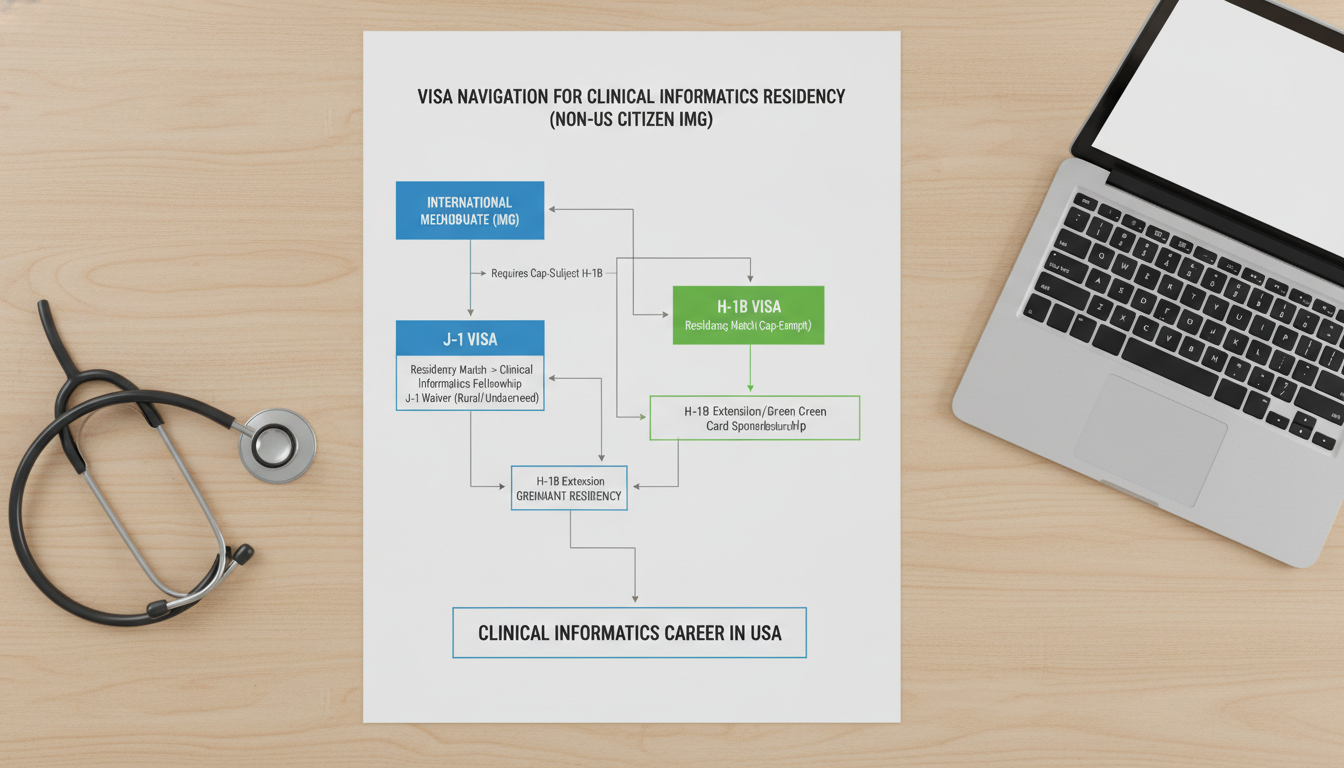
Strategic Visa Planning for a Clinical Informatics Career
Once you understand the fundamentals of J‑1 vs H‑1B, the next step is strategic planning tailored to your goals in health IT and clinical informatics.
Step 1: Clarify Your Long-Term Goal
For a non-US citizen IMG focused on clinical informatics, goals often include:
- Board certification in a primary specialty (e.g., IM, FM, Peds, Pathology, EM, Anesthesiology)
- ACGME-accredited clinical informatics fellowship (2 years)
- Long-term US-based work in:
- Health system informatics leadership (CMIO, Associate CMIO, Director of Clinical Informatics)
- EHR vendor or other health IT company
- Academic clinical informatics research role
- Startup or digital health innovation
Each of these end-goals interacts differently with visa rules. For example:
- If you want to quickly transition into a private health IT company role post-fellowship, avoiding the J‑1 2-year home requirement (or securing a waiver early) becomes crucial.
- If you’d be happy to work in an underserved area clinically while doing informatics work on the side (or through a hospital system), a J‑1 waiver job could be a reasonable path.
Step 2: Decide Your Preferred Visa Type (If You Have a Choice)
Ask yourself:
- Can you realistically complete USMLE Step 3 before applying to the Match?
- Are you willing to limit your residency applications to programs that sponsor H‑1B?
- How critical is it for you to have maximum flexibility to work in the US immediately after training with no home return requirement?
Scenario A: You strongly prioritize long-term US flexibility and a pure informatics/health IT trajectory
- Aim for H‑1B for residency if possible.
- Focus on programs that clearly state “H‑1B sponsorship available” and have a track record of sponsoring IMGs on H‑1B.
- Plan to start the green card process early (during fellowship or early attending) to avoid problems with the 6-year H‑1B max.
Scenario B: You want broad residency options and are open to a service obligation (waiver or home return)
- Accept J‑1 for residency.
- Plan ahead for a J‑1 waiver job if you intend to stay in the US; coordinate with your informatics career plans (e.g., choose specialties and regions likely to have underserved area opportunities + informatics-friendly systems).
Step 3: Integrate Visa Strategy into Your Residency Application
When applying for residency:
Research program visa policies specifically
- On ERAS program descriptions, websites, and FREIDA, look for:
- “We sponsor J‑1 only”
- “We sponsor J‑1 and H‑1B”
- “We do not sponsor visas” or “US citizen/green card only”
- For someone targeting H‑1B, this step is crucial. You may need to email program coordinators to confirm current practice.
- On ERAS program descriptions, websites, and FREIDA, look for:
Highlight your informatics interest early and clearly
- Personal statements and interviews:
- Articulate a consistent narrative: “I aim to complete residency in X specialty and then pursue a clinical informatics fellowship.”
- Emphasize how you plan to contribute to quality improvement, EHR optimization, or analytics during residency.
- Programs that see your long-term plan clearly may be more willing to support a specific visa (e.g., H‑1B) if they believe you’ll add value.
- Personal statements and interviews:
Time your USMLE Step 3 (if pursuing H‑1B)
- Ideal: Have Step 3 passed by the time rank lists are certified, so program directors know they can proceed with H‑1B if they match you.
- If this is not feasible, be explicit in communication:
- Provide a realistic timeline for Step 3 completion.
- Some programs may still sponsor H‑1B conditional on you passing by a set deadline.
Step 4: Think Ahead to Clinical Informatics Fellowship
As a non-US citizen IMG, your residency visa influences your fellowship visa:
If you’re on J‑1 in residency, the default is another J‑1 DS-2019 for an informatics fellowship. Make sure:
- Your total GME length stays within ECFMG’s time limits.
- You keep track of your 2-year home requirement and whether a waiver is needed.
If you’re on H‑1B, you can:
- Extend your H‑1B with a new petition for the informatics fellowship (particularly at cap-exempt academic centers).
- Alternatively, some fellows switch to J‑1 if their program prefers; this may not be ideal if you previously avoided J‑1 for flexibility.
Practical tip: When interviewing for residency, ask informally:
- “Do your graduates commonly go into clinical informatics fellowships?”
- “Which informatics fellowships have your residents matched into?”
- “Do you sponsor H‑1B for fellowship as well?” (if the same institution offers an informatics fellowship)
Programs with established clinical informatics paths will better understand your visa needs.
Common Visa Pathways and Realistic Scenarios for Foreign National Medical Graduates
To make these concepts more concrete, here are some realistic pathways for a non-US citizen IMG passionate about clinical informatics.
Pathway 1: J‑1 Residency → J‑1 Informatics Fellowship → J‑1 Waiver Job
Profile:
- Foreign national medical graduate from a country with limited opportunities for advanced health IT training
- Accepts J‑1 for residency to maximize match chances
Steps:
- Match into a 3-year residency (e.g., Internal Medicine) on J‑1.
- Build a strong informatics portfolio during residency:
- QI projects, EHR optimization initiatives
- Basic data analytics or informatics electives
- Work with the hospital IT/CMIO office
- Match into a 2-year clinical informatics fellowship on J‑1, likely at a large academic center.
- Towards the end of fellowship, seek a J‑1 waiver job:
- Often a full-time clinical role in an underserved area, possibly at a hospital system with interest in informatics improvement
- Use your informatics skills to lead local health IT projects, gain leadership experience
- After waiver service (usually 3 years), you become eligible for:
- H‑1B transfers or green card sponsorship by your employer (depending on their policies)
Advantages:
- Maximizes match opportunities from the start
- Straightforward ECFMG process
- Allows you to stay within academic informatics training
Challenges:
- Need to secure a J‑1 waiver job that also supports your informatics growth
- Some health IT industry roles may be harder to access immediately after training until you clear the waiver obligation or adjust status
Pathway 2: H‑1B Residency → H‑1B Informatics Fellowship → Academic or Health IT Career
Profile:
- Non-US citizen IMG with strong USMLE scores, early Step 3 completion, and clear academic informatics goals
Steps:
- Before match, pass USMLE Step 3.
- Apply primarily to programs that offer H‑1B sponsorship.
- Match into a 3-year residency, secure H‑1B (cap-exempt institution preferred).
- Engage deeply in informatics:
- Join EHR committees and clinical decision support projects
- Co-author QI or informatics papers or presentations
- Learn SQL/R/Python/basic analytics if possible
- Match into a 2-year clinical informatics fellowship at a cap-exempt academic center; continue on H‑1B.
- During fellowship or early in your informatics-focused attending job, begin green card process (employer-sponsored or self-petition like EB-2 NIW if appropriate).
Advantages:
- No automatic 2-year home requirement
- High flexibility for post-fellowship roles, including in health IT companies and startups
- More straightforward path to long-term US practice and informatics leadership
Challenges:
- Fewer residency programs are available (H‑1B only)
- Timing Step 3 and H‑1B processing can be stressful
- You must watch your total H‑1B time carefully
Pathway 3: Already a US Permanent Resident or US Citizen
If you are a non-US medical graduate but a US permanent resident (green card holder) or citizen (e.g., through naturalization, family, or birth), your training path is much simpler:
- You apply to residency without visa constraints.
- You then apply to clinical informatics fellowship like any other graduate.
In this case, the “visa navigation” element becomes less about residency visa and more about ensuring you can work in diverse settings, including industry or startups, which a green card or citizenship easily supports.

Practical Tips, Common Pitfalls, and Actionable Advice
Practical Tips for Non‑US Citizen IMGs Focused on Informatics
Start visa research early—before ERAS season
- Make a spreadsheet of programs of interest, listing:
- Visa types sponsored
- History of sponsoring H‑1B
- Associated clinical informatics faculty or fellowships
- Make a spreadsheet of programs of interest, listing:
Network with current residents and fellows
- Reach out to:
- Current IMGs in your desired programs (through LinkedIn, alumni, or institutional contacts)
- Current clinical informatics fellows who were IMGs
- Ask specifically:
- “Which visa are you on?”
- “How supportive was your program in navigating visa issues?”
- Reach out to:
Leverage your informatics interest as a unique strength
- Programs often value residents who can help improve EHR workflows and QI.
- Mention informatics-related experience in your personal statement and interviews:
- Experience with clinical decision support, data analysis, EHR building, or digital health tools
- Even small projects (Excel dashboards, basic scripting, research databases) can show genuine interest.
Keep detailed records
- Maintain a portfolio with:
- DS-2019 or I-797 copies
- I-94 records
- All visa approval notices
- Documentation of time spent in the US and abroad
- This becomes critical for later transitions (fellowship, waiver, green card).
- Maintain a portfolio with:
Stay flexible but intentional
- Circumstances may change (program policies, personal situation, US immigration law).
- Have a Plan A (ideal) and Plan B (realistic alternative) for both visa type and career steps.
Common Pitfalls to Avoid
Assuming all programs treat visas the same
- Policies vary widely, even within the same hospital system. Always verify.
Ignoring Step 3 timing if you want H‑1B
- Not planning Step 3 can force you into J‑1 when you might have preferred H‑1B.
Underestimating the 2-year J‑1 home requirement
- Many IMGs assume they’ll “figure out the waiver later.” For a clinical informatics career, early planning is vital, because industry opportunities might not align with underserved-area waiver jobs.
Not considering total time limits (J‑1 cap, 6-year H‑1B)
- Long training pathways (residency + multiple fellowships) must be carefully timed.
Relying on informal advice only
- Always consult:
- Official ECFMG and USCIS guidelines
- Institutional GME office
- If needed, an experienced immigration attorney familiar with physician visas
- Always consult:
FAQ: Visa Navigation for Non‑US Citizen IMGs in Clinical Informatics
Q1. As a non-US citizen IMG who wants a clinical informatics fellowship, is J‑1 or H‑1B better for residency?
There is no one-size-fits-all answer. H‑1B typically offers more long-term flexibility (no automatic 2-year home return requirement) and may align better with industry/health IT careers after fellowship. However, not all programs sponsor H‑1B, and it usually requires USMLE Step 3 before starting residency. J‑1 is more widely available and may increase your odds of matching but often requires a waiver or 2-year home return before you can work in the US long-term. Your choice should consider your Step 3 timing, desired residency programs, and long-term informatics goals.
Q2. Can I do a clinical informatics fellowship on a J‑1 visa?
Yes. Many ACGME-accredited clinical informatics fellowships accept J‑1 trainees through ECFMG sponsorship. You must ensure that your total J‑1 training time (residency + fellowship(s)) does not exceed ECFMG’s limit (commonly 7 years). You will likely still be subject to the 2-year home country requirement unless you later obtain a J‑1 waiver.
Q3. Will being on a J‑1 visa prevent me from working in health IT or industry after my fellowship?
Being on a J‑1 does not permanently prevent you from working in health IT or industry, but it adds extra steps. You must either:
- Fulfill the 2-year home country requirement, or
- Obtain a J‑1 waiver (often through service in an underserved US area or other mechanisms)
Only after that can you typically change status to H‑1B or apply for a green card through many employment-based categories. This can delay or complicate a direct move into a US-based health IT company immediately after training.
Q4. Do clinical informatics fellowships sponsor H‑1B visas?
Many academic clinical informatics fellowships at university hospitals or major health systems do sponsor H‑1B, especially if they are cap-exempt institutions. However, policies vary. Before ranking fellowships, confirm directly:
- Which visa types they sponsor
- Whether they have previously trained fellows on H‑1B
- Any requirements (e.g., USMLE Step 3, prior H‑1B history)
By approaching visa navigation as an integral part of your career strategy—rather than a last-minute administrative hurdle—you can build a realistic, resilient pathway from non-US citizen IMG to successful residency graduate, clinical informatics fellow, and ultimately a leader in health IT.