Understanding the Visa Landscape as a Non‑US Citizen IMG
For a non-US citizen IMG aiming for a family medicine residency in the United States, visa navigation is just as critical as exam scores and clinical experience. Many highly qualified applicants fail to match or cannot start their position simply because the visa piece is misunderstood, delayed, or poorly planned.
In family medicine—one of the most IMG‑friendly specialties—programs frequently sponsor or accept residents on visas. But policies vary widely by institution, state, and year. As a foreign national medical graduate, you’ll need to understand:
- The main residency visa options
- How J-1 vs H-1B compare for FM residency
- How your visa choice affects your long‑term career and green card path
- What to ask programs about visa sponsorship
- Key timelines and common pitfalls
This guide focuses specifically on non-US citizen IMGs targeting family medicine residency, and walks through practical, step-by-step strategies to navigate the process confidently.
Core Visa Options for IMGs Entering Family Medicine Residency
As a non-US citizen IMG seeking a GME (graduate medical education) position, three visa categories are most relevant:
- J-1 Exchange Visitor Visa (ECFMG-sponsored)
- H-1B Temporary Worker Visa (employer-sponsored)
- Other/less common options (e.g., O-1, dependent visas, permanent residents)
1. J-1 Exchange Visitor Visa for Clinical Training
The J-1 is the most common visa for IMGs in residency and fellowship, administered through ECFMG.
Key characteristics:
- Sponsor: ECFMG is your sponsoring organization, not the residency program itself.
- Purpose: Graduate medical education or training (residency/fellowship).
- Duration: Usually for the full length of your ACGME-accredited family medicine residency (3 years), annually renewed.
- Two‑year home residency requirement (212(e)): Most J-1 physicians must return to their home country (or last country of permanent residence) for a cumulative 2 years after training or obtain a waiver before changing to most other US visa types or applying for a green card.
Advantages for a family medicine residency applicant:
- Widely accepted in FM: Many community and university-affiliated family medicine residency programs sponsor J-1 visas, making it the most accessible option for a non-US citizen IMG.
- Predictable process: ECFMG has a standardized application system; programs are used to it.
- No USMLE Step 3 required: You can start residency with USMLE Step 1 and 2 (or equivalent) and ECFMG certification.
Limitations and implications:
- Return home or waiver requirement: After your training, you must:
- Return home for two years; or
- Obtain a J-1 waiver position (e.g., Conrad 30, federal or VA waivers) and work in an underserved or designated area for typically 3 years, usually in primary care/family medicine.
- Restrictions during training: Moonlighting, job changes, and non-standard training paths can be more complex under J-1 rules.
- Dependents: Spouse and minor children typically get J-2 status. In many cases, J-2 spouses can apply for work authorization, but this can be subject to changing rules and processing delays.
2. H‑1B Visa for Residency (Temporary Worker in Specialty Occupation)
The H-1B allows you to work in the US in a specialty occupation, including physician roles. For residency, you are technically employed as a “resident physician” and must meet certain criteria.
Key characteristics:
- Sponsor: Directly sponsored by the residency program/employer.
- Requirements:
- USMLE Step 3 (or COMLEX Level 3 equivalent where accepted).
- Unrestricted state medical license or eligibility for a training license as required by the state.
- Duration: Initially up to 3 years, extendable to a maximum of 6 years (with some exceptions for green card processing).
- No automatic two‑year home residency requirement: This is a major distinction from J-1.
Advantages for a non-US citizen IMG in family medicine:
- No 2-year home residence requirement: You are not obligated to leave the US or obtain a waiver after training.
- Flexibility for future career: Easier transitions to jobs, fellowships, or employer-sponsored green card processes.
- Direct employment relationship: The program handles your petition; everything is aligned with your role as an employee.
Limitations:
- Fewer FM programs sponsor H‑1B: Many family medicine programs simply do not sponsor H‑1B visas; they may state “J-1 only” or “No visas except J-1.”
- Higher bar to qualify: You must pass USMLE Step 3 early enough for H‑1B filing before residency start (often by December–February before July 1 start).
- Cost and administrative burden: Filing fees and legal work fall on the program; some institutions have policies against H‑1B sponsorship for residents.
- Cap considerations: Most teaching hospitals are cap-exempt, but if you change to a non-exempt employer later, cap issues can arise.
3. Other Relevant Statuses and Less Common Paths
Some non-US citizen IMGs may already be in the US in another status:
- F‑1 (Student) with OPT: If you studied in the US (e.g., MPH, research master’s), you might be on F-1 with Optional Practical Training. You still need to switch to J-1 or H-1B to start clinical residency.
- H‑4 / L‑2 / dependent statuses: You can remain in dependent status, but clinical residency typically requires its own independent work-authorized status (J-1 or H-1B).
- O‑1 (Extraordinary Ability): Rare for residency, more common for senior researchers; can be relevant later in career or for dual-intent purposes.
- Permanent Residents (Green Card Holders): If you obtain a green card (through family, employment, diversity visa, etc.), the residency visa issue largely disappears; you apply as any US applicant would.

J‑1 vs H‑1B: Strategic Considerations for Family Medicine
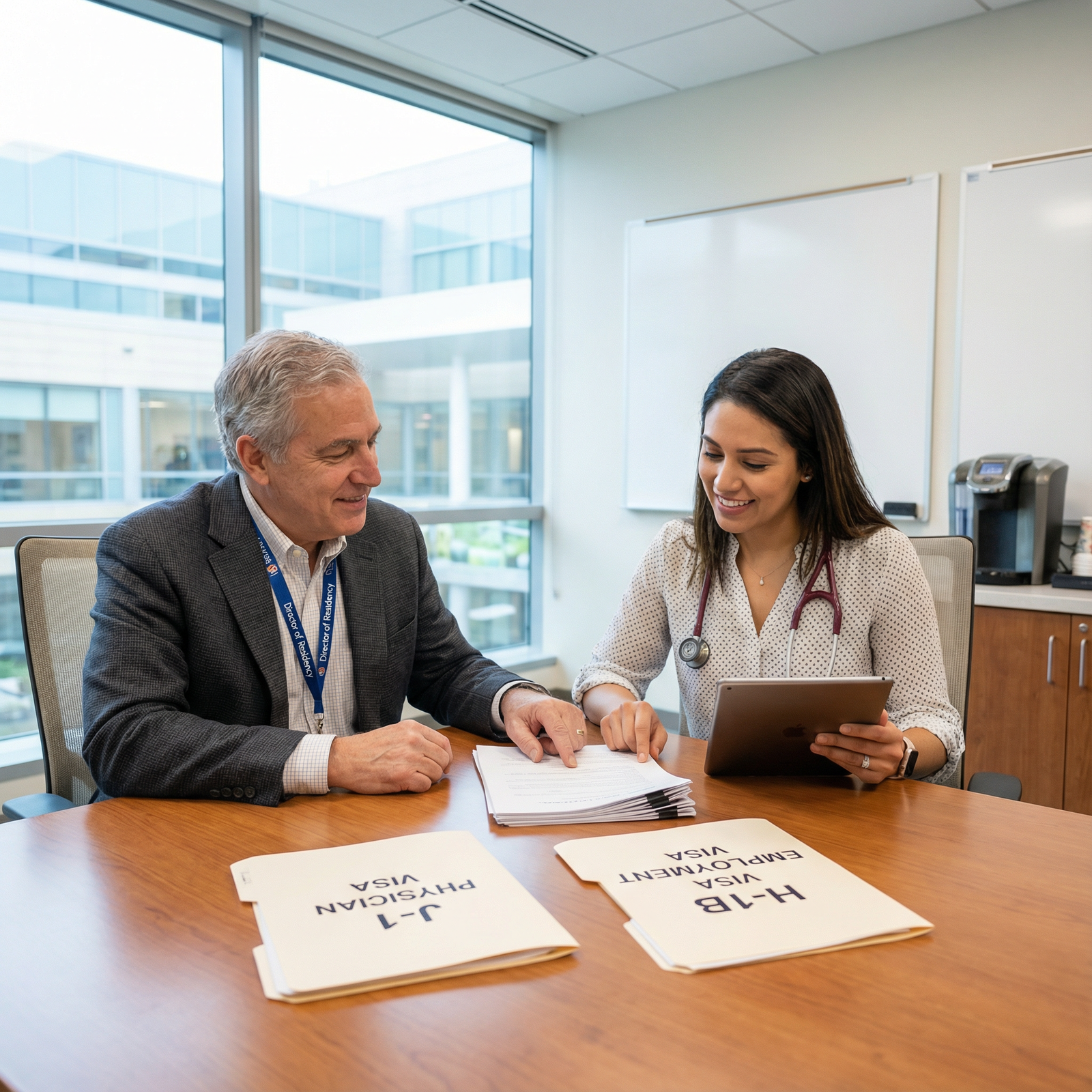
One of the most important decisions for a foreign national medical graduate is whether to pursue a J-1 or H‑1B, when you have a choice. In family medicine, that choice may or may not be available depending on the program.
How Family Medicine Programs Typically Approach Visa Sponsorship
Residency programs fall loosely into four categories:
J‑1 only:
- Most common, especially in community-based FM programs.
- They accept J‑1 through ECFMG but do not sponsor H‑1B at all.
J‑1 preferred, occasional H‑1B:
- Mainly sponsor J‑1, but may consider H‑1B for exceptional applicants or in special circumstances.
H‑1B and J‑1 both accepted:
- Less common in FM but highly favorable for IMG visa options.
- You may be allowed to choose if you meet the requirements.
No visa sponsorship:
- Only accept US citizens, permanent residents, or those who already have work authorization independent of the program.
When researching programs, always verify their current stance on visas via:
- Program website and FAQ
- FREIDA / ACGME / program listings
- Direct email to program coordinator or manager
Comparing J‑1 vs H‑1B for a Non‑US Citizen IMG in FM
1. Competitiveness and match chances
- J‑1:
- More FM programs accept J‑1, increasing your list size.
- Programs used to working with J‑1 IMGs may be more comfortable with your profile.
- H‑1B:
- Smaller program pool; some highly competitive academic FM programs may offer H‑1B, but many community-based programs do not.
- Some programs may see Step 3 completion as a positive sign of readiness.
Implication: If you need the broadest possible FM match list, J‑1 is usually more realistic.
2. Post‑residency options and geographic flexibility
- J‑1:
- You face the 2-year home requirement or must secure a waiver job.
- Waiver jobs (e.g., Conrad 30) are typically in underserved or rural areas. For family medicine, this can align well with your training, but geographic flexibility is reduced.
- H‑1B:
- You can seek jobs or fellowships across the country without the J‑1 waiver constraint.
- Transition to employer-sponsored green card is often more straightforward.
Implication: If your long-term plan is to remain in the US with maximum geographic flexibility, H‑1B offers advantages—but only if you can secure it.
3. Examination and timing pressure
- J‑1:
- Requires ECFMG certification and state licensing prerequisites for a training license—no Step 3 requirement at the visa stage.
- H‑1B:
- Requires Step 3 completed early enough for petition filing (often by late winter before residency start).
- This can be particularly challenging if you are outside the US or have limited exam centers.
Implication: If passing Step 3 early is uncertain, plan for J‑1, and only pursue H‑1B where feasible.
4. Long-term immigration strategy
For many non-US citizen IMGs, family medicine is attractive precisely because of its alignment with J-1 waiver jobs (rural/underserved). This can actually turn the J-1’s “disadvantage” into a structured pathway:
- J‑1 + FM + waiver job → H‑1B → Green Card
Common path:- Complete FM residency on J‑1
- Secure a J‑1 waiver position in a medically underserved area
- Work 3 years on H‑1B in that position
- Employer sponsors permanent residency
For those with family or personal reasons requiring more control over geography and practice setting, the H‑1B from the start—if available—may better suit long-term goals.
Planning Ahead: Step-by-Step Strategy for Visa Navigation
To maximize your FM match success as a non-US citizen IMG, build visa planning into each stage of your application and training.
1. Pre-Application Phase (12–24 Months Before Match)
Clarify your constraints and preferences:
- Are you willing and able to return to your home country for 2 years if necessary?
- Would you be comfortable practicing in rural or underserved areas?
- Do you have strong reasons to stay in specific regions (family, spouse’s job, etc.)?
Decide your primary target visa:
- If you need maximum match opportunities and can embrace underserved work:
- Plan for J‑1 as your baseline.
- If you can realistically pass Step 3 early and aim for maximum post-residency flexibility:
- Consider H‑1B where programs offer it.
USMLE strategy:
- For J‑1-focused plan:
- Prioritize strong Step 2 CK scores and timely ECFMG certification.
- For H‑1B-focused plan:
- Schedule Step 3 as soon as feasible—ideally during or before the ERAS application cycle so you can list it on your application and discuss it in interviews.
2. Program Research and Application Strategy
Build a visa-conscious program list:
- Identify:
- J‑1 friendly FM programs
- Programs that explicitly sponsor H‑1B
- Programs that accept both visas
- Use:
- FREIDA filters and narratives
- Program websites (look for “residency visa,” “IMG visa options,” or “non-US citizen IMG” language)
- IMG forums and alumni networks (but always verify directly with programs)
Contact programs directly when unclear:
A concise email to the program coordinator is appropriate, for example:
“I am a non-US citizen IMG interested in your Family Medicine residency. Could you please clarify whether your program sponsors visas and, if so, which types (J‑1, H‑1B)?”
Do this before spending ERAS tokens on uncertain programs, especially if you require H‑1B.
Balance your application pool:
- For a typical non-US citizen IMG:
- Majority of programs: J‑1-sponsoring FM programs.
- A smaller subset: Programs that can offer H‑1B if you meet Step 3 and other requirements.
- For an exceptionally strong applicant with Step 3 done and excellent scores/USCE:
- You might increase the proportion of H‑1B-sponsoring programs, but keep a strong core of J‑1 options to protect your match chances.
3. Interview Season and Ranking Strategy
Discuss visas professionally and briefly:
During interviews, it is acceptable to ask targeted questions about visa sponsorship, but avoid making it the main focus of your conversation. For example:
- “I am a non-US citizen IMG on [current status]. Could you share how your program typically sponsors residents’ visas?”
- “If matched here, would I be eligible for either J‑1 or H‑1B sponsorship, assuming I meet all exam and licensing requirements?”
Clarify important details:
- Do they cover all visa-related fees and legal costs?
- For H‑1B:
- Do they require Step 3 by a specific date?
- Do they have a history of H‑1B approvals?
- For J‑1:
- Are there any institutional or state-related constraints?
Ranking strategy:
- If you care more about training quality/location than visa type:
- Rank programs primarily by fit and training environment, as long as they will sponsor at least one viable visa type for you.
- If avoiding a J‑1 home residency requirement is your highest priority (e.g., due to safety concerns, family issues in your home country):
- Give significant weight to H‑1B-sponsoring programs, but be realistic and maintain enough J‑1 options to match.

After the Match: Practical Steps and Common Pitfalls
Once you match into a family medicine residency, visa work begins in earnest. Timely action is critical to avoid delays that could jeopardize your start date.
1. Immediately After Match Day
Confirm your visa category with the program:
- Ensure both you and the program agree whether you will proceed with J‑1 or H‑1B.
- Ask for a clear timeline and list of required documents.
Coordinate with ECFMG (for J‑1):
- Monitor your ECFMG OASIS/ECFMG account for J‑1 sponsorship instructions.
- Prepare necessary documents:
- Form DS-2019 application
- Passport copies
- ECFMG certificate
- Contract/offer letter from the residency program
- Statement of need from your home country’s Ministry of Health or equivalent (often a time-consuming step).
For H‑1B petitions:
- Provide all requested documents to the program’s HR or legal department promptly:
- Passport
- USMLE transcripts showing Step 3
- Education and medical degree verification
- CV and credentials
- Any past US immigration records (I-20s, I-94s, DS-2019s, prior visas).
2. Avoiding Common Visa Pitfalls
Late Step 3 completion (for H‑1B):
- If you are relying on H‑1B and do not pass Step 3 in time, your program may be unable to file the petition. You might have to switch to J‑1 (if the program can sponsor it) or, worst-case, lose the position.
- Strategy: Take Step 3 early, aim to pass on first attempt, and inform programs of your progress.
Delays in home country Statement of Need (J‑1):
- Some Ministries of Health move slowly; missing this document can delay DS-2019 issuance and your visa interview.
- Strategy: Start this process as early as allowed; connect with other IMGs from your country for practical tips.
Security checks and administrative processing:
- Some applicants may face “administrative processing” at the consulate, causing delays.
- Strategy: Attend visa interview as soon as you receive DS-2019 or H‑1B approval notice; avoid last-minute scheduling.
Travel restrictions and expiration dates:
- Keep track of validity periods for your visa stamp, I-94, and DS-2019 or I-797.
- Always discuss travel plans with your GME office or legal advisor before leaving the US during training.
3. Thinking Ahead: Post‑Residency Planning During FM Training
Especially under J‑1, begin planning your post-residency pathway in your second year:
- Research J‑1 waiver programs (e.g., Conrad 30 in different states, federal options, VA, Appalachian Regional Commission, etc.).
- Network with FM attendings who have completed waiver jobs.
- Understand how early you must sign a contract for a waiver position (often 12–18 months before finishing residency).
Under H‑1B:
- Talk to your program and potential future employers about green card sponsorship early.
- Keep track of your time in H‑1B status to avoid exceeding the 6-year limit.
Practical Tips and Actionable Advice for Non‑US Citizen FM Applicants
Start with honest self-assessment:
- Academic profile, exam timeline, and personal priorities around location and long-term immigration will determine whether J‑1, H‑1B, or either is realistic.
Use data and networks:
- Talk to current FM residents from your home country.
- Ask specifically which visa they used and what challenges they faced.
- Many non-US citizen IMGs in family medicine are willing to share detailed experiences.
Document organization:
- Keep a digital folder with:
- Passport copies
- Exam score reports
- ECFMG certificate
- Medical school diploma and transcripts
- Prior US immigration documents
- This greatly speeds up visa applications and responses to program requests.
- Keep a digital folder with:
Communicate professionally with programs:
- Be clear but concise when discussing visas.
- Show that you have done your homework (“I understand your program sponsors J‑1 visas; I’m fully prepared to pursue that route.”).
Stay updated on policy changes:
- US immigration rules can change: J‑1 vs H‑1B policies, work authorization for dependents, or processing times.
- Rely on official sources (ECFMG, USCIS, Department of State) and your program’s legal advisors, rather than rumors.
Consider long-term alignment with family medicine’s strengths:
- Family medicine is often the best specialty for J‑1 waiver routes because most waiver jobs are in primary care in underserved areas.
- This alignment can turn the J‑1’s constraints into a clear, achievable path to long-term practice in the US.
FAQs: Visa Navigation for Non‑US Citizen IMGs in Family Medicine
1. As a non-US citizen IMG, is it harder to match into family medicine if I need a visa?
Family medicine is one of the more IMG‑friendly specialties, and many programs are accustomed to sponsoring J‑1 visas. Your need for a visa does not automatically block you, but it can reduce the number of programs you can apply to—especially if you require H‑1B only. Strong scores, US clinical experience, solid letters, and a clear commitment to FM can offset the perceived administrative burden of visa sponsorship.
2. Should I delay applying for family medicine residency until I pass USMLE Step 3 so I can get an H‑1B?
Not necessarily. Delaying an application cycle has opportunity costs and may not yield a significantly better outcome if only a minority of programs you’re targeting sponsor H‑1B. Many non-US citizen IMGs match successfully into J‑1-sponsoring FM programs and then follow the J‑1 waiver → H‑1B → green card path. Consider your competitiveness, program preferences, and personal constraints before deciding to delay.
3. Can I switch from J‑1 to H‑1B during or after residency?
While you cannot simply “switch” without addressing the 2‑year home residency requirement, a common path is:
- Complete residency on J‑1
- Obtain a J‑1 waiver job (often in underserved/rural family medicine)
- Change status to H‑1B for that waiver position
This satisfies your J‑1 obligation via service rather than physical return home. Directly changing from J‑1 to H‑1B without a waiver or completing the 2‑year home stay is typically not allowed.
4. How early should I start planning my visa strategy for FM residency?
Ideally 1–2 years before applying. This allows you time to:
- Align exams (especially Step 3 if you aim for H‑1B)
- Research visa-friendly family medicine programs
- Understand your home country’s Statement of Need process (for J‑1)
- Build a realistic, balanced list of programs based on your visa options
Starting early reduces last-minute pressure and helps you present yourself as a well-prepared, low-risk applicant in the eyes of residency programs.
Thoughtful visa planning, combined with a strong application and a clear commitment to family medicine, can transform the complexity of US immigration rules into a structured path toward your goal: practicing as a family physician in the United States. As a non-US citizen IMG, your journey is challenging but entirely achievable with the right information, strategy, and timing.