Understanding the Visa Landscape as a Non‑US Citizen IMG
For a non-US citizen IMG aiming to train in a state university residency program, visa navigation is just as critical as test scores and letters of recommendation. Even a strong application can fail to convert into a residency position if your visa strategy is unclear, unrealistic, or mismatched with a program’s policies.
This article focuses on foreign national medical graduates seeking residency in state university residency and public medical school residency programs across the United States. These programs often have defined institutional policies, affiliated legal teams, and visa sponsorship practices that affect what they can realistically offer: J-1 vs H-1B, rare alternatives, and long-term planning for fellowship and beyond.
We will cover:
- Core visa types for residency (J-1, H-1B, and others)
- How state university programs typically handle IMG visa options
- Strategic planning for USMLE, ECFMG certification, and visa timing
- Matching your profile to the right visa and programs
- Post-residency pathways and the 2-year home residency requirement
- Practical examples and common pitfalls
Throughout, “non-US citizen IMG” and “foreign national medical graduate” are used interchangeably to refer to applicants who are not US citizens or permanent residents and obtained their primary medical qualification outside the US.
Core Visa Options for Residency: What Really Matters
For residency training, the overwhelming majority of non-US citizen IMGs are sponsored on:
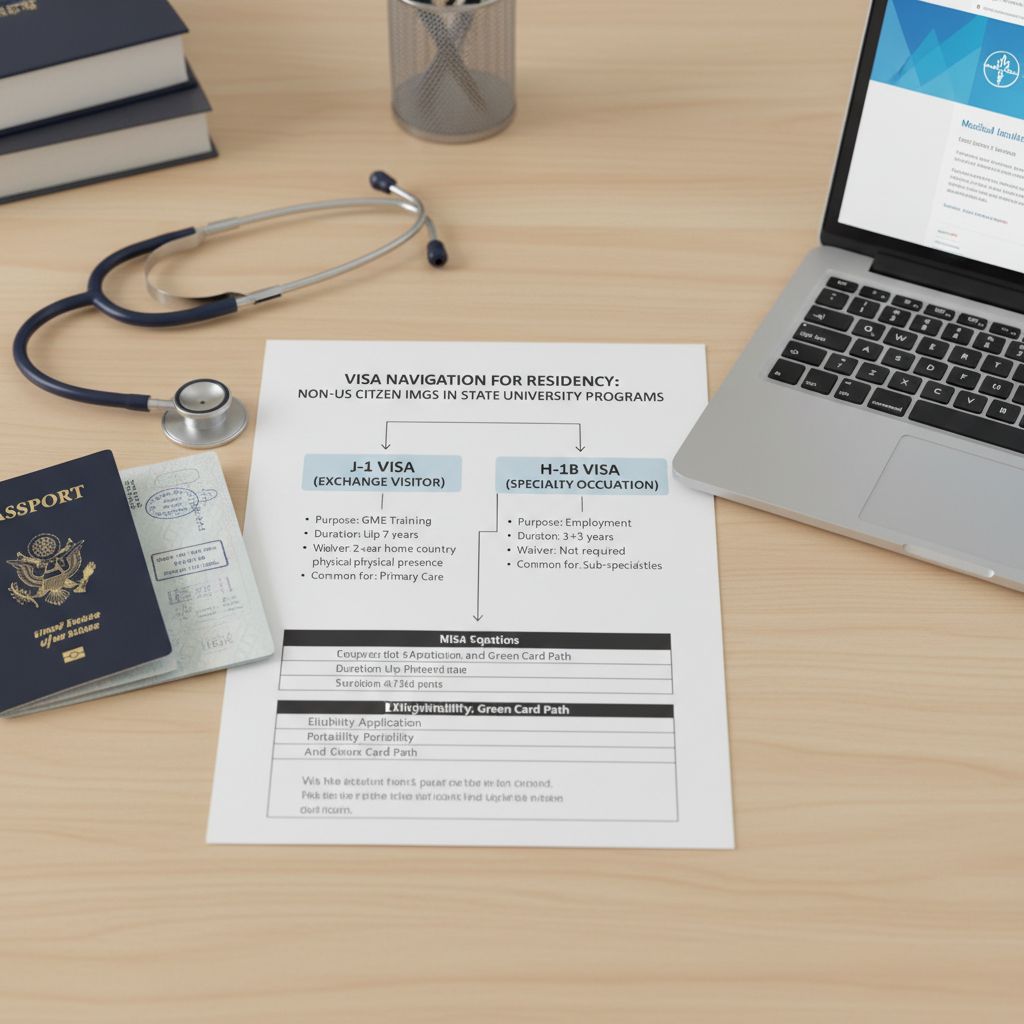
- J-1 (ECFMG-sponsored exchange visitor physician)
- H-1B (temporary worker in specialty occupation)
Other visa categories occasionally appear but are far less common or less practical.
J-1 Visa: The Default Pathway for Most IMGs
The J-1 physician visa is the most frequently used visa for residency and fellowship.
Key features:
- Sponsor: ECFMG (Educational Commission for Foreign Medical Graduates), not the residency program itself.
- Purpose: Graduate medical education/training (residency, fellowship).
- Duration: Typically up to 7 years of total clinical training time (some exceptions).
- Work location: Restricted to approved training sites listed in the program’s documents to ECFMG.
- Funding: Acceptable from GME salary/funding sources as normal.
Advantages for a non-US citizen IMG:
Widely accepted by state university residency programs
- Many public medical school residency programs sponsor only J-1 for IMGs.
- Simplifies institutional legal and HR processes—ECFMG handles main sponsorship.
Predictable and well-established
- Clear ECFMG requirements for certification, contracts, and visa documents.
- Renewed annually via program verification; less subject to random selection or lottery issues.
Relatively flexible for subspecialty training
- Easy to extend for fellowship as long as within the 7-year cap and medically justified.
Disadvantages:
2-year home-country physical presence requirement (INA 212(e))
- Most J-1 physicians are subject to this requirement.
- After completing training, you must either:
- Return to your home country for a total of two years, or
- Obtain a J-1 waiver (e.g., via Conrad 30, VA, federal agency, hardship, or persecution-based waiver) before changing to H-1B, L, or permanent residence (green card).
Limited “dual intent”
- J-1 is not officially a dual-intent visa (unlike H-1B).
- This doesn’t bar long-term US plans, but you must be careful with timing of immigration petitions (like I-140) and travel.
Not ideal for long research-only periods
- Designed specifically for clinical training; research-only extensions can be complex.
Practical implications for state university programs:
- Many state universities prefer J-1 because:
- ECFMG handles the complex physician-specific sponsorship.
- It avoids institutional H-1B caps and legal expenses.
- It standardizes visa management across multiple residency and fellowship programs.
As a non-US citizen IMG targeting state university programs, you should assume J-1 will be the default residency visa unless a program explicitly states that it also sponsors H-1B.
H-1B Visa: Attractive but More Limited and Competitive
The H-1B visa is a work visa for “specialty occupations” and is attractive to foreign national medical graduates who want a more direct path toward US permanent residence.
Key features:
- Sponsor: The residency program (or hospital/health system) itself.
- Purpose: Employment in a specialty occupation (residency/fellowship counts).
- Duration: Generally up to 6 years total in H-1B status across all employers.
- Dual intent: You may pursue permanent residence (green card) while on H-1B with fewer concerns.
Advantages:
No J-1 2-year home residency requirement
- You are not subject to the J-1 2-year home country requirement.
- You can transition to a green card more directly after training (if you find an employer sponsor).
Clear dual-intent status
- Easier to file I-140 and I-485 petitions while remaining in status.
Often preferred for long-term US career planning
- Especially attractive to those from countries with long green-card backlogs who want to start the process early.
Disadvantages:
Not all state university programs sponsor H-1B for residents
- Some state institutions have strict “J-1 only” policies.
- Others limit H-1B to certain specialties or senior training levels (e.g., fellows only).
Requirements are stricter
Typical H-1B requirements for residency:- Step 3 (USMLE) must be passed before H-1B petition filing.
- Full ECFMG certification.
- A state medical license/permit (varies by state).
Cost and administrative burden
- Legal fees and filing fees are higher.
- Programs may be constrained by state university HR policies, union agreements, or budget limits.
Cap, lottery, and timing complexities
- University-affiliated hospitals are often cap-exempt (good news), but:
- Movement between cap-exempt and cap-subject employers later can be complex.
- Timing must align with residency start dates, Step 3 results, and credentialing.
- University-affiliated hospitals are often cap-exempt (good news), but:
For a non-US citizen IMG applying to state university residency programs, securing H-1B is possible but less common and more competitive than J-1. You must be well-prepared and strategic.
Other, Less Common Visa Pathways
Other visas may be relevant in specific scenarios:
F-1 with OPT (Optional Practical Training)
- Rare for residency; some graduates of US or Caribbean schools on F-1 may use OPT for research or transitional work, then switch to J-1 or H-1B for residency.
O-1 (extraordinary ability)
- Occasionally used for highly accomplished physician-scientists, more often for faculty or senior researchers than residents.
TN, E-3, etc.
- TN (for Canadian/Mexican) and E-3 (for Australians) can be used in certain clinical roles but are rarely used for ACGME-accredited residency training; institutional policies may not support them.
In practice, for residency in a state university program, you will almost always be choosing between J-1 vs H-1B.
How State University Programs Typically Handle Visa Sponsorship
Public medical school residency programs function within state regulations, public funding rules, and university HR policies. This shapes how they approach IMG visa options.
Common Visa Policies in State University Residency Programs
Across state university programs, you will often encounter:
“J-1 Only” Policy
- Many internal medicine, pediatrics, and family medicine programs at public medical schools explicitly state:
- “We sponsor J-1 visas only.”
- H-1B may be reserved for faculty, not residents.
- Many internal medicine, pediatrics, and family medicine programs at public medical schools explicitly state:
“J-1 Preferred, Selective H-1B”
- Some programs primarily use J-1 but may sponsor H-1B for:
- US medical graduates needing a work visa.
- Highly competitive IMG candidates with Step 3 already passed and a strong research/academic fit.
- Often more common in procedurally oriented specialties (e.g., radiology, anesthesia) or in institutions aiming to retain trainees long-term.
- Some programs primarily use J-1 but may sponsor H-1B for:
Full Flexibility (J-1 and H-1B)
- A minority of state university programs offer both visas widely.
- These are often large academic centers with robust legal support and strong institutional commitment to international recruitment.
Actionable advice:
Before applying, check each program’s website for “visa sponsorship” or “international medical graduates” sections. If unclear, email the program coordinator before ERAS submission and ask specifically:
“Does your program sponsor J-1, H-1B, or both for non-US citizen IMGs?”
This prevents wasting applications on programs that will not consider you under your preferred visa category.
Institutional Factors That Affect Visa Choices
A state university’s approach to visas is shaped by:
GME office and university HR policy
- Some universities mandate a standard visa category for all trainees.
- University legal counsel may prefer J-1 for simplicity and risk reduction.
Funding source and salary structure
- Public institutions must follow state rules for salaries, benefits, and positions.
- H-1B prevailing wage requirements and processing fees can be a barrier.
Historical practice and case law
- If a university has previously faced immigration or employment audits, they may tighten policies and favor J-1.
Strategic recruitment goals
- University hospitals in underserved or rural states may be more open to J-1 waivers after residency (Conrad 30), encouraging J-1 sponsorship during training.
As a foreign national medical graduate, understanding these systemic factors helps you interpret program policies and manage expectations.
Planning Your Application Strategy Around Visa Options
You cannot treat visa issues as an afterthought. To be competitive for state university residency programs as a non-US citizen IMG, integrate visa strategy into:
- Exam timelines
- US clinical experience planning
- Program selection
- Communication with programs
Step 1: Clarify Your Long-Term Goals
Ask yourself:
- Do you plan to live and work long-term in the US after training?
- How important is early green card processing?
- Are you willing or able to:
- Return to your home country for 2 years after training?
- Work in an underserved area for a J-1 waiver?
If your top priority is long-term US practice without a 2-year home return:
- H-1B is more aligned with your goals.
- However, be realistic: Can you secure H-1B sponsorship at a state university residency?
If you are flexible or open to underserved work/J-1 waivers:
- J-1 may be perfectly acceptable.
- You can still remain in the US after training using Conrad 30 or other waiver programs.
Step 2: Align Exams and Credentials With Your Target Visa
For J-1 (ECFMG-sponsored):
- USMLE Step 1 + Step 2 CK passing scores.
- ECFMG certification before starting residency.
- Step 3 is not required for J-1 residency sponsorship (though helpful overall).
For H-1B residency:
Most state university residency programs that sponsor H-1B require:
USMLE Step 3 passed before H-1B petition filing
- Plan to complete Step 3 before Match or very soon after if you are targeting H-1B.
- This often means taking Step 3 while applying or even before your ERAS submission.
ECFMG certification by the time of H-1B filing.
Eligibility for a training license in the specific state.
Practical timeline for a non-US citizen IMG targeting H-1B:
- Year 0–1: Step 1, Step 2 CK, clinical electives/observerships.
- Year 1: Pass Step 3 by fall/winter if you plan to apply for H-1B-supported residency.
- ERAS season: Indicate clearly in your application or personal statement that you have Step 3 and are open to H-1B.
- After Match: Program files H-1B; start date usually July 1.
If you cannot complete Step 3 in time, J-1 will likely be your only practical option for PGY-1 at most public medical school residency programs.
Step 3: Research Programs by Visa Policy and Track Record
When targeting state university residency programs, build a spreadsheet with:
- Program name and specialty
- State and affiliated university
- Published visa policy (J-1 only, J-1 + H-1B, or unclear)
- Historical data (from past residents, alumni websites, or program lists)
- Do they have current or past residents on H-1B?
- Do they have many J-1 IMGs?
- Any communicated notes from the coordinator (e.g., “We rarely sponsor H-1B except in special circumstances”)
Example:
State University A, Internal Medicine:
- Website: “We sponsor J-1 visas only.”
- Strategy: Apply only if you accept J-1; do not expect H-1B.
State University B, Anesthesiology:
- Website: “We sponsor J-1 and H-1B for highly qualified candidates with Step 3.”
- Former residents: Several current H-1B holders listed.
- Strategy: Strong H-1B target if your profile is competitive (Step 3 done, strong scores, some research).
Step 4: Communicate Clearly and Realistically With Programs
When programs invite you for interviews, you may be asked about your visa preferences.
Tips for answering:
- Be honest but flexible if possible:
- “I am open to either J-1 or H-1B sponsorship and understand your program’s policy will guide the final decision.”
- If you strongly prefer H-1B:
- Explain your reasons concisely (e.g., long-term US plans, home-country obligations).
- Show that you have already passed Step 3 and meet state licensing requirements.
- Avoid demanding a specific visa when the program has clearly stated limitations. That can hurt your ranking.

After the Match: Residency Visa Logistics and Common Pitfalls
Once you match into a state university residency program, the real visa work begins. The timeline and process differ depending on whether you will be on J-1 or H-1B.
J-1 Visa Process Through ECFMG
Typical steps after you match on a J-1 track:
Program provides a contract and completes ECFMG paperwork
- GME office submits training program details (Form DS-3035 equivalents and institutional forms) to ECFMG.
You complete ECFMG’s online J-1 application (EVSP)
- Submit:
- Valid passport
- Medical diploma and ECFMG certificate
- Statement of need from your home country’s Ministry of Health (in many cases)
- Proof of financial support (residency salary is usually sufficient)
- Submit:
ECFMG issues DS-2019
- You use this document to:
- Schedule your J-1 visa interview at a US consulate/embassy.
- Pay SEVIS fees.
- You use this document to:
Consular interview and visa stamping
- Be prepared to show intent to return after training (at least in theory), financial means, and strong ties to home country.
Common J-1 pitfalls:
- Delays in obtaining the Statement of Need from your home country.
- Inadequate time to schedule embassies with long wait times.
- Misunderstanding about the 2-year home residency requirement; you cannot switch to H-1B or green card without a waiver or fulfilling the requirement.
H-1B Visa Process Through the State University
If your state university residency program agrees to sponsor H-1B:
Credentialing and licensing first
- Program ensures you qualify for a training license and have:
- Passed Step 3
- ECFMG certification
- This can be time-consuming for some states.
- Program ensures you qualify for a training license and have:
Labor Condition Application (LCA)
- The institution files LCA with the Department of Labor.
- They must meet or exceed the prevailing wage.
H-1B petition (Form I-129)
- Filed by the university/hospital.
- Premium processing may be used to expedite.
Consular interview (if abroad) or change of status (if in US)
- You must be in valid status until H-1B approval (if already in the US).
Common H-1B pitfalls:
- Late Step 3 result causing delays in filing.
- University legal or HR re-evaluating and withdrawing H-1B sponsorship due to cost or policy.
- Tight timelines between approval and the residency start date.
Because of these pitfalls, some state universities prefer to default to J-1 even for candidates who qualify for H-1B.
Post-Residency Planning: J-1 Waivers, H-1B Transfers, and Beyond
Your choice of residency visa has major consequences after graduation.
If You Train on a J-1 Visa
Unless your J-1 is not subject to the 2-year requirement (rare for physicians), you must:
- Return home for two cumulative years, or
- Obtain a J-1 waiver.
Common waiver pathways:
Conrad 30 Program (State Health Department Waivers)
- Each state can recommend up to 30 J-1 physicians per year in designated shortage areas.
- Typically requires a 3-year, full-time contract in an underserved area (often rural or inner-city).
Federal agency waivers
- VA, HHS, ARC, DRA, etc. can sponsor if you work in their facilities or special projects.
Hardship or persecution waivers
- If returning home would cause exceptional hardship to a US citizen/permanent resident spouse or child, or if you fear persecution.
- These are complex legal cases requiring specialized immigration counsel.
After a waiver is approved, you can change to H-1B with the employer who sponsored your waiver (e.g., Conrad 30 site), then later pursue a green card.
If You Train on an H-1B Visa
You are not bound by a 2-year home return requirement. After residency you can:
- Transfer your H-1B to a new employer (e.g., a hospital or private practice).
- Start the green card process (PERM → I-140 → I-485) without the added step of a J-1 waiver.
- Continue onto fellowship, often also on H-1B, if the sponsoring institution allows.
However, note:
- Your H-1B 6-year total limit includes residency plus all future H-1B time; you must plan accordingly.
- Some fellowships and academic centers may only sponsor J-1, even if your residency was on H-1B, which can complicate transitions.
Strategic Takeaways for Non-US Citizen IMGs
- J-1 is the most realistic and widely available route for residency in state university programs.
- H-1B is attractive but limited to certain programs, requires Step 3, and depends heavily on institutional policy.
- A public medical school residency may have less flexibility than private hospitals because of state and university HR rules.
- Long-term planning (waivers, underserved practice, fellowships) should inform your visa preference but cannot override program policies.
FAQs: Visa Navigation for Non-US Citizen IMGs in State University Programs
1. As a non-US citizen IMG, should I avoid J-1 because of the 2-year home requirement?
Not necessarily. For many foreign national medical graduates, J-1 is the only realistic visa option in state university residency programs. The 2-year home residency requirement can often be bypassed with a Conrad 30 waiver or other waiver pathways. If your long-term goals include primary care or hospitalist work in underserved or rural areas, J-1 followed by a waiver may align well with your career.
2. How can I maximize my chances of getting H-1B sponsorship for residency?
To improve your chances:
- Pass USMLE Step 3 early, ideally before ERAS submission.
- Target state university programs that explicitly state they sponsor H-1B for residents.
- Build a strong profile: high Step scores, meaningful US clinical experience, research (especially at that institution), and strong letters.
- Communicate professionally: state your interest in H-1B but acknowledge and respect the program’s policies and constraints.
Even with all these steps, remember that J-1 may still be the only option many programs can offer.
3. Can I switch from J-1 to H-1B during or immediately after residency?
You cannot simply switch from J-1 to H-1B if you are subject to the 2-year home-country physical presence requirement unless:
- You have completed the 2-year home stay, or
- You have obtained a J-1 waiver (Conrad 30, federal agency, hardship, or persecution).
Once the waiver is approved, you may change to H-1B status with a qualifying employer (often the one sponsoring your waiver). Without a waiver or fulfilling the 2 years, you cannot change to H-1B or obtain a green card.
4. Do all public medical school residency programs treat IMGs the same regarding visas?
No. Even among state university residency programs, policies vary widely:
- Some are J-1 only for all foreign trainees.
- Some sponsor both J-1 and H-1B, but restrict H-1B to highly qualified candidates or certain specialties.
- Others may change policies over time due to leadership, legal guidance, or funding changes.
Always verify current policy on the program’s website and, if needed, via direct email to the program coordinator. Never assume that one state university’s visa practice applies to another.
By understanding the landscape of IMG visa options—particularly J-1 vs H-1B—and how they intersect with the realities of state university residency and public medical school residency programs, you can make informed, strategic decisions as a non-US citizen IMG. With early planning, realistic expectations, and clear communication, your visa pathway can support rather than limit your journey through the US residency match and beyond.