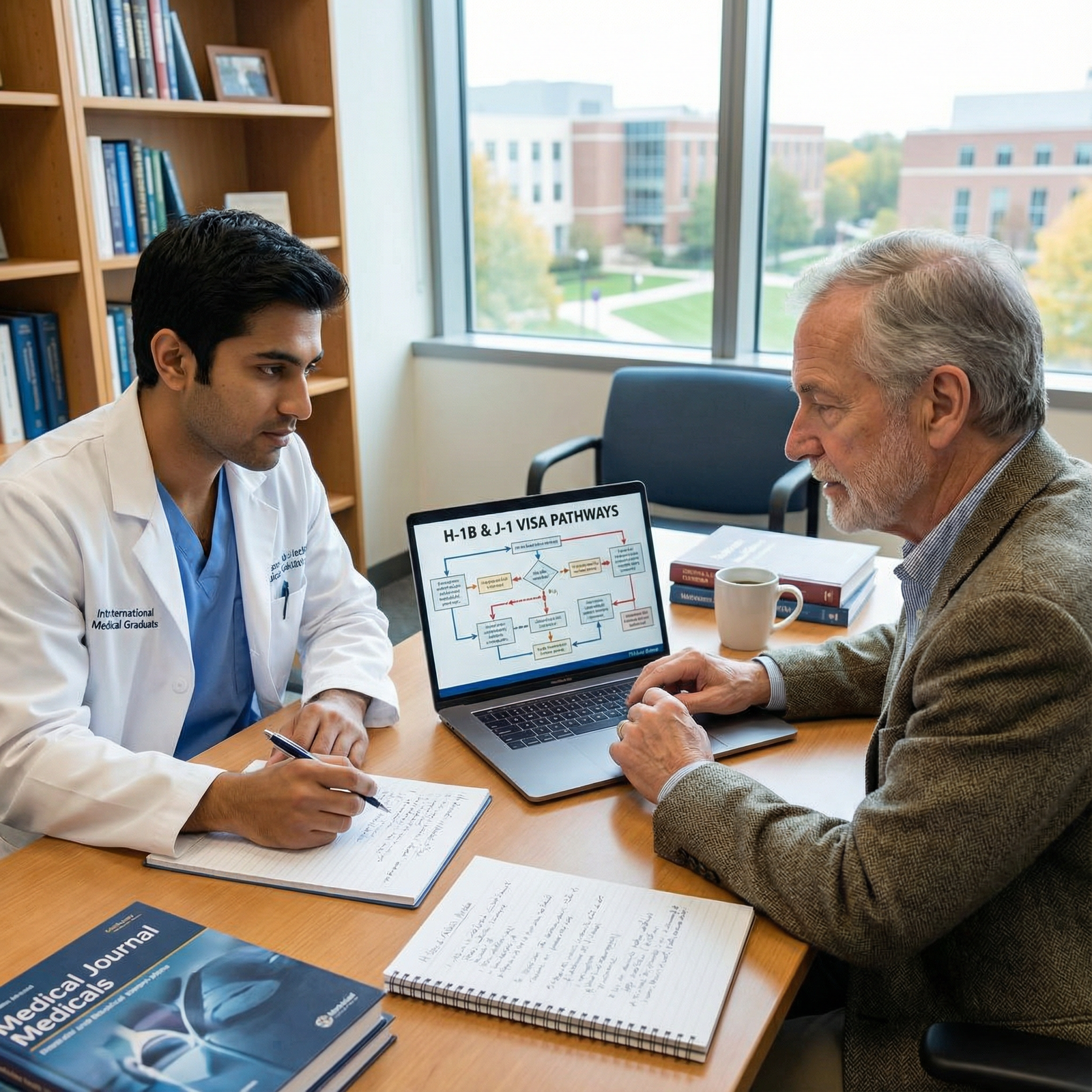
Understanding the Visa Landscape for Vascular Surgery Residency
For a non-US citizen IMG interested in vascular surgery residency in the United States, visa navigation is as important as your board scores and letters of recommendation. Vascular surgery—especially the integrated vascular program pathway—is highly competitive and relatively small. Many programs sponsor visas, but not all, and some will clearly prefer one visa type over another. A strong application can be limited or even blocked if your visa strategy is unclear or unrealistic.
In this article, we’ll walk through:
- The main residency visa types for non-US citizen IMGs
- J-1 vs H-1B considerations specific to vascular surgery
- How visa status influences program selection, networking, and interview strategy
- Planning for fellowship and long-term career as a foreign national medical graduate
- Practical steps, timelines, and red flags to watch for
Throughout, the focus is on the unique needs of a non-US citizen IMG pursuing vascular surgery residency or an integrated vascular program.
Core Visa Options for Non-US Citizen IMGs in Vascular Surgery
The Main Residency Visa Categories
For graduate medical education in the US, most non-US citizen IMGs use one of three paths:
- J-1 Exchange Visitor (ECFMG-sponsored)
- H-1B Temporary Worker (institution-sponsored)
- Permanent Resident (Green Card) or Other Status (e.g., EAD)
Even if you already have an independent status (such as a green card or work-based EAD), you should still understand the standard IMG visa options (J-1 vs H-1B) because they influence how programs think about sponsorship, costs, and long-term employability.
J-1 Exchange Visitor Visa
The J-1 visa is the most common training visa for IMGs. Key characteristics:
- Sponsor: ECFMG (not the individual hospital)
- Purpose: Graduate medical education (residency and fellowship)
- Duration: Up to 7 years for clinical training (in most cases)
- Home Residence Requirement: 2-year rule at completion (unless waived)
- Work Location: Tied to the approved training program
For vascular surgery, J-1 is often acceptable for both general surgery residency followed by vascular fellowship, and for integrated vascular surgery residency (0+5), because the total typical GME time doesn’t exceed the 7-year J-1 limit.
H-1B Temporary Worker Visa
The H-1B visa is a dual-intent work visa allowing specialty occupation employment.
- Sponsor: The individual residency program/hospital
- Duration: Typically up to 6 years total (including all employers)
- Requirements:
- Must have USMLE Step 3 passed before the petition is filed
- Employer must pay prevailing wage and legal/filing costs
- Cap-exempt status: University-affiliated hospitals are usually cap-exempt
For a foreign national medical graduate targeting vascular surgery, H-1B is attractive because it avoids the J-1 home residence requirement and aligns well for those planning to seek long-term US practice and later permanent residency. However, not all vascular surgery or integrated vascular programs sponsor H-1B due to expense and complexity.
Green Card or Other Work Authorization
If you are a non-US citizen IMG who:
- Already has a US green card
- Holds an Employment Authorization Document (EAD) via another route (e.g., asylum, TPS, pending adjustment)
- Has spousal-dependent EAD (e.g., H-4 EAD)
…you often do not need a specific residency visa, which is a major advantage.
Programs generally love applicants who do not require visa sponsorship, particularly in small, resource-intensive specialties like vascular surgery. Make this clear in your application if applicable.
J-1 vs H-1B: Strategic Considerations for Vascular Surgery
Comparing J-1 vs H-1B for a Vascular Surgery Career
The “J-1 vs H-1B” decision is not purely academic; it shapes your career trajectory.
Key comparison points for a non-US citizen IMG in vascular surgery:
| Factor | J-1 Visa | H-1B Visa |
|---|---|---|
| Sponsor | ECFMG | Hospital/program |
| Common in GME? | Very common | Selective; fewer programs |
| Step 3 required? | No | Yes (before filing) |
| Home return rule | 2-year requirement at end | None |
| Training duration limit | Typically up to 7 years | 6 years total (all H-1B time) |
| Ease for programs | Easier, standardized | More complex, expensive |
| Path to green card | Requires waiver first | Can adjust status without waiver |
For vascular surgery specifically, you must also think about total training length:
Integrated Vascular Surgery (0+5)
- 5 years total in a single integrated vascular program
- Usually compatible with J-1’s 7-year training window
Traditional Path: General Surgery (5 years) + Vascular Fellowship (2 years)
- 7 years total
- Also typically compatible with J-1 time limits, but leaves less flexibility for an extra research year or remediation
If you anticipate extended research time, remediation, or dual fellowships, J-1 time caps become more important. With H-1B, the 6-year total can also be constraining if your general surgery residency itself is 5 years and you hope for an H-1B vascular surgery fellowship afterward.
When J-1 May Be Preferable
Choosing J-1 can make sense when:
Your priority is to maximize program options. Many integrated vascular programs and general surgery residencies accept J-1 but refuse H-1B.
Your country has multiple J-1 waiver opportunities for underserved service after training (e.g., Conrad 30 waivers in many states).
You:
- Are comfortable with the idea of working in a medically underserved area after training, or
- Are open to returning home for at least 2 years post-training.
You want to focus fully on matching into a top vascular surgery track without adding the H-1B complexity to your application.
In competitive specialties, you rarely want to limit the number of programs that can consider you; J-1 tends to keep more doors open.
When H-1B May Be Preferable
H-1B could be strategically better when:
- You are firmly committed to staying in the US long-term and want the cleanest path to a green card.
- You have already passed Step 3 before applications and can demonstrate readiness for H-1B sponsorship.
- Your target programs—and you should verify this carefully—explicitly sponsor H-1B for residents.
- Your spouse/partner’s status or your family plan makes the 2-year home residency requirement especially problematic.
Example scenario:
You are a non-US citizen IMG who completed a US general surgery preliminary year, passed Step 3, and now plan to re-apply to categorical general surgery residency with a goal of vascular surgery fellowship. A few university-based programs where you’ve rotated specifically endorse H-1B sponsorship. In this case, asking for or preferring H-1B could be realistic and beneficial.
However, always be honest: if a program does not sponsor H-1B, do not insist on it as a condition. For small integrated vascular programs with 1–2 positions per year, visa complexity can be a tiebreaker against you.
How Visa Status Shapes Your Application Strategy in Vascular Surgery
Researching Program Visa Policies
For an integrated vascular program or general surgery residency (as a step toward vascular), you must assume that visa policy varies widely.
Where to look:
- FREIDA and official program websites: Check sections like “For IMGs” or “Visa Sponsorship.”
- ERAS program listings: Some programs indicate whether they sponsor J-1, H-1B, or neither.
- Program communications: Call or email the program coordinator with very specific questions:
- “Do you sponsor J-1 visas through ECFMG for residents?”
- “Do you sponsor H-1B visas for residents, and if so, is USMLE Step 3 required by rank list or start date?”
Keep a spreadsheet tracking each program’s policy. For vascular surgery, which has fewer total programs and positions, you can and should track this meticulously.
Tailoring Your ERAS Application to Your Visa Reality
For a non-US citizen IMG, clarity is reassuring to programs. In your ERAS and communications:
- State your citizenship and current US status precisely.
- Indicate if you require visa sponsorship or already have a green card/EAD.
- If you are open to both J-1 and H-1B, say so; do not insist on H-1B unless you truly have a strong reason.
- If aiming for H-1B, highlight USMLE Step 3 passed and any prior US training/work that demonstrates familiarity with the healthcare system.
In your personal statement, you generally don’t need to go deep into visa issues. However, for a highly specialized field like vascular surgery where continuity and long training are critical, a brief mention such as:
“As a non-US citizen IMG, I am fully prepared to pursue residency via either J-1 or H-1B sponsorship, and I have already completed USMLE Step 3 to support institutional preferences.”
…can show foresight and reduce unspoken concerns.
Impact on Integrated Vascular vs Traditional Path
Your visa choices can influence whether you pursue:
Direct integrated vascular surgery residency (0+5)
- Highly competitive; positions are limited
- Many programs sponsor only J-1
General surgery residency (categorical) followed by vascular fellowship
- Also competitive but more positions at the residency level
- May provide more options to secure H-1B early, then continue to fellowship
Practical approach:
- Apply broadly to both integrated vascular programs and strong general surgery programs with good vascular exposure.
- Don’t let visa policy alone dictate your path, but:
- If integrated programs mostly offer J-1 in your situation, be prepared to accept J-1 if that’s your main gateway to vascular surgery.
- If your dream is long-term US practice without J-1 waiver constraints and you have Step 3, emphasize H-1B when feasible with selected programs that sponsor it.

J-1 Visa Details for Foreign National Medical Graduates in Vascular Surgery
Eligibility and Documentation
To obtain a J-1 for residency or fellowship, a non-US citizen IMG must:
- Be ECFMG certified
- Have a valid ECFMG-sponsored J-1 DS-2019 for the specific training program
- Show evidence of adequate financial support (usually via the residency contract)
- Maintain good standing in training
For an integrated vascular surgery residency, each year of your 5-year program is approved sequentially. For the traditional path (general surgery + vascular fellowship), you’ll obtain:
- J-1 approval for general surgery residency first, then
- Later, a new DS-2019 for vascular surgery fellowship
Always track your total training years; adding a research year or switching tracks may need ECFMG review and justification.
Two-Year Home Residence Requirement and Waiver Options
At the end of your J-1 training, you face:
- A requirement to return to your home country for 2 years, or
- Obtain a J-1 waiver allowing you to stay and work in the US.
Common J-1 waiver options for physicians:
Conrad 30 Waiver (State-based)
- You work in a designated underserved area for typically 3 years full-time.
- Each US state can recommend up to 30 waivers per year.
- Many waiver jobs are in primary care, but some opportunities exist in specialties, including surgery, depending on the state.
Federal Agency Waivers (e.g., VA, HHS, etc.)
- More niche but sometimes open to specialists.
- Often tied to research or service to specific populations.
Hardship or Persecution Waivers
- Based on personal circumstances (e.g., danger in home country, extreme hardship to US spouse/children).
- Complex, often requiring legal assistance.
For a vascular surgeon who trained on J-1:
- You may need to take an underserved area vascular job or a more general surgical role initially to complete a waiver obligation.
- Strategic networking during fellowship with potential waiver employers is essential.
Action step: During residency or fellowship, talk to senior residents/fellows and alumni about their J-1 waiver experiences in vascular surgery or surgical subspecialties. This gives a realistic picture of post-training options.
H-1B Visa Nuances for Vascular Surgery Residency and Fellowship
Requirements and Common Pitfalls
To pursue H-1B for residency (or later, vascular fellowship), you must:
- Pass USMLE Step 3 before the program can file the H-1B petition.
- Have a valid job/contract from a cap-exempt employer (usually an academic hospital).
- Ensure your medical license or training license is compatible with H-1B timing in your state.
Common pitfalls for non-US citizen IMGs:
- Step 3 timing: Taking Step 3 late in the application cycle can delay or prevent the H-1B petition. Ideally, have Step 3 completed before ERAS submission if you plan to request H-1B.
- Total duration: If you spend 5 years on H-1B in general surgery, only 1 year of H-1B remains for vascular fellowship before reaching the 6-year H-1B limit—unless you obtain an extension through a green card process.
- Program reluctance: Some integrated vascular programs will state, “We only sponsor J-1,” to avoid H-1B costs and legal complexity.
Transitioning from H-1B to Fellowship or Practice
For a foreign national medical graduate on H-1B:
If you match into an H-1B general surgery residency, you may:
- Continue H-1B into vascular surgery fellowship if the new employer is also willing and timing allows within your 6-year limit.
- Seek H-1B extensions if you have started a green card process (e.g., via PERM and I-140 approvals).
If you match into an H-1B integrated vascular surgery residency, your entire 5-year integrated training may consume most of your H-1B time, but you will often be ready to transition to attending practice and pursue a green card with your employer.
Given the complexity, a qualified immigration attorney is crucial once you reach years 3–4 of H-1B training and start planning long-term.

Practical Planning Timeline and Action Steps for Non-US Citizen IMGs
1–2 Years Before Application (Medical School or Pre-Residency)
- Clarify your long-term goal:
- Are you aiming for an integrated vascular program directly?
- Or do you prefer a general surgery residency first, then vascular fellowship?
- Begin Step exam planning:
- Aim to complete USMLE Step 2 CK with a competitive score for vascular surgery.
- Plan USMLE Step 3 by the year before ERAS if you want serious H-1B consideration.
- Seek US clinical experience in surgery or vascular surgery:
- Observerships, externships, or research positions.
- Try to rotate at institutions that have a history of sponsoring residency visa options for IMGs.
ERAS Application Year
- Prepare your CV and personal statement emphasizing:
- Clear interest in vascular surgery.
- Commitment to rigorous surgical training.
- In your application:
- Clearly list your citizenship and current US status.
- If you can accept J-1, state your openness.
- If you are pursuing H-1B, highlight Step 3 and be realistic about program selection.
- Build a program list that considers:
- Visa sponsorship (J-1 only? H-1B possible? None?)
- Case volume, research opportunities, and vascular faculty interests.
Interview Season
- Be ready for visa-related questions:
- “What visa will you need for training?”
- “Have you completed USMLE Step 3?”
- Keep answers concise and confident:
- “I am a non-US citizen IMG and will need sponsorship. I am eligible and open to J-1, and I have completed Step 3 should your institution prefer H-1B.”
- Do not turn the entire conversation into an immigration seminar, but demonstrate that you understand the basics and are not naïve.
Rank List and Post-Match
- If you match:
- Coordinate early with the GME office and international office about your J-1 or H-1B process.
- Track deadlines for DS-2019 or H-1B petitions very carefully.
- If you don’t match:
- Consider research positions in vascular surgery or related fields on an appropriate visa (often J-1 research, F-1 OPT, or other statuses).
- Use that time to strengthen your profile, complete Step 3, and clarify your future residency visa choices.
Frequently Asked Questions (FAQ)
1. As a non-US citizen IMG, will being on J-1 hurt my chances of getting a vascular surgery attending job in the US?
Not necessarily, but it will shape your path. Many former J-1 trainees practice successfully in the US after completing a J-1 waiver job (often in an underserved area) for 3 years. For a vascular surgeon, waiver positions may be less numerous than for primary care, but they do exist. Early networking and flexibility about location are key. Employers know how J-1 waivers work; what matters most is your skill and case experience.
2. Do integrated vascular surgery programs commonly sponsor H-1B?
Some do, but a significant number prefer only J-1 because H-1B involves greater cost and administrative work. You must verify each program’s policy individually. If your dream is an integrated vascular program and you are a foreign national medical graduate, being open to J-1 usually keeps more options available. If you strongly prefer H-1B, focus on a subset of programs known to sponsor it and ensure Step 3 is done well before application.
3. If I train in general surgery on H-1B, can I still get H-1B for vascular surgery fellowship?
Possibly, but it depends on timing. You are generally allowed 6 years total in H-1B status. If you spend 5 years on H-1B in general surgery, you may have only 1 year left. Some vascular fellowships are 2 years, and in that situation, you’d need to explore options such as starting a green card process that allows for H-1B extensions beyond 6 years. This is complex and usually requires close coordination between your fellowship employer and an immigration attorney.
4. I already have a green card or EAD. Should I still mention visas in my application?
Yes, clearly state that you do not require visa sponsorship. Programs value this clarity, especially in a small and highly specialized field like vascular surgery. You don’t need to go into detail about how you obtained your status; a simple line in your application or interview (e.g., “I am a permanent resident and do not need a residency visa”) is sufficient and often seen as a practical advantage.
Navigating residency visa options as a non-US citizen IMG in vascular surgery is complex—but manageable with early planning, honest communication, and realistic expectations. Understand J-1 vs H-1B trade-offs, study each program’s policies, align your exam timing with your visa goals, and keep your long-term vascular surgery career in mind as you choose your training path.