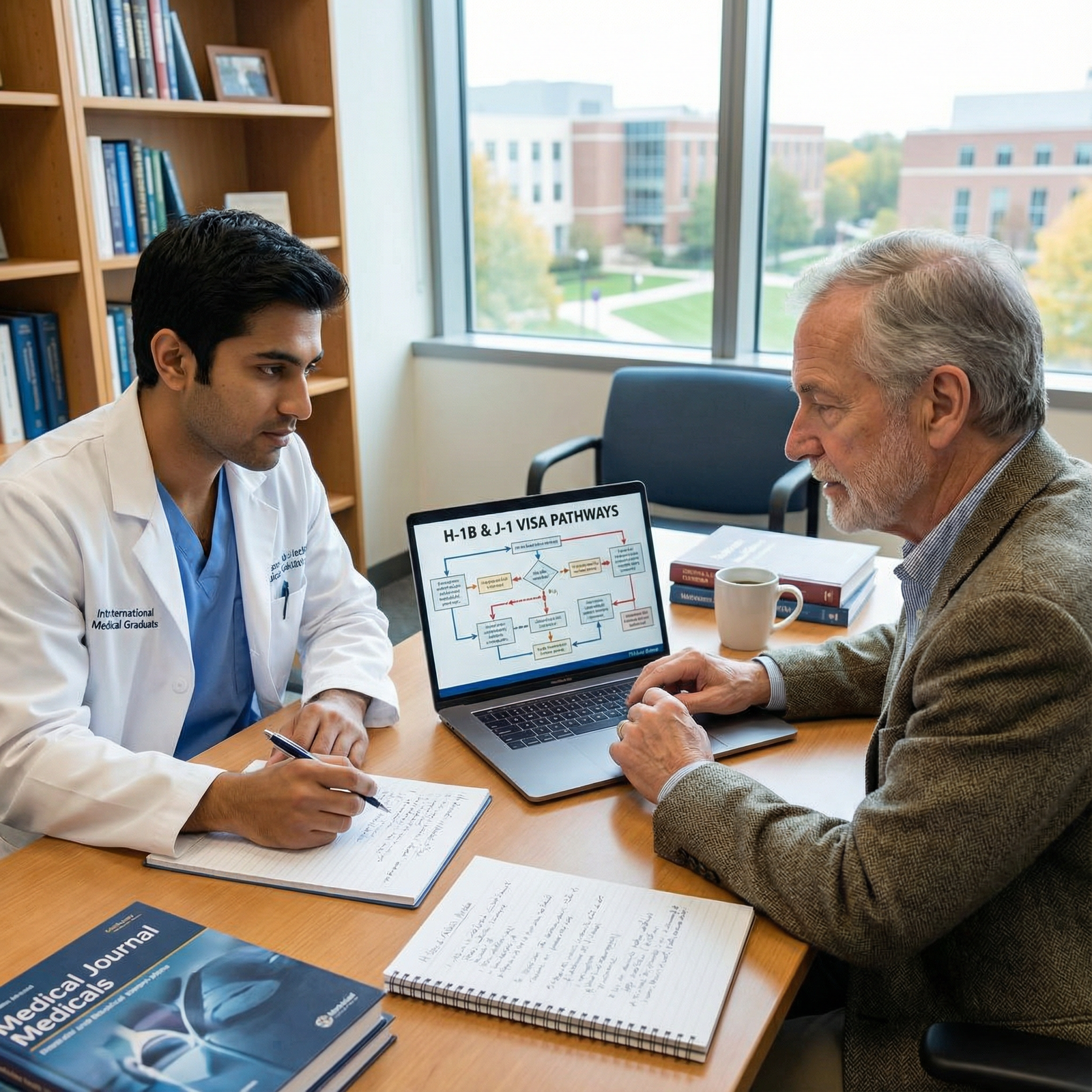
Understanding the Visa Landscape for Non-US Citizen IMGs in Dallas–Fort Worth
For a non-US citizen IMG considering Dallas–Fort Worth (DFW) for residency, visa planning is as critical as exam scores or US clinical experience. Many strong candidates struggle not because of qualifications, but because they misunderstand residency visa rules, mistime key steps, or target programs that cannot sponsor them.
The DFW metroplex (including Dallas, Fort Worth, Arlington, Plano, Irving, and surrounding communities) is home to multiple academic and community hospitals and a growing number of residency positions. Many of these programs routinely train international graduates—but each has its own policies around residency visa sponsorship.
This guide focuses on helping the foreign national medical graduate who is not a US citizen or permanent resident navigate visa options for residency in DFW, with a particular focus on IMG visa options and how to strategize your applications.
We will cover:
- J-1 vs H-1B basics and how they apply to residency
- The typical visa policies in Dallas residency programs
- Practical, step-by-step planning for ERAS, interviews, Match, and post-Match stages
- Special issues (USMLE attempt limits, Step 3 timing, dependents, and long-term planning)
- Frequently asked questions
Core Visa Options for Residency: J-1 vs H-1B for IMGs
The core decision point for most non-US citizen IMGs is J-1 vs H-1B. Understanding what each means for training in DFW medical training environments (and beyond) will shape your trajectory from Match through fellowship and early practice.
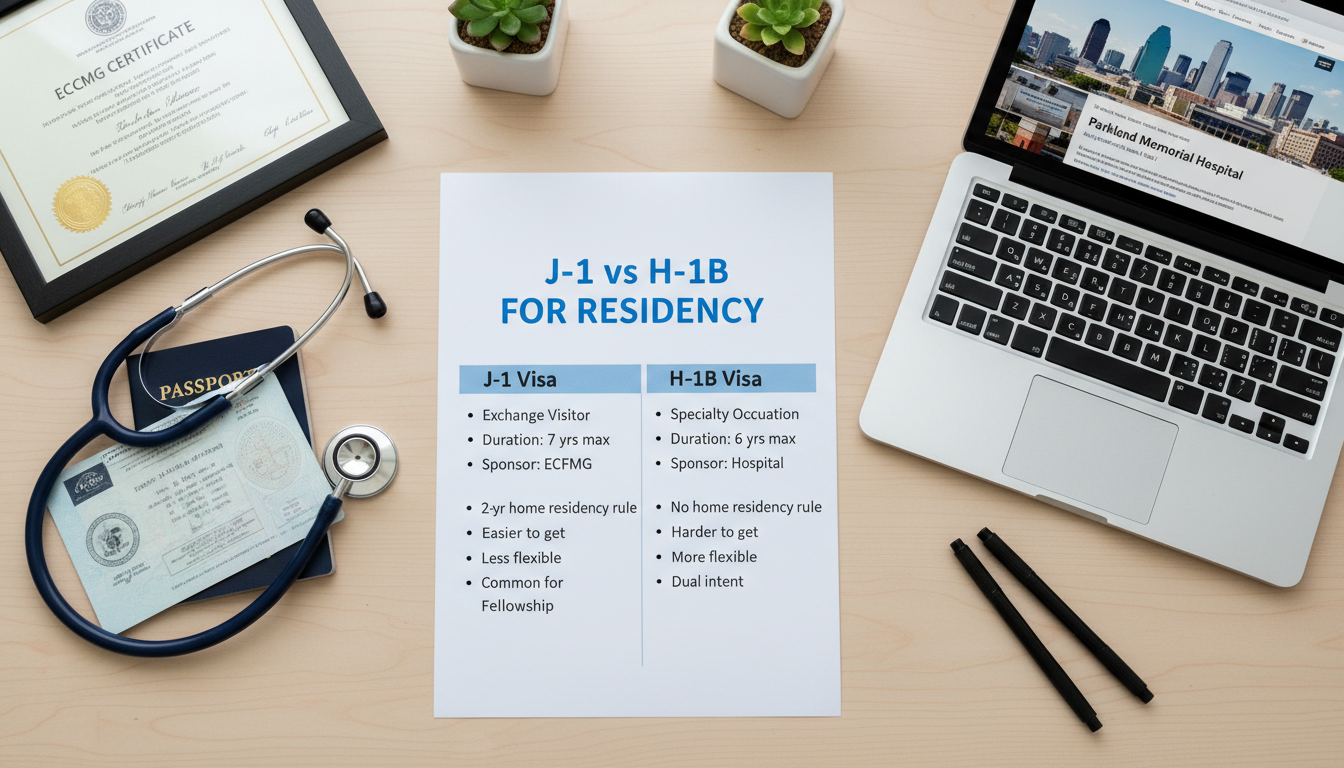
The J-1 Visa for Residency (ECFMG-Sponsored)
The J-1 Exchange Visitor visa for physicians is the most common pathway for international graduates entering residency in the United States.
Key points:
- Sponsor: ECFMG (Educational Commission for Foreign Medical Graduates), not the residency program directly.
- Purpose: Graduate medical education (GME) – residency and fellowship.
- Validity: Typically granted in 1-year increments, renewable up to the length of an ACGME-accredited training program (residency + fellowship) as approved.
- Two-year home residence requirement: After finishing J-1 training, you must return to your home country (or country of last legal permanent residence) for a total of two years, unless you obtain a J-1 waiver.
Pros of J-1 for a non-US citizen IMG:
- Widely accepted: Many Dallas residency programs only sponsor J-1.
- Standardized process: ECFMG handles most of the immigration paperwork.
- No USMLE Step 3 requirement before starting residency.
- Typically faster and more predictable for entry into PGY-1.
Cons of J-1:
- Two-year home residency requirement (212(e)) can limit direct transition to H-1B or permanent residence after training, unless a waiver is obtained.
- J-1 is tied specifically to training; you cannot practice independently as an attending on J-1.
- Dependent employment for spouses (J-2 with EAD) is possible but requires an application and processing time.
Relevance for DFW:
In the Dallas–Fort Worth area, most large academic centers (e.g., UT Southwestern/ Parkland, some Baylor/THR-affiliated programs) are very familiar with J-1 sponsorship. Many community-based programs in North Texas also prefer J-1 because the ECFMG takes on much of the administrative burden.
The H-1B Visa for Residency
The H-1B visa is a temporary worker visa used in many professional fields, including medicine. It can be used for residency, but with stricter requirements.
Key points:
- Sponsor: The residency program acts as the H-1B employer.
- Purpose: Specialty occupation—requires at least a bachelor’s degree; for physicians, this is interpreted as a medical degree plus credentialing.
- Validity: Usually granted in up to 3-year increments, with a typical total cap of 6 years (extensions in special circumstances).
- No two-year home residency requirement: You are not subject to 212(e) as with J-1.
Pros of H-1B for a foreign national medical graduate:
- More straightforward path to continuing in the US for fellowship, hospitalist work, or other roles without a J-1 waiver.
- Easier transition to green card in many cases, especially with employer sponsorship.
- Spouses on H-4 status may, in certain circumstances (if I-140 is approved), become eligible for work authorization (H-4 EAD).
Cons of H-1B:
- Not all DFW residency programs sponsor H-1B: Many explicitly state “J-1 only” in their policies.
- USMLE Step 3 required before H-1B filing in most states (including Texas) for residency training.
- More costly and administratively complex for the program (attorney fees, filing fees, timing with the academic year).
- Generally more competitive: Some programs may reserve H-1B slots for particularly strong candidates or certain specialties.
Relevance in Dallas–Fort Worth:
In the DFW metroplex, a subset of programs (especially some larger, better-resourced institutions) may sponsor H-1B for residency, but usually with strict conditions:
- Successful USMLE Step 3 by a certain deadline (often by rank list submission or very shortly after Match).
- Strong overall application (high scores, solid US clinical experience, strong letters).
- Willingness and capacity of the program’s institution to manage H-1B petitions.
You must check each program’s website and confirm during interviews if H-1B sponsorship is an option.
Other Statuses Occasionally Seen
While J-1 vs H-1B dominates the discussion, you might encounter:
- F-1 with OPT: Important for international students graduating from US medical schools. You could use OPT for a short bridge, but for residency you almost always transition to J-1 or H-1B.
- O-1 (extraordinary ability): Rare for residency; more common for senior attending physicians or physician-scientists with strong research portfolios.
- Green card / US permanent residence: If you already have this, your process is similar to that of a US citizen. Visa issues largely disappear.
For the typical non-US citizen IMG living outside the US or on a non-immigrant visa, the realistic options for DFW residency are J-1 or H-1B.
Visa Policies in Dallas–Fort Worth Residency Programs
Understanding local patterns helps you target programs strategically.
Typical Visa Approaches in the DFW Area
While every institution is different, common patterns among Dallas residency programs include:
J-1 only programs
- Many community-based internal medicine, family medicine, pediatrics, and transitional year programs.
- Rationale: Less cost and paperwork, reliance on ECFMG oversight.
- Impact: Ideal if you are open to J-1 and possibly later J-1 waiver jobs in Texas or other states.
J-1 preferred, limited H-1B
- Some academic and large teaching hospitals in DFW fall into this category.
- Policy examples:
- “We generally sponsor J-1 visas; H-1B sponsorship considered in exceptional cases.”
- “H-1B sponsorship is limited and primarily for applicants who have passed USMLE Step 3 and meet additional criteria.”
- Impact: As a non-US citizen IMG with high scores and Step 3, you may be considered for H-1B if you articulate your long-term plans and timing.
J-1 or H-1B routinely
- Less common but present in some large systems with extensive immigration infrastructure.
- These programs might be particularly attractive if you seek an H-1B path, but competition can be intense.
No visa sponsorship
- A small number of programs may state “We do not sponsor visas,” which effectively excludes most non-US citizen IMGs unless they already hold work authorization (e.g., green card, EAD through another category).
How to Research Visa Policies for DFW Medical Training Programs
Use multiple sources and always verify the most recent information:
Program websites
- Look under “Eligibility and Requirements,” “International Medical Graduates,” or “FAQ.”
- Example language:
- “We sponsor J-1 visas through ECFMG.”
- “We do not sponsor H-1B visas for residency training.”
- Note any fine print about Step 3 or deadlines.
FREIDA (AMA Residency & Fellowship Database)
- Many programs list visa policies.
- Check that the FREIDA listing matches the program website; if not, assume the website is more current.
Email the program coordinator
- Especially if the policy is unclear:
- “Do you sponsor visas for non-US citizen IMGs?”
- “Do you sponsor both J-1 and H-1B, or J-1 only?”
- Keep your email short, professional, and specific.
- Especially if the policy is unclear:
Ask during interviews
- During Q&A with the program director or residents, you can ask:
- “Could you clarify your visa sponsorship policies for IMGs?”
- “Is H-1B sponsorship available, and if so, what requirements should applicants meet?”
- This also demonstrates that you are planning ahead.
- During Q&A with the program director or residents, you can ask:
Strategy: Balancing J-1 and H-1B Programs in Your DFW List
For a non-US citizen IMG targeting Dallas–Fort Worth:
If you are open to J-1:
- You can apply broadly across DFW, including many community and academic programs.
- Use J-1 programs to increase your chances of matching in the metroplex.
If you strongly prefer H-1B:
- Identify all DFW programs that at least sometimes sponsor H-1B.
- Be realistic: the number is smaller, and competition is higher.
- Strongly consider taking USMLE Step 3 before the Match (more on this below).
- To avoid limiting your Match chances too severely, include some J-1 programs unless you are prepared to match outside the US or wait another cycle.
Balanced approach:
- Apply to both J-1-only and H-1B-capable programs.
- Rank based on overall fit, training quality, and your tolerance for the J-1 home requirement vs long-term US plans.
Step-by-Step Timeline: Visa Navigation From Application to Start Date
Managing your residency visa correctly is all about timing. Here is a practical roadmap tailored to non-US citizen IMGs targeting DFW.
1. 12–18 Months Before Residency Start: Early Planning
Key tasks:
- Complete or plan remaining USMLE steps:
- Step 1 and Step 2 CK are mandatory.
- Step 3 is optional for J-1 but often required for H-1B.
- Understand your long-term goals:
- Are you likely to seek a J-1 waiver job in Texas or another state?
- Do you strongly want to avoid the J-1 home residency requirement?
- Research DFW programs:
- Create a spreadsheet noting:
- Visa policies (J-1 only, J-1 + H-1B, none).
- IMG friendliness (percentage of IMGs, average scores, USCE expectations).
- Location within DFW (Dallas vs Fort Worth vs suburbs).
- Create a spreadsheet noting:
Advice: If H-1B is truly important to you, begin preparing for USMLE Step 3 early. Texas has no special exemption allowing residency H-1B without Step 3.
2. ERAS Season (Application Submission: September–October)
ERAS and application strategy:
- In your Personal Statement:
- You can mention that you are a non-US citizen IMG and briefly express your understanding of visa processes, especially if applying for H-1B.
- In your MyERAS application:
- Accurately list your citizenship and current visa status.
- Program selection:
- Include a mix of:
- J-1 only programs you would truly attend.
- Programs that consider H-1B, especially those in DFW if that region is a high priority.
- Include a mix of:
For H-1B-focused candidates:
- If you have already passed Step 3:
- Consider highlighting it in your CV and ERAS experiences section.
- Programs may see you as “H-1B ready.”
- If Step 3 is pending:
- Be realistic about your ability to pass it and have results available before programs need to file H-1B petitions.
3. Interview Season (October–January): Clarifying Visa Options
During interviews with Dallas residency programs, this is your opportunity to explore IMG visa options more deeply.
Questions to consider asking (politely and at appropriate times):
- “Do you sponsor J-1 visas for IMGs through ECFMG?”
- “Do you sponsor H-1B visas for residents, and what are the conditions (e.g., Step 3 by a certain date)?”
- “Have you recently had residents on H-1B or J-1 from similar backgrounds?”
Signals to watch for:
- Programs that are confident and specific about their policies tend to handle visa issues smoothly.
- If they say “We prefer J-1, but H-1B might be possible,” clarify:
- “Is H-1B sponsorship realistic for someone who already has Step 3 completed?”
- “Is there a limit on the number of H-1B positions per year?”
Balancing transparency and strategy:
- It is acceptable to state:
- “I’m open to J-1 sponsorship” if that is true.
- “I would prefer an H-1B if available, and I have passed Step 3,” but make it clear that you can work within their policies.

After the Match: Concrete Visa Steps for DFW Residency
Once you match into a DFW program, your visa path becomes more concrete.
If You Match on a J-1 Visa
1. ECFMG sponsorship process
- Your program will provide you with:
- An official offer/appointment letter.
- Institutional information needed for ECFMG forms.
- You will:
- Complete the online ECFMG J-1 application (Form DS-3035-related steps are for waivers later; initial sponsorship uses ECFMG’s dedicated portal).
- Submit documents:
- Medical diploma and translation (if not in English).
- Valid ECFMG certification.
- Statement of need from your home country’s Ministry of Health or equivalent.
- Proof of passed exams.
- Pay applicable fees.
2. DS-2019 issuance and embassy appointment
- After ECFMG approves your application, you will receive Form DS-2019.
- You then:
- Pay the SEVIS I-901 fee.
- Schedule a J-1 visa interview at a US embassy/consulate.
- Prepare:
- DS-160 confirmation.
- DS-2019.
- Passport and photos.
- Financial support documentation if required.
- Any additional local requirements.
3. Arrival in Dallas–Fort Worth
- J-1 entry allowed up to 30 days before your program start date.
- Coordinate with your GME office for:
- Orientation dates.
- Hospital onboarding.
- I-94 verification and any local ID or licensing steps.
If You Match on an H-1B Visa
1. Institutional petition preparation
- Your residency program’s HR/legal office (or external counsel) will:
- Gather documents:
- Your medical degree, ECFMG certificate.
- Proof of USMLE Step 3.
- Texas medical training license documentation (if applicable).
- File Form I-129 H-1B petition with USCIS, often requesting premium processing to ensure timely approval before July 1.
- Gather documents:
2. Timing considerations
- Because residency start dates are fixed, DFW institutions often:
- File early (March–April) after Match Day.
- Insist that Step 3 results be available before filing.
- If you are outside the US:
- After I-129 approval (I-797 approval notice), you schedule an H-1B visa interview at a US embassy/consulate.
- If you are already in the US in another status:
- A change of status may be requested as part of the I-129 petition.
3. Start of training
- Arrive in the US with your H-1B visa stamp (if abroad).
- Attend GME orientation and complete local HR requirements.
- Keep copies of I-797 approval, I-94, and contracts for future renewals or status changes.
Long-Term Planning: J-1 Waivers, H-1B Beyond Residency, and Life in DFW
For J-1 IMGs: Waiver and Return Options
If you complete residency or fellowship on J-1, you will face the two-year home residence requirement unless you obtain a waiver.
Common J-1 waiver pathways:
Conrad 30 program (state-based)
- Each US state can sponsor up to 30 J-1 waivers per year for physicians who agree to work in underserved areas.
- Texas participates actively and has many underserved regions.
- Job commitments usually require 3 years of full-time service in a designated location.
- Many positions are outside central Dallas–Fort Worth, but some may be in underserved pockets of the metroplex.
Federal programs
- VA (Veterans Affairs), Health and Human Services, and other federal agencies can sponsor J-1 waivers under certain conditions.
Hardship or persecution waivers
- Less common and more complex; based on extreme hardship to a US citizen/permanent resident spouse/child or fear of persecution in your home country.
If you plan to build a long-term life in DFW:
- Consider doing your residency or fellowship in DFW, then seeking a Conrad 30 or similar position in Texas (which may or may not be in DFW, but could be nearby).
- Many physicians eventually move back to urban areas after waiver obligations are complete, often on H-1B or as permanent residents.
For H-1B IMGs: From Residency to Fellowship and Beyond
If you train on H-1B:
- You can continue on H-1B for fellowship (if sponsored) or attending positions.
- Remember the 6-year typical total limit:
- Time used in residency counts.
- Time in fellowship counts.
- Many physicians pursue employment-based green cards (EB-2, EB-1) during or after training.
- DFW has:
- Large health systems (e.g., Baylor Scott & White, Texas Health Resources, UT Southwestern, Methodist, HCA) that frequently sponsor experienced physicians for permanent residence.
- Numerous private groups that may also sponsor green cards.
Practical tip: Start discussing future immigration plans with your employer/attorney early—ideally in your last year of residency or fellowship.
Considerations for Family and Dependents
Whether on J-1 or H-1B:
- Spouses and children:
- J-1 dependents: J-2 status—spouses can apply for work authorization (EAD).
- H-1B dependents: H-4 status—spouses may work only if eligible for H-4 EAD (usually when the H-1B holder has an approved I-140).
- Schooling: Children can attend school in Texas on either J-2 or H-4.
- Cost of living in DFW:
- Generally more affordable than coastal cities, but housing and childcare costs can still be significant.
- Choose your program location within DFW with commute and family needs in mind.
FAQs: Visa Navigation for Non-US Citizen IMGs in Dallas–Fort Worth
1. As a non-US citizen IMG, is it realistic to get H-1B sponsorship for residency in Dallas–Fort Worth?
It is possible but more limited than J-1 sponsorship. Some DFW programs do sponsor H-1B for residency, particularly larger academic institutions with robust immigration offices. However, many programs are J-1 only. If you want an H-1B, you’ll generally need:
- Strong academic credentials and USMLE scores.
- Completed USMLE Step 3 before the program’s H-1B filing deadline.
- To target a subset of programs that explicitly or historically sponsor H-1B.
A balanced strategy often includes both H-1B-capable and J-1 programs to avoid overly restricting your Match options.
2. Should I take USMLE Step 3 before applying to DFW residency programs if I’m interested in H-1B?
If your goal is H-1B, taking and passing Step 3 before or early in the application season is a significant advantage. Many DFW programs that sponsor H-1B require:
- Step 3 passed before submitting the H-1B petition.
- In some cases, Step 3 passed before ranking you, or at least before Match Day.
Even for J-1-track applicants, having Step 3 can signal academic strength and may help later if you transition to H-1B for fellowship or practice.
3. If I match into a Dallas residency program on a J-1, am I stuck outside the US after training because of the two-year rule?
Not necessarily “stuck,” but you are subject to the two-year home residence requirement unless you obtain a waiver. Many J-1 physicians:
- Complete a J-1 waiver job in Texas or another state (often in underserved areas) on H-1B for 3 years.
- Then transition to permanent residence or continue on H-1B in more flexible locations, sometimes eventually returning to large metro areas like DFW.
The two-year requirement is a serious consideration but is commonly navigated through waiver programs, especially for primary care and certain specialties.
4. How do I find out which Dallas–Fort Worth programs are IMG- and visa-friendly?
Use a combination of strategies:
- Program websites: Look for clear statements about IMGs and visa sponsorship (J-1, H-1B, or none).
- FREIDA: Check each program’s data on IMGs and visas.
- Networking: Contact current or recent residents (via LinkedIn, alumni networks, or program social media) who trained as IMGs.
- Interview questions: During interviews, ask about the proportion of IMGs, recent visa sponsorships, and support for foreign national medical graduates.
Programs with a consistent history of training IMGs and sponsoring J-1 or H-1B tend to be more experienced and supportive in handling visa processes.
By understanding J-1 vs H-1B, researching Dallas residency programs thoroughly, planning your IMG visa options early, and aligning your strategy with your long-term goals, you can significantly improve your chances of successfully starting and completing residency in the Dallas–Fort Worth area as a non-US citizen IMG.