Understanding the Visa Landscape for Non‑US Citizen IMGs in Diagnostic Radiology
For a non-US citizen IMG or foreign national medical graduate aiming for a diagnostic radiology residency in the United States, the scientific part of your journey (exams, research, clinical rotations) is only half the story. The other half is visa strategy.
The type of residency visa you hold can affect:
- Which programs will rank you
- Your flexibility in moonlighting and research
- Your ability to bring dependents
- Your future options for fellowship, employment, and permanent residency
- Whether you must return home after training
This article breaks down the key IMG visa options, how they interact specifically with the diagnostic radiology match, and how to build a smart, realistic visa plan as a non-US citizen IMG.
The Two Main Residency Visa Pathways: J‑1 vs H‑1B
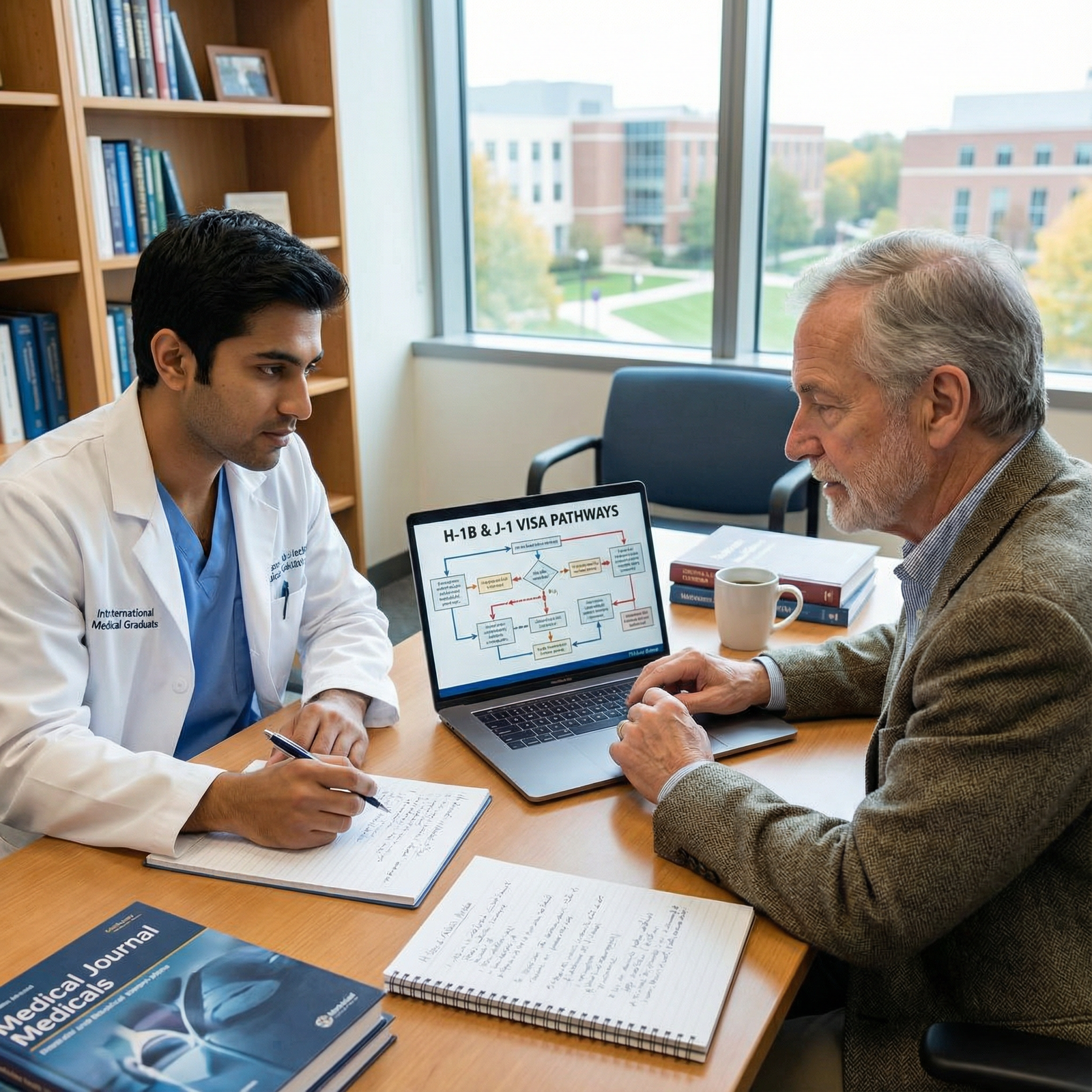
Most non‑US citizen IMGs in radiology residency use one of two visa classifications: the J‑1 Alien Physician visa or the H‑1B Temporary Worker visa. Understanding J‑1 vs H‑1B is the cornerstone of visa navigation.
J‑1 Alien Physician Visa (ECFMG Sponsored)
Who uses it?
The majority of foreign national medical graduates in US GME, including many diagnostic radiology residents, are on J‑1 visas sponsored by ECFMG.
Key features:
- Sponsor: ECFMG (not the individual residency program)
- Purpose: Graduate medical education and training
- Maximum duration: Up to 7 years for clinical training (adequate for a 4-year diagnostic radiology residency plus most fellowships)
- USMLE requirement: Typically USMLE Step 1, Step 2 CK, and valid ECFMG certification
- Employment: Only at the approved training site(s) listed in your DS‑2019
- Moonlighting: Usually restricted; depends on ECFMG and institutional policies
- Dependents: J‑2 status for spouse and children, with possible work authorization for spouse (EAD)
Biggest downside: The 2‑year home-country physical presence requirement
After completing training on a J‑1 physician visa, you are generally required to return to your home country for a cumulative two years before you can:
- Obtain H‑1B or L‑1 visas, or
- Adjust status to permanent residency (green card)
You can bypass this only if you obtain a J‑1 waiver (e.g., Conrad 30 waiver, hardship, or persecution-based waiver), which typically requires:
- A US employer (often in a medically underserved area) willing to sponsor you
- A multi-year service commitment after training (commonly 3 years full-time)
For diagnostic radiologists, waiver jobs may be:
- In rural or underserved community hospitals
- In small private groups contracted with underserved hospitals
- Occasionally in tele-radiology models combined with onsite coverage
Advantages of J‑1 for radiology residency:
- Broadly accepted by US diagnostic radiology programs
- Easier for many programs to sponsor (no complex USCIS petitions)
- Fits well with 4-year DR + 1-year fellowship sequence
- Allows you to match widely, including university and community programs
Disadvantages:
- The 2‑year home residency requirement or need for a waiver
- Less flexibility for moonlighting or side work
- Greater dependency on post-training waiver jobs (which may not be in your ideal geographic or practice setting)
H‑1B Visa (Temporary Worker in Specialty Occupation)
Who uses it?
A smaller, but important subset of non-US citizen IMGs in radiology obtain H‑1B visas.
Key features:
- Sponsor: The residency program (institution)
- Purpose: Employment in a specialty occupation (here, physician in training)
- Maximum duration: 6 years total in H‑1B status (including any previous H‑1B employment)
- USMLE requirement: Must have USMLE Step 3 passed before the H‑1B petition is filed (a crucial timing consideration)
- Employment: Only for the sponsoring employer (and specific work locations in the petition)
- Moonlighting: May be allowed if explicitly included and compliant with visa rules and institutional policy
- Dependents: H‑4 status for spouse and children (H‑4 spouse cannot work without separate authorization category)
No automatic 2‑year home requirement
Unlike the J‑1 physician visa, H‑1B does not impose a 2‑year home-country residency requirement at the end of training. This can make subsequent transition to:
- Fellowship (on H‑1B)
- Attending job (H‑1B or other)
- Green card sponsorship
more straightforward, assuming you can find employers willing and able to sponsor.
Advantages of H‑1B for radiology residency:
- No J‑1 2‑year home requirement
- Often more flexibility in post-residency employment and green card pathways
- Perceived as more “stable” for long-term US career planning
Disadvantages:
- Fewer diagnostic radiology programs sponsor H‑1B (or have limited slots)
- Requires USMLE Step 3 before the start of residency (often by March of the match year to allow time for petitions)
- More expensive and administratively burdensome for programs (legal and filing fees)
- Subject to US immigration policy changes and sometimes to H‑1B cap issues (less common in academic hospitals that are cap-exempt, but still a consideration)
J‑1 vs H‑1B: What Radiology Program Directors Consider
When a radiology program chooses which visa options it will support, they weigh several factors:
- Administrative complexity: J‑1 is centralized via ECFMG; H‑1B is employer-driven and more paperwork-heavy.
- Cost: H‑1B involves legal fees and filing costs; programs may be hesitant unless you’re a particularly competitive applicant.
- Duration of training: Diagnostic radiology (4 years) plus optional fellowship (typically 1 year) can fit within both visa types. But if you want multiple fellowships, H‑1B years can be used up quickly.
- Institutional policy: Some universities mandate “J‑1 only” for all residents/fellows; others support both.
For a non‑US citizen IMG in radiology, this means:
- Many top-tier academic radiology residencies are J‑1 only.
- Some community and hybrid academic programs may be more open to H‑1B.
- A small number of highly IMG-friendly academic radiology programs offer both J‑1 and H‑1B pathways with clear policies.
How Visa Strategy Interacts with the Diagnostic Radiology Match
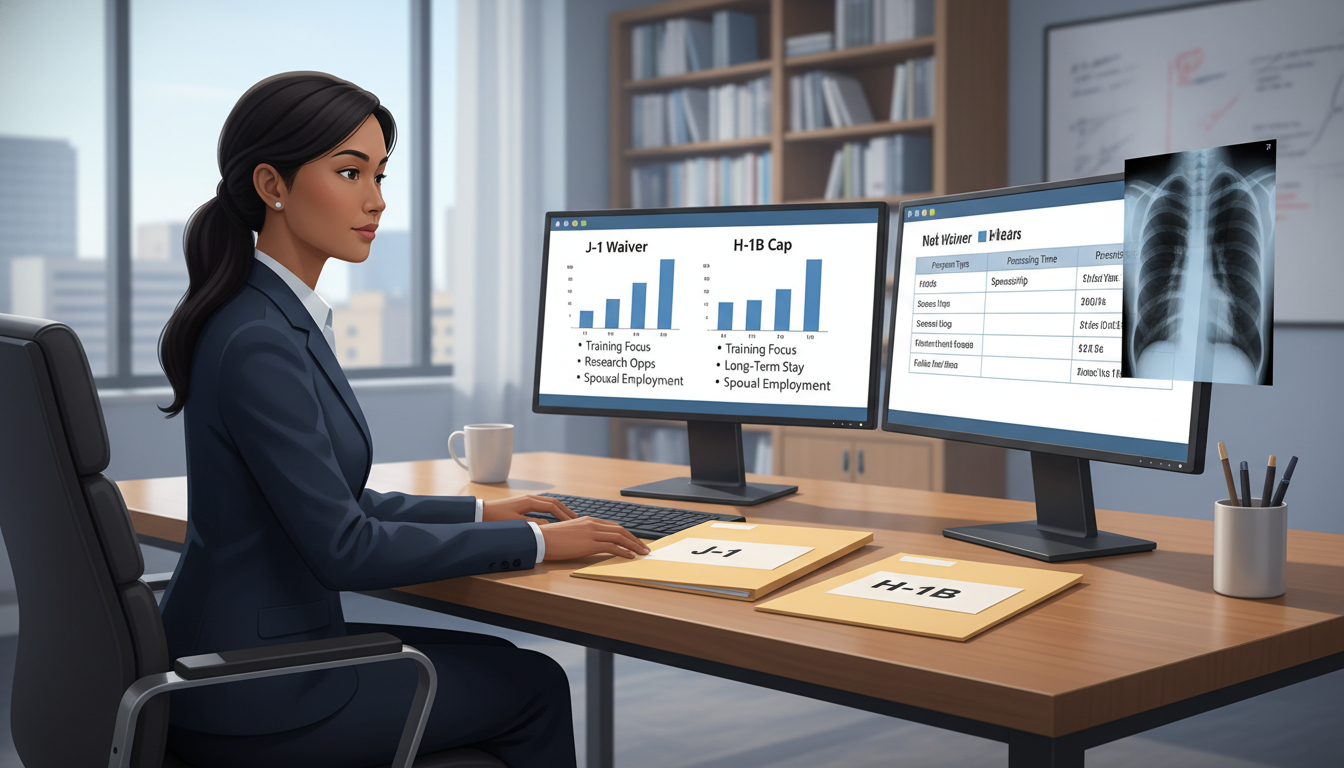
Your visa status and timing actively shape your diagnostic radiology match strategy. You cannot treat visa issues as an afterthought; they must be incorporated into your planning from the earliest stages.
Step 1: Clarify Your Long-Term Career Goals
Before choosing between J‑1 vs H‑1B, ask:
- Do you envision your long-term career in the US?
- If yes, avoiding or managing the J‑1 2‑year home requirement is important, but not always mandatory.
- Are you open to working in underserved or rural areas after training?
- If yes, a J‑1 waiver path may be realistic, even for radiology.
- Do you anticipate needing more than one fellowship or extended subspecialty training?
- This can impact your total allowable time in J‑1 (7 years) or H‑1B (6 years).
- Do you have a strong personal reason to avoid a compulsory return home after training?
- Family, political, or career factors may push you toward an H‑1B preference or a J‑1 waiver strategy.
Step 2: Map Visa Requirements Onto the Match Timeline
For a typical ERAS and NRMP cycle:
- Year −2 to −1 (pre-application): Take USMLE Step 1 and Step 2 CK, secure ECFMG certification, obtain US clinical experience and radiology exposure if possible.
- Year −1 (application year):
- If you’re targeting H‑1B, you should plan to take and pass USMLE Step 3 no later than early in the application year (ideally by November–December of the calendar year before residency begins, but specific institutional deadlines vary).
- If you’re open to J‑1, Step 3 timing is less critical (it’s not required for ECFMG-sponsored J‑1).
- Match year:
- Programs will ask about your visa needs during interviews.
- Those offering H‑1B may require evidence of scheduled or completed Step 3.
If Step 3 is not completed in time, some programs that initially considered you for H‑1B may either:
- Offer to sponsor you on J‑1 instead (if they support both), or
- Be unable to rank you due to internal policy constraints.
This timing consideration is especially delicate for non‑US citizen IMGs who might struggle to get Step 3 slots early or must travel to the US solely for the exam.
Step 3: Research Program Visa Policies Carefully
In diagnostic radiology, programs vary widely:
- Some list “J‑1 only (ECFMG-sponsored)” on their websites.
- Some state “J‑1 and H‑1B considered”, with caveats.
- A few do not explicitly state a policy online (you must ask by email).
Actionable steps:
Use FREIDA and program websites
- Search: “Visa sponsorship” + “Diagnostic Radiology” + program name.
- Confirm if non‑US citizen IMG and foreign national medical graduate are explicitly welcome.
Ask intelligently by email (before applying widely)
Example message:Dear [Program Coordinator/Program Director],
I am an international medical graduate and non‑US citizen IMG, currently ECFMG certified and planning to apply to your Diagnostic Radiology residency this cycle. I would require visa sponsorship.
Could you please confirm which visa types your program sponsors for residents (J‑1, H‑1B, or both), and whether there are any specific requirements or limitations for IMG applicants?
Thank you very much for your time.
Sincerely,
[Your Name], MDTrack responses in a spreadsheet:
- Columns for: Program, City/State, University/Community, J‑1?, H‑1B?, Notes (Step 3 deadline, caps, IMG friendliness, etc.)
Use this to guide how you distribute your ERAS applications, particularly if you strongly prefer a specific residency visa pathway.
Strategic Considerations for J‑1 and H‑1B in Radiology
When a J‑1 Visa is a Rational (and Often Ideal) Choice
Many non-US citizen IMGs initially think they must avoid J‑1 at all costs. For diagnostic radiology, this is an oversimplification.
J‑1 may serve you well if:
- You want the broadest possible program list (including many academic DR programs).
- You are flexible geographically for post-training employment.
- You are open to exploring J‑1 waiver positions in radiology post-fellowship.
- Your home-country situation makes a 2‑year return possible (or at least not catastrophic).
Example scenario:
- You match into a strong university diagnostic radiology residency on a J‑1 visa.
- During residency, you build an excellent research portfolio in neuroradiology.
- You complete a one-year neuroradiology fellowship, still under J‑1, within your 7-year training maximum.
- You then apply for a Conrad 30 waiver in a US state with demand for neuroradiology services in underserved areas, accepting a 3-year service contract.
- Once the waiver is granted and you enter H‑1B employment, you can later pursue a green card through your employer.
This path is realistic and commonly followed across specialties, including radiology, though waiver job availability varies by region and subspecialty.
When an H‑1B Visa is Worth Aggressively Targeting
H‑1B may be especially attractive if:
- You have compelling reasons not to return home for 2 years (family safety, political concerns, etc.).
- You intend to build a long-term academic or private practice career in the US without immigration constraints linked to waiver service.
- You already have strong USMLE scores and can confidently pass Step 3 early.
- You are competitive for programs that are known to support H‑1B for non‑US citizen IMGs.
Example scenario:
- You complete a preliminary internship in internal medicine on J‑1 (or another status).
- During or just after internship, you take USMLE Step 3 and pass.
- You match into a diagnostic radiology residency at a program that explicitly sponsors H‑1B; they file a cap-exempt H‑1B petition for your four years of DR training.
- You then continue to a 1-year H‑1B neuroradiology fellowship at the same or another cap-exempt institution.
- During fellowship, your employer initiates a green card petition, allowing you to continue working beyond the initial 6-year H‑1B limit if necessary (via AC21 extensions in certain scenarios).
This path is logistically complex but powerful for long-term immigration stability.
Hybrid Paths and Status Changes
Occasionally, non-US citizen IMGs transition from one status to another during their training and early career:
- J‑1 for residency; H‑1B for fellowship and beyond:
You still face the 2‑year home requirement unless you secure a J‑1 waiver before switching, but this can make financial/administrative sense for institutions. - J‑1 to O‑1 (Extraordinary Ability) for particularly accomplished radiology researchers:
- Rare but possible for highly published, well-recognized academic radiologists; can interact with waiver rules in complex ways.
- Non-immigrant to immigrant status (green card) during or after fellowships:
- Requires careful planning with an immigration attorney and supportive employer.
Practical Steps for Non‑US Citizen IMGs Planning for Radiology Residency
1. Build a Visa-Aware Application Timeline
For a non-US citizen IMG seeking a diagnostic radiology match:
Years before match:
- Aim for strong USMLE Step 1 and Step 2 CK scores.
- Obtain ECFMG certification as early as possible.
- Seek US clinical experiences, ideally including radiology electives or observerships, to demonstrate genuine specialty interest.
12–18 months before residency start:
- Decide if you will seriously pursue H‑1B.
- If yes, schedule and pass USMLE Step 3 early, factoring in:
- Visa and travel requirements to sit the exam.
- Score reporting time (usually 3–4 weeks, sometimes longer).
Application season:
- Tailor your program list based on:
- Visa sponsorship policies
- Historical IMG friendliness
- Your competitiveness (scores, research, letters)
Interview season:
- Prepare a clear, honest, and concise explanation of:
- Your visa needs (“I will require visa sponsorship”)
- Your flexibility (“I am open to both J‑1 and H‑1B if your institution supports them” or “I strongly prefer H‑1B due to [specific reason]”)
- Avoid sounding demanding; frame it as a question plus flexibility, not an ultimatum.
2. Clarify with Each Program: What Are the Exact VISA_OPTIONS_FOR_IMGS?
During interviews or by follow-up emails, ask targeted questions:
- “Does your diagnostic radiology residency sponsor J‑1, H‑1B, or both for non-US citizen IMGs?”
- “If H‑1B is possible, is there a requirement that USMLE Step 3 be completed by a specific date?”
- “Are there institutional limitations on the total number of H‑1B residents?”
- “For J‑1 residents, do you have experience supporting alumni through the J‑1 waiver process after fellowship?”
Use the answers to adjust your rank list. For example:
- Rank J‑1-only programs higher if:
- They are your top academic choices.
- You are comfortable with the J‑1 waiver route.
- Rank H‑1B-supporting programs higher if:
- Avoiding the 2‑year requirement is a major priority.
- You have Step 3 passed and meet their criteria.
3. Understand the Impact of Intern Year and Transitional Years
Diagnostic radiology residency starts at PGY‑2 (R1 year), preceded by a clinical intern year (PGY‑1). Visa planning must consider both segments:
- Some applicants do a preliminary or transitional year in the US before DR on one visa (J‑1 or H‑1B) and then switch status for radiology.
- If you’re on a J‑1 for intern year and move to J‑1 for radiology, your total J‑1 time counts continuously toward the 7-year limit.
- If you start on H‑1B for internship, that year counts toward the 6-year H‑1B cap, reducing remaining years for DR + fellowship.
Discuss this with:
- Prospective programs’ coordinators
- An immigration attorney if your plan involves multiple status changes or prior US experience
4. Plan Early for Post-Residency: Fellowship and Waiver Jobs
For diagnostic radiology, fellowship training is extremely common (e.g., neuroradiology, interventional, MSK, body, pediatric, thoracic). Visa implications:
On J‑1:
- Fellowship is usually just a continuation of your J‑1 training.
- Check your total J‑1 time does not exceed 7 years.
- Start exploring J‑1 waiver options during fellowship (not after it ends).
On H‑1B:
- Fellowship may involve a new or amended H‑1B petition, especially if changing institution.
- H‑1B time used in residency counts against the 6-year total, so longer training paths (e.g., additional research years, second fellowships) require early planning.
For J‑1 waiver jobs in radiology, research:
- States with active Conrad 30 programs that historically support radiology positions.
- National Health Service Corps or Veterans Affairs roles (where applicable).
- Private radiology groups serving underserved hospitals.
Talk to seniors or former IMGs in your radiology department who have completed this path; their practical experience is invaluable.
Common Pitfalls and How to Avoid Them
Ignoring Step 3 timing when interested in H‑1B
- Outcome: Losing H‑1B opportunities or being forced into J‑1 unexpectedly.
Assuming all programs treat visas the same
- Outcome: Applying to many programs that do not sponsor your required visa type.
Underestimating the J‑1 2‑year home requirement
- Outcome: Realizing late that your post-training job choices are constrained.
Not documenting visa-related communication with programs
- Outcome: Misunderstandings about what was “promised” or possible.
Making visa status your opening topic in every interview
- Outcome: Risk of appearing more focused on immigration than on radiology training. Discuss it when appropriate, but center your passion for radiology first.
FAQs: Visa Navigation for Non‑US Citizen IMG in Diagnostic Radiology
1. As a non-US citizen IMG, is it realistic to match into diagnostic radiology on an H‑1B visa?
Yes, but it is more challenging than J‑1. You must:
- Pass USMLE Step 3 early.
- Target programs that explicitly sponsor H‑1B for residents.
- Present a competitive radiology application (strong scores, research, solid letters).
Even then, some programs may limit the number of H‑1B slots. Many successful foreign national medical graduates do obtain H‑1B for radiology, but you should apply broadly and simultaneously be open to J‑1 if necessary.
2. Will being on a J‑1 visa hurt my chances of matching into a competitive radiology fellowship later?
Generally no. Fellowship directors primarily care about:
- The quality of your residency training
- Your clinical skills and subspecialty interest
- Research output and letters of recommendation
Many high-caliber radiology fellows in the US are on J‑1 visas sponsored by ECFMG. The main J‑1 issue is not fellowship acceptance, but what happens after fellowship (J‑1 waiver and long-term employment), which you should plan for during fellowship.
3. Can I change from J‑1 to H‑1B after finishing radiology residency?
Yes, but not automatically. You must address the J‑1 2‑year home requirement first. Options include:
- Fulfilling the 2 years in your home country; or
- Obtaining a J‑1 waiver (e.g., Conrad 30) by securing an eligible US job and governmental support.
After the home requirement is waived or fulfilled, you can transition to H‑1B sponsorship for employment or further training (e.g., certain fellowships that will file for you). This process is complex and typically requires an immigration attorney.
4. Should I tell programs during interviews that I strongly prefer H‑1B over J‑1?
You should be honest but tactful. A balanced approach is:
Clearly state you will require visa sponsorship.
Mention that you’d be grateful for any sponsorship the institution can provide.
If directly asked about preference, you can explain:
- “Given my long-term goal to remain in the US, H‑1B would be ideal if feasible, but I understand institutional policies and I remain open to J‑1 if that is what your program supports.”
Avoid sounding inflexible or giving the impression you would decline a position solely based on J‑1. Programs want trainees committed to the specialty and the training environment, not only the visa.
By building your diagnostic radiology application around an informed visa strategy—understanding J‑1 vs H‑1B, aligning exams with timelines, and targeting programs wisely—you significantly increase your chances of a successful diagnostic radiology match and a sustainable long-term career in the United States as a non-US citizen IMG.