
Navigating the US visa landscape as a non-US citizen IMG pursuing emergency medicine residency can feel as stressful as a busy overnight shift—multiple moving parts, strict timelines, and high stakes. Understanding your residency visa options early is critical to maximizing your chances in the EM match and avoiding last‑minute surprises that could derail your plans.
This guide explains the key visa pathways, practical strategies, and common pitfalls specifically for foreign national medical graduates targeting emergency medicine residency in the United States.
Understanding the Big Picture: Visa and the EM Match
Before diving into J-1 vs H-1B and other IMG visa options, it helps to frame how visas fit into the overall residency application process.
How Visa Status Interacts with the EM Match
When you apply through ERAS and participate in the NRMP Match:
- Programs see your citizenship status and visa needs (from ERAS application fields and sometimes from your personal statement or CV).
- Most programs that take IMGs will label themselves in FREIDA and on their websites as:
- “J-1 only”
- “J-1 and H-1B considered”
- “US citizenship/permanent residency required”
- The program does not sponsor your visa at the application stage; sponsorship happens only after you match.
In emergency medicine, many community and some academic programs are IMG-friendly, but:
- A large proportion support only J-1 visas through ECFMG.
- A smaller subset will consider H-1B.
- A minority do not sponsor any visas.
Why Visa Planning Is Especially Important in Emergency Medicine
Emergency medicine has a few characteristics that make visa planning crucial:
- Fast-paced training environment – Programs want to be sure you’ll start on time; any visa delay can be a major concern.
- Shift-based schedules and moonlighting potential – Some visa categories have implications for moonlighting and outside employment.
- Post-residency practice options – Many EM physicians consider working in underserved or rural areas, where Conrad-30 J-1 waivers and H-1B transfers are especially relevant.
Planning early—ideally 1–2 years before applying—will help align your exam timing (USMLEs), ECFMG certification, and documentation with realistic EM match and visa goals.
Core Visa Options for Non-US Citizen IMGs in EM
For a non-US citizen IMG, the two primary residency visa options are:
- J-1 (Exchange Visitor Physician) – Sponsored by ECFMG
- H-1B (Temporary Worker in Specialty Occupation) – Sponsored directly by the residency program
Other categories (F-1 OPT, green card, O-1) may appear in special cases, but the vast majority of emergency medicine residents fall into J-1 or H-1B.
J-1 Visa: The Default Pathway for Most EM IMGs
The J-1 Exchange Visitor visa is the most common route for a non-US citizen IMG entering any specialty, including emergency medicine.
Who sponsors the J-1?
- Not the program.
- ECFMG is the official J-1 sponsor for international physicians in training.
Baseline requirements:
- Valid ECFMG certification (all USMLE Steps or acceptable equivalents passed, medical school verified).
- Letter of Offer (contract) from a J-1 eligible residency program.
- Proof of sufficient financial support (your salary letter usually covers this).
- Proof of adequate health insurance (usually via the residency program).
- Compliance with any country-specific rules (for example, home-country funding or restrictions).
Key advantages of the J-1:
- Widely accepted: Many EM programs that sponsor IMGs accept J-1 exclusively.
- Clear process: ECFMG is experienced; they provide detailed checklists and timelines.
- Predictable for programs: Many GME offices are set up to work smoothly with J-1 residents.
Key limitations of the J-1:
- Two-year home-country physical presence requirement (the famous “2-year rule”):
- After completing your training, you must either:
- Return to your home country for 2 years, or
- Obtain a waiver of this requirement.
- After completing your training, you must either:
- No self-employment or independent locums – You’re tied to approved training.
- Limited direct path to a green card during training – You typically deal with this after training, via waiver and later status changes.
H-1B Visa: A More Flexible but Less Available Option
The H-1B is a work visa for specialty occupations. For emergency medicine residency:
Who sponsors the H-1B?
- The residency program/hospital is your petitioner.
- ECFMG is not involved in H-1B sponsorship.
Baseline requirements specific to residency:
- USMLE Step 3 passed before visa filing (non-negotiable in nearly all cases).
- Valid ECFMG certification.
- A program that explicitly sponsors H-1B for residents.
- Ability to meet all USCIS filing deadlines before your July 1 start date.
Key advantages of the H-1B:
- No automatic 2-year home-country rule like J-1 (though other issues may trigger similar requirements in rare cases).
- Generally more flexible after residency:
- Easier to move to another employer on H-1B status.
- More straightforward to transition to a green card if employer-sponsored.
- Some programs allow limited moonlighting on H-1B if within the same employer and consistent with your role.
Key limitations of the H-1B:
- Fewer EM programs offer it for residency than J-1.
- Requires USMLE Step 3 before filing—this can be logistically challenging if you’re outside the US.
- Higher legal and filing costs for the institution.
- Potential timing risks: if the petition is delayed or denied, you may not start on time.
Practical takeaway: As a foreign national medical graduate targeting emergency medicine, you should be prepared to use a J-1 visa unless:
- You already have Step 3 done early, and
- You are applying to a sufficient number of H-1B-friendly EM programs.
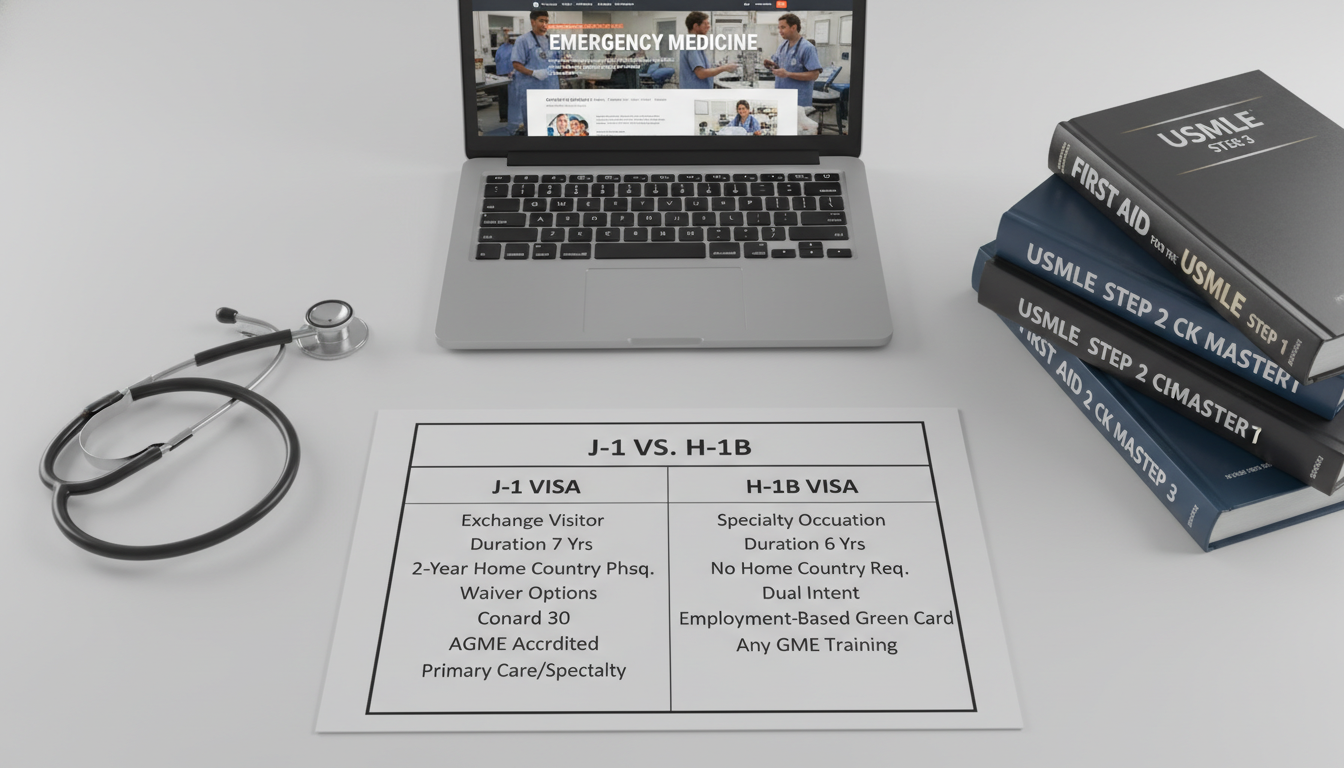
J-1 vs H-1B for Emergency Medicine: Strategic Comparison
Choosing between J-1 and H-1B is less about picking your favorite and more about matching your personal circumstances and career goals to what is realistically available.
Training Experience During Residency
Clinical duties and training quality under J-1 vs H-1B are essentially the same:
- Your day-to-day EM residency experience (trauma bays, procedures, night shifts, didactics) is unaffected by visa type.
- Program leadership and faculty rarely treat residents differently based solely on visa status.
The main differences show up in administrative issues and post-residency options.
Post-Residency Plans and the Two-Year Rule
On J-1:
- After EM residency (and any EM fellowships on J-1), you cannot simply stay in the US on a work visa unless you:
- Return to your home country for 2 cumulative years, or
- Obtain a J-1 waiver, most commonly through:
- Conrad-30 Waiver Programs (state-based, for service in a designated underserved area),
- Federal programs (e.g., VA, HHS, etc.),
- Other “interested government agency” waivers.
For emergency medicine, Conrad-30 waivers are common because:
- Many EM jobs in rural or underserved areas qualify.
- States often value EM coverage for underserved emergency departments.
On H-1B:
- There is generally no 2-year home requirement tied to the H-1B status itself.
- After residency, you can:
- Transfer your H-1B to a new employer.
- Begin employment in a wide range of EM practice settings (subject to H-1B sponsorship).
- Start or continue a green card process, if your employer supports it.
Program Availability and Competitiveness
For J-1:
- Many EM programs that accept foreign national medical graduates are J-1 only.
- You will have broader geographic and program diversity if you are fully open to J-1.
For H-1B:
- Only a subset of EM programs sponsor H-1B for residents.
- These programs may be more competitive for IMGs because:
- They attract applicants who strongly prefer H-1B.
- They often expect higher scores and stronger applications, since they are investing more administrative effort and money.
Timing, Exams, and Logistics
USMLE Step 3 is the main differentiator.
- J-1: Step 3 is not required.
- H-1B: Step 3 is required before filing, which should happen months before July 1.
If you are outside the US, scheduling Step 3, obtaining a visa to take it (if necessary), and receiving your score in time can all be challenging.
Strategic advice:
- If you are targeting H-1B, schedule Step 3 as early as possible, ideally before you submit ERAS or no later than early winter.
- If you cannot realistically complete Step 3 early, you should:
- Embrace J-1 as your main pathway, or
- Be prepared to have H-1B as a bonus, not a requirement.
Step-by-Step Timeline: From Application to Visa Issuance
To avoid missed deadlines and last-minute crises, align your EM match timeline with visa milestones.
1–2 Years Before Applying
- Clarify your goals:
- Are you open to J-1, or do you feel you must have H-1B?
- What are your long-term plans (practice in US vs home country)?
- Finish USMLE Steps 1 and 2 CK with strong scores; EM is competitive.
- Begin US clinical experience (USCE) if possible—EM electives or observerships are valuable for both match and visa credibility.
- Start researching:
- EM programs’ visa policies via FREIDA, program websites, and email.
- Geographic regions where you’d be comfortable fulfilling a Conrad-30 waiver (if considering J-1).
6–12 Months Before ERAS Opens
- Aim to complete and verify:
- ECFMG certification or at least all exam components.
- English language proficiency if needed for ECFMG.
- If targeting H-1B:
- Register and plan for USMLE Step 3.
- Make sure passport is valid for several years.
- Start a secure folder for:
- Medical degree and transcripts,
- ECFMG certificate,
- Passport biographic page,
- Prior US visas and entry stamps (if any).
During the Application Season (September–February)
- In your ERAS application:
- Accurately indicate your citizenship and visa needs.
- You generally do not need to state a strict preference like “H-1B only” unless specifically asked.
- On program websites and at interviews:
- Confirm visa policies and any changes from what’s listed online.
- Politely ask:
- “Do you sponsor J-1 and/or H-1B visas for residents?”
- “Do you require Step 3 for visa sponsorship?”
- If Step 3 results come back:
- Update your ERAS application and inform programs, especially those open to H-1B.
After the Match: Visa Processing Phase
Once you match:
Program onboarding & documentation
- You’ll receive a contract and onboarding instructions.
- For J-1:
- Program’s GME office submits an online request to ECFMG.
- You submit the required forms and supporting documents to ECFMG.
- For H-1B:
- GME office and legal team request documents from you:
- Passport, ECFMG certificate, Step 3 result, CV, etc.
- GME office and legal team request documents from you:
ECFMG or USCIS processing
- J-1:
- ECFMG issues Form DS-2019 (your J-1 eligibility document).
- H-1B:
- The hospital’s attorney files the H-1B petition (Form I-129) with USCIS.
- They may use premium processing to guarantee faster adjudication.
- J-1:
Visa stamping at a US consulate (if outside the US)
- With your DS-2019 (J-1) or approval notice (H-1B), you schedule a visa interview.
- You should ideally enter the US no more than 30 days before your program start date for J-1, and as permitted by H-1B rules.
Arrival and orientation
- Attend GME orientation and EM residency orientation.
- Keep all original documents safely stored (passports, DS-2019 forms, I-797 approval notices).
Critical point: Always check processing times early. Start the ECFMG J-1 or H-1B paperwork as soon as your program allows. Any delay can threaten your ability to start on time.

Common Challenges and How to Manage Them
Even well-prepared IMGs can face unexpected hurdles in the EM match–visa process. Knowing them in advance helps you navigate proactively.
1. Programs Changing or Restricting Visa Sponsorship
GME budgets and policies change. A program that previously offered H-1B might switch to J-1 only, or may temporarily stop sponsoring any visas.
How to manage:
- Check current information every cycle; don’t rely only on older spreadsheets or forum posts.
- During interviews, ask program leadership directly (politely, once).
- Apply to a broad mix of programs rather than relying on a small number of H-1B-friendly institutions.
2. Late ECFMG Certification or Exam Results
If your ECFMG certification is delayed, you may not be able to obtain a J-1 DS-2019 in time.
How to manage:
- Take USMLEs early enough that all scores are reported long before Match Day.
- Ensure your medical school submits required documents to ECFMG promptly.
- Communicate closely with ECFMG and your residency if issues arise.
3. Step 3 Timing for H-1B
Many foreign national medical graduates underestimate the time needed to schedule, take, and receive Step 3 results.
How to manage:
- Treat Step 3 as a year-prior task, not something to squeeze in during the match season.
- If timing becomes tight, be honest with yourself:
- Shift expectations from “H-1B required” to “J-1 accepted”.
- Focus on maximizing your EM match outcome first; visa type is secondary for many candidates.
4. Visa Interview or Administrative Processing Delays
Some applicants face additional administrative processing (often called “administrative review”) at the consulate, which can delay visa issuance.
How to manage:
- Schedule the visa interview as soon as you receive the DS-2019 or H-1B approval.
- Bring complete documentation:
- Residency contract, DS-2019 or I-797, ECFMG certificate, financial documents, home-country ties where appropriate.
- Stay in touch with your program if delays occur—programs sometimes can provide supporting letters, though they cannot control consular decisions.
5. Balancing Long-Term Goals with Visa Realities
Some non-US citizen IMGs feel strongly opposed to the J-1 due to the 2-year home requirement. Others prefer J-1 because it is more accessible than H-1B.
How to manage:
Separate your thinking into:
- Matching into EM – The first and most important step.
- Long-term immigration plan – J-1 waiver, H-1B transfers, green card, or return home.
Many EM J-1 graduates:
- Secure Conrad-30 waivers in underserved EDs.
- Transition to H-1B after the waiver job starts.
- Eventually obtain permanent residency.
If you categorically refuse J-1, you may significantly reduce the number of EM programs that can rank you, which can lower your overall match chances.
Practical Application Strategies for Non-US Citizen EM Applicants
To maximize your success as a foreign national medical graduate in emergency medicine, integrate visa awareness into your overall match strategy.
1. Build a Targeted Program List
Create three categories:
- Category A – J-1 only programs
- Bread-and-butter of your list if you are open to J-1.
- Category B – J-1 and H-1B programs
- Prioritize these if you want H-1B but are open to J-1 fallback.
- Category C – H-1B only (rare) or H-1B-favored
- Great if you have Step 3 early and a strong application.
Include enough programs in each category to reach a total application number appropriate for your competitiveness (often 40–60+ for IMGs in EM, sometimes more depending on your profile).
2. Communicate Clearly but Flexibly
In interviews and emails:
- Be honest about your status: “I am a non-US citizen IMG; I will require visa sponsorship.”
- Express flexibility where possible: “I am open to J-1 sponsorship and am also working toward Step 3 for potential H-1B, depending on your program’s policies.”
- Avoid ultimatums like “H-1B or I will not rank you” unless you are absolutely certain and can afford the consequence of reduced options.
3. Strengthen Your Application Beyond Visa Considerations
Remember that visa needs are only one part of how programs evaluate you. To offset any concerns, show you are a low-risk, high-value applicant:
- Strong USMLE scores, especially Step 2 CK.
- Substantial US clinical experience, ideally EM electives with US letters.
- Demonstrated teamwork, communication skills, and familiarity with US healthcare.
- Clear commitment to emergency medicine through research, volunteering, or prior experience.
Programs are more willing to navigate visa complexity for a resident they believe will excel clinically and academically.
4. Keep Organized Records
Maintain a digital (and, when possible, physical) file with:
- Passport and previous visas.
- ECFMG certificate and USMLE score reports.
- Medical school diploma and transcripts.
- Marriage certificate and family documents (if applying with dependents).
- All visa-related forms (DS-2019s, I-797s, I-94 records).
Efficient documentation minimizes delays and shows professionalism when working with GME and legal offices.
FAQs: Visa Navigation for Non-US Citizen IMGs in Emergency Medicine
1. As a non-US citizen IMG, do I have to decide between J-1 vs H-1B before applying?
You do not need to make an irrevocable choice before applying. You should:
- Understand the benefits and limits of each.
- Know your own constraints (e.g., Step 3 timing).
- Apply to a mix of programs that sponsor J-1 and, if realistic, H-1B.
Your actual visa path usually becomes clear after you match, based on your program’s policy and your exam status. Flexibility generally improves your EM match prospects.
2. Is matching into EM on a J-1 visa a disadvantage for my future career?
Not necessarily. Many successful emergency physicians trained on J-1 visas. However, J-1 comes with the two-year home-country requirement, which you must address via:
- Returning home for 2 years, or
- Securing a waiver position (e.g., Conrad-30) in an underserved US setting.
For EM, waiver jobs are often reasonably available, especially in rural or underserved EDs. After completing your waiver, transitioning to H-1B and then permanent residency is common.
3. Can I moonlight as an EM resident on J-1 or H-1B?
Moonlighting depends on institutional policies, state licensing, and visa rules:
- J-1: Generally restricted to training activities authorized by ECFMG and your sponsorship documents. Many J-1 residents cannot moonlight independently.
- H-1B: Some programs allow internal moonlighting if:
- It is within the same employer,
- Fits within the role described in the H-1B petition, and
- Is allowed by hospital and state regulations.
Always confirm with your program director, GME office, and legal/HR before taking any moonlighting work.
4. If I fail to secure an H-1B, will that hurt my chance to match into EM?
Your ability to match into emergency medicine is driven primarily by:
- The strength of your overall application (scores, USCE, letters, interviews).
- The number and type of programs you apply to.
- Your flexibility with visa type and location.
If you cannot complete Step 3 in time for H-1B, you can still be a very competitive J-1 candidate. Many EM programs are comfortable with J-1 sponsorship. The key is to apply broadly and be transparent about your situation.
By understanding how residency visas work, planning ahead for J-1 vs H-1B, and structuring your EM match strategy around realistic IMG visa options, you can greatly reduce uncertainty and focus on what ultimately matters most: becoming an excellent emergency physician.