
Navigating the U.S. visa system as a non-US citizen IMG aiming for residency in Houston can feel as complex as studying for Step 1 all over again—especially if you are doing it from abroad. Yet, understanding your residency visa options early can significantly improve your chances of matching and smoothly starting your training in one of the country’s largest medical hubs.
This guide walks you through the key concepts, timelines, and strategic decisions, with a particular focus on Houston residency programs and the Texas Medical Center residency environment.
Understanding the Houston and Texas Medical Center Landscape
Houston is one of the most IMG-friendly cities in the U.S., but that doesn’t automatically mean every program is IMG- or visa-friendly. Before diving into J-1 vs H-1B debates, it helps to understand where you’re applying.
Why Houston Is Important for a Foreign National Medical Graduate
Houston is home to the Texas Medical Center (TMC), the largest medical complex in the world. It includes:
Major academic centers:
- Baylor College of Medicine
- McGovern Medical School at UTHealth Houston
- MD Anderson Cancer Center
- Texas Children’s Hospital
- Houston Methodist Hospital
- Memorial Hermann–TMC
Dozens of ACGME-accredited residency and fellowship programs
For a foreign national medical graduate, this means:
- A higher absolute number of residency positions
- Programs with long-standing experience sponsoring visas for IMGs
- Many services and institutional support (International Offices, GME offices familiar with visa sponsorship, etc.)
However, visa policies vary by:
- Institution (e.g., Baylor vs UTHealth)
- Program (e.g., Internal Medicine vs Orthopedics)
- Visa category (J-1 only vs J-1 and H-1B)
You cannot assume that because one Houston program sponsors a particular visa, all of them do.
Core Visa Options for Non-US Citizen IMGs in Houston
Most non-US citizen IMGs entering residency do so on a J-1 or H-1B visa. Other paths (e.g., green card, EAD, dependent visas) exist but are less common at the start of residency.
1. J-1 Visa for Clinical Training
The J-1 Exchange Visitor Visa (Alien Physician category) is administered by the Educational Commission for Foreign Medical Graduates (ECFMG) as the “sponsor.” It is the most common visa for IMGs in residency nationwide.
Key features:
- Status: Non-immigrant exchange visitor (trainee)
- Sponsor: ECFMG (not the hospital directly)
- Purpose: Graduate medical education (residency/fellowship)
- Duration: Typically valid for the length of the residency/fellowship, with specific maximums by specialty and some flexibility
Advantages:
- Widely accepted:
- Many Houston residency programs labeled “IMG friendly” accept J-1s.
- Several Texas Medical Center residency programs clearly state “J-1 sponsored by ECFMG” on their websites.
- Centralized management: ECFMG has standardized rules and documentation, making the process predictable compared with some institutional H-1B variability.
- Less institution burden: Programs often prefer J-1 because the administrative and legal side is shared with ECFMG.
Disadvantages / Limitations:
- Two-year home residency requirement (212(e)):
- After completing training, J-1 physicians are generally required to return to their home country for a total of two years before becoming eligible for certain U.S. immigration benefits (e.g., H-1B, L-1, permanent residency) unless they get a J-1 waiver.
- Limited moonlighting:
- Full-time clinical work outside of the approved training program is generally not allowed.
- Some internal moonlighting may be permitted if ECFMG and program rules are followed, but must be carefully checked.
- Switching paths is harder:
- Moving from J-1 to another status (e.g., H-1B, green card) before completing training is complex and often not realistic.
2. H-1B Visa for Residency
The H-1B is a temporary work visa for “specialty occupations” and can be used by some programs for residency or fellowship.
Key features:
- Status: Non-immigrant “specialty occupation” worker
- Sponsor: The hospital or institution (e.g., Baylor, UTHealth, Methodist) directly
- Requirement:
- You must have passed USMLE Step 3 before H-1B petition filing in most states, including Texas.
- Duration: Up to 6 years total in H-1B status (including time outside residency if any).
Advantages:
- No automatic two-year home residency requirement
- Dual intent: H-1B allows dual intent (you may pursue permanent residency while on H-1B).
- Better for long-term U.S. plans:
- If you want to stay in the U.S. post-residency and possibly go straight into practice or longer fellowships without navigating J-1 waivers, H-1B can be advantageous.
Disadvantages / Limitations:
- Fewer programs sponsor H-1B for residency:
- Some Houston residency programs do; others explicitly do not.
- Many list “J-1 only” on their websites.
- Higher administrative burden and cost for the institution
- USMLE Step 3 required before H-1B petition:
- This means you must take and pass Step 3 early (often before the Match season or at least before the program files the petition).
3. Other Immigration Statuses (Less Common for Initial Entry)
Some foreign national medical graduates may already be or become eligible for different statuses:
- Permanent resident (green card):
- If you are a green card holder, you do not need a residency visa. Programs treat you like a U.S. graduate in terms of employment eligibility.
- EAD (Employment Authorization Document) based on:
- Asylum
- Marriage to a U.S. citizen
- Certain student or dependent categories
- Dependent visas (e.g., H-4, L-2):
- Some allow work authorization through an EAD, but this can be nuanced and timing-dependent.
Programs will still consider licensure and USMLE requirements, but their visa sponsorship burden may be lower if you already have work authorization.
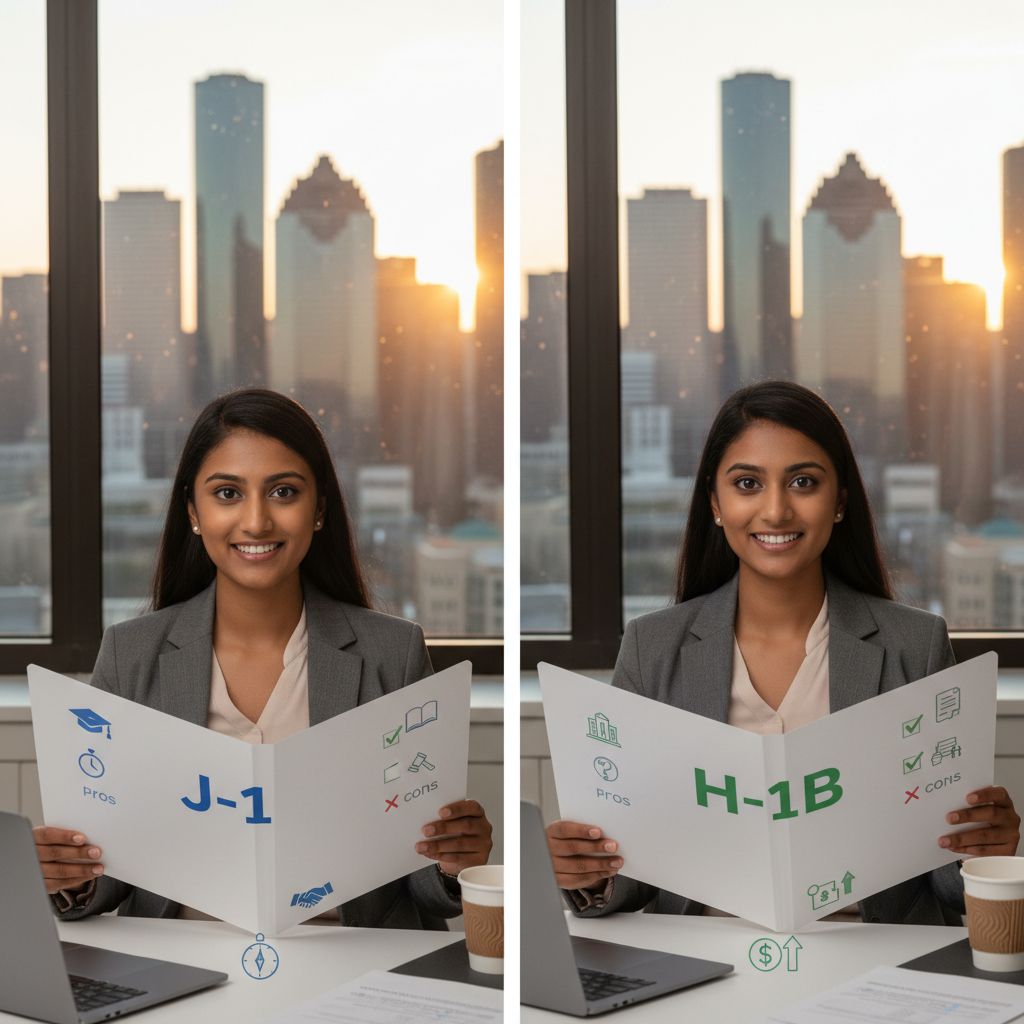
J-1 vs H-1B: Strategic Considerations for Houston IMGs
Choosing between J-1 vs H-1B is one of the most consequential early decisions for a non-US citizen IMG. In Houston specifically, several factors influence this:
1. Your Long-Term Career Goals in the U.S.
If your goal is long-term U.S. practice and permanent residency:
- H-1B is usually more aligned with your aims:
- Dual intent fits pathways to green card sponsorship.
- Avoids the J-1 two-year home residency requirement or waiver process.
If you are open to returning home or working abroad after training:
- J-1 may be entirely reasonable:
- Broad access to programs
- Clear, well-established route for training only
2. Your Program Choices in Houston
Many Houston and Texas Medical Center residency programs state their visa policy clearly:
- Some: “We accept J-1 visa (ECFMG-sponsored) only.”
- Some: “We accept J-1 and may consider H-1B for exceptional candidates who have passed USMLE Step 3.”
- A few: “We do not sponsor visas.”
Actionable steps:
- Check each program’s GME or residency website:
- Look under “Eligibility and Requirements,” “International Medical Graduates,” or “Visa Information.”
- Email the program coordinator if unclear:
- Ask specifically, “Does your program sponsor J-1, H-1B, or both for international medical graduates?”
- Keep a visa-policy spreadsheet:
- Program name
- Visa types accepted
- Any notes (e.g., “H-1B only for fellowship,” “Step 3 required by X date”)
As a non-US citizen IMG, your final rank list should align with realistic IMG visa options—especially if you are strongly set on H-1B.
3. Your Timeline for USMLE Exams
For H-1B for residency in Texas, passing Step 3 early is critical.
- You typically need Step 3 before the H-1B petition is filed, which may be:
- Late spring or early summer before your residency start date
- Some institutions may require proof earlier.
If you are still working on Step 2 CK during the Match cycle, pursuing H-1B sponsorship becomes harder to time correctly.
4. Financial and Administrative Trade-Offs
From the institution’s perspective:
- J-1 = predictable, ECFMG-centered process
- H-1B = more legal fees, paperwork, prevailing wage considerations
Programs that are already accustomed to H-1B for fellows or faculty may be more open; others will not consider it at all. This often explains why some Houston residency programs strongly prefer J-1 for IMGs.
Practical Application Timeline and Tasks for Visa Planning
To succeed as a non-US citizen IMG targeting Houston or Texas Medical Center residency, map your visa planning to the Match timeline.
1. 12–18 Months Before Match: Strategic Planning
Tasks:
- Decide whether J-1, H-1B, or “either” is your target.
- Research Houston-area programs and categorize them:
- J-1 only
- J-1 + H-1B
- No visa sponsorship
- Plan your USMLE schedule:
- If aiming for H-1B, build in time to:
- Pass Step 3
- Receive your score report before programs need to file H-1B.
- If aiming for H-1B, build in time to:
Example:
- If you aim to start residency in July 2027:
- Take Step 3 no later than late 2026 or very early 2027, allowing for delays or retakes.
2. ERAS Season (Application Submission)
When completing ERAS:
- Clearly list your citizenship and visa needs accurately.
- Be honest about your status (e.g., “Require visa sponsorship; open to J-1 or H-1B”).
- In your personal statement or communications:
- You don’t need to write a long visa rationale, but for programs known to favor H-1B, you might mention having already passed Step 3 and being fully eligible.
During interview season:
- Prepare concise, confident explanations of your status:
- “I am a foreign national medical graduate currently on [X status] and will require [J-1/H-1B] sponsorship to begin residency.”
- If you prefer H-1B: “I have already passed Step 3 and, if feasible within your institution’s policies, would be interested in H-1B sponsorship.”
3. After Match: Coordinating with GME and ECFMG / Legal
Once you match in March:
- You will receive information from the program and the GME office about the next steps.
- If J-1:
- Start the ECFMG J-1 sponsorship process as soon as the program instructs you:
- Upload required documents (Form 235, Statement of Need, etc.).
- Coordinate with your home country’s Ministry of Health (for the Statement of Need) if required.
- Start the ECFMG J-1 sponsorship process as soon as the program instructs you:
- If H-1B:
- Work closely with your program’s GME and HR:
- Ensure Step 3 results are available.
- Provide documents (degree, ECFMG certificate, passport, transcripts).
- The institution’s attorney will file the H-1B petition, often with premium processing to meet the July 1 start date.
- Work closely with your program’s GME and HR:
Be responsive. Delays in providing documents can threaten your ability to start on time.
Post-Residency Planning: J-1 Waivers, H-1B Extensions, and Staying in the U.S.
Many IMGs only discover the complexity of post-residency visa issues when they are already busy interns. Planning early—especially in a city like Houston with many opportunities—is essential.
If You Trained on a J-1
You will likely face the two-year home residency requirement or need a J-1 waiver.
Common waiver options for physicians include:
Conrad 30 Waiver Program (State-based)
- Each U.S. state can sponsor up to 30 J-1 physicians per year to work in underserved areas.
- Many job offers will be in rural or underserved communities, sometimes outside Houston or even outside Texas.
- If approved, you get a waiver of the 2-year rule in exchange for 3 years of service in a qualifying area (often on H-1B).
Federal Agency Waivers
- Some federal agencies (e.g., VA, HHS, etc.) can sponsor waivers for physicians serving particular populations.
- These may be rarer, and competition can be intense.
Hardship or Persecution Waivers
- Based on personal circumstances (e.g., severe hardship to a U.S. citizen spouse or child, or fear of persecution in your home country).
- These are legally complex and require specialized immigration counsel.
Key implications for Houston-trained J-1 physicians:
- You may need to leave the Houston metro area after residency for a waiver job.
- Alternatively, you might secure a waiver-supported position in greater Texas depending on availability and demand.
If You Trained on H-1B
You do not have the automatic 2-year home requirement.
Your main considerations:
- H-1B time limits:
- Maximum 6 years in H-1B status (with some exceptions if a green card process is underway).
- Job search after residency:
- You can move to another employer on H-1B if they are willing to sponsor and you have remaining time.
- Permanent residency (green card):
- Many physicians on H-1B pursue employer-sponsored green card processes during or shortly after residency/fellowship.
For Houston specifically:
- The Texas Medical Center and surrounding health systems employ many H-1B physicians and are generally familiar with the process through their institutional attorneys, particularly for subspecialists and hospital-employed physicians.
Practical Tips and Common Pitfalls for Non-US Citizen IMGs in Houston
1. Start Visa Planning Early
Do not wait until Match week to think about your residency visa. For a non-US citizen IMG, visa strategy is part of your overall residency application strategy.
- Decide your preferred visa type early.
- Align your exam timeline, program list, and personal statement accordingly.
2. Document Everything and Keep Copies
Whether J-1 or H-1B, you will repeatedly need:
- Passport (valid for at least 6 months beyond intended stay)
- Medical diploma and transcripts
- ECFMG certificate
- USMLE score reports
- Previous visa documents if you have been in the U.S. (I-20, DS-2019, I-94, etc.)
Keep scanned, well-organized copies for quick access.
3. Verify Program Policies Directly (Not Just on Forums)
Forums and social media can be helpful but may be outdated or inaccurate. For Houston residency programs, information might change year to year.
- Always verify via:
- Official program or GME website
- Direct email to coordinator or program director
- Ask specific rather than vague questions:
- “For the upcoming Match cycle, which visa types will your program sponsor for IMGs?”
- “Does your program require Step 3 for H-1B sponsorship, and by what date?”
4. Communicate Clearly and Professionally
Visa status is a sensitive but routine subject for programs with IMGs. You should:
- Be clear about what you need, but not demanding.
- Show that you have done your homework:
- For example: “I understand your institution typically sponsors J-1 through ECFMG. I’m fully eligible for that pathway. I have also completed Step 3; if H-1B sponsorship is sometimes considered, I would be very interested, but I understand institutional constraints.”
5. Consider Professional Legal Advice When Needed
While general visa information is widely available, your personal circumstances may be more complex:
- Previous U.S. visa history
- Status violations or overstays
- Country-specific issues
- Family members with different statuses
In such cases, consulting a qualified U.S. immigration attorney familiar with physician visas can be highly valuable—particularly before making irreversible choices (e.g., switching from F-1 OPT to J-1, or declining one type of visa for another).
FAQs: Visa Navigation for Non-US Citizen IMGs in Houston
1. As a non-US citizen IMG, is it harder to match in Houston because of visa issues?
Not necessarily. Houston and the Texas Medical Center host many IMGs on J-1 and H-1B visas each year. The key challenges are:
- Choosing programs that actively sponsor your visa category
- Having competitive exam scores, clinical experience, and letters
- Meeting specific requirements (e.g., Step 3 for H-1B)
Visa needs add complexity but do not automatically block you from matching in Houston.
2. Can I switch from J-1 to H-1B during residency in Houston?
In practice, this is difficult and often not permitted within the same training program. Once you begin residency on a J-1 visa for clinical training:
- ECFMG expects you to complete training in J-1 status.
- Transitioning directly to H-1B mid-residency is rarely feasible.
- Most J-1 to H-1B switches occur after completion of training, typically in the context of a J-1 waiver job.
3. Do all Texas Medical Center residency programs offer H-1B?
No. Many Texas Medical Center residency programs accept only J-1 for IMGs. Some offer both J-1 and H-1B; a few may not sponsor visas at all. You must research each program individually and, if needed, confirm via email.
4. If I am a foreign national medical graduate with a green card, do I still need to worry about visa options?
If you already have permanent residency (green card), you do not need a residency visa (J-1 or H-1B). Programs will view you as work-authorized and will not need to sponsor you. However, you still must:
- Meet ECFMG certification requirements
- Pass the necessary USMLE exams
- Satisfy state medical board requirements for licensure and training
By planning your visa navigation for residency as carefully as you plan your exam preparation, you can significantly reduce stress and uncertainty. For a non-US citizen IMG targeting Houston residency programs, a clear understanding of IMG visa options, especially J-1 vs H-1B, will help you create a realistic application strategy and set you up for a smooth transition into training at the heart of the Texas Medical Center.