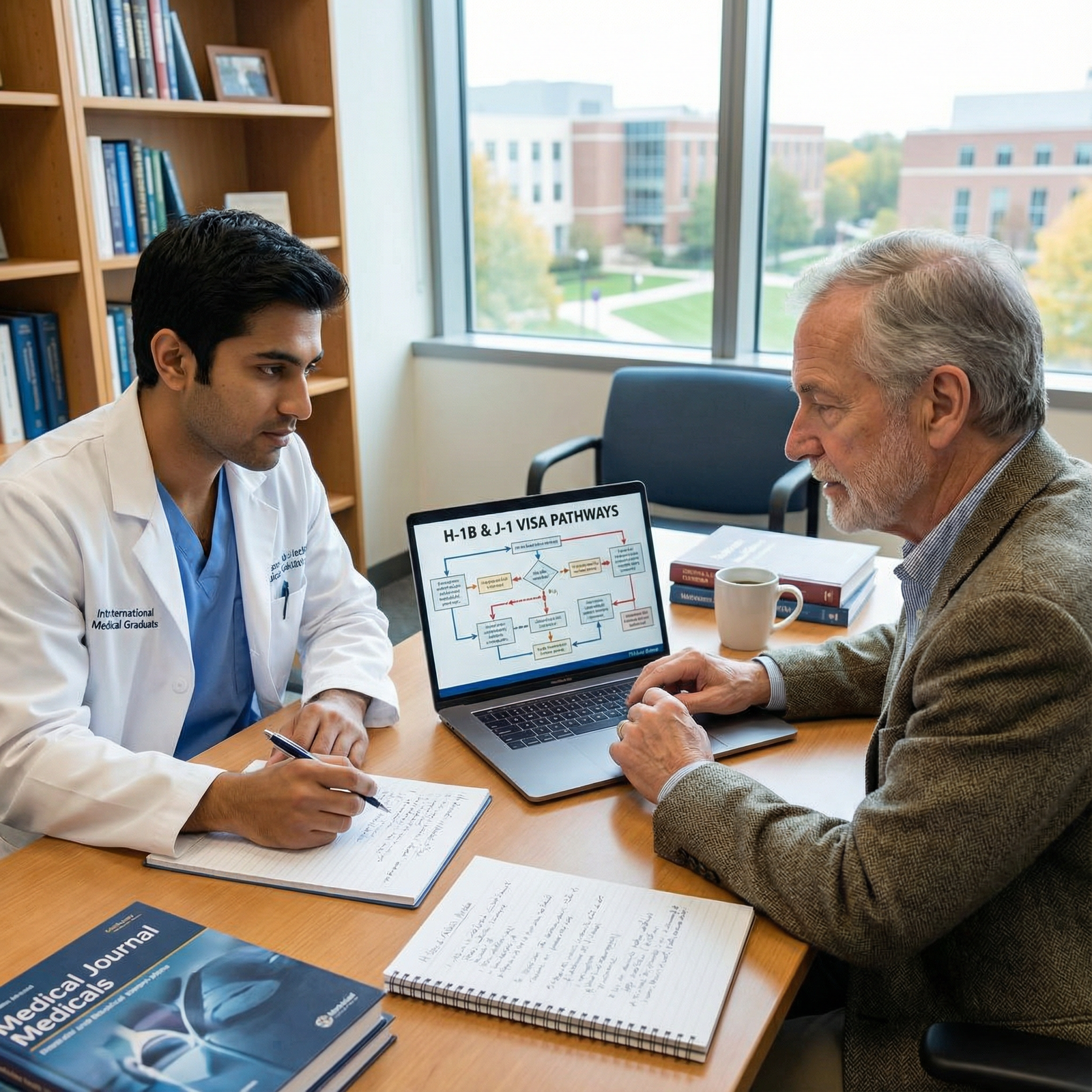
Understanding the Visa Landscape as a Non‑US Citizen IMG in Interventional Radiology
For a non-US citizen IMG aiming for interventional radiology (IR) residency in the United States, visa navigation is almost as important as your Board scores and research output. Interventional radiology is highly competitive; add the complexity of IMG visa options, and strategy becomes essential from day one.
This article walks you through what you need to know—specifically as a foreign national medical graduate targeting interventional radiology residency: which visas exist, how programs think about J‑1 vs H‑1B, how this affects your IR match strategy, and what to plan for beyond residency.
We’ll focus on:
- Key visa categories for residency training
- Special considerations for IR (integrated vs independent)
- J‑1 vs H‑1B trade‑offs for a non-US citizen IMG
- How to research and target visa‑friendly IR programs
- Long‑term planning for fellowship and post‑training practice
Throughout, “IR residency” refers mainly to integrated Interventional Radiology (IR/DR) programs, but most principles also apply to the independent IR residency and DR programs with ESIR pathways.
Core Visa Options for Interventional Radiology Residency
1. The Two Main Residency Visa Types: J‑1 and H‑1B
For graduate medical education, almost all non-US citizen IMGs are sponsored on either:
- J‑1 Physician Visa (Educational and Cultural Exchange)
- H‑1B Specialty Occupation Visa
Other categories (e.g., F‑1 OPT, green card, O‑1) may apply for a minority, but J‑1 vs H‑1B will be the central decision for most foreign national medical graduates entering IR.
J‑1 Physician Visa (ECFMG‑Sponsored)
Overview
- Primary visa route for IMGs doing residency and fellowship in the United States.
- Sponsored by ECFMG, not by the individual residency program’s HR office.
- Specifically designed for graduate medical education (GME).
Key Features
- Program sponsorship: ECFMG issues your DS‑2019 once your IR program confirms your appointment.
- Duration: Typically the total length of GME training, up to a maximum (usually 7 years, with possible extensions in limited circumstances).
- Home residence requirement (212(e)): After finishing J‑1 training, you must return to your home country (or country of last permanent residence) for 2 years, unless you obtain a J‑1 waiver.
- No “dual intent”: Official intent is temporary training and return home, although there are legal pathways to stay via waiver routes.
Why programs like J‑1 for IR
- Streamlined: ECFMG manages most of the bureaucracy; GME offices are very familiar with it.
- Cost‑effective: Less expensive for the institution than sponsoring an H‑1B.
- Predictable: Standard across specialties; IR programs know the process well.
Implications for IR applicants
- Easy to obtain if you are ECFMG certified and have a contract.
- Virtually all IR programs that accept IMGs accept J‑1 visa residents.
- The main downside is the 2‑year home residency requirement, which affects post‑residency plans.
H‑1B Visa (Specialty Occupation)
Overview
- Employment‑based visa used across many professions.
- For residency and fellowship, it is sponsored directly by the institution, not ECFMG.
Key Features
- Specialty occupation: Residency physician roles qualify.
- License/exam requirements: Must have USMLE Step 3 (or equivalent) completed before H‑1B filing, and meet state licensing requirements (which may include certain training or documentation).
- Duration: Up to 6 years total (including any time in other H‑1B positions), usually granted in multi‑year increments.
- Dual intent: You can legitimately intend to immigrate; easier to transition to green card paths.
Why H‑1B is trickier for IMGs in IR
- Higher institutional burden: More legal and filing costs; more complex timelines.
- Regulatory constraints: Some teaching hospitals simply do not sponsor H‑1B for residents or fellows.
- Step 3 timing: Many foreign national medical graduates don’t have Step 3 completed when ERAS opens, limiting eligibility.
Implications for IR applicants
- Fewer integrated IR programs offer H‑1B for PGY‑2 entry positions compared to J‑1.
- H‑1B can be advantageous for staying in the US after training (no J‑1 waiver needed).
- If you want H‑1B for IR, you must align testing, licensing, and application timing very carefully.
2. Other Visa and Status Situations You Might See
While less common, a non-US citizen IMG in IR might be in one of these categories:
- F‑1 (Student) with OPT: You completed an MD/DO or graduate degree in the US and are on Optional Practical Training. For GME, you will still need to move to J‑1 or H‑1B; F‑1/OPT alone is not a long‑term solution for residency.
- Greencard holder / Permanent resident: If you become a permanent resident before or during residency, you no longer need a residency visa; you are equivalent to a US citizen for most GME purposes.
- O‑1 Visa (Extraordinary Ability): Rare at the residency level, sometimes possible later for highly accomplished physician‑scientists, especially in academic IR.
For this article, we’ll focus on J‑1 vs H‑1B, because those are the primary IMG visa options directly relevant to IR residency training.
How Visa Status Interacts with IR Pathways (Integrated, Independent, ESIR)
Interventional radiology training structures add another layer of complexity for a non-US citizen IMG planning around the IR match and visa regulations.
1. Integrated IR/DR Residency (Primary Pathway)
Integrated IR/DR is a 6‑year program (PGY‑1 to PGY‑6):
- PGY‑1: Transitional year, prelim medicine/surgery, or categorical.
- PGY‑2 to PGY‑6: Diagnostic radiology core + IR specialization.
Visa implications
- J‑1: Typically straightforward; you’ll get J‑1 coverage for the entire 6‑year integrated IR program (often through multiple DS‑2019 renewals).
- H‑1B:
- Some programs may only sponsor H‑1B starting at PGY‑2, expecting a separate PGY‑1 on J‑1 or another visa.
- Others might not sponsor H‑1B at all for integrated IR; some only for senior levels.
- You must ensure your Step 3 is done before H‑1B filing (which may be months before start date).
Actionable tip: When researching integrated IR programs, specifically ask:
- “Do you sponsor J‑1 for integrated IR residents?”
- “Do you sponsor H‑1B for integrated IR residents? If yes, starting from which PGY level, and what are your Step 3 requirements?”
2. Independent IR Residency (Post‑DR Pathway)
The independent IR residency is usually a 2‑year program after completion of:
- A diagnostic radiology residency (DR) or
- An ESIR DR pathway (which may shorten independent IR to 1 year).
Visa implications
- Many non-US citizen IMGs complete DR on a J‑1 first.
- For independent IR, you may:
- Continue on J‑1 (within ECFMG maximum training limits).
- Or, if transitioning away from J‑1 restrictions, try to move to H‑1B (but you still must resolve any J‑1 home residency requirement later).
Actionable tip: If you are in DR on J‑1 and aiming for independent IR, talk to your current GME office and ECFMG early about:
- Total J‑1 duration allowed for DR + IR combined.
- Whether you need any special approvals for extending J‑1 into IR training.
3. ESIR (Early Specialization in Interventional Radiology)
ESIR is a pathway within diagnostic radiology that allows you to complete an abbreviated independent IR residency (often 1 year instead of 2).
From a visa perspective:
- Still typically under your DR residency visa.
- The main factor is whether your total J‑1 training years remain within allowed limits if you add IR training.
- On H‑1B, no special additional visa requirement—just ensure your overall H‑1B time (max 6 years) covers all training.
J‑1 vs H‑1B: Strategic Considerations for IR‑Bound IMGs
The “J‑1 vs H‑1B” decision is one of the most critical strategic choices for a non-US citizen IMG pursuing an interventional radiology residency.
1. Advantages and Disadvantages for IR Applicants
J‑1 Physician Visa: Pros and Cons
Pros
- High availability: Many more IR programs accept J‑1 than H‑1B.
- Simpler for programs: ECFMG handles much of the process, making IR PDs more comfortable recruiting J‑1 candidates.
- Facilitates multiple training stages: J‑1 can cover DR + IR fellowship/residency sequentially.
- Easier timing: No need for Step 3 before starting; you can focus on USMLE 1 and 2 CK during the IR application season.
Cons
- 2‑year home country physical presence requirement (212(e)):
- You must return home for 2 years or obtain a J‑1 waiver before you can:
- Convert to H‑1B, or
- Obtain permanent residency (green card) via certain paths.
- This affects your ability to immediately practice IR in the US after training.
- You must return home for 2 years or obtain a J‑1 waiver before you can:
- Limited long‑term flexibility:
- Some academic IR jobs may prefer or require eligibility for H‑1B or permanent residency.
- Additional administrative steps:
- J‑1 waiver process is separate and can be competitive (state Conrad waivers, federal waivers, hardship/persecution claims, etc.).
H‑1B Visa: Pros and Cons
Pros
- No 2‑year home residency requirement: You can move directly into practice, fellowship, or academic positions after training without a waiver.
- Dual intent: Easier to transition to green card while in training, especially in academic IR.
- Perceived stability: Some institutions prefer H‑1B physicians for long‑term recruitment.
Cons
- Fewer IR programs offer it:
- Some GME offices categorically do not sponsor H‑1B for residents.
- Others limit H‑1B to fellows or senior residents only.
- Higher barriers for applicants:
- Must pass USMLE Step 3 early (often by the fall or winter before July 1 start).
- Must meet state licensing rules, which may require additional documentation or experience.
- Institutional cost and complexity:
- Filing fees and attorney costs borne by the institution.
- Programs may hesitate to invest in H‑1B sponsorship for early residents.
2. Which Visa Should a Non‑US Citizen IMG Prefer for IR?
There is no universal answer; it depends on your background and long‑term goals.
J‑1 might be more realistic if:
- You are early in training and have not taken Step 3 yet.
- You are applying to highly competitive integrated IR programs and want the widest range of program options.
- You are comfortable potentially:
- Returning to your home country after training, or
- Pursuing a J‑1 waiver job (often in underserved/rural settings) for 3 years after training.
H‑1B might be worth prioritizing if:
- You already have Step 3 done and state licensing eligibility by ERAS season.
- You have strong IR‑oriented credentials (research, US clinical experience, letters) that make you competitive for the subset of IR programs that sponsor H‑1B.
- Your clear long‑term goal is to remain in the US for practice without a J‑1 waiver.
- You are applying to or matching in a DR program that explicitly sponsors H‑1B and supports your IR plans (ESIR/independent IR).
Practical approach for many IMGs
- Apply broadly with no strict visa preference, but:
- Ask each program early about visa sponsorship.
- Rank based not only on training quality but also on visa feasibility and long‑term fit.
- If you receive multiple offers, then weigh the quality of IR training vs. visa type and your future plans.
3. J‑1 Waivers and Their Impact on an IR Career
If you train on a J‑1 and want to stay in the US long‑term, you’ll likely need a J‑1 waiver that removes the 2‑year home residence requirement.
Common waiver pathways include:
- Conrad 30 Waiver (State programs):
- You work for 3 years in a designated underserved area (often primary care/specialty roles in community hospitals).
- For IR, options exist but may be fewer than for primary care.
- Federal programs: For example, VA or other federal agencies sponsoring waivers for needed specialists.
- Hardship or persecution waivers: If returning home would cause severe hardship to a US citizen/permanent resident spouse/child, or if you fear persecution.
Impact on IR practice
- You may need to accept a non‑ideal geographical location or a mixed IR/DR position to secure a waiver job.
- After the 3‑year waiver service, you have more freedom to move into academic or private practice IR roles.
Actionable tip: Talk to senior IR attendings and alumni who were J‑1 IMGs. Ask how they navigated waiver positions and how it affected their IR practice mix.

Building a Visa‑Smart IR Match Strategy as a Non‑US Citizen IMG
Your visa plans should be integrated into your IR match strategy from the earliest stages.
1. Researching Visa Policies of IR Programs
Most interventional radiology residency websites only briefly mention visa policies, if at all. For accurate, current information:
- Check GME or institutional pages:
- Look for “Visa sponsorship” or “International medical graduate” FAQs.
- Confirm whether they accept non-US citizen IMG applicants and which visas they support.
- Email or call:
- Contact the GME office, not just the IR program coordinator.
- Ask specific questions: “Do you sponsor J‑1 for IR? Do you ever sponsor H‑1B for residents?”
- Use alumni networks:
- Talk to current or former IR and DR residents from your school or country who matched in the US.
- They often know which programs are truly IMG‑ and visa‑friendly, beyond website claims.
Keep a structured spreadsheet including:
- Program name
- Type (Integrated IR/DR, DR with ESIR, Independent IR)
- Visa sponsorship: J‑1 (Y/N), H‑1B (Y/N), F‑1/OPT accepted (Y/N)
- Any extra notes (Step 3 requirement for H‑1B, prior IMG residents, etc.)
2. Timing: USMLE Step 3 and Application Planning
For J‑1, Step 3 timing is flexible.
For H‑1B, timing is critical:
- You generally must have USMLE Step 3 passed by the time the institution files the H‑1B petition (often several months before your start date).
- Some states require Step 3 for limited medical license, which is often a condition for H‑1B.
Actionable timeline example for IR‑bound IMG targeting H‑1B
- 2 years before expected residency start:
- Complete USMLE Step 1 and Step 2 CK with strong scores.
- Plan Step 3 exam around your available time (e.g., during internship or after graduation if possible).
- 12–18 months before start (ERAS year):
- Aim to have Step 3 done before or early in ERAS season if you want to be a serious H‑1B candidate.
- Post‑interview:
- If a program expresses strong interest and sponsors H‑1B, confirm their internal deadlines for Step 3 and documentation.
If early Step 3 is not feasible, do not panic: prioritize J‑1‑friendly IR programs while still sitting Step 3 when practical for longer‑term career goals.
3. Targeting DR vs Integrated IR as an IMG with Visa Constraints
Because integrated IR/DR positions are few and highly competitive, many non-US citizen IMGs pursue:
- Diagnostic Radiology residency first, with later:
- ESIR pathway during DR, then
- Independent IR residency.
From a visa standpoint:
- More DR programs sponsor J‑1 than H‑1B; a moderate subset sponsor H‑1B.
- Once in DR, you can build a strong internal case for IR training:
- Strong DR performance
- Research and mentorship in IR
- ESIR selection
Strategy example
- If you are a foreign national medical graduate with good but not stellar scores and limited US IR experience:
- Apply broadly to DR programs that accept J‑1 and/or H‑1B.
- Target DR programs with known ESIR tracks and a history of placing residents into IR.
- Secure J‑1 for DR if necessary, then navigate IR fellowship or independent residency later.
This indirect route can be more realistic than matching straight into integrated IR for many non-US citizen IMGs.
Long‑Term Planning: Beyond IR Residency on a Visa
Your residency visa choice affects not only your IR match but your post‑training career trajectory—fellowship, academic jobs, and long‑term immigration options.
1. If You Train on J‑1
Things to plan for:
- J‑1 total duration: Ensure your DR + IR training fits within ECFMG’s maximum allowed period.
- Post‑training plan:
- Begin researching J‑1 waiver jobs during your final IR training years.
- Discuss with mentors how to balance clinical IR practice with waiver obligations.
- Immigration steps:
- After completing 3‑year waiver employment, you can:
- Move to a new employer on H‑1B.
- Pursue permanent residency (green card) through employment‑based categories (e.g., EB‑2, NIW, etc.).
- After completing 3‑year waiver employment, you can:
Realistic IR scenarios
- Some J‑1 waiver positions may require a mixed IR/DR role rather than 100% IR.
- Academic IR waiver roles exist but may be more competitive; some are at safety‑net hospitals in urban or rural underserved settings.
2. If You Train on H‑1B
Key planning points:
- Watch the 6‑year limit:
- DR + IR training can approach or exceed 6 years, especially if you had previous H‑1B time in another field.
- You may need early planning for green card filing to extend H‑1B beyond 6 years.
- Green card strategy:
- Academic employers may sponsor EB‑2 or EB‑1B green cards.
- High‑level researchers may qualify for EB‑1A or NIW pathways.
- Mobility:
- You can move directly from IR residency/fellowship into an H‑1B attending physician role without J‑1 waiver restrictions.
3. Family and Personal Life Considerations
As a non-US citizen IMG, your visa status also impacts:
- Spouse’s work authorization (J‑2 vs H‑4 EAD rules).
- Children’s schooling and potential “aging out” if they approach 21 years old on dependent status.
- Ability to travel internationally during training (visa stamp renewal risks, administrative processing delays).
Actionable tip: Whenever you approach visa renewal or change of status, coordinate with:
- Your GME office or institutional immigration counsel.
- Your rotational schedules (avoid critical IR rotations or board exam months during expected travel for visa stamping).
FAQs: Visa Navigation for Non‑US Citizen IMGs in Interventional Radiology
1. I am a non‑US citizen IMG without Step 3 yet. Can I still match into an interventional radiology residency?
Yes. Many integrated IR and DR programs accept IMGs on J‑1 visas, which do not require Step 3 for initial entry. You can sit Step 3 later during residency. To maximize options, target programs that explicitly state they sponsor J‑1 and have a history of training IMGs. H‑1B‑only programs will be difficult without Step 3 completed before application or shortly after interviews.
2. Is J‑1 or H‑1B better for an IR career in the long term?
“Better” depends on your goals:
- J‑1:
- Easiest to obtain and widely accepted for IR residency and fellowships.
- Comes with a 2‑year home residency requirement, which you must either fulfill or waive (usually via a 3‑year waiver job).
- H‑1B:
- More complex to obtain and less commonly sponsored for integrated IR.
- No 2‑year home rule, easier path to stay in the US and pursue a green card.
If your top priority is matching IR at all, J‑1 flexibility may be more important. If your top priority is staying in the US long‑term without waiver constraints, H‑1B is more attractive—provided you can meet its requirements and find an IR program that sponsors it.
3. Can I switch from J‑1 to H‑1B after finishing IR training?
You cannot simply change from J‑1 to H‑1B inside the US while subject to the 212(e) 2‑year home residency requirement. You must either:
- Fulfill the 2‑year home country requirement, or
- Obtain a J‑1 waiver (e.g., Conrad 30, federal program, hardship/persecution waiver).
Once the requirement is waived or fulfilled, you may be eligible for H‑1B for an attending job. However, certain narrow exceptions and complex legal strategies exist; discuss your case with a qualified immigration attorney.
4. As a foreign national medical graduate targeting IR, should I apply only to integrated IR programs or also to DR?
Most non‑US citizen IMGs should apply to both:
- Integrated IR/DR programs where they are competitive and visa policies are favorable.
- Diagnostic Radiology (DR) programs, especially those with ESIR tracks or strong connections to IR fellowships.
Given the competitiveness of IR, using DR as an entry route—and then pursuing ESIR followed by independent IR—can significantly increase your chances of ultimately becoming an interventional radiologist. For visa strategy, DR programs often provide more options and a stable platform from which to plan your IR path.
Visa navigation is inseparable from your IR training strategy as a non‑US citizen IMG. Start planning early, gather precise information from programs and GME offices, and align your testing, application choices, and long‑term goals with the realities of J‑1 vs H‑1B sponsorship. Doing so will not only strengthen your IR match chances but also set a more secure foundation for your future career in interventional radiology in the United States.