
Understanding the Visa Landscape as a Non‑US Citizen IMG in Med-Peds
For a non-US citizen IMG interested in Medicine-Pediatrics (Med-Peds), visa navigation is as critical as board scores, letters, and personal statements. Many foreign national medical graduates underestimate how much residency visa planning can shape their medicine pediatrics match strategy: which programs you apply to, how you rank them, and even how you plan your long-term career in the US.
This article walks through visa navigation step-by-step, specifically tailored to IMGs aiming for Med-Peds. You’ll learn how residency visa decisions intersect with Med-Peds training structure, common pathways for non-US citizen IMGs, and practical strategies for optimizing your medicine pediatrics match.
Key terms you’ll see throughout:
- IMG – International Medical Graduate
- Non-US citizen IMG / foreign national medical graduate – You do not hold US citizenship or permanent residency (green card)
- Residency visa – Visa that allows you to do postgraduate training in the US (commonly J-1 or H-1B)
- Med-Peds – Combined Internal Medicine and Pediatrics residency (4 years, dual board eligibility)
Med-Peds Residency Basics and Why Visa Strategy Matters
Med-Peds is a 4-year combined program that leads to board eligibility in both Internal Medicine and Pediatrics. It trains physicians to care for patients across the lifespan, and is especially relevant for:
- Complex transition-of-care patients (pediatric to adult)
- Chronic diseases starting in childhood and continuing into adulthood
- Global health and underserved populations
- Hospital medicine and primary care across age groups
Why Med-Peds Is Distinct for Visa Planning
Compared with categorical Internal Medicine or Pediatrics, Med-Peds has some unique visa-related considerations:
Program availability is smaller.
There are far fewer Med-Peds programs than categorical IM or Peds. As a non-US citizen IMG, adding visa filters on top of a small specialty pool can sharply reduce your options if you are not strategic.Training is longer than many categorical programs.
Four years (versus three for IM or Peds). This matters for:- J-1 home-country requirement timing
- H-1B maximum total duration calculations (if planning future fellowships)
- Long-term career and family planning
Fellowships may follow.
Many Med-Peds graduates pursue subspecialties (adult or pediatric). Your residency visa choice affects:- What visa you can use for fellowship
- Your timeline toward permanent residency
- Whether fellowship programs will sponsor your desired visa
Institutional policies differ.
Some institutions sponsor H-1B only for categorical programs; others are more flexible. For Med-Peds specifically, be prepared that a subset of programs may prefer or only sponsor J-1 visas for foreign national medical graduates.
The bottom line: For a non-US citizen IMG in Med-Peds, you need to understand J-1 vs H-1B and how each path aligns with your longer-term goals.
Core Residency Visa Options for Non-US Citizen IMGs
1. J-1 Physician Visa (ECFMG-Sponsored)
The J-1 is the most common residency visa for non-US citizen IMGs, including in Med-Peds.
Key features:
- Sponsored by ECFMG, not directly by the residency program
- You are coming as a trainee for graduate medical education
- Used for residency, fellowship, and sometimes research training
Eligibility basics:
- Valid ECFMG certification (USMLE exams, primary source verification, etc.)
- Contract/offer from an ACGME-accredited residency (like Med-Peds)
- Passing USMLE Step 1 and Step 2 CK (and often OET/English language proof)
- Proof of adequate funding (usually the residency salary suffices)
- Sufficient English proficiency
Duration:
- Typically granted 1 year at a time, renewable annually
- Maximum of 7 years total for clinical training, with possible exceptions for certain fellowships or academic roles
A standard 4-year Med-Peds residency easily fits within this 7-year limit, even if you later do a 2–3 year fellowship (e.g., adult cardiology, pediatric endocrinology, Med-Peds hospitalist-focused training within that time frame).
2-Year Home Country Physical Presence Requirement
The major downside of the J-1 for many non-US citizen IMGs is the 212(e) home-country requirement:
- After completing your training, you must return to your home country (or country of last long-term residence) for a total of 2 years before you can:
- Change to or receive an H-1B
- Receive an immigrant visa/green card
- Adjust status to permanent residency in the US
You cannot simply remain in the US and switch to another status that leads to long-term work without:
- Fulfilling the 2-year requirement in your home country, or
- Obtaining a J-1 waiver (commonly through service in a medically underserved area)
Advantages of J-1 for Med-Peds IMGs
Widely accepted:
Many Med-Peds programs are comfortable with J-1 sponsorship; no complicated H-1B filing.Centralized process:
ECFMG guides the process, and institutional grad medical education (GME) offices are familiar with it.Visa timing is often simpler:
Compared to H-1B with cap and lottery issues (for non-cap-exempt sponsors), J-1 processing is relatively predictable.Flexibility for fellowships:
You can continue on J-1 through fellowship as long as you remain within the 7-year training limit.
Key Limitations
- 212(e) requirement restricts your immediate post-training options in the US.
- Your long-term plan likely requires:
- A J-1 waiver job (usually 3 years in an underserved area)
- Or returning to your home country for 2 years
- J-1 waiver opportunities can be competitive and geographically limited.
2. H-1B Visa for Graduate Medical Education
The H-1B is a dual-intent “specialty occupation” work visa used by some residency programs for non-US citizen IMGs. Not all programs sponsor H-1B, and among those that do, not all will do so for Med-Peds.
Key features:
- You are a worker, not a trainee visa holder
- Sponsored directly by the institution employing you (the residency program or parent hospital)
- Allows dual intent (you may seek permanent residency while on H-1B)
Basic requirements for IMGs:
- Passed USMLE Step 1, Step 2 CK, and Step 3 before H-1B filing (this is crucial and time-sensitive)
- ECFMG certification completed
- Valid state license or training license as required
- Employer willing and able to sponsor H-1B
Duration:
- Typically granted up to 3 years at a time
- Maximum standard total of 6 years in H-1B status
- Time spent outside the US can sometimes be recaptured
- Extensions beyond 6 years possible in specific green card processes
For Med-Peds, a 4-year residency alone uses most or all of your typical H-1B time. If you plan additional fellowship training afterward, you must be strategic about timing and possible transfers or extensions.
Advantages of H-1B for Med-Peds IMGs
No 2-year home requirement.
You can:- Continue in the US after training
- Transition directly into an attending role
- Pursue permanent residency (green card) without going home for 2 years or needing a waiver
Dual intent:
Easier to begin an employment-based green card process during or after residency.Attractive to some employers:
Post-residency employers may be more familiar with H-1B transitions, especially large health systems.
Key Limitations
Not all Med-Peds programs sponsor H-1B.
Among those that do sponsor H-1B at their institution, some restrict it to categorical programs or to critical subspecialties.USMLE Step 3 deadline is challenging.
You must pass Step 3 in time for H-1B filing (often by early spring before your July start date). For many non-US citizen IMGs, especially those abroad, that timeline is tight.6-year cap limits training plus fellowship.
A 4-year Med-Peds residency leaves 2 years for fellowship (unless you move to another type of visa, recapture time, or qualify for cap-exempt/extension pathways through an academic institution).Higher institutional administrative burden and cost.
This makes some programs hesitant to offer H-1B, particularly if they have easy access to J-1 candidates.
3. Other Residence/Visa Scenarios
While less common, it’s important to be aware of alternatives and edge cases:
Green card holders or US permanent residents:
If you obtain a green card before residency (through family, employment, asylum, etc.), you no longer need a residency visa. Your Med-Peds application is treated similarly to US graduates in terms of immigration.Other temporary statuses (F-1, O-1, etc.):
- F-1 (student) OPT as a pathway into residency is rare and complex, especially for Med-Peds. Few programs will hire on F-1/OPT for residency; J-1 or H-1B is the standard.
- O-1 (extraordinary ability) may be an option for highly accomplished physician-scientists later in your career (usually not for initial residency training).
In practice, if you are a non-US citizen IMG planning a Med-Peds career, you are almost certainly choosing between J-1 vs H-1B.
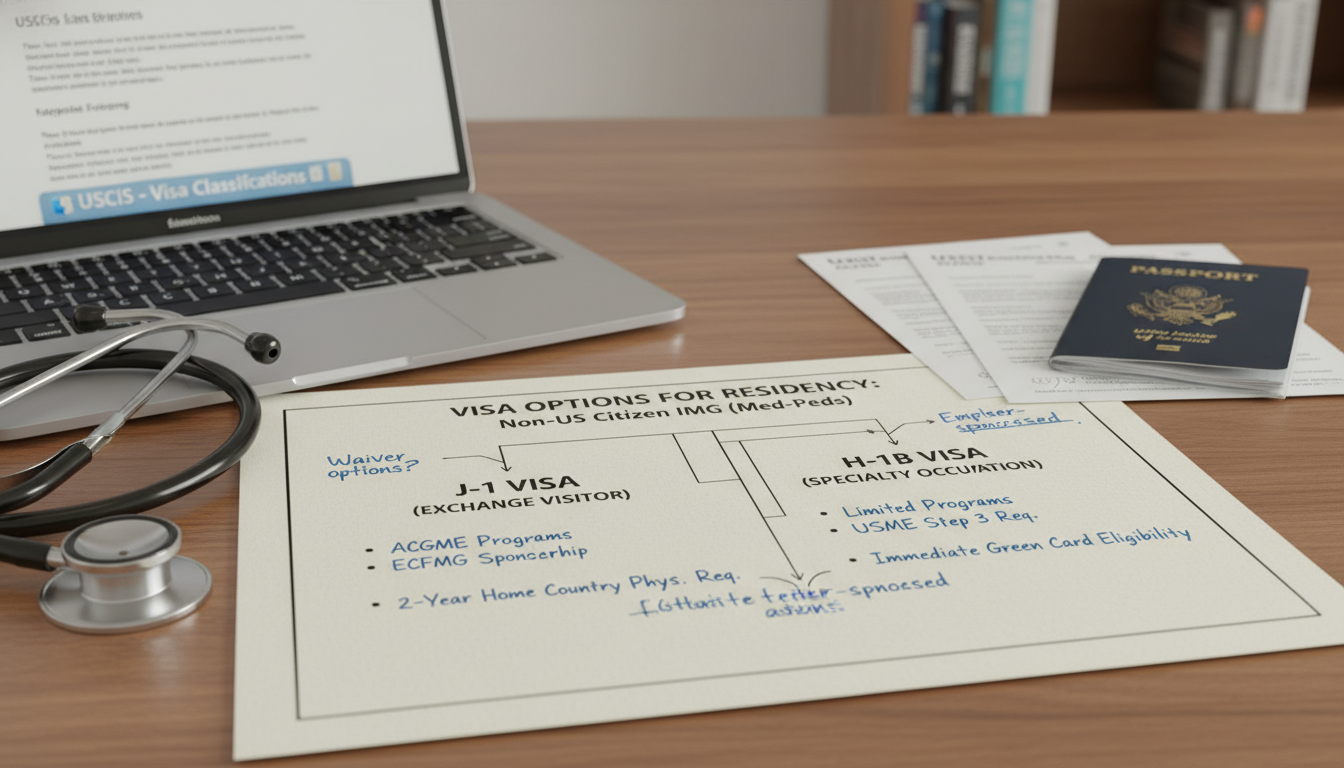
J‑1 vs H‑1B: Strategic Comparison for Med-Peds Applicants
Questions to Ask Yourself
To choose the right residency visa strategy, ask:
How strong is my USMLE timeline?
- Can you realistically pass Step 3 before ERAS rank lists lock, or program H-1B filing deadlines?
- If not, aiming for J-1 is more practical.
How certain am I about doing fellowship after Med-Peds?
- If you strongly want a longer fellowship (e.g., adult cardiology, GI), the J-1’s 7-year training window may be more flexible than a 6-year H-1B cap.
Am I prepared to work in an underserved area for a J-1 waiver job?
- If you like the idea of serving in rural or underserved communities, J-1 + waiver pathway can align with your values and career.
How important is staying continuously in the US after training?
- If you cannot or do not want to return home or risk gaps, H-1B’s lack of a home requirement is attractive—but also harder to obtain and maintain within a 4+ year timeline.
Does my preferred Med-Peds program sponsor my desired visa type?
- Some top Med-Peds programs are J-1 only. Others more IMG-friendly may offer H-1B. Always verify.
Practical Pros and Cons for a Med-Peds Track
Scenario A: You select J‑1 for Med‑Peds
Pros:
- More programs open to you (many Med-Peds residencies are J-1 only).
- Visa process is standardized, predictable.
- Easier to incorporate fellowship later; 7-year cap usually sufficient for 4+3 or 4+2 training sequences.
Cons:
- Need to plan early for a J-1 waiver job after training (location, specialty, employer).
- Geographic and job flexibility may be limited right after fellowship.
- Family considerations (spouse, children) are affected by 212(e) requirement.
Scenario B: You select H‑1B for Med‑Peds
Pros:
- No 2-year home requirement.
- Easier to progress to a green card while working.
- Attractive continuity for those planning long-term US careers without mandatory return.
Cons:
- Limited program availability (especially in smaller Med-Peds departments).
- USMLE Step 3 timing pressure; failure to pass in time could cost you the H-1B option.
- 4-year Med-Peds residency nearly exhausts the standard 6-year H-1B period—may complicate fellowship plans.
How Programs View J‑1 vs H‑1B in Med-Peds
Academic “big-name” programs:
Often default to J-1 for IMGs across departments. Some may selectively offer H-1B only in departments with strong financial or research justification. Med-Peds might not be prioritized for H-1B at such institutions.Community or university-affiliated programs:
More variable. Some are highly IMG-friendly and will support H-1B if:- You meet all requirements early
- They have prior experience with H-1B filings
Pure community programs with limited GME infrastructure:
Many stick to J-1 because it’s simpler and handled through ECFMG.
When researching programs, always look at:
- The program website
- The institution’s GME/visa policy page
- Past resident profiles (do they list J-1 or H-1B for recent graduates?)
- Direct email to the program coordinator for confirmation
Application Strategy: Aligning Your Med-Peds Match with Visa Realities
Step 1: Clarify Your Preferred Visa Path Early
By the time you finalize your ERAS application, you should have a primary visa plan and a backup:
- Primary: J-1; Backup: none or long-term waiver plan
- Primary: H-1B; Backup: J-1 at a program you like and trust
Indicate your openness clearly:
- In ERAS, answer visa-related questions honestly (e.g., “will you require visa sponsorship?”).
- In communication with programs, you can state:
- “I am open to J-1 sponsorship and would prefer H-1B if available.”
- Or “I am specifically seeking programs that can sponsor H-1B due to long-term plans, but I understand institutional constraints.”
Step 2: Research IMG Visa Options for Each Med-Peds Program
Create a simple spreadsheet that includes:
- Program name and location
- University affiliation
- Visa types accepted (J-1 only, J-1 and H-1B, unclear)
- Notes from:
- Program website
- FREIDA
- Email responses from coordinators
- Residents’ experiences (forums, alumni, etc.)
If a site is vague (“We accept IMGs”), don’t assume; ask specifically:
- “Do you sponsor J-1 and/or H-1B visas for Med-Peds residents?”
- “If H-1B is available for other departments, is it also available for Med-Peds?”
Step 3: Be Realistic about Numbers and Competitiveness
As a non-US citizen IMG, you must often:
- Apply broadly to Med-Peds programs open to your desired residency visa.
- Consider including some categorical IM and/or Peds programs as backup if:
- You are very visa-constrained (e.g., H-1B only).
- Your profile is marginal for Med-Peds in general.
An example approach:
- 30–40 Med-Peds programs that accept J-1
- Subset of 10–15 that also accept H-1B if that’s preferable
- 10–20 categorical Internal Medicine or Pediatrics programs with favorable IMG visa policies
Step 4: USMLE Step 3 and H‑1B Timing for Med-Peds
If you are serious about H-1B:
- Take USMLE Step 3 as early as feasible after Step 2 CK.
- Plan to have your score reported before January–March of your application year, as many institutions finalize H-1B petitions in early spring.
- Discuss timing explicitly with programs that indicate H-1B sponsorship:
- “I plan to take Step 3 in [Month, Year]. Would that timeline allow for H-1B filing if I match to your program?”
If the timeline is uncertain, do not rely solely on H-1B. Keep J-1-accepting programs on your list.

Long-Term Planning: After Med-Peds Residency
Your residency visa choice affects your post-residency and post-fellowship options.
Path 1: J‑1 Med-Peds → Fellowship → J-1 Waiver Job
Common sequence for a foreign national medical graduate:
- 4 years of Med-Peds residency on J-1
- 2–3 years of fellowship (adult or pediatric subspecialty, or Med-Peds relevant area) on J-1, staying within the 7-year cap
- Apply for a J-1 waiver job, typically involving:
- A full-time clinical position in a medically underserved area or health professional shortage area (HPSA)
- A minimum of 3 years of service
- After waiver service, you can:
- Transition to H-1B or another employment-based visa
- Begin or continue a green card process (EB-2, EB-1, NIW, etc.)
Med-Peds can be especially valued in rural/underserved regions because:
- You care for both adults and children
- You can fill multiple community needs with one provider
This can help when negotiating waiver positions.
Path 2: H‑1B Med-Peds → Fellowship → Attending Role
- 4 years of Med-Peds residency on H-1B
- Potential fellowship on H-1B (or academic J-1, depending on institution)
- Transition to an attending role and pursue:
- H-1B extension or transfer
- Green card (often employer-sponsored)
Because of H-1B’s 6-year cap:
- If residency uses 4 years, fellowship may be limited to 2 additional years, unless:
- You move to a cap-exempt institution
- You recapture time abroad
- You qualify for green card-related H-1B extensions (e.g., I-140 approved)
Work closely with:
- Your fellowship institution’s legal/HR team
- Immigration counsel if possible
to avoid mid-training status problems.
Family and Lifestyle Considerations
Spouse and children:
- On J-1, dependents hold J-2 status; some can obtain work authorization.
- On H-1B, dependents hold H-4; work authorization is more restricted, but may be possible later in a green card process.
Travel:
- Both visas require careful attention to visa stamping and re-entry.
- During transitions (residency to fellowship, fellowship to job), international travel can be riskier; plan any major trips in consultation with your program and/or attorney.
Citizenship timeline:
- Neither visa directly leads to US citizenship.
- The pathway is typically: secure long-term status (often via green card) → maintain permanent residency → qualify for naturalization after the required number of years.
Practical Tips and Common Pitfalls for Non-US Citizen IMGs in Med-Peds
Practical Tips
Start visa research 12–18 months before ERAS opens.
Don’t wait until interview season to think about residency visa details.Keep documentation organized:
- Passport copies, medical diploma, ECFMG certificate
- USMLE score reports
- Translations and notarizations (if applicable)
- Prior visa documents (F-1, B-1/B-2, etc.)
Maintain clear communication with programs:
- Answer all supplemental questions on IMG visa options honestly.
- If your situation changes (e.g., you pass Step 3 earlier than expected), update them.
Use Med-Peds alumni networks:
- Contact Med-Peds graduates from your country or region.
- Learn how they navigated J-1 vs H-1B, especially in your target programs.
Consult an immigration attorney for complex cases.
- Especially if you have previous US visas, status violations, or complicated travel histories.
- An early consultation can prevent serious problems later.
Common Pitfalls
Assuming all programs treat Med-Peds like Internal Medicine for visa sponsorship.
Some institutions will sponsor H-1B for IM but not for Med-Peds due to administrative or budget differences.Leaving USMLE Step 3 too late if you aim for H-1B.
Missing this deadline may force you to switch to J-1 or risk losing a position.Not planning for the J-1 2-year home requirement.
Hoping “I’ll figure it out later” is risky; become familiar with waiver programs (Conrad 30, VA, federal programs) early.Relying on unofficial information.
Always verify visa policies with official program or institutional sources, not only forums or social media.
FAQs: Visa Navigation for Non-US Citizen IMGs in Medicine-Pediatrics
1. As a non-US citizen IMG, do Med-Peds programs prefer J‑1 or H‑1B applicants?
Most Med-Peds programs that take IMGs are comfortable with J-1 and may even be J-1 only. A smaller subset will sponsor H-1B. Programs rarely “prefer” H-1B because it is more complex and costly; if they offer it, it’s usually a courtesy to strong candidates or part of an institutional policy across residencies. If you are open to J-1, you will generally have more Med-Peds options.
2. If I do a 4-year Med-Peds residency on J‑1, can I still do a fellowship in the US?
Yes—if you remain within the 7-year maximum for J-1 clinical training. A typical path is:
- 4 years Med-Peds
- 2–3 years of fellowship (e.g., pediatric cardiology, adult infectious diseases, Med-Peds hospital medicine via adult or peds track)
Most combinations fit into 7 years, but if you anticipate longer or multiple fellowships, you must plan carefully and may need to consider alternative strategies.
3. How can I find out whether a specific Med-Peds program sponsors H‑1B visas?
Check:
- The program’s website (often under “Eligibility and Visa Sponsorship” or “For International Medical Graduates”)
- The GME office or institution-wide residency pages
- Contact the program coordinator and ask directly:
- “Do you sponsor J-1 and/or H-1B visas for Med-Peds residents?”
- “Are H-1B visas available specifically for Med-Peds, not just for other departments?”
Document these answers in your application spreadsheet so you can plan your rank list accordingly.
4. If I start Med-Peds on J‑1, can I later switch to H‑1B during residency?
Sometimes, but it is not guaranteed and can be complex:
- You would still be subject to the 2-year home-country requirement unless you obtain a J-1 waiver first.
- Some institutions will not switch you from J-1 to H-1B mid-training.
- Changing status mid-residency might interrupt your ability to travel and could pose administrative challenges. In most cases, it’s better to choose your primary visa strategy upfront and stay on that path for the duration of residency and, if possible, fellowship.
Visa navigation is a core part of your Med-Peds journey as a non-US citizen IMG. By understanding the differences between J-1 vs H-1B, clarifying your long-term goals, and aligning your program choices with realistic visa options, you can protect your ability to train fully and build the Med-Peds career you envision in the United States.