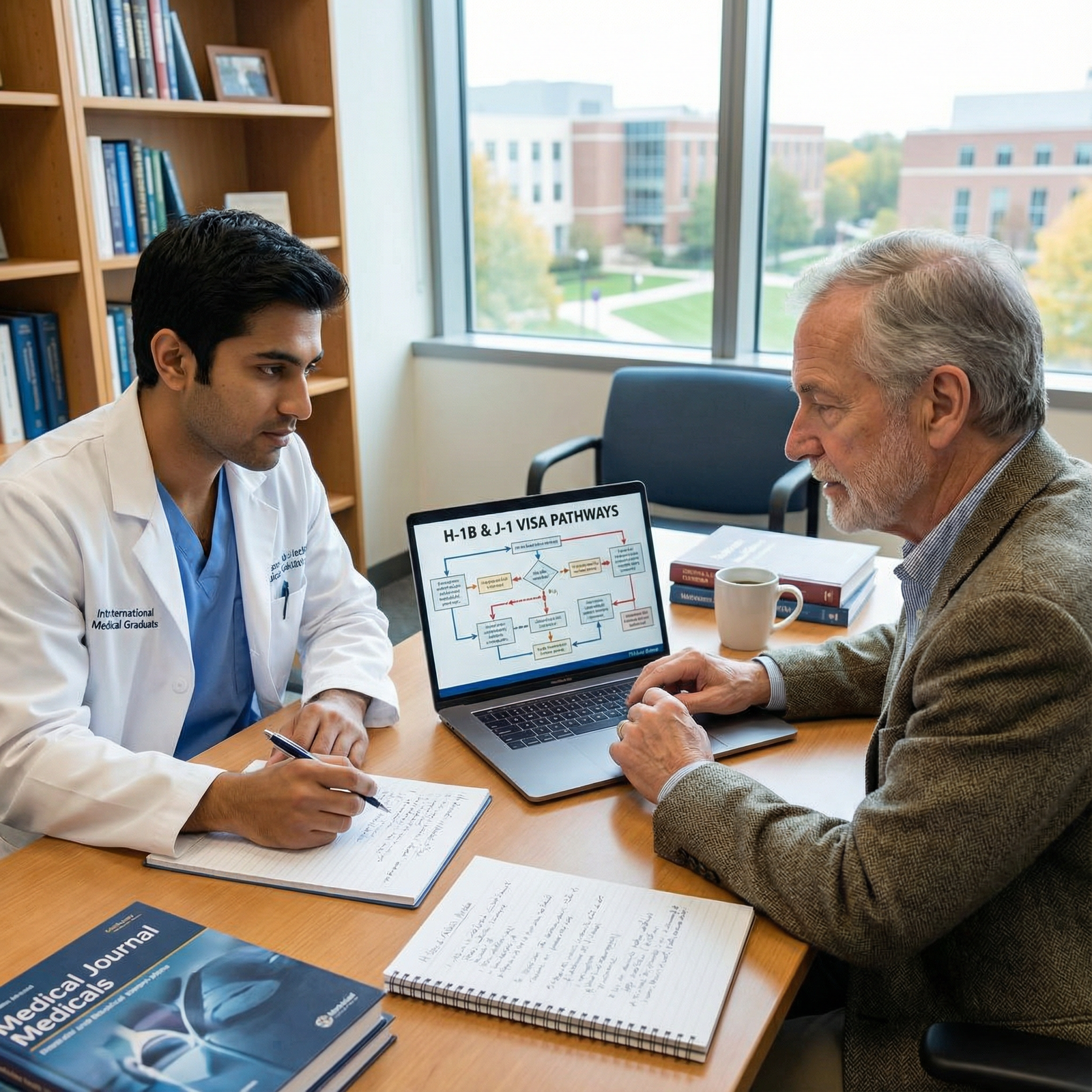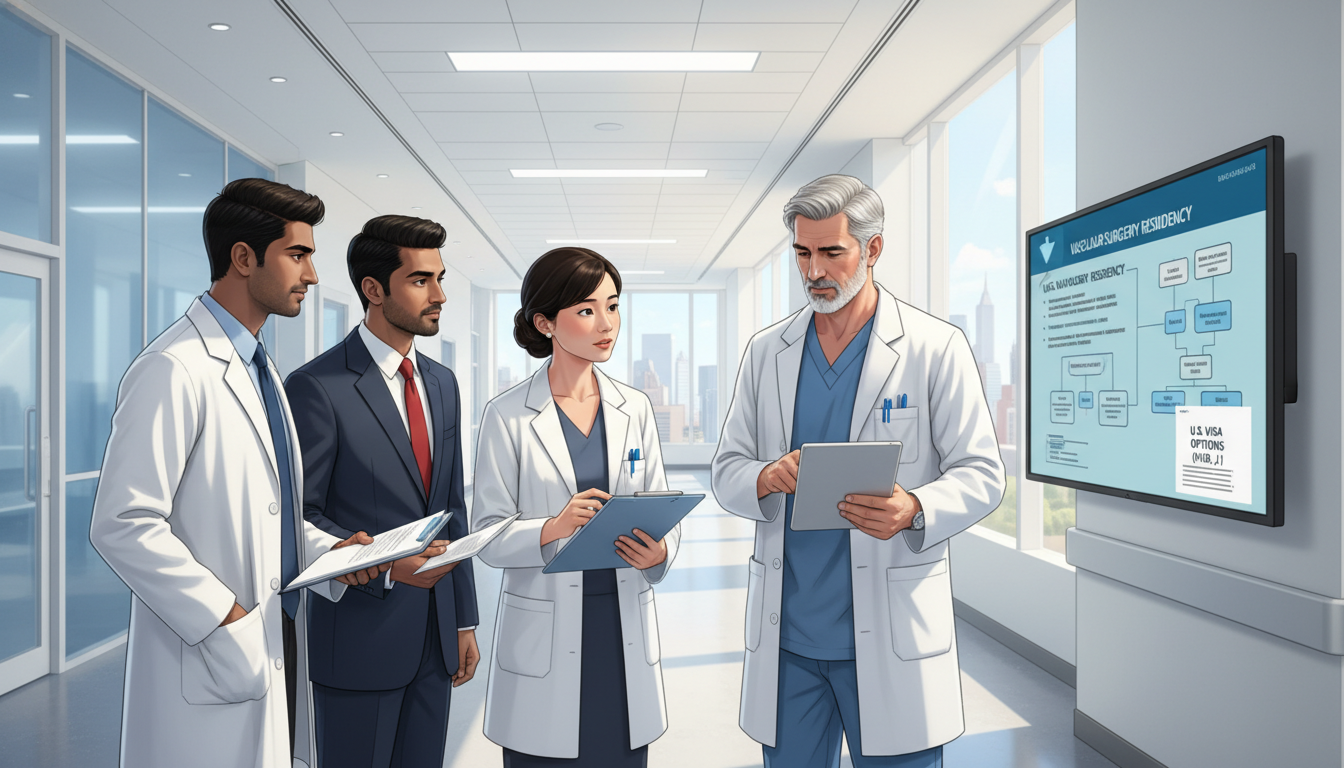
International medical graduates (IMGs) bring essential diversity, language skills, and global perspectives to neurology in the United States. But as a non-US citizen IMG or foreign national medical graduate, even the strongest application can falter if your visa strategy is unclear or unrealistic.
In neurology—where programs often rely on residents to cover busy inpatient services, stroke codes, and night call—programs are particularly sensitive to visa timelines, costs, and long-term work authorization. Understanding IMG visa options, how they intersect with neurology residency, and how they affect both your neuro match and future career is critical.
This guide walks you through what you need to know, specifically as a non-US citizen IMG aiming for neurology residency in the US.
Understanding the Big Picture: How Visas Shape Your Neurology Career
Before diving into J-1 vs H-1B, it helps to understand the overarching framework:
- You cannot start residency without work authorization (usually J-1 or H-1B).
- Visa options affect:
- Which programs can rank you
- When you start orientation (often late June)
- Your post-residency options (fellowship, practice, research)
- Where you can eventually work (urban vs rural, academic vs private practice)
- Neurology is a specialty with:
- Many academic programs (often J-1 friendly, H-1B variable)
- Heavy reliance on subspecialty fellowship (stroke, epilepsy, neuromuscular, etc.)
- Good demand in underserved areas (important for waiver jobs after a J-1)
In other words, visa planning is not separate from your neurology career planning—it is deeply integrated.
Core Visa Options for Neurology Residency: J-1 vs H-1B
The two main visas you’ll encounter for residency are:
- ECFMG-sponsored J-1 physician visa
- H-1B temporary worker in a specialty occupation
Understanding J-1 vs H-1B—and what each means in neurology—is essential.
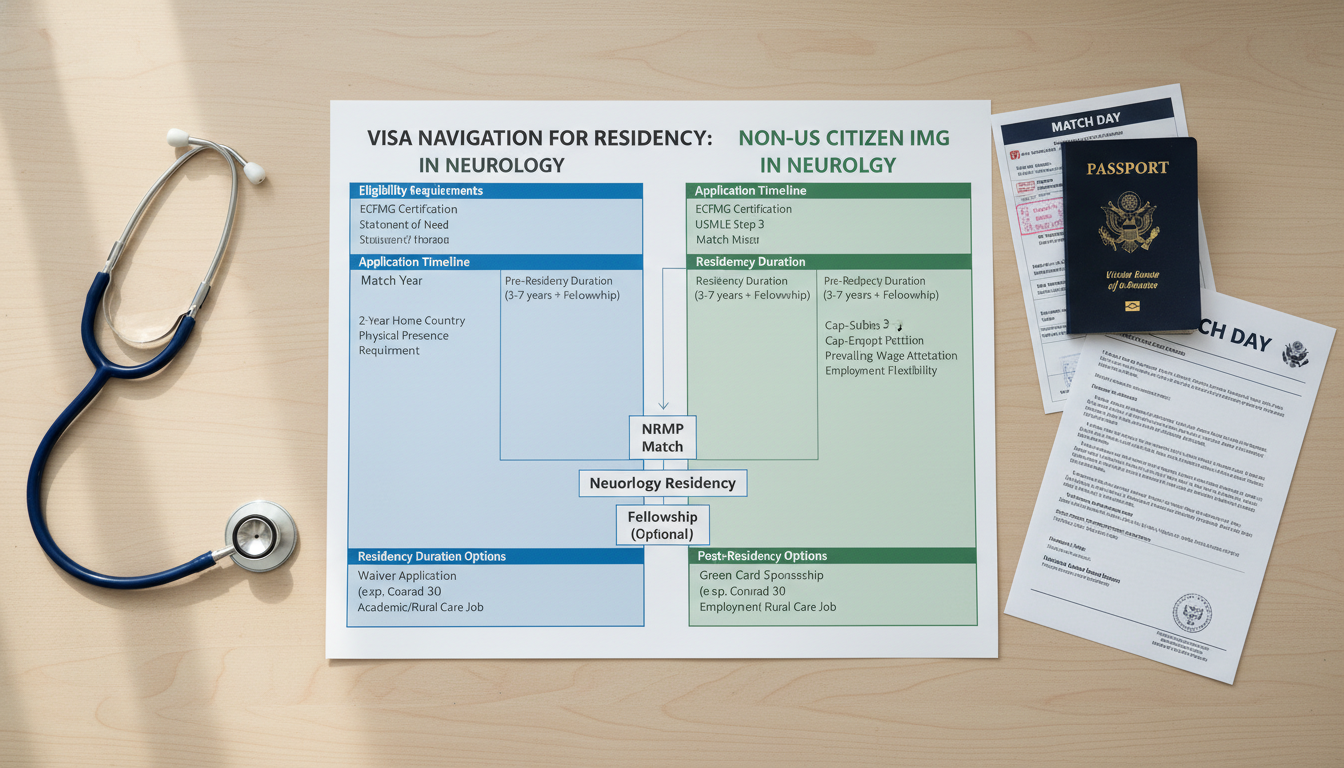
1. J-1 Physician Visa (ECFMG Sponsored)
What it is:
A training visa specifically for physicians in residency or fellowship, sponsored by ECFMG (Educational Commission for Foreign Medical Graduates).
Key features relevant to neurology:
- You must be ECFMG certified before ECFMG can issue sponsorship documents.
- Tied to accredited GME training (residency/fellowship) at ACGME-accredited programs.
- Valid for the length of training, usually:
- 4 years for adult neurology
- Additional time for fellowship(s) with ECFMG approval
- You must generally return to your home country (or country of last permanent residence) for 2 years after training unless you obtain a waiver.
Pros for neurology residency:
- Widely accepted: Many neurology programs accept J-1 and are very familiar with it.
- Predictable process: ECFMG has standardized procedures; GME offices know how to handle it.
- Flexible for multiple fellowships, within reason, as long as the training plan is approved.
- No USMLE Step 3 requirement for the visa itself (though some programs still prefer it).
Cons / limitations:
- Two-year home residency requirement (INA 212(e)):
- You cannot easily switch to H-1B, green card, or many other statuses without either:
- Spending 2 years physically present in your home country, or
- Obtaining a J-1 waiver (e.g., Conrad 30, academic/VA, hardship/fear of persecution).
- You cannot easily switch to H-1B, green card, or many other statuses without either:
- You cannot moonlight outside your approved training site (strict training-only nature).
- Not a direct path to permanent residency; you’ll typically need:
- J-1 waiver job in an underserved area, then
- H-1B or another visa type, followed by
- Green card sponsorship.
Neurology-specific angle:
J-1 remains the most common visa type among non-US citizen IMGs in neurology because:
- Many academic neurology departments are J-1 friendly.
- Large neurology training programs with many IMGs are accustomed to J-1 sponsorship.
- After residency, J-1 waivers are often available in neurology shortage areas, especially in:
- Rural regions
- Mid-size cities
- Hospital systems with stroke centers needing 24/7 coverage
2. H-1B Visa (Temporary Worker in Specialty Occupation)
What it is:
An employment visa used by many professionals. For residency, the hospital is the employer and petitioner.
Key features relevant to neurology:
- You must usually have:
- USMLE Step 3 passed
- Full or institutional state medical license eligibility (depends on state rules)
- The hospital must prove you are in a “specialty occupation” and pay the prevailing wage.
- Valid up to 6 years total, including any time used before residency.
Pros for neurology residency:
- No two-year home residency requirement.
- More straightforward transition to:
- Attending positions on H-1B (if you have time left)
- Green card (PERM/EB-2, EB-1 in some academic/clinical roles)
- Some neurology fellows prefer H-1B during fellowship if they plan to stay in the US long-term in large academic centers.
Cons / limitations:
- Not all neurology programs sponsor H-1B:
- Some avoid it due to cost, complexity, or institutional policy.
- Others only sponsor H-1B for fellows, not residents.
- Step 3 requirement is a major timing challenge for IMGs:
- You need to pass before visa filing—which often means before or very soon after Match, leaving little time if you’re still overseas.
- The 6-year limit can be tight if you:
- Use H-1B for residency (4 years) plus neurology fellowship (1–2+ years)
- Already spent time on H-1B in another field/country
- Changing employers (e.g., from residency hospital to fellowship institution) requires new petitions, adding cost and uncertainty.
Neurology-specific angle:
Some neurology programs (especially high-profile academic centers) strongly prefer J-1 for residents but are open to H-1B for fellows. Others do sponsor H-1B residents, particularly if:
- Your profile is exceptionally strong.
- You already have Step 3 and meet licensing requirements.
- Institutional GME and legal teams are comfortable with H-1B for trainees.
Choosing Between J-1 and H-1B as a Non-US Citizen IMG
There is no universal “best visa.” The right choice depends on your career plans, competitiveness, and flexibility.
Practical Comparison: J-1 vs H-1B for Neurology Residency
| Factor | J-1 Physician | H-1B |
|---|---|---|
| Commonness in neurology residency | Very common | Less common |
| Accepted by most neuro programs? | Yes | Varies widely |
| USMLE Step 3 required? | No (for visa) | Yes (usually before petition) |
| Two-year home residency requirement | Yes, unless waived | No |
| Moonlighting outside training | Generally not allowed | Sometimes allowed with proper authorization |
| Effect on fellowship | J-1 fellowship is common | Possible but subject to remaining H-1B years and employer policy |
| Long-term US stay path | Usually via J-1 waiver job → H-1B → green card | Direct H-1B → green card path possible |
Strategic Considerations for Neurology Applicants
Competitiveness & Program Reach
If your application is solid but not elite (e.g., moderate scores, some attempts, or gaps), restrictive visa demands (like H-1B only) can dramatically limit options.
- Safer for match rate: Be open to J-1.
- If you insist on H-1B, you may:
- Apply to fewer programs overall.
- Be filtered out by programs that don’t handle H-1B.
- Need strong US clinical experience and references to offset.
Long-Term Goal: Return Home vs Stay in the US
- If you definitely plan to return home, J-1 is usually fine and often simpler.
- If you strongly want to settle in the US, H-1B has advantages but is harder to obtain at the residency stage.
Readiness for Step 3
- If you can take and pass Step 3 early (before Match or soon after), you become more viable for H-1B.
- If Step 3 will be delayed (e.g., still finishing internship abroad, limited Prometric availability), J-1 is more realistic.
Willingness to Work in Underserved Areas
- J-1: You’ll likely need to accept a J-1 waiver job in an underserved area (three-year commitment) after residency/fellowship.
- Neurology demand is strong in such areas, but you must be okay with location constraints.
- H-1B: More flexibility in choosing practice location early on, though you may still take underserved positions for better green card timelines.
Family and Personal Considerations
- Spouse/children statuses differ:
- J-2 (dependents of J-1) can apply for work authorization (EAD).
- H-4 (dependents of H-1B) generally cannot work unless certain green card stages are reached.
- Schooling for children, spouse’s career plans, and support systems are all part of this decision.
- Spouse/children statuses differ:
How Visa Status Affects Your Neurology Match Strategy
Your residency visa situation is not an afterthought; it directly shapes how you apply, which programs you target, and how you present yourself to program directors.
1. Researching Programs by Visa Policy
Most neurology programs list visa information on:
- Institutional GME websites
- Program-specific websites
- FREIDA and other directories
- NRMP/ERAS program descriptions (to some extent)
Key questions to answer for each program:
- Do they sponsor J-1? (Most do.)
- Do they sponsor H-1B for residents?
- If yes, do they require Step 3 by the time of rank list or by contract signing?
- Do they have a history of matching non-US citizen IMGs?
- Do they have a large proportion of foreign national medical graduates currently in training?
Actionable tip:
Create a spreadsheet with columns:
- Program name
- City/state
- Visa types accepted: J-1 / H-1B / both
- Priority: High / Medium / Low based on:
- Visa fit
- Your competitiveness
- Location and training quality
This helps you structure a realistic neuro match list that maximizes both your chances and your visa compatibility.
2. Communicating Your Visa Needs (Without Red Flags)
In your application and interviews:
- Be clear and honest about your citizenship and visa situation.
- Don’t demand a specific visa if your application is not strong enough to justify extra burden on the program.
- If you have Step 3 and prefer H-1B:
- Phrase it as a preference, not an ultimatum.
- Example:
“I am open to a J-1 visa and understand many programs use it; however, because I hope to build a long-term career in US academic neurology, I would be grateful if an H-1B could be considered where institutionally feasible.”
If a program states on its website or during interview that it only sponsors J-1, do not push aggressively for H-1B. That can harm your rank position.
3. Timing: Matching, Visa Processing, and Start Dates
Timeline layers for a non-US citizen IMG neurology applicant:
- July–September (pre-application): Decide your visa strategy; finish Step 3 if aiming for H-1B; confirm ECFMG certification timing.
- September–February: Application and interviews; clarify which programs can sponsor your visa type.
- March: Match Day.
- April–May: Programs initiate visa paperwork (J-1 sponsorship or H-1B petition).
- June–July: Visa interviews at US consulate (if abroad); travel; residency orientation.
Potential pitfalls:
- Delayed ECFMG certification → delays J-1 sponsorship.
- Late Step 3 result → H-1B petition filed too late for July 1 start.
- Consular backlogs or administrative processing → risk of missing orientation.
Actionable tip:
Build contingency time into everything. Aim to complete:
- ECFMG certification before applying
- Step 3 by early winter (December–January) of application year if seeking H-1B
Post-Residency Pathways in Neurology: How Your Residency Visa Limits or Enables Options
The visa you hold during neurology residency shapes your next 5–10 years:
- Fellowship (stroke, epilepsy, movement disorders, neurocritical care, etc.)
- J-1 waiver jobs
- Academic vs private practice
- Path to green card
If You Train on a J-1 Visa
After residency (and possibly fellowship), you’ll face the 2-year home residency rule unless waived. The most common path for neurology:
1. J-1 Waiver Jobs (Conrad 30 and Others)
- Conrad 30 Waiver Program:
- Each US state can sponsor up to 30 J-1 physicians per year to work in underserved areas.
- Neurology is less saturated than primary care in some states, making waivers feasible.
- Usually requires:
- 3-year full-time employment contract
- Work in a Health Professional Shortage Area (HPSA) or meet another qualifying category
- Other waiver routes:
- VA (Veterans Affairs) hospitals
- Academic or research-based waivers
- Hardship or persecution-based waivers (rare and complex)
Once the waiver is approved, you typically shift to H-1B with your employer and can work toward a green card.
2. Fellowships on J-1
You can often extend J-1 for neurology fellowships, such as:
- Vascular neurology
- Clinical neurophysiology
- Epilepsy
- Movement disorders
- Neurocritical care
- Neuromuscular
- Neuroimmunology / MS
But the more fellowships you stack, the later you will begin your waiver-obligated clinical work, delaying long-term stability and green card progress.
If You Train on an H-1B Visa
You avoid the 2-year home requirement but face H-1B time limits.
Key questions:
- How many H-1B years are used in residency?
- Neurology residency = 4 years
- How many years remain for:
- Fellowship (1–2 years)
- Early attending practice before green card?
If you:
- Start H-1B from year 1 of residency → ~2 years left after residency.
- Use 4 years in residency + 2 years in fellowship → you may hit the 6-year limit as you finish fellowship.
You may then need:
- Green card process started early (PERM approved, I-140 filed).
- Time recapture (if you had significant time outside US while on H-1B).
- A shift back to J-1 for fellowship in rare scenarios (complex).
This is why some institutions prefer J-1 for residency and consider H-1B later for faculty positions, after waiver obligations (if any) are satisfied.
Practical Action Plan for Non-US Citizen IMGs Targeting Neurology
Bringing everything together, here is a step-by-step framework you can use.
Step 1: Clarify Your Long-Term Goals
Write down:
- Do I want to:
- Return home after neurology training?
- Remain in the US long-term as an academic neurologist?
- Keep both options open?
- Am I willing to:
- Work in a rural or underserved US area for 3+ years if needed?
- Delay permanent settlement in exchange for broader training opportunities?
This shapes your risk tolerance for different IMG visa options.
Step 2: Decide Your “Ideal” Visa Path and Your “Acceptable” One
Example:
- Ideal: H-1B for residency → H-1B for fellowship → academic job → green card.
- Acceptable: J-1 for residency and fellowship → J-1 waiver neurology job → H-1B → green card.
Be realistic: for many non-US citizen IMGs in neurology, the acceptable plan is the one that actually works.
Step 3: Align Your Preparation
If aiming to keep H-1B on the table:
- Plan to take USMLE Step 3 early, ideally:
- During a research year in the US, or
- During internship at home with flexible scheduling.
- Gather US clinical experience (USCE) and strong letters to justify a program investing in your H-1B.
Regardless of visa path:
- Ensure ECFMG certification is not delayed.
- Maintain excellent communication with your medical school or internship institution for required documents (diploma, transcripts).
Step 4: Build a Visa-Aware Neurology Program List
- Identify:
- Programs that sponsor J-1 only.
- Programs that sponsor J-1 and H-1B.
- Programs that historically match foreign national medical graduates.
- Calibrate:
- At least 50–70% of your applications should be to J-1-friendly programs.
- Only reserve “H-1B required” for top-tier segments if your CV is genuinely competitive.
Step 5: During Interviews – Ask Smart, Targeted Visa Questions
Examples:
- “Does your program sponsor J-1 visas through ECFMG for neurology residents?”
- “Under what circumstances do you sponsor H-1B visas for residents, if at all?”
- “Do you currently have any residents or fellows on H-1B or J-1 in your department?”
Avoid:
- Appearing focused on visa at the expense of training.
- Long, detailed immigration discussions with busy interviewers; keep it concise and professional.
Step 6: After Match – Stay Proactive and Organized
Once you match:
- Respond quickly to the program’s GME office about required documents.
- For J-1:
- Complete the ECFMG online application promptly.
- Prepare for consular processing (if outside the US) with sufficient lead time.
- For H-1B:
- Provide Step 3 proof and other licensing documents.
- Keep close contact with HR/immigration team for petition status and start date planning.
FAQs: Neurology Residency Visa Navigation for Non-US Citizen IMGs
1. As a non-US citizen IMG, should I avoid programs that only offer J-1 if I want to stay in the US long-term?
Not necessarily. Many neurologists have built long, successful careers in the US starting on J-1 visas. The J-1 path typically includes a waiver job in an underserved area, followed by H-1B and then green card sponsorship. If you categorically avoid J-1-only programs, you may significantly reduce your chances of matching in neurology. A more balanced strategy is to prioritize training quality and match probability, while still exploring H-1B where realistically possible.
2. How important is USMLE Step 3 for neurology residency if I’m a foreign national medical graduate?
For J-1 sponsorship, Step 3 is not required. However, many neurology programs value Step 3 because it suggests better preparation for residency. For H-1B, Step 3 is usually mandatory and must be passed before the visa petition. If you are targeting H-1B-friendly neurology programs, early completion of Step 3 is a major advantage and sometimes a strict prerequisite.
3. If I start neurology residency on J-1, can I switch to H-1B during residency?
In most cases no, because J-1 physician visas come with the two-year home residency requirement. You would normally need to obtain a J-1 waiver before changing to H-1B, which is not something that typically happens during residency. The more realistic transition is: J-1 for residency/fellowship → J-1 waiver job → H-1B → green card.
4. Do neurology fellowships have different visa policies than residency programs?
They can. Some institutions that only sponsor J-1 for residents may be more open to H-1B for fellows, especially for hard-to-fill neurology subspecialties. Others maintain the same policy (J-1 only) across all GME training. If your long-term plan involves a specific fellowship (e.g., neurocritical care, epilepsy), it is wise to research visa practices in those fellowship programs early—ideally during residency—so you can align your strategy.
Navigating visas as a non-US citizen IMG in neurology can feel overwhelming, but a structured approach—understanding J-1 vs H-1B, aligning your neuro match strategy with realistic IMG visa options, and planning beyond residency—will dramatically improve your chances of both matching and building the career you want.