Navigating residency visa options as a non-US citizen IMG in Philadelphia is challenging but absolutely manageable with the right strategy. Philadelphia is home to major academic centers—upenn (Penn), Jefferson, Temple, Drexel, Einstein, Main Line Health, and others—each with its own policies around sponsorship and visa types. Understanding how residency visas work, especially J-1 vs H-1B, is crucial to planning your career and choosing where and how to apply.
Below is a detailed guide tailored specifically to the non-US citizen IMG or foreign national medical graduate targeting Philadelphia residency programs.
Understanding Your Residency Visa Landscape as a Non-US Citizen IMG
Before you compare J-1 vs H-1B, it helps to define who you are legally and what that means during application season.
Who Counts as a “Non-US Citizen IMG”?
You are typically in this category if:
- You completed medical school outside the United States and Canada, and
- You are not a US citizen or permanent resident (green card holder).
This includes:
- Foreign national medical graduates currently abroad
- IMGs doing research, observerships, or advanced degrees in the US on F-1, J-1, or other non-immigrant visas
- Graduates with pending green card applications but no approved permanent residency yet
If you already hold a green card or US citizenship, visa navigation is largely a non-issue for residency. For everyone else, residency visa strategy is a central part of your planning.
The Key Visa Pathways for Residency
For postgraduate medical training (residency and fellowship), there are three main scenarios:
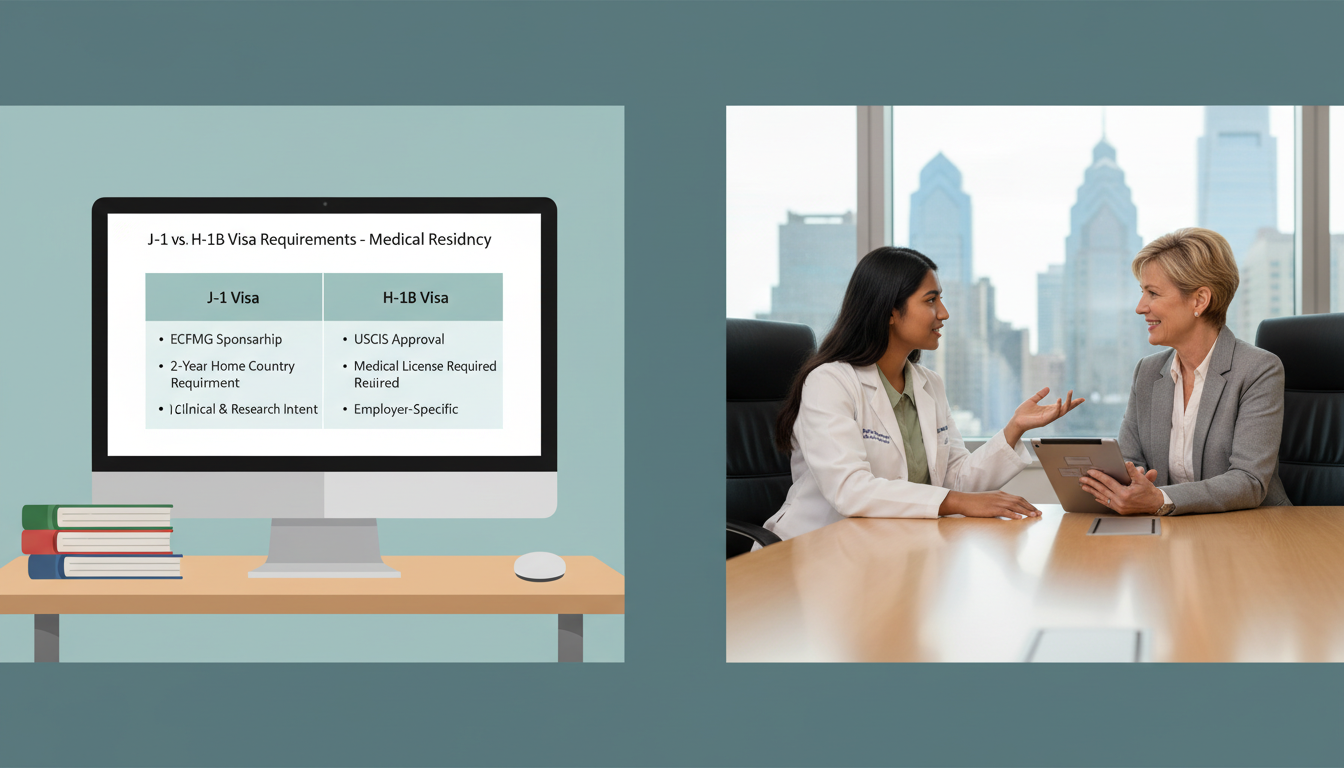
J-1 Exchange Visitor Physician Visa
- Sponsored by ECFMG, not directly by a hospital
- Most common visa for IMGs in US residency
- Typically requires a 2-year home-country physical presence after completion (the “2-year rule”), unless waived
H-1B Temporary Worker (Physician/Professional)
- Employer-sponsored visa (hospital/university is your petitioner)
- Less common for first-year residents, but used more in some specialties and for fellows
- Can be dual intent (can pursue green card while in status)
Other Status (F-1, J-2, H-4, etc.) transitioning into J-1/H-1B
- Some IMGs are already in the US on F-1 (student), O-1 (extraordinary ability), or as dependents (J-2, H-4)
- Often, these will still need to change status to J-1 or H-1B to start residency
The core decision for most non-US citizen IMGs is: J-1 vs H-1B for residency.
J-1 vs H-1B: What Every Foreign National Medical Graduate Must Know
Both visas can lead to a successful training and career, but they differ significantly in flexibility, requirements, and post-residency options—especially within Pennsylvania and the greater Philadelphia region.
J-1 Physician Visa: The Default Path for Many IMGs
Most Penn residency programs and other Philadelphia institutions are very comfortable with the J-1 pathway because ECFMG centralizes sponsorship and compliance.
Key features:
- Sponsor: ECFMG (Educational Commission for Foreign Medical Graduates)
- Usage: Specifically designed for international physicians in training
- Duration: Granted in 1-year increments; usually up to 7 years for training
- Exam requirement: Must have ECFMG certification (USMLE Steps completed + other ECFMG requirements)
- Funding: Must show adequate financial support (usually via residency salary contract)
2-Year Home-Country Rule (INA 212(e))
Most J-1 physicians are subject to a 2-year home-country physical presence requirement after training. This means:
- You must return to your country of nationality or last residence for 2 years OR
- Obtain a J-1 waiver (for example, a Conrad 30 waiver position in an underserved area)
- Until you satisfy or waive this requirement, you generally cannot change status to H-1B, L-1, or obtain a green card from within the US
Advantages of the J-1 for Philadelphia-bound IMGs:
- Widely accepted: Most academic programs in Philadelphia readily take J-1 applicants
- Centralized process: ECFMG’s standardized procedures make it predictable
- No USMLE Step 3 requirement before starting residency
- Suitable for a broad range of specialties, including those with longer training (up to 7 years)
Challenges:
- The 2-year home-country rule can limit immediate post-residency options in the US
- Requires navigating a J-1 waiver if you wish to remain and work in the US directly after training
- Often less flexible than H-1B in terms of long-term immigration planning
H-1B Physician Visa: More Control, More Requirements
H-1B is a temporary worker visa for specialty occupations, which includes physicians in residency or fellowship when the role requires an MD/DO plus licensing exams.
Key features:
- Sponsor: The employer (residency program/hospital/university)
- Duration: Initially up to 3 years, extendable to 6 years total (with certain exceptions)
- USMLE requirement: Typically must have Step 3 passed before petition
- Licensing: Must meet state licensing requirements (e.g., Pennsylvania training license criteria)
- Cap-exempt status: Most large academic hospitals (like Penn, Jefferson, Temple) are cap-exempt due to affiliated non-profit or university status. This means:
- No need to enter the general H-1B lottery
- Can file H-1B at any time of year
Advantages of H-1B:
- No 2-year home-country rule
- Dual intent: You can pursue a green card while on H-1B
- Generally seen as more favorable for long-term US immigration planning
- After residency, you can transition more easily into H-1B-attending positions without dealing with J-1 waiver constraints
Challenges:
- Not all Philadelphia residency programs sponsor H-1B for PGY-1 positions
- Requires USMLE Step 3 before the program can file the petition—this is often a major timing challenge for IMGs
- Legal/filing costs are higher, and some programs may avoid H-1B sponsorship because of this
- If you ever plan to work outside a cap-exempt institution, you may later need a cap-subject H-1B (and usually the lottery) unless you get a green card first
Philadelphia Residency Landscape: Visa Sponsorship in Practice
Philadelphia is a dense academic hub with multiple teaching hospitals. For a non-US citizen IMG, understanding program-specific visa sponsorship policies is crucial.
Major Philadelphia and Nearby Institutions and Typical Patterns
While policies can change, the following general patterns are often seen (always verify on each program’s website or by email):
Penn Medicine (University of Pennsylvania / Penn residency programs)
- Large academic center; many programs sponsor J-1 via ECFMG as default
- Some programs may sponsor H-1B for residents/fellows, particularly in specialties like internal medicine, anesthesia, radiology, and some fellowships, but this varies by department
- For H-1B, expect Step 3 completion and often strong academic metrics
Thomas Jefferson University / Jefferson Health
- Historically very IMG-friendly in multiple specialties
- Commonly accept J-1; H-1B sponsorship can be program-dependent
- May be open to H-1B for certain high-need specialties or strong candidates
Temple University Hospital
- Academic center with multiple residency programs
- Generally sponsors J-1; check program websites for H-1B policies
- Some departments may prefer J-1 only for logistical simplicity
Drexel, Einstein, Main Line Health, Cooper (across the river but part of the regional ecosystem)
- Many of these institutions use J-1 as their main visa pathway
- H-1B availability needs to be checked program-by-program
Smaller community and suburban programs around Philadelphia
- Often prefer J-1 only due to limited legal resources and familiarity
- May not sponsor H-1B at all, especially for categorical PGY-1 positions
How to Research and Confirm Visa Policies
When targeting a Philadelphia residency, you should:
Check the program website “International Medical Graduate” or “Eligibility Requirements” section
Look for language like:- “We sponsor J-1 visas through ECFMG only.”
- “We sponsor J-1 and H-1B visas for eligible applicants.”
- “We do not sponsor visas.”
Use FREIDA and program directories
FREIDA often mentions whether a program will consider non-US citizen IMGs and whether visa sponsorship is available.Email the program coordinator
If the website is unclear, send a brief, professional email asking:- Whether the program sponsors J-1, H-1B, both, or neither
- If H-1B is an option, whether USMLE Step 3 is required before ranking or only before starting the program
Talk to current residents
Residents from your home country or other IMGs can provide real-world confirmation on how often the program actually sponsors H-1B vs J-1.
Strategic Planning: Choosing Between J-1 and H-1B for Philadelphia Residency
Your choice of visa pathway should align with both short-term goals (matching into residency) and long-term plans (where you want to practice and live).
Step 1: Clarify Your Career and Location Goals
Ask yourself:
- Do you plan to live and work long-term in the US?
- Are you open to working in an underserved or rural area after training (which is often necessary for J-1 waivers)?
- Do you hope to remain in Philadelphia or Pennsylvania for your attending career?
- How important is the ability to transition smoothly into a green card?
If your long-term goal is clearly to stay in the US in a major metro area like Philadelphia, H-1B may be strategically superior. But if you are open to working in underserved communities—often outside major cities—J-1 plus a waiver pathway can work extremely well.
Step 2: Assess Your Current Credentials and Timing
For J-1:
- Need ECFMG certification (USMLE Steps, English proficiency where required, primary source verification completed)
- Must demonstrate a valid contract with a training program
- No Step 3 requirement for initial sponsorship
For H-1B:
- Need USMLE Step 3 passed before the petition is filed
- For a July 1 start, many programs want Step 3 completed by December–January of the application/match year
- Must meet Pennsylvania training license requirements (varies by specialty and state board policies)
- Your program must be ready to invest time and money in H-1B paperwork
If you are late in the season without Step 3, J-1 is often the only realistic option for that match cycle, especially in Philadelphia where timelines are tight.
Step 3: Adjust Your Application Strategy Based on Visa Flexibility
You can absolutely apply broadly and let visa feasibility be a secondary filter. A practical approach:
- Target mostly J-1-friendly programs in Philadelphia if:
- You have not completed Step 3
- You have a weaker portfolio and need to maximize your chance of getting interviews
- Include H-1B-sponsoring programs if:
- You have Step 3 passed early
- You have a strong CV (high scores, US clinical experience, research, etc.)
- Your long-term plan strongly favors an H-1B route

Practical Steps: How to Handle Visa Issues in the Residency Application and Match
1. ERAS Application: Presenting Your Status Correctly
In your ERAS application:
- Indicate your citizenship and that you are a non-US citizen IMG
- If you are already in the US (F-1, J-1, etc.), specify current visa status
- In the personal statement or supplemental (if appropriate), you may briefly clarify that:
- You are eligible for ECFMG J-1 sponsorship, and/or
- You have USMLE Step 3 completed and are eligible for H-1B sponsorship (if true)
Avoid writing long visa narratives in your personal statement; mention key facts only if they support your candidacy (e.g., Step 3 passed, prior US visa experience).
2. During Interviews: When and How to Discuss Visa Issues
Program directors and coordinators expect non-US citizen IMGs to ask about residency visa questions, but time and approach matter:
- Do ask, but keep it concise and professional:
- “Could you clarify whether your program sponsors J-1 and/or H-1B visas for residents?”
- “For applicants with Step 3 completed, is H-1B sponsorship a possibility for categorical residents?”
- Do not spend half your interview on immigration topics. Show you are primarily focused on clinical and educational aspects.
- Avoid sounding like you are only interested in a program because it offers a certain visa. Balance genuine interest in the program with practical questions.
3. After Match: Coordinating ECFMG or H-1B Paperwork
If You Match on a J-1
- Your program will send you instructions to start the ECFMG J-1 sponsorship process.
- You will need:
- Signed contract or official offer letter
- ECFMG certification
- Documentation of funding
- DS-2019 application materials
- If you are outside the US:
- You will schedule a visa interview at a US consulate once you receive form DS-2019
- If you are in the US in another status:
- You may file for change of status from inside the US, or travel and re-enter with a J-1 visa (your program and ECFMG will advise).
If You Match on an H-1B
- The hospital/university legal office prepares the H-1B petition:
- Labor Condition Application (LCA)
- Form I-129 and supporting evidence
- Your Step 3 results, ECFMG certification, and any state training license documents
- You must:
- Provide all requested documents promptly
- Ensure your passport is valid for the duration required
- If abroad:
- Once H-1B is approved, you attend a consular visa interview
- If in the US:
- You may change status to H-1B from your current visa, if allowed, or travel and re-enter
Timely cooperation is critical; delays can threaten your ability to start on time in July.
Long-Term Planning: J-1 Waivers, H-1B Transitions, and Green Card Strategies
For a non-US citizen IMG, residency is only one stage of the immigration journey. Your visa choices in Philadelphia may shape your options after training.
If You Train on a J-1 in Philly
Typical next steps:
J-1 Waiver Job
- Often in underserved, rural, or semi-urban areas—sometimes within Pennsylvania, New Jersey, or nearby states
- Common programs:
- Conrad 30 State Waiver Programs
- Federal programs for underserved communities or specific agencies
- After a waiver and typically 3 years of service, you can transition:
- J-1 → H-1B → potential green card
Return to Home Country for 2 Years
- Some IMGs choose to comply with the 2-year rule, then return to the US later as an H-1B worker, student, or immigrant
Marriage or Other Independent Immigration Pathway
- Marriage to a US citizen or other family/EB-based immigration categories can sometimes bypass or change the dynamic around the 2-year rule (requires individualized legal advice)
If You Train on an H-1B in Philly
Typical path:
- Continue on H-1B as a Fellow or Attending
- You may stay within the same or another cap-exempt institution (academic centers, certain non-profit hospitals)
- Pursue Employment-Based Green Card
- Many academic centers and large groups will sponsor IMGs for EB-2 or EB-3 green cards
- Transition from Cap-Exempt to Cap-Subject H-1B
- If you move to a private group or non-academic employer, you may later need a cap-subject H-1B (subject to the annual lottery), unless you already have a green card or other arrangement
Because of the complexity of these pathways, particularly for those staying long-term in the US, consulting an immigration attorney is wise, especially after you have secured a residency position.
FAQs: Visa Navigation for Non-US Citizen IMG in Philadelphia
1. As a non-US citizen IMG, can I match into a Philadelphia residency if I need visa sponsorship?
Yes. Many Philadelphia residency and Penn residency programs accept non-US citizen IMGs and sponsor J-1 visas via ECFMG. Some programs also sponsor H-1B. Your task is to identify which programs explicitly support IMGs and offer compatible IMG visa options.
2. Should I prioritize H-1B over J-1 if I’m planning to stay in the US long-term?
H-1B often provides more straightforward long-term immigration flexibility (no 2-year home-country rule, dual intent), but it is harder to obtain: you must have USMLE Step 3, and not all programs will sponsor it. J-1 is more widely accepted, especially for initial residency. A balanced strategy is to be open to J-1 but specifically apply to programs that may sponsor H-1B if your credentials allow.
3. If a program in Philadelphia says “J-1 only,” can I still ask for H-1B consideration?
You can ask politely, but most programs that state “J-1 only” are firm on that policy due to institutional or financial constraints. Repeatedly pushing for an exception may harm your candidacy. Instead, focus on programs that are openly H-1B-friendly if H-1B is critical for you.
4. Do I need an immigration lawyer before applying to residency?
You do not need a lawyer to apply for residency, fill out ERAS, or interview. However, consulting a qualified immigration attorney can be very helpful if:
- You have complex history (prior visa denials, out-of-status periods, J-1 2-year rule questions)
- You are strategizing between multiple long-term immigration paths
- You want personalized advice on J-1 waiver options or employment-based green cards after training
For most non-US citizen IMGs, serious legal counseling becomes particularly important after match, when finalizing your residency visa and planning the post-residency phase.
Category: VISA_OPTIONS_FOR_IMGS
Phase: RESIDENCY_MATCH_AND_APPLICATIONS