
Understanding the Visa Landscape as a Non-US Citizen IMG in Preliminary Surgery
As a non-US citizen IMG pursuing a prelim surgery residency in the United States, you are navigating two complex systems at the same time: the residency application process and US immigration law. This is challenging even for highly qualified candidates. Visa planning cannot be an afterthought; for a foreign national medical graduate, it often shapes where you can apply, which programs will rank you, and what happens after your preliminary surgery year ends.
This guide is tailored specifically to non-US citizen IMGs targeting preliminary general surgery positions (PGY-1 prelim) and, in some cases, PGY-2 prelim spots. It walks through:
- Core IMG visa options for residency (J-1 vs H-1B and others)
- How a prelim surgery residency affects your visa strategy
- What to look for on program websites and during interviews
- How to plan long-term if you want to stay in the US after your prelim year
- Practical, step-by-step actions you can take in each application season
While this article offers structured guidance, immigration situations can be highly individualized. Always confirm details with your program and, when needed, a qualified immigration attorney.
Core Visa Options for Residency: J-1 vs H-1B and Other Paths
Most non-US citizen IMGs training in US residency programs use one of two visas: the J-1 exchange visitor physician visa or the H-1B temporary worker visa. Understanding the differences in purpose, requirements, and long-term implications is crucial, especially when you’re applying to a one-year preliminary surgery residency.
1. The J-1 Visa for Physicians
The J-1 visa for clinical training is sponsored by the Educational Commission for Foreign Medical Graduates (ECFMG), not directly by the residency program (though the program must agree to host you).
Key features:
- Purpose: Graduate medical education (residency, fellowship)
- Sponsor: ECFMG
- Common for: Most IMGs in residency
- Duration: Typically year-by-year, up to a maximum of 7 years (total GME)
- Employment: Only at the approved training program(s)
- Two-year home residence requirement (INA 212(e)):
After completing J-1 training, most physicians must return to their home country (or country of last residence) for two years before being eligible for certain US immigration benefits (e.g., H-1B, L-1, or permanent residency), unless they obtain a waiver.
For a prelim surgery residency, the J-1 is generally easy to set up if:
- You have ECFMG certification
- You have passed USMLE Step 1 and Step 2 CK (and any current ECFMG requirements)
- You possess valid Statement of Need from your home country’s health authority
- You can show sufficient financial support (usually via your residency contract)
Advantages of J-1 for prelim surgery:
- Widely accepted: More surgery programs sponsor J-1 than H-1B
- Often simpler: Immigration processing is more standardized via ECFMG
- Predictable timeline: Many GME offices are very familiar with it
- No USMLE Step 3 requirement for visa issuance (though some programs may still want it)
Disadvantages:
- Home residence requirement complicates long-term plans
- Waiver pathways (e.g., Conrad 30, federal waivers) are usually geared to fully trained specialists, not surgeons who have completed only a preliminary surgery year
- Limited flexibility to change to non-training roles during J-1 status
For a foreign national medical graduate planning only one or two prelim years and then returning home or going to a different country, the J-1 can be reasonable. If your goal is long-term US practice, the J-1 requires strategic planning around future waiver options—and a prelim-only pathway can make that more complex.
2. The H-1B Visa for Residency
The H-1B is a temporary work visa for “specialty occupations.” Some residency programs are willing to sponsor H-1B for residents; many are not, especially for preliminary positions.
Key features:
- Purpose: Temporary specialty occupation employment
- Sponsor: Your residency hospital/university (direct employer)
- Commonly used when:
- Programs are open to long-term pathways to employment
- Candidates already have USMLE Step 3
- Candidates and programs want to avoid J-1 home residency requirement
- Duration:
- Initial approval up to 3 years, renewable up to 6 years total (with some exceptions when green card is in process)
Typical eligibility hurdles for IMGs:
- USMLE Step 3 required before filing H-1B petition in most states
- Must demonstrate that the resident salary meets the prevailing wage (usually satisfied via standard GME contracts)
- Program must be willing and able to handle the more complex immigration process and costs
Advantages for a non-US citizen IMG in prelim surgery:
- No J-1 home residence requirement
- Potentially easier transition to continued H-1B for categorical surgery, another specialty, or even attending-level positions later
- Can be a stronger base for long-term immigration plans (e.g., H-1B to green card)
Disadvantages:
- Fewer programs sponsor H-1B for preliminary year residents than for categorical residents
- Cost and legal complexity discourage some institutions
- Step 3 requirement can be a barrier for students or recent graduates
- Limited total duration (6 years in most cases), which may conflict with multiple years of training + fellowship
For a prelim surgery residency, an H-1B can be a powerful tool if you plan to continue in the US (transitioning to a categorical position in surgery or another specialty). However, it requires deliberate planning: scheduling Step 3 early, targeting programs that clearly offer H-1B sponsorship, and coordinating timelines carefully.
3. Other Statuses: F-1, TN, and Others
A few non-US citizen IMGs may encounter additional visa categories:
F-1 with Optional Practical Training (OPT):
- Some IMGs are in the US on F-1 visas for research, MPH, or other graduate degrees.
- Post-graduation, OPT may allow 12 months of work in their field.
- However, F-1/OPT is rarely used as the main status for residency; most programs require switching to J-1 or H-1B.
TN (for Canadian/Mexican citizens):
- Limited applicability for direct clinical residency roles; more relevant to some research or faculty positions after training.
O-1 (extraordinary ability):
- Occasionally used for very high-achieving researchers; not common for preliminary residents.
For almost all foreign national medical graduates entering a prelim surgery residency, you will be deciding mainly between J-1 vs H-1B.
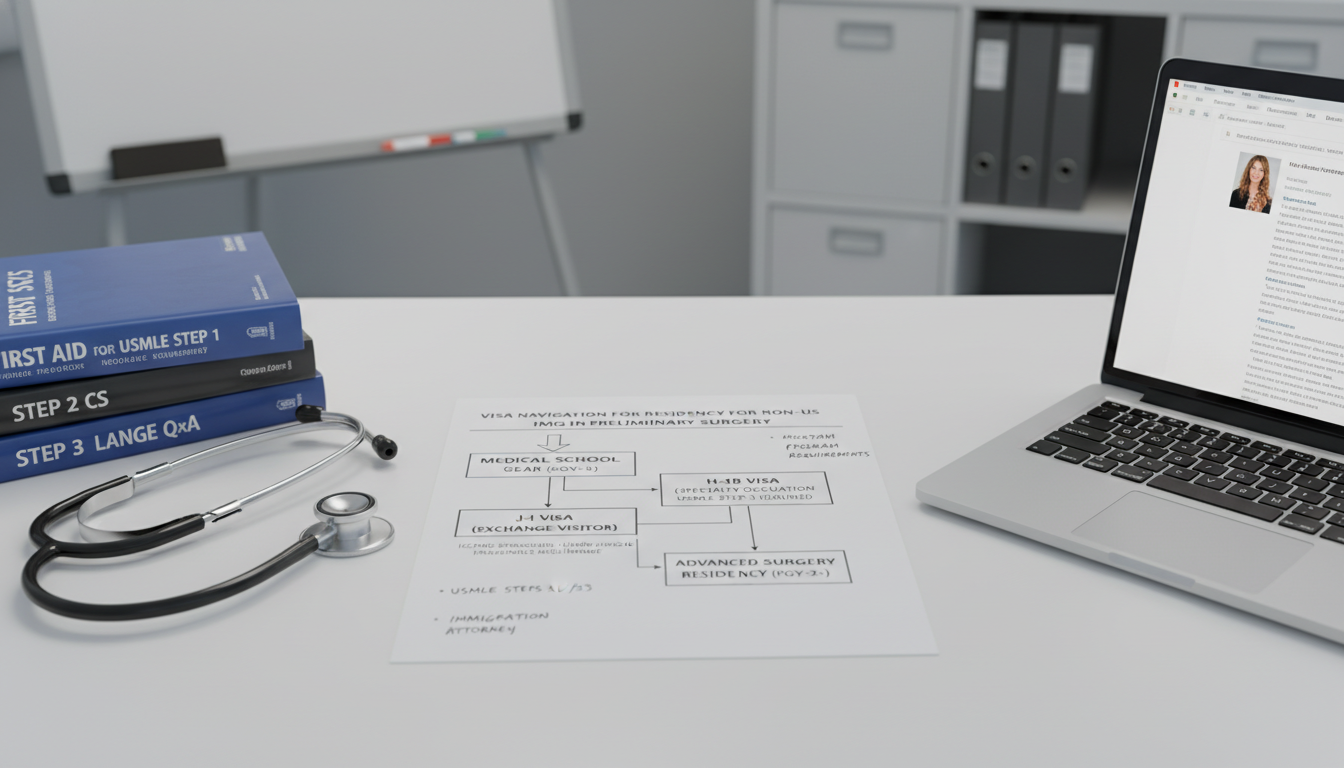
How the Preliminary Surgery Year Changes Your Visa Strategy
Unlike a categorical position that leads to board eligibility in general surgery over 5 years, a prelim surgery residency is typically:
- 1–2 years in duration
- Not guaranteed to continue into a categorical slot
- Sometimes designed primarily for those pursuing other fields (e.g., radiology, anesthesiology, urology) that require a preliminary surgery year
These structural differences can have major implications for your residency visa planning.
1. Short Duration and Immigration “Continuity”
Most visa processes are built around a multi-year training plan. With a preliminary year, you must think beyond the first 12 months:
- What happens after the prelim year?
- Do you plan to enter a categorical surgery spot?
- Are you targeting another specialty that accepts previous surgery prelim years?
- Are you open to returning home or training in another country?
Your visa must be compatible not only with the prelim year but with realistic next steps.
Example scenario:
- You match to a 1-year prelim surgery residency on a J-1 visa.
- During PGY-1, you secure a categorical internal medicine position for the following year at another US hospital.
- Your new IM program also sponsors J-1, and ECFMG extends your J-1 DS-2019.
- You complete 3 years of IM on J-1.
- Now you face the two-year home residence requirement, with eventual waiver planning.
In this case, J-1 works reasonably well if you’re comfortable with J-1 constraints and eventual waiver issues.
2. H-1B and the Preliminary Year: Practical Limits
Programs are frequently reluctant to sponsor H-1B for prelim-only posts because:
- The resident will be staying only one year, making the legal expense less attractive for the institution.
- H-1B often requires more institutional approval and attorney collaboration than a J-1.
- The administrative effort is higher compared with simply accepting J-1 trainees.
However, there are exceptions, such as:
- Institutions with a policy to sponsor H-1B for all residents who meet criteria, regardless of categorical vs preliminary status.
- Situations where the prelim year is essentially a trial year with strong potential for converting into a categorical slot in the same department.
If your long-term plan is to stay in the US and you wish to avoid J-1 because of the home residency requirement, then:
- Target surgery programs that explicitly sponsor H-1B
- Sit for USMLE Step 3 early
- Confirm in writing (or at least clearly) that the program is open to H-1B even for prelim positions
3. Transitioning from Prelim to Categorical: Visa Implications
If you start your prelim surgery residency on one visa and then change to another program or specialty, you may need:
- New DS-2019 (for J-1) from ECFMG, coordinated through the new program
- New H-1B petition or amendment filed by the new employer
- Timing alignment so that your visa status does not lapse between programs
When planning your prelim strategy:
- Assume instability: A prelim position does not guarantee a spot the following year.
- Build visa plans that let you pivot if you get an offer in another specialty or institution.
4. Visa and Fellowship Planning After Prelim + Categorical
Some non-US citizen IMGs use a prelim surgery year as part of a longer trajectory:
- Prelim surgery year (PGY-1)
- Categorical position in another specialty (e.g., anesthesiology, radiology, neurology)
- Fellowship
- Employment and permanent residency
In such cases:
- J-1 visa: Each transition (prelim → categorical → fellowship) will require ECFMG coordination but generally follows a consistent pattern. The major factor is eventually satisfying or waiving the 2-year rule.
- H-1B visa: You must carefully track the total H-1B time used during residency and fellowship against the 6-year maximum, while aligning it with permanent residency plans if you aim to stay in the US afterward.
Choosing Between J-1 vs H-1B as a Non-US Citizen IMG in Preliminary Surgery
There is no single “best” visa for all foreign national medical graduates. The right choice depends on your long-term goals, exam status, and the types of programs you can realistically match.
1. Key Questions to Ask Yourself
Before you apply, consider:
What is my long-term plan?
- “I want to do one prelim year and return home.”
- “I want to eventually practice long-term in the US.”
- “I am flexible; I’ll see which opportunities come.”
Have I passed USMLE Step 3 (or when will I be able to)?
- If not, H-1B is generally not an option for your first year.
How competitive is my profile for prelim vs categorical surgery?
- If you are mostly aiming at prelim-only roles, fewer H-1B options may be available.
Am I willing to accept the J-1 home residency requirement in exchange for broader program options?
- Many candidates prioritize matching over having the “perfect” visa.
2. Typical Profiles and Visa Choices
Profile A: Strong IMG, Step 3 done, long-term US goals
- Wants: categorical surgery ideally, but applying widely including prelim
- Strategy:
- Target institutions known for H-1B sponsorship
- Emphasize ability to start on H-1B (Step 3 completed, documentation ready)
- Still remain open to J-1 if categorical positions are only available that way
- Trade-off: Might limit the list of programs if insisting on H-1B only; risk of not matching.
Profile B: Good IMG, Step 3 not yet done, primarily chasing a prelim spot
- Wants: at least one US year to build clinical experience, then reapply to surgical or other specialties
- Strategy:
- Accept that J-1 is the most realistic path for the prelim year
- Work on USMLE Step 3 during or after prelim year if aiming for later H-1B-based training
- Trade-off: Must plan for future J-1 waiver or fulfill the 2-year rule.
Profile C: IMG planning to return home after prelim or short US experience
- Wants: surgical exposure, CV enhancement, and experience only
- Strategy:
- J-1 is usually simplest; home residency requirement may not be a burden (you plan to return anyway)
- Trade-off: Limited flexibility if you later change your mind and want to stay long-term.
3. Long-Term Implications of Each Route
J-1 Path:
- Pros:
- More programs will consider your application
- Streamlined, predictable ECFMG process
- Cons:
- Must later:
- Obtain a J-1 waiver (often requiring underserved-area work), or
- Complete 2 years in home country before using H visas or getting a green card
- Must later:
H-1B Path:
- Pros:
- Better aligned with long-term US practice and permanent residency
- No 2-year home residency requirement
- Cons:
- Fewer prelim surgery programs will sponsor it
- Requires Step 3, more paperwork, and sometimes slower onboarding
Many non-US citizen IMGs adopt a pragmatic approach: they remain open to both visas, prioritize matching into a solid program, and then refine their immigration strategy after establishing themselves in US training.

Practical Steps for Navigating Visa Issues During the Application and Match Cycle
To make visa navigation more manageable, break it into stages: pre-application, ERAS/Match, and post-match.
1. Pre-Application (6–18 Months Before Match)
a. Clarify your long-term goals and constraints
- Decide whether your priority is:
- Any US training vs only training that fits a specific immigration path
- Returning home vs building a long-term US career
b. Organize your documentation
- Valid passport (with enough validity)
- ECFMG certification status
- USMLE transcripts
- Medical school diploma and transcripts
- Prior visa history (if any) and related documents
c. Plan for USMLE Step 3 (if relevant)
- If H-1B is important for you:
- Register early for Step 3
- Aim to pass before Match Day, so programs see you as fully eligible for H-1B
d. Research programs’ visa policies
- Use FREIDA, program websites, and email to identify:
- Programs that sponsor J-1 only
- Programs that sponsor both J-1 and H-1B
- Programs that do not sponsor visas (avoid these if you have no existing work authorization)
Make a spreadsheet noting:
- Program name
- Sponsorship (J-1, H-1B, both, none)
- Whether they have prelim surgery residency positions
- Any notes on preferences for citizen/green card holders vs IMGs
2. Application Season (ERAS Submission and Interview Phase)
a. Tailor your application list
- For a non-US citizen IMG, consider a broad application strategy, especially to programs that:
- Explicitly mention accepting IMGs
- Have a track record of sponsoring visas
- Offer prelim surgery year positions alongside categoricals
b. Communicate professionally about visa needs
In your application or during interviews:
- Be clear and concise:
- “I am a non-US citizen IMG currently requiring visa sponsorship. I am eligible for a J-1 visa, and I am working on Step 3 to be eligible for H-1B if your institution offers it.”
- Avoid sounding inflexible unless you truly cannot accept a particular visa category.
c. During interviews: questions to ask (tactfully)
Examples of appropriate questions:
- “Does your institution sponsor visas for preliminary surgery residents, and if so, which types?”
- “For IMGs who start here on a J-1, have you had residents successfully transition into categorical positions within your institution?”
- “If a resident switches from a prelim to a categorical position, how does your GME office support the visa transfer or extension process?”
Take notes on each program’s answers to compare later.
3. Rank List and Match Day
a. Balancing program quality vs. visa flexibility
When creating your rank list, weigh:
- Program training quality and support
- Historical acceptance of IMGs
- Visa sponsorship clarity
- Location and personal considerations
It might be rational, for some candidates, to rank a slightly less prestigious program higher if it offers:
- Reliable visa sponsorship, and
- A realistic chance at continued training after the prelim year
b. Post-Match Actions
Once you match:
- Contact your program’s GME office promptly:
- Confirm type of visa they will sponsor (J-1 or H-1B)
- Ask for a timeline of immigration steps
- If J-1:
- Follow instructions for ECFMG’s online J-1 sponsorship process
- Obtain and submit Statement of Need
- If H-1B:
- Provide all requested documents (Step 3 scores, credentials, prior status documents) to your program’s legal/HR team
- Be ready for premium processing decisions based on start date
4. During the Prelim Year
Your visa strategy continues after you arrive:
- Keep copies of all I-94 records, DS-2019 or I-797 approvals, and employment contracts
- Stay in close communication with GME if you plan to:
- Apply for a categorical surgery spot
- Transfer to another specialty
- Extend training at the same or another institution
For J-1 physicians, start learning early about:
- J-1 waiver pathways (e.g., Conrad 30, VA, federal programs)
- How much total J-1 time you may need for further training
For H-1B physicians:
- Track how many years of H-1B you’ve used during residency
- If possible, talk with mentors or an immigration attorney about long-term routes to permanent residency if you see your future in the US.
Common Pitfalls and How to Avoid Them (Especially in Preliminary Surgery)
Even highly qualified IMGs can run into preventable problems. Here are some frequent issues specific to prelim surgery and visa navigation—and how to avoid them.
1. Assuming All Programs Sponsor Visas for Prelims
Reality:
Many institutions that sponsor visas for categorical residents may not be willing to do so for prelim-only positions.
Prevention:
- Verify on program websites or by email before ranking.
- During interviews, explicitly confirm sponsorship policies for prelim residents.
2. Delaying Step 3 if You Want H-1B
If you want H-1B and postpone Step 3 until late PGY-1:
- Your program might not be able to file H-1B in time.
- You may be forced onto J-1 or face a delayed start.
Prevention:
- If H-1B is central to your long-term plan, treat Step 3 as a priority before Match or early after graduation.
3. Underestimating the Impact of the J-1 Home Requirement
Many IMGs accept a J-1, then later realize:
- It is not simple to convert to H-1B or permanent residency without fulfilling or waiving the two-year rule.
- J-1 waiver jobs can be geographically limited and often primary care–focused, which may not match a surgical background.
Prevention:
- Before committing, at least have a rough understanding of:
- Waiver opportunities for surgeons in your country/region of interest
- Whether you’re comfortable with the idea of returning home if needed
4. Poor Communication with GME About Career Changes
If you secure a categorical spot elsewhere but wait too long to inform your current program and GME office:
- Visa transfer or extension can become rushed and stressful.
- Start dates could be affected.
Prevention:
- As soon as you have a secured offer for the next training step, inform both your current and future GME offices.
- Ask clearly, “What do you need from me to ensure a smooth visa continuation or transfer?”
FAQs: Visa Navigation for Non-US Citizen IMGs in Preliminary Surgery
1. As a non-US citizen IMG, can I do a prelim surgery year on a J-1 and then switch to H-1B later for another residency?
Yes, but only if you either:
- Obtain a J-1 waiver (e.g., Conrad 30, federal waiver), or
- Return to your home country for two years to satisfy the home residence requirement.
Without one of those, you are typically not eligible for an H-1B or green card after holding a J-1 physician visa. This is why your initial choice of visa (and your long-term goals) matters.
2. Do many prelim surgery programs sponsor H-1B?
Fewer prelim programs sponsor H-1B compared to categorical programs. It’s not impossible, but you should not assume H-1B sponsorship for a preliminary year. Research carefully:
- Look for clear statements on program websites or FREIDA.
- Directly email or ask during interviews, “Do you sponsor H-1B for preliminary surgery residents who have Step 3?”
3. I’m a foreign national medical graduate currently in the US on F-1 for an MPH. Can I start prelim surgery on OPT instead of J-1 or H-1B?
In most cases, residency programs expect clinical trainees to be on J-1 or H-1B, not F-1/OPT. While there are rare exceptions, you should plan for a transition to a residency-appropriate visa category. Discuss this early with:
- Your MPH program’s international office
- The GME office of any residency offering you a position
4. Should I avoid J-1 completely if I want a long-term career in the US after surgery training?
Not necessarily. Many IMGs build long, successful US careers after J-1 visas by:
- Completing training
- Obtaining a J-1 waiver (often via service in underserved areas)
- Transitioning to H-1B or permanent residency
However, being on J-1 means you must plan carefully for the waiver or home residence requirement. If you have the option of a strong program that offers H-1B and aligns with your goals, that may simplify your path—but matching should remain your first priority.
By understanding the strengths and limitations of each IMG visa option, and by planning early around J-1 vs H-1B, you can align your preliminary surgery residency with your broader professional and immigration goals. Thoughtful preparation now will pay off in flexibility, security, and opportunity throughout your training journey in the United States.