
Understanding the Visa Landscape as a Non-US Citizen IMG in Psychiatry
Visa navigation is one of the most critical—and most confusing—parts of the journey for a non-US citizen IMG aiming for a psychiatry residency in the United States. Your visa status directly affects:
- Which programs you can apply to
- Where you can train
- Future fellowship and job opportunities
- Your long‑term ability to stay and work in the US
For a foreign national medical graduate interested in psychiatry, being strategic about visa planning can significantly improve your psych match chances and your career stability afterward.
This article focuses specifically on residency visa navigation for psychiatry, and is tailored to the needs of the non-US citizen IMG (often living abroad or in the US on another status like F‑1).
We will cover:
- The main visa types used for residency training
- J-1 vs H-1B in the context of psychiatry
- How visa type affects your psych match strategy
- Common scenarios (F‑1 students, Caribbean graduates, physicians abroad, dependents)
- Practical steps to optimize your IMG visa options and documentation timeline
Core Visa Types for Psychiatry Residency: What You Really Need to Know
1. The J‑1 Visa (ECFMG-Sponsored) – The Most Common Path
For a non-US citizen IMG in psychiatry, the J-1 physician visa sponsored by ECFMG is the most commonly used route.
Key features of the J‑1 for residency:
- Sponsor: ECFMG (not the individual program)
- Purpose: Graduate medical education and clinical training
- Duration: Typically up to 7 years (sufficient for psychiatry + most fellowships)
- Requirement: Return to home country for two years after training, unless a waiver is obtained
- Work restriction: You can work only at the training sites listed in your DS‑2019 and program’s documentation
Why so many psychiatry programs rely on J‑1:
- Streamlined process: Programs are used to working with ECFMG, not with USCIS directly
- Less administrative burden for the institution
- Predictable process and requirements
- Widely accepted by university and community psychiatry programs
Minimum requirements to qualify (typical J‑1 for residency):
- Valid ECFMG Certification (or ready prior to start date)
- A confirmed residency position (ERAS/NRMP or Pre‑Match for some institutions)
- Valid passport
- Statement of need from your home country’s Ministry of Health or equivalent
- Proof of funding (salary from GME contract usually suffices)
- Documentation of medical school and training history
For a foreign national medical graduate, J‑1 is often the default IMG visa option unless you actively target H‑1B‑sponsoring programs.
2. The H‑1B Visa – Less Common, More Complex, but Powerful
The H‑1B is a temporary worker visa for specialty occupations. In residency:
- Sponsor: The residency program (institution) files with USCIS
- Duration: Typically up to 6 years total (time in residency + possible extensions from prior H‑1B use)
- Requirement: Pass USMLE Step 3 before H‑1B petition filing (some states require Step 3 for licensure, too)
- No two‑year home requirement like J‑1
Many IMGs see H‑1B as more attractive due to better long‑term immigration pathways, but it comes with real trade‑offs.
How Common Is H‑1B in Psychiatry?
- A minority of psychiatry residency programs sponsor H‑1B
- University-based programs with strong institutional immigration support are more likely to offer it
- Community programs and smaller institutions often do not sponsor H‑1B due to cost and legal complexity
Realistically: If H‑1B is your goal for psychiatry residency, you must search specifically for programs that:
- Explicitly state “H‑1B sponsorship available”
- Or mention “J‑1 and H‑1B visas considered”
3. Other Statuses Sometimes Seen (But Less For Core Residency)
Other categories that sometimes intersect with residency:
- F‑1 student with OPT: Typically used before residency (e.g., a US master’s or research year). OPT is too short and restricted for all 4 years of psychiatry residency, but can bridge time before J‑1 or H‑1B.
- Green Card / Permanent Resident: Not a visa, but if you have this, you apply as a US IMG and do not need J‑1 or H‑1B.
- Dependent visas (e.g., H‑4, L‑2, E‑2 dependents): May allow work authorization (via EAD), but many GME offices prefer a physician-specific visa status (J‑1/H‑1B) for residency.
- O‑1, TN, E‑3, etc.: Rare in residency; mostly specialized or country-specific categories.
For most non-US citizen IMGs in psychiatry, the real decision is J‑1 vs H‑1B.
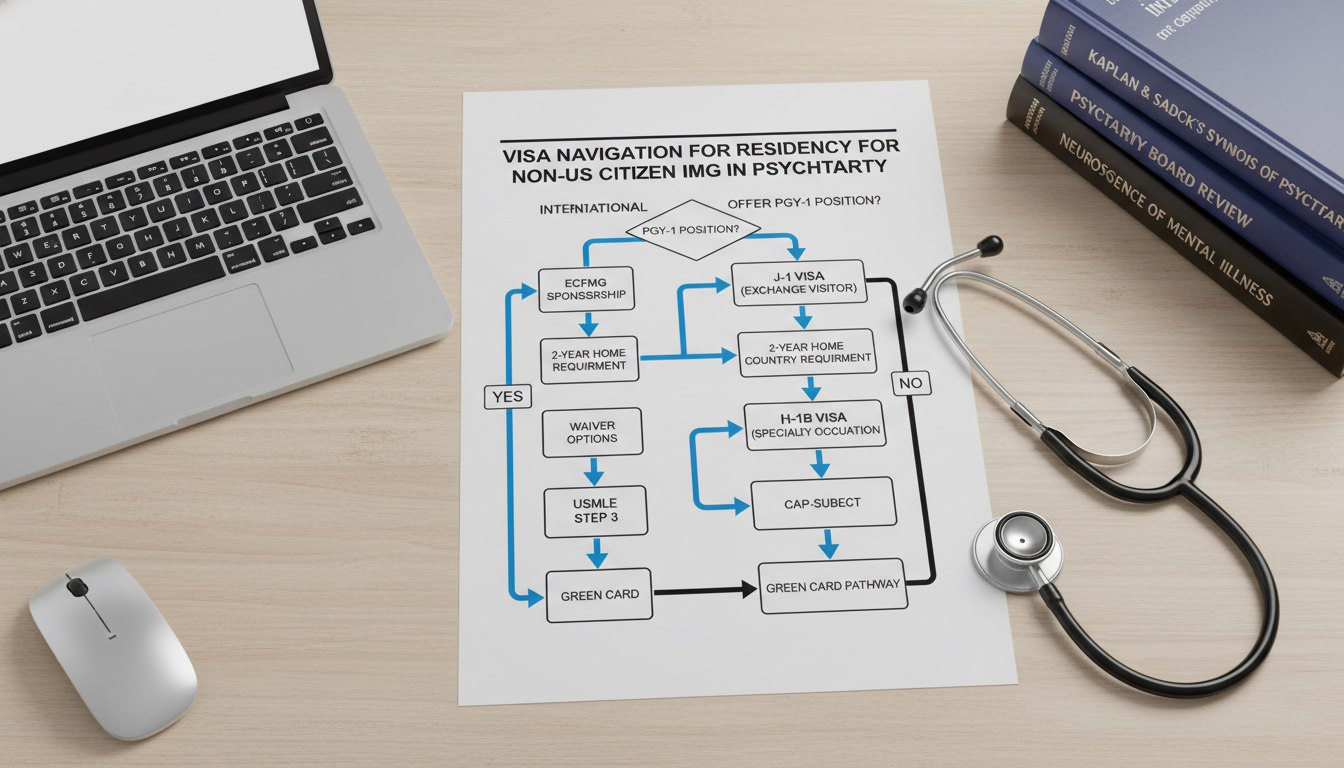
J‑1 vs H‑1B in Psychiatry: Strategic Pros and Cons
Understanding J‑1 vs H‑1B in the context of a psychiatry career is essential for smart planning. Both can get you into residency, but they shape your post‑residency pathway differently.
J‑1 Visa: Pros and Cons for Psychiatry
Advantages:
Widest program availability
- Most psychiatry programs sponsor J‑1.
- This maximizes your psych match list and geographic flexibility.
Simpler for the program
- ECFMG handles sponsor responsibilities.
- Programs are very familiar with J-1 processes, decreasing likelihood of institutional resistance.
Good for residency + many fellowships
- Psychiatry residency is 4 years.
- Popular fellowships (child & adolescent, addiction, forensic, consult-liaison) are usually 1 year; total 5 years, well within 7‑year J‑1 limit.
Structured oversight
- ECFMG provides support, compliance reminders, and maintains your record—useful if you are unfamiliar with US immigration.
Disadvantages:
Two-Year Home Residency Requirement (INA 212(e))
- You must return to your home country for a total of two years after training, unless you get a waiver.
- You generally cannot change to H‑1B or get a green card until this requirement is fulfilled or waived.
J‑1 Waiver Needed for Long‑Term Stay in US
- For psychiatrists, this often means working in an underserved area for 3 years under a waiver program (e.g., Conrad 30, federal programs).
- These jobs can offer good experience but may limit geographic flexibility temporarily.
No “dual intent”
- J‑1 is technically not a dual-intent visa. While many IMGs ultimately transition to permanent residency, you must maintain the appearance of temporary intent when applying or renewing.
H‑1B Visa: Pros and Cons for Psychiatry
Advantages:
No Two‑Year Return Requirement
- You are free from the J‑1 home residency requirement constraint.
- This can simplify your path to green card sponsorship after or even during residency.
Stronger Long‑Term Alignment with US Career Plans
- H‑1B is a dual-intent visa, making it more straightforward to pursue permanent residency.
- Employers (hospitals, academic centers, private groups) are more familiar with H‑1B to green card transitions.
Flexibility After Residency
- You can freely move to different H‑1B sponsoring employers (subject to transfer processes).
- No need for a waiver job unless you previously had J‑1 status.
Disadvantages:
Fewer Psychiatry Programs Sponsor H‑1B
- Limits your program list significantly. Some otherwise ideal programs might be unavailable.
- In a competitive psych match, that restriction can lower your overall match probability.
USMLE Step 3 Requirement Before H‑1B Filing
- You must complete Step 3 early, often before ranking programs or by a strict deadline.
- This can be challenging for IMGs not in the US or without access to US-based clinical/research positions.
Institutional Burden and Cost
- Programs must file with USCIS, pay attorney and filing fees, and comply with Department of Labor rules.
- Some institutions apply internal rules like: “Interns must be on J‑1 only” or “No H‑1B sponsorship for residency, only for faculty.”
Strategic Summary: Which Should a Non-US Citizen IMG in Psychiatry Prioritize?
If your top priority is: “Just match into a good psychiatry residency”
- Be open to J‑1 and apply broadly.
- The larger your target list, the better your psych match chances, especially if your application has any weaknesses (YOG gap, lower scores, limited USCE).
If your top priority is: “Long-term immigration flexibility, green card pathway, and avoiding waiver obligations”
- Consider aggressively pursuing H‑1B‑sponsoring psychiatry programs.
- But maintain a backup plan that includes J‑1 at programs you would be happy to join.
Many strong non-US citizen IMGs adopt a mixed strategy:
- Identify and prioritize H‑1B‑friendly psychiatry programs for early applications and networking.
- Also apply to a wide range of J‑1 programs to protect overall match probability.
How Visa Type Affects Your Psychiatry Match Strategy
Your residency visa preference directly informs:
- Which programs go on your ERAS list
- How early you must take Step 3
- How you discuss visa matters in emails and interviews
Step 1: Researching Programs by Visa Policy
For a foreign national medical graduate in psychiatry, program filtering is essential.
Use these sources:
- FREIDA (AMA): Filter by “accepts J-1”, “accepts H‑1B”.
- Program websites: Look for sections titled “Eligibility & Visa Sponsorship” or “Information for International Medical Graduates”.
- Email the program coordinator (professionally, and briefly) if the policy is unclear.
Sample email:
Subject: Visa Sponsorship for IMG Applicant – Psychiatry Residency
Dear [Coordinator Name],
I am an international medical graduate planning to apply to your psychiatry residency program this cycle. Could you please confirm whether your program sponsors visas for non-US citizen IMGs, and if so, which types (J‑1, H‑1B, or both)?
Thank you very much for your time and assistance.
Sincerely,
[Your Name], MD
Keep a spreadsheet with columns for:
- Program name
- State / city
- J‑1 status (Yes/No)
- H‑1B status (Yes/No)
- Notes (e.g., “H‑1B only after PGY‑1”, “J‑1 preferred”, “no visa sponsorship”)
Step 2: Planning USMLE Step 3 Based on Your Visa Goal
- If aiming for J‑1 only: Step 3 is not required for the visa. You can focus on matching first, then take Step 3 during residency.
- If aiming for H‑1B: Plan to complete Step 3 before programs file your visa, ideally by January–February of the match year, and sometimes even earlier depending on institution timelines.
Practical timeline example for H‑1B aspirants:
- Year -2 / early Year -1: Finish Step 1, Step 2 CK
- Year -1: Apply to psychiatry; schedule Step 3 for late Year -1 or very early match year
- Match year (spring): Program files H‑1B with your Step 3 result in hand
If Step 3 timing is uncertain, prioritize programs that are flexible or open to J‑1.
Step 3: Interview and Rank List Strategy by Visa Type
During interviews:
- Be honest but concise about your visa needs.
- If you are flexible (J‑1 or H‑1B), say so clearly—it can reassure programs.
- Example: “I am eligible for ECFMG-sponsored J‑1 and would also be interested in H‑1B sponsorship where available, but I’m fully comfortable training under J‑1.”
When ranking:
- Balance: Program quality, location, visa type, and your long-term goals.
- For some IMGs, an excellent J‑1 program in a strong academic center outweighs a weaker H‑1B program.
- For others with strong long‑term immigration priorities, an H‑1B program—even if mid-tier—may be strategically better.

Common Scenarios for Non-US Citizen IMGs in Psychiatry
Scenario 1: IMG Living Abroad with No Current US Visa
Profile:
You finished medical school in your home country, passed USMLE Steps 1 and 2 CK, and are applying directly to US psychiatry programs from abroad.
Typical visa path:
- Programs will almost always consider you for ECFMG-sponsored J‑1.
- A smaller subset will consider you for H‑1B if you complete Step 3 early and they have the capacity.
Advice:
- Be open to J‑1 to maximize chances.
- If you specifically want H‑1B, start Step 3 planning very early and heavily target programs known to sponsor H‑1B.
- Pay attention to statement of need requirements from your home country for the J‑1; research your Ministry of Health’s process and timelines in advance.
Scenario 2: Non-US Citizen IMG on F‑1 (US Master’s or Research) or J‑1 Research
Many foreign national medical graduates enter the US first for:
- A master’s (e.g., MPH, MS) on F‑1
- Research fellowships on J‑1 research
Key points:
- F‑1 status with OPT can allow you to work for a limited time post-graduation, but is almost never sufficient for full residency.
- Research J‑1 is different from J‑1 clinical; switching to J‑1 for residency can still trigger a new two‑year home requirement.
Strategic tips:
- Use your time in the US to build strong US clinical experience (USCE) and psychiatry-related research.
- Clarify with immigration counsel and ECFMG how prior J‑1 will interact with a future clinical J‑1.
- Plan early for the transition from F‑1/J‑1 research to a residency visa (J‑1 clinical or H‑1B).
Scenario 3: Caribbean or US-Based IMG (Non-US Citizen)
If you are a non-US citizen IMG who attended a Caribbean or other international school with US clinical rotations:
- You may already hold F‑1, B‑1/B‑2, or no current US status.
- Your match profile often fits well with psychiatry programs.
Visa implications:
- You are still considered a foreign national medical graduate for visa purposes.
- Many programs will see you as “IMG requiring visa sponsorship” regardless of US clinical exposure.
Best practices:
- Clarify your current status and timeline (e.g., when F‑1 ends, whether you’ll have OPT).
- Be realistic about whether you can complete Step 3 before match deadlines if aiming for H‑1B.
- Talk to your school’s international office; they often have up-to-date knowledge about IMG visa options and residency outcomes.
Scenario 4: IMG on a Dependent Visa (H‑4, L‑2, etc.)
If you live in the US because a family member has a work visa:
- Some dependent statuses allow work authorization (EAD)—for example, H‑4 (with conditions), L‑2.
- Technically, you might be able to work as a resident on EAD alone.
However:
- Many GME offices prefer residents to hold a physician-specific visa (J‑1/H‑1B) due to regulatory clarity.
- Some institutions will require you to transition to J‑1 or H‑1B even if you have an EAD.
Action items:
- Discuss with your target programs’ GME offices early.
- Consider consulting an immigration attorney about whether staying on your dependent status or changing to J‑1/H‑1B is best long-term.
Practical Steps & Timeline for Visa Navigation in Psychiatry
12–24 Months Before Match
- Complete USMLE Steps 1 and 2 CK.
- Decide your primary visa goal: J‑1 only, H‑1B only, or flexible.
- Research psychiatry programs and make a visa-policy-filtered list.
- If aiming for H‑1B, plan when to schedule Step 3.
6–12 Months Before ERAS Submission
- Email coordinators of programs with unclear visa policies.
- Strengthen psychiatry-specific experiences: electives, observerships, research.
- Start preparing documents often required for ECFMG J‑1 sponsorship (passport validity, academic documents, etc.).
ERAS Season and Interview Period
- In your CV and personal statement, do not lead with visa needs, but be ready to discuss if asked.
- Clearly state your flexibility when appropriate (“I am eligible and open to J‑1; I am also interested in H‑1B if available and understand the need for Step 3.”).
- Keep track in your spreadsheet of actual responses from programs on visa sponsorship.
Post-Match: Visa Application Logistics
If matched on J‑1:
- Your program will initiate the J‑1 process with ECFMG.
- You will submit required forms and receive a DS‑2019.
- You will attend a visa interview at a US consulate (if abroad).
- You enter the US on J‑1 physician visa and begin training.
If matched on H‑1B:
- Your program and their legal team will file a petition with USCIS.
- You provide Step 3 results, medical license eligibility documents, degree verification, etc.
- After approval, if you are outside the US, you attend a consular interview; if you are inside, you may change status.
Frequently Asked Questions (FAQ)
1. As a non-US citizen IMG, will choosing J‑1 hurt my future career in psychiatry?
Not necessarily. Many successful academic psychiatrists and private practitioners started on J‑1. What changes is your early post‑residency path:
- You will likely need a J‑1 waiver job in an underserved area for about 3 years.
- After that, you can often transition to H‑1B or a green card, then move to other positions.
If you are flexible with location right after training, J‑1 is perfectly compatible with a strong long-term psychiatry career.
2. Can I switch from J‑1 to H‑1B during or after residency?
If you are subject to the two-year home residency requirement, you generally cannot change status in the US to H‑1B or obtain an H‑1B visa abroad until:
- You complete the 2-year physical presence in your home country, or
- You obtain a J‑1 waiver (through programs like Conrad 30, federal agencies, etc.).
Some specialty cases and country-based nuances exist, so individual legal advice is recommended. But in broad terms: J‑1 → H‑1B requires either fulfilling or waiving the 2-year requirement.
3. Is it worth prioritizing H‑1B programs if I’m a strong psych applicant?
It depends on your risk tolerance and long-term goals:
- If you are an exceptionally strong candidate (top scores, strong USCE, research, excellent letters), prioritizing H‑1B programs may still leave you with a good match probability.
- If your application has any vulnerabilities (average scores, older graduation year, limited USCE), narrowing your list to H‑1B-only programs can significantly increase the risk of not matching.
A balanced approach—favoring H‑1B where feasible but keeping J‑1 options—is often safest.
4. Does my home country affect my J‑1 waiver chances as a psychiatrist?
Yes, indirectly. J‑1 waiver opportunities often depend on:
- State Conrad 30 programs: Each state has its own priorities and timelines; some prioritize primary care, but psychiatry is increasingly valued due to shortages.
- Local needs for mental health services: Many underserved regions have a high demand for psychiatrists, which can favorably position you for waiver jobs.
Some countries also have specific policies regarding issuance of statements of need for psychiatry training. Always check your Ministry of Health’s rules early in your planning.
Navigating the residency visa system as a non-US citizen IMG in psychiatry is complex, but with early planning and a clear understanding of J‑1 vs H‑1B, you can make informed choices that support both your psych match success and your long‑term career in the United States.