Understanding the Visa Landscape for Non-US Citizen IMGs in Atlanta
For a non-US citizen IMG planning to train in Atlanta, visa strategy is just as important as your Step scores and letters of recommendation. Atlanta residency programs—especially the large academic centers like Emory, Morehouse, Grady-affiliated programs, and community hospitals across metropolitan Atlanta—host many foreign national medical graduates each year, but their visa policies differ significantly.
Before you apply, you should understand:
- Which visa types are realistically available (J-1, H-1B, and alternatives)
- How your long-term career plans in the US influence the best choice
- How Atlanta- and Georgia-specific factors (like Conrad 30 waivers) affect your path
This article walks through the practical side of visa navigation for residency for non-US citizen IMGs targeting Atlanta, including actionable steps, typical pitfalls, and real-world examples.
Core Visa Types for Residency in Atlanta
1. J-1 vs H-1B: The Two Main Residency Visa Paths
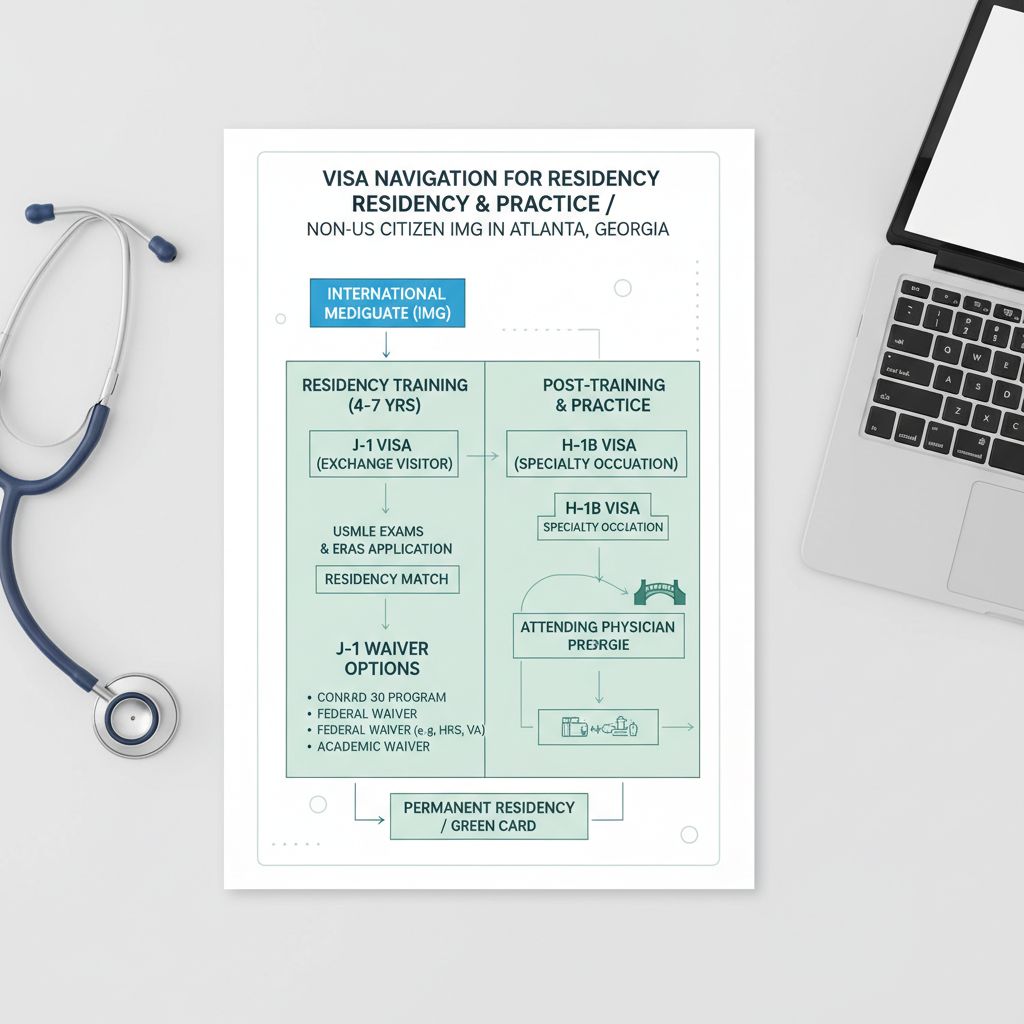
Most foreign national medical graduates in Georgia residency programs will be on either a J-1 exchange visitor visa sponsored by ECFMG or an H-1B temporary worker visa sponsored by the residency program.
J-1 Exchange Visitor (Clinical)
Key features:
- Sponsor: ECFMG (not the hospital directly)
- Duration: Up to 7 years for clinical GME (some exceptions)
- USMLE requirement: You must have passed Step 1, Step 2 CK, and meet ECFMG certification criteria
- Home residency requirement: Typically a 2-year home-country physical presence requirement after completion of training, unless you get a waiver
- Common in Atlanta: Yes. Many Atlanta residency programs sponsor only J-1
Advantages:
- Widely accepted by GME programs
- Centralized process through ECFMG
- Relatively predictable and standardized requirements
Disadvantages:
- 2-year home-country requirement can limit future US options without a J-1 waiver
- Less flexible than H-1B for certain long-term immigration plans
- You cannot moonlight outside the training program
H-1B Temporary Worker (Physician)
Key features:
- Sponsor: The residency or fellowship program directly
- Duration: Up to 6 years total in H-1B status (including residency and fellowship), with complex extension options if pursuing a green card
- USMLE requirement: Must have passed all three Steps (Step 1, Step 2 CK, Step 3) at the time of H-1B filing
- No home residency requirement like J-1
Advantages:
- More compatible with long-term immigration plans (e.g., green card sponsorship)
- No mandatory 2-year home return obligation
- Some programs view H-1B candidates as more likely to remain in their system long-term
Disadvantages:
- Not all Atlanta residency programs sponsor H-1B
- Requires Step 3 before starting residency (timing challenge)
- More complex and expensive for programs (attorney fees, filing fees), so they may have stricter selection thresholds
J-1 vs H-1B in practical terms for Atlanta:
- Many Atlanta residency programs (especially large academic centers) accept both but prefer J-1 for logistical reasons.
- Some community or suburban Georgia residency programs explicitly do not sponsor H-1B.
- A smaller subset will actively consider H-1B for highly competitive candidates, particularly in specialties where they hope to retain graduates long-term.
For a non-US citizen IMG targeting Atlanta, you should research program visa policies before applying and align them with your long-term US plans.
How Visa Choice Affects Long-Term Plans in Georgia
1. Long-Term Practice in the US (Especially Georgia)
If your goal is permanent practice in the US, possibly staying in Atlanta or another part of Georgia after training, your visa path matters.
J-1: Home Residency Requirement and Waiver Options
Under the J-1:
- You must spend 2 years physically present in your home country after training, unless you obtain a J-1 waiver that allows you to stay and work in the US.
Common waiver routes relevant to Georgia:
Conrad 30 waiver (state-based)
- Each US state (including Georgia) can sponsor up to 30 J-1 waivers per year for physicians.
- Typically requires:
- Full-time employment in a designated underserved area (e.g., rural or inner-city shortage area)
- A 3-year service commitment
- Many J-1 IMGs finishing Atlanta programs aim for positions in rural Georgia or underserved areas to secure a Conrad 30 waiver.
Federal program waivers
- Agencies like the VA (Department of Veterans Affairs) or HHS (for certain specialties) can sponsor waivers for service in specific facilities.
- Less common but worth exploring in later stages of training.
Hardship or persecution waivers
- Based on demonstrating exceptional hardship or potential persecution if you return to your home country.
- Highly individualized, complex, and lawyer-intensive.
Practical implication:
If you do residency in Atlanta on a J-1 and then want to stay in Georgia, you’ll likely need to:
- Seek a Conrad 30 or similar waiver job, often in underserved settings
- Complete a 3-year service in that location on an H-1B status
- Only then fully move toward longer-term options (e.g., green card through employer)
H-1B: A More Direct Path
If you complete residency on an H-1B:
- You do not owe any home-country physical presence time.
- You can transition more smoothly to:
- H-1B-attending roles
- Employer-sponsored permanent residency (green card)
However, keep in mind:
- If you spend most of your 6-year H-1B limit in training (residency + fellowship), there may be limited time left for post-training practice unless your employer starts the green card process early enough to allow extensions beyond the 6-year limit under certain rules (e.g., AC21).
Strategic take-away:
- If long-term US practice is your priority, and you can realistically secure an H-1B (Step 3, strong profile, programs willing to sponsor), it can be more straightforward.
- If you are comfortable with potentially working in underserved Georgia or rural areas for a few years post-residency, J-1 with a future Conrad 30 plan can be a viable strategy.
Visa Requirements in Practice: What Atlanta Programs Expect
1. General Expectations for a Foreign National Medical Graduate
Regardless of visa type, an Atlanta residency program will expect:
- Valid ECFMG Certification
- Medical diploma verified
- USMLE Steps passed per ECFMG standards
- Clear visa history
- No serious visa violations or overstays
- Competitive academic and clinical profile
- US clinical experience is particularly helpful in Georgia residency applications
- English proficiency and ability to communicate effectively with a diverse patient population (Atlanta’s patient population is ethnically and socioeconomically diverse)
2. Typical Visa Policies of Atlanta Residency Programs
While policies vary, you may encounter the following patterns:
J-1 only
- Many internal medicine, pediatrics, family medicine, and some surgical programs in Atlanta follow a J-1 only policy.
- Reason: J-1 sponsorship is centralized through ECFMG and easier for institutions administratively.
J-1 primarily, H-1B selectively
- Some larger academic centers may say:
- “We sponsor J-1 visas; H-1B visas may be considered for exceptional candidates.”
- In practice, they might reserve H-1B for:
- Candidates who already passed Step 3
- Subspecialty fellows rather than residents
- Long-term recruits they hope to retain on faculty
- Some larger academic centers may say:
H-1B-friendly programs (still relatively few)
- More likely in certain highly competitive specialties or private/community programs that actively invest in H-1B sponsorship.
- You should verify via:
- Program websites
- Emailing the program coordinator
- Talking to current residents/IMGs on LinkedIn or through alumni networks
3. Timing and Documentation Pitfalls
For IMG visa options, timing is critical:
J-1 timeline:
- After you match, your program issues a training appointment contract.
- You complete ECFMG’s J-1 sponsorship application (Form DS-3035 and related documents).
- ECFMG issues a DS-2019 for visa application.
- You schedule the J-1 visa interview at a US consulate.
H-1B timeline:
- Requires passing USMLE Step 3 early enough for:
- Credential review
- Attorney preparation of the H-1B petition
- USCIS adjudication (Premium Processing often used)
- Can be tight for non-US citizens if Step 3 is left until the last minute.
- Requires passing USMLE Step 3 early enough for:
Advice:
- If you want an H-1B for an Atlanta residency, aim to:
- Pass Step 3 before the Match (ideally by the fall before Match Day)
- Highlight this clearly on ERAS and during interviews
- If you’re comfortable with the J-1 path, you still need to be proactive:
- Organize your home-country documents
- Plan for possible delays at consulates in high-demand seasons
Strategic Planning for Non-US Citizen IMGs Targeting Atlanta
1. Pre-Application Phase: Define Your Visa Priorities
Ask yourself:
Do I envision long-term practice in the US?
- If yes, think carefully about H-1B vs J-1 + waiver.
Am I prepared and able to pass Step 3 before the Match season?
- If yes, H-1B becomes a realistic option.
Am I open to practicing in underserved or rural areas of Georgia for several years after training?
- If yes, J-1 with a future Conrad 30 waiver can be a solid plan.
How risk-tolerant am I regarding immigration complexity and costs?
- H-1B and later green card processes often involve higher personal and institutional costs and legal complexity.
2. Application Phase: Program Selection with Visa in Mind
When building your ERAS list for Atlanta residency programs and the broader Georgia region:
Categorize programs by visa policy
Check each program’s website for:- “We sponsor J-1 visa only”
- “We sponsor J-1 and H-1B”
- “We cannot sponsor visas”
Contact programs if unclear
A brief, professional email to the program coordinator might ask:- “Do you currently sponsor H-1B visas for residents, or J-1 only?”
- “Have you sponsored H-1B for IMGs in the last few cycles?”
Balance your list
Consider:- A core set of programs that explicitly sponsor your preferred visa
- Additional programs that sponsor J-1 (if you are open to both options) to improve Match security
Example approach:
- Your goal: H-1B but open to J-1
- Strategy:
- 10–15 programs in Atlanta/Georgia known to consider H-1B
- 20+ additional J-1-friendly programs in Atlanta and nearby states (Alabama, South Carolina, Tennessee, etc.)
- Ensure you don’t depend on a very small pool of H-1B willing programs only.
3. Interview Phase: Communicating Visa Needs
When interviewing with Atlanta programs:
Be honest but concise:
- “I am a non-US citizen IMG and will require visa sponsorship. I am open to a J-1 and, if your program sponsors H-1B, I would be interested in that as well. I have already passed Step 3.”
or - “I will require J-1 sponsorship; I understand your program typically sponsors J-1 visas through ECFMG.”
- “I am a non-US citizen IMG and will require visa sponsorship. I am open to a J-1 and, if your program sponsors H-1B, I would be interested in that as well. I have already passed Step 3.”
Don’t make visa the main topic:
- Programs want to see genuine interest in their training environment, patient population, and educational strengths.
- Address visa questions when appropriate (often the program will ask or provide information).
Clarify after the interview if needed:
- If your visa policy question remains unclear, you can send a brief follow-up email to the coordinator.
4. Post-Match Phase: Executing Your Visa Plan
Once you match into an Atlanta program:
If J-1:
- Follow your program’s and ECFMG’s checklist precisely.
- Start gathering:
- Passport
- Medical school documentation
- Proof of funding (usually through program contract)
- Any home-country documentation ECFMG requests
If H-1B:
- Cooperate fully with the program’s HR and legal team.
- Provide:
- Step 3 score report
- Credentials and diplomas
- CV and completed forms promptly
- Ask about the target start date and contingencies if USCIS processing is delayed.

Common Scenarios for Non-US Citizen IMGs in Atlanta
Scenario 1: J-1 Resident Matching in Internal Medicine in Atlanta
- You match to an Atlanta internal medicine residency that only sponsors J-1.
- You complete 3 years of IM training.
- During PGY-2 and PGY-3, you:
- Network with physicians practicing in underserved regions of Georgia.
- Search for Conrad 30 waiver-eligible jobs (often primary care in rural or small-city settings).
- After residency:
- You sign a 3-year contract with a rural Georgia clinic.
- The employer files a Conrad 30 J-1 waiver request.
- You change status from J-1 to H-1B through that employer and complete your service.
- Later, the employer can sponsor a green card.
Scenario 2: H-1B Resident in a Competitive Specialty in Atlanta
- You pass Step 3 early and match into a H-1B-sponsoring Atlanta program.
- You complete residency (and possibly fellowship) within the 6-year H-1B limit or secure timely green card sponsorship to extend beyond it.
- Your long-term job search is not constrained by J-1 waiver requirements, giving you broader geographic and practice options (though you still may choose Georgia for family or lifestyle reasons).
Scenario 3: Changing Plans Mid-Residency
- You begin on a J-1 assuming you will return home.
- During residency, you decide you want to stay in the US.
- You now:
- Explore J-1 waiver routes (Conrad 30, VA, hardship, etc.).
- Adjust your career search to prioritize waiver-eligible roles.
- Conclusion: Even if you start residency on J-1 without long-term plans, you often still have pathways to remain in Georgia or the US, but they will shape the type and location of your first job.
Practical Tips and Action Steps
Start visa planning at least one year before applying.
- Understand J-1 vs H-1B in detail.
- Talk with senior IMGs who trained in Atlanta or Georgia.
Use visa policy as a filter for your residency list.
- Don’t waste applications on programs that clearly cannot sponsor your needed visa type.
If aiming for H-1B, prioritize Step 3 early.
- Consider taking Step 3 while you are still in your home country or during US clinical experience (if allowed and feasible).
- Make a realistic schedule for exam preparation.
Stay informed on Atlanta- and Georgia-specific trends.
- Keep an eye on whether Georgia is filling all its Conrad 30 slots each year.
- Learn which regions of Georgia are most open to hiring J-1 waiver physicians.
Work with an experienced immigration attorney when needed.
- Especially important for:
- Complex visa histories
- Changing from J-1 to H-1B via waiver
- Green card planning
- Especially important for:
Document everything carefully.
- Keep digital copies of:
- Passports and visas
- USMLE score reports
- ECFMG certificate
- DS-2019 or I-797 approvals
- This will simplify every subsequent application step.
- Keep digital copies of:
Frequently Asked Questions (FAQ)
1. As a non-US citizen IMG, is it easier to get J-1 or H-1B for an Atlanta residency?
For most IMGs, J-1 is easier and more common for Atlanta residency programs. J-1 is centrally managed by ECFMG and widely accepted. H-1B is possible but requires Step 3, program willingness to sponsor, and additional legal/financial effort from the institution. Many Atlanta residency programs explicitly sponsor only J-1.
2. I want to stay in Atlanta or Georgia long-term. Should I avoid the J-1 visa?
Not necessarily. Many J-1 IMGs train in Atlanta and then stay in Georgia via J-1 waiver jobs, often through the Conrad 30 program or other federal waivers. However, this usually requires a 3-year service commitment in an underserved area, which may not be in central Atlanta. If avoiding that obligation is important, pursuing H-1B residency and longer-term immigration planning might be better—if you can realistically meet the requirements and find an H-1B-supportive program.
3. Can I switch from J-1 to H-1B during residency in Atlanta?
Switching directly from J-1 (clinical) to H-1B during residency is highly constrained because of the 2-year home-country requirement attached to the J-1. Generally, you need either:
- A J-1 waiver (e.g., Conrad 30 or another authorized sponsor) followed by a change to H-1B, typically for a post-residency job, or
- Fulfilling the 2-year home residence requirement.
So, you should assume you’ll stay on J-1 throughout residency and only plan a shift to H-1B after training through a waiver or home-country return.
4. Do all Georgia residency programs support J-1 waivers after graduation?
Residency programs themselves generally do not provide J-1 waivers. J-1 waiver sponsorship typically comes from:
- State health departments (e.g., Georgia’s Conrad 30 program)
- Federal agencies (e.g., VA, HHS in certain contexts)
Your Atlanta residency program may guide and advise you, but the actual waiver support comes from your post-residency employer and the relevant state or federal agency. It’s your responsibility to search for waiver-eligible positions and employers.
Navigating residency visa options as a non-US citizen IMG in Atlanta requires early planning, realistic expectations, and a clear understanding of J-1 vs H-1B implications. By aligning your visa strategy with your long-term career goals and leveraging the specific opportunities available in Georgia residency training and practice, you can build a viable path from Match Day to a stable medical career in the US.