Understanding the Visa Landscape for Non‑US Citizen IMGs in Miami
For a non-US citizen IMG, matching into a residency in Miami combines two complex journeys: succeeding in a competitive academic environment and navigating U.S. immigration law. South Florida offers vibrant clinical training, large underserved populations, and strong academic centers—but also some of the strictest institutional policies around residency visa sponsorship.
This guide focuses on practical, step‑by‑step visa navigation for a non-US citizen IMG or foreign national medical graduate targeting Miami residency programs and the wider South Florida residency ecosystem. You’ll learn the basics of visa types, how Miami programs approach sponsorship, and how to align your application strategy with realistic IMG visa options.
Core Visa Types for Miami Residency Programs
Most Miami programs sponsor or accept only two main visa categories for graduate medical education: J-1 and H-1B. Understanding the differences—especially J-1 vs H-1B—is essential before you start your ERAS list.
1. J-1 Physician Visa: The Standard Route for IMGs
The J-1 physician visa (sponsored exclusively by the Educational Commission for Foreign Medical Graduates – ECFMG) is the most common visa for non-US citizen IMGs entering residency nationwide, including Miami.
Key Features
- Sponsor: ECFMG (not the residency program itself)
- Purpose: Graduate medical education and training
- Length: Usually duration of residency + any approved fellowships; typically up to 7 years total
- Work restriction: You can only work for the training program and in approved training sites
- Two-year home-country physical presence requirement (212(e)):
After completion of training, you must either:- Return to your home country (country of last permanent residence) for an aggregate of 2 years, or
- Obtain a J-1 waiver (e.g., Conrad 30, federal agency waiver) to stay and work in the U.S.
Pros for a Non-US Citizen IMG in Miami
- Most widely accepted: The majority of Miami residency programs that take IMGs sponsor J-1s.
- Easier institutional burden: ECFMG handles sponsorship, so programs often prefer it.
- Faster to initiate: Administrative processes are standardized and predictable.
- Flexible for fellowship: Many universities in South Florida are used to extending J-1 sponsorship into fellowship.
Cons / Limitations
- Home return / waiver requirement: The 212(e) condition can limit future flexibility; you must plan ahead for:
- Returning home, or
- Securing a waiver job (often in underserved or rural U.S. areas)
- No “dual intent”: Technically a non-immigrant visa without presumed intent to immigrate; can complicate some green card strategies.
- No moonlighting outside program: Strictly limited to ECFMG-approved training activities (with rare, very controlled exceptions).
Eligibility Essentials
To obtain a J-1 for residency:
- Have valid ECFMG certification
- Have a contract or formal offer letter from an ACGME-accredited program
- Provide financial documentation (your residency salary typically suffices)
- Demonstrate sufficient English proficiency (via exams already required for ECFMG)
- Submit required forms through OASIS / ECFMG and via the program’s GME office
For a non-US citizen IMG, especially first entering the U.S. for training, J-1 is often the most realistic starting point in Miami.
2. H-1B Visa: Possible, But Limited in Miami
The H-1B is an employment-based, “dual-intent” visa that allows you to work in the U.S. temporarily in a specialty occupation (which includes medicine). In residency, it can be more complex than J-1.
Key Features
- Sponsor: The residency program (employer), supported by the institution’s legal/HR office
- Purpose: Employment in a specialty occupation
- Length: Up to 6 years total (initial period often 3 years, extendable)
- Exam requirement: Must pass USMLE Step 3 before H-1B petition filing for most states/programs
- Dual intent: Allows clearer pathway toward future permanent residency (green card) if employer-sponsored later
Pros for a Foreign National Medical Graduate
- No two-year home return rule: You are not subject to 212(e).
- Dual intent: You can pursue a green card during training if feasible.
- Transition flexibility: Transition to attending positions or fellowships on H-1B or employment-based green card can be more straightforward.
Cons / Limitations
- Fewer programs willing to sponsor:
In Miami and broader South Florida:- Many university hospitals (e.g., large academic centers) default to J-1 only.
- Community-based programs may have more flexibility but often still prefer J-1.
- Administrative and legal costs: Programs pay legal fees and filing costs; some simply don’t have the budget or infrastructure.
- USMLE Step 3 timing: You must pass Step 3 early enough to process the H-1B before July 1 start.
- Cap vs cap-exempt:
- University-affiliated hospitals are often cap-exempt, which is helpful.
- However, not every Miami institution is structured the same; confirming cap-exempt status is crucial.
Street-Level Reality in Miami
- Many Miami residency programs explicitly state on their GME/Residency webpages:
- “We sponsor J-1 visas only” or
- “We do not sponsor H-1B visas for residency.”
- Some programs might accept applicants on H-1B (transfers), but not initiate new H-1B visas for PGY‑1.
- A small subset of programs—particularly in certain specialties (e.g., internal medicine, neurology, psychiatry)—may consider H-1B for exceptional candidates, but this is an exception, not the rule.
If H-1B is a priority for you, you must identify those specific Miami programs early using their websites, FREIDA, and direct GME communications.
3. Other Visa Categories and Why They Rarely Apply
While you may hear about other statuses, for a non-US citizen IMG entering residency in Miami, these are usually not primary options:
- F-1 Student Visa with OPT:
- Sometimes used by graduates of U.S. medical schools or Caribbean schools with U.S. campuses.
- OPT (Optional Practical Training) is typically not enough to cover multi-year residency; programs prefer J-1 or H-1B.
- O-1 “Extraordinary Ability” Visa:
- Rare in residency; sometimes used for research-focused physician-scientists at the faculty level.
- TN (for Canadians/Mexicans), E-2, etc.:
- Typically do not align well with standard GME structures.
In practice, plan your Miami residency path assuming a J-1 vs H-1B decision, and treat other visas as exceptional, niche possibilities.
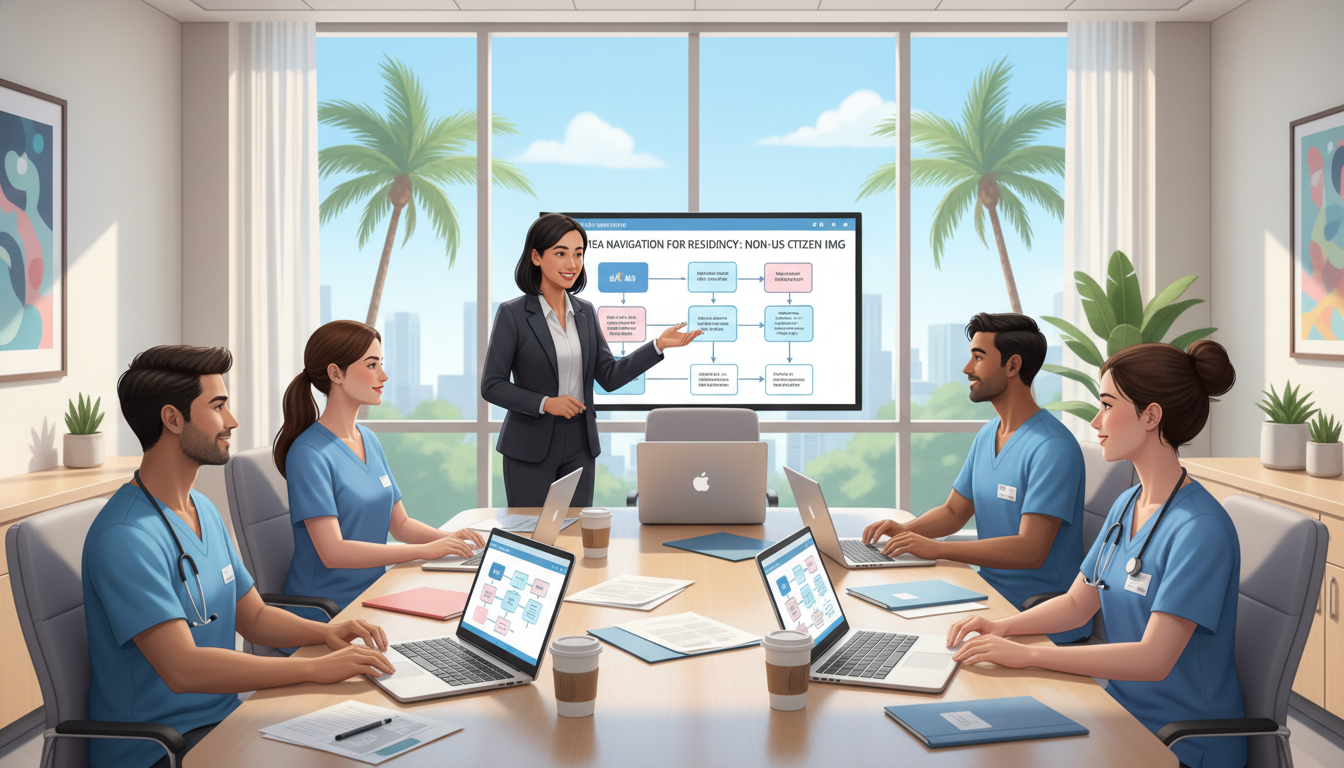
How Miami and South Florida Programs Approach Visa Sponsorship
Miami is home to multiple large academic centers and numerous community hospitals. Each has its own policy and comfort level with residency visas.
1. Common Institutional Patterns in Miami
Most major hospitals and universities in the Miami area:
- Sponsor J-1 visas consistently through ECFMG.
- Limit or avoid H-1B sponsorship for PGY‑1 residents.
- Include specific visa statements on:
- GME office websites
- Departmental residency pages
- FREIDA and other directories
Common wording you’ll see:
- “We sponsor J-1 visas only for international medical graduates.”
- “We do not sponsor H-1B visas for residency training.”
- “Applicants must be U.S. citizens, permanent residents, or eligible for ECFMG-sponsored J-1 visa.”
2. Differences by Program Type
Large Academic Centers (e.g., University-Affiliated Hospitals)
- Often strictly J-1 only policies for residents.
- May sponsor H-1B for fellows or faculty, not for incoming interns.
- Have seasoned GME offices that process large numbers of J-1s yearly.
Community-Based and Smaller Programs
- Can be more variable:
- Some are J-1 only for simplicity.
- Some accept H-1B transfers (IMGs already on H-1B in the U.S.).
- A minority may sponsor new H-1B visas if you meet specific criteria (Step 3 passed, strong profile).
Fellowships in Miami and South Florida
- Greater willingness to consider H-1B for fellows compared with residents.
- If you’re already on J-1 for residency, they’ll often continue J-1 sponsorship instead.
3. How to Research Visa Policies for Miami Residency Programs
Before submitting applications as a foreign national medical graduate, systematically check visa details:
Program Websites (GME + Department)
Search specifically for:- “International medical graduates”
- “Non-US citizen IMG”
- “Visa sponsorship”
- “J-1 vs H-1B”
FREIDA and Residency Explorer
Check the “Visa” or “International Graduates” sections.Direct Email to Program Coordinators
Write a concise, professional message. For example:Dear [Coordinator Name],
I am a non-US citizen IMG interested in your [specialty] residency program. Could you please clarify what types of residency visa you sponsor for matched IMGs (e.g., J-1 only, J-1 and H-1B, or other)? Additionally, do you have any specific requirements for foreign national medical graduates regarding visa or USMLE Step 3 timing?
Thank you for your time and assistance,
[Your Name], [Medical School], [Graduation Year]Connect with Current Residents
Use LinkedIn, program Instagram, or alumni networks. Ask them privately:- What visa they’re on
- How supportive the program was with immigration processes
Document your findings in a spreadsheet for every Miami residency program you consider.
Choosing Between J-1 and H-1B as a Non‑US Citizen IMG in Miami
Your choice (where you have one) should be based on your long-term goals, short-term feasibility, and each program’s actual policy.
1. When J-1 Is Usually the Best (or Only) Choice
For many applicants targeting South Florida residency, J-1 is de facto the primary path:
- You have not taken Step 3 yet, or won’t have results before rank list deadlines.
- You are applying to many competitive Miami programs that are clearly J-1 only.
- You are flexible about working in underserved U.S. areas after residency (for a J-1 waiver).
- You want to maximize your chances of matching in Miami, rather than limiting your options to the few H-1B sponsors.
In these scenarios, choose programs that clearly accept J-1 and build a strong ECFMG-backed application.
2. When H-1B Might Be Worth Pursuing
Consider targeting H-1B residency visa options if:
- You already passed USMLE Step 3 with strong scores.
- You have a long-term plan to remain in the U.S. and want:
- A smoother green card pathway
- To avoid the J-1 two-year home requirement and waiver system
- You identify specific Miami or South Florida residency programs that:
- Explicitly sponsor or accept H-1B for residents
- Have previously trained H-1B IMGs (confirm via residents or alumni)
However, even in this case:
- Apply broadly, including J-1 sponsoring programs in case H-1B positions are unavailable.
- Be prepared that some programs may initially interview you as “visa-flexible” but later limit final offers to J-1 only.
3. Hybrid Strategy: J-1 Now, H-1B Later
Many foreign national medical graduates follow this practical sequence:
Residency on J-1 in Miami
- Gain strong training, build a network, and learn the U.S. healthcare system.
Fellowship on J-1 or H-1B (depending on options)
- In some cases, fellows switch to H-1B if institutions support it.
J-1 Waiver Job or Return Home
- Obtain a waiver job (often on H-1B) in an underserved area after fellowship, which also aligns with many hospital recruitment needs.
- Alternatively, return to home country for the two-year period then explore future U.S. options or global opportunities.
For many non-US citizen IMGs, this hybrid route balances feasibility (J-1 now) with long-term career aims.

Step‑by‑Step Visa Navigation Through the Residency Application Timeline
Align your visa planning with each stage of the residency match cycle to avoid surprises.
Step 1: Pre‑Application (6–18 Months Before ERAS)
- Clarify your immigration status:
- Are you outside the U.S., on a visitor visa, or studying on F-1?
- Are you already on an H-1B or other status?
- Complete USMLE exams:
- Step 1 and Step 2 CK at minimum for ECFMG certification.
- Step 3 if you are seriously pursuing H-1B–only programs.
- Research Miami visa policies thoroughly:
- Create a list of programs with columns for:
- Accepts IMGs? (Y/N)
- Visa types: J-1 / H-1B / both / none
- Special notes: “Requires Step 3 for interview,” “J-1 only,” etc.
- Create a list of programs with columns for:
Step 2: ERAS Application Season
- In your personal statement or CV, you may mention:
- “Eligible for ECFMG-sponsored J-1 visa”
- If applicable: “USMLE Step 3 passed; eligible for H-1B sponsorship”
- When invited to interview:
- Confirm visa sponsorship policy politely before traveling for in-person interviews or committing significant time.
- If you are flexible between J-1 and H-1B, say so clearly.
Step 3: Rank List Strategy
- Prioritize programs that:
- Explicitly confirm they will support your needed visa.
- Have a track record of successful IMG visa processing.
- Avoid ranking programs where:
- Visa policy is ambiguous or
- They “might consider” sponsorship but won’t commit clearly.
Step 4: After Match – Visa Processing
If matched to a J-1 sponsoring program in Miami:
- The GME office sends:
- Appointment letter/contract
- Instructions for ECFMG J-1 sponsorship application (Form DS-2019 process)
- You submit required documents via ECFMG:
- Passport, medical diploma, ECFMG certificate, financial support, etc.
- Once DS-2019 is issued:
- Book a U.S. consular appointment in your country for the J-1 visa stamp.
- Prepare for interview (typical questions: purpose of visit, training program, ties to home country).
If matched to an H-1B sponsoring program:
- Program initiates petition with its legal counsel:
- Labor Condition Application (LCA)
- H-1B I-129 petition filing (cap-exempt if a qualifying institution)
- You provide:
- Degree proof, ECFMG certificate, USMLE Step 3 proof, licensing eligibility, etc.
- After approval (I-797 notice):
- You apply for an H-1B visa stamp at a U.S. consulate (if outside U.S.).
Throughout, stay in close contact with:
- Program coordinator
- GME office
- ECFMG (for J-1)
- Employer’s immigration attorney (for H-1B)
Practical Tips and Common Pitfalls for Non‑US Citizen IMGs in Miami
1. Be Honest and Consistent About Your Visa Status
- Do not misrepresent past overstays, denials, or prior visa history.
- Discrepancies surface during security checks and can jeopardize both the visa and residency position.
2. Prioritize Programs Where Your Visa Type Is Welcome
For a non-US citizen IMG, prestige is not everything. A realistic Miami strategy may be:
- Target a broader set of South Florida residency programs that explicitly welcome IMGs and sponsor J-1.
- Include a few H-1B-friendly programs if Step 3 and your profile support it.
- Avoid wasting resources on programs that:
- Rarely take IMGs
- Have unclear or restrictive visa policies
3. Plan Early for J-1 Waiver or Post‑Training Pathways
If you choose J-1, start thinking about the two-year home requirement during residency:
- Explore Conrad 30 waiver opportunities (each state has its rules; Florida’s are competitive).
- Network with attendings and alumni who took J-1 waiver jobs.
- Consider whether you’d be willing to train in Miami but later work in another U.S. state for a waiver.
4. Leverage Miami’s International Nature—but Don’t Rely on It
Miami is highly international, with many Spanish-speaking and Caribbean communities. This can help your clinical experience and patient rapport. However:
- Immigration enforcement and visa rules are federal, not local.
- Being in Miami does not mean immigration is “easier”; institutional policy still rules.
5. Use Professional Help When Needed
If your case is complex (prior visa denials, immigration violations, status changes), consult:
- A qualified U.S. immigration attorney with healthcare and J-1/H-1B experience.
- Do this before the Match if possible, especially if you suspect any red flags.
FAQ: Visa Navigation for Non‑US Citizen IMGs in Miami
1. As a non-US citizen IMG, can I choose freely between J-1 and H-1B for Miami residency?
Not usually. Most Miami residency programs define their own policies. Many sponsor J-1 only, regardless of your Step 3 status. A smaller number offer H-1B in specific situations. Your “choice” is essentially shaped by which programs you apply to and which ones rank you.
2. Do Miami programs favor J-1 over H-1B for IMGs?
Yes, in general. J-1 is administratively simpler because ECFMG is the sponsor, and institutions in South Florida often have established J-1 pipelines. H-1B implies higher legal cost and responsibility for the hospital, so it is inherently more restricted. Some Miami institutions may reserve H-1B mainly for faculty or fellows.
3. If I start residency on a J-1 in Miami, can I switch to H-1B during training?
It’s uncommon and depends on multiple factors: your program’s willingness, ECFMG rules, and your immigration history. Switching mid-residency can also complicate your J-1 two-year rule and waiver options. Most IMGs either complete residency fully on J-1 or secure H-1B later for a waiver job or faculty position.
4. Are visa options different for Caribbean graduates applying to Miami compared to other IMGs?
If you are a foreign national medical graduate from a Caribbean school, your citizenship, not your school’s location, determines your status as a non-US citizen IMG. Many Caribbean grads initially hold F-1 or other student visas; however, for residency in Miami, you usually still need a J-1 or H-1B. Some schools help bridge F-1 to J-1, but institutional residency visa policy in Miami remains the key factor.
By understanding J-1 vs H-1B, carefully researching each Miami residency program’s sponsorship policies, and aligning your long-term immigration goals with realistic IMG visa options, you can make informed, strategic decisions as a non-US citizen IMG seeking South Florida training.