Orthopedic surgery is one of the most competitive specialties in the United States. For international medical graduates (IMGs), the challenge is twofold: excelling in a very selective ortho match while also navigating complex residency visa rules. Understanding IMG visa options and planning early can determine whether even a strong applicant is rankable and employable.
This guide walks you step-by-step through visa navigation for orthopedic surgery residency in the U.S.—from J-1 vs H-1B decisions to how visa status affects program selection, match strategy, and long-term career plans.
The Big Picture: Why Visa Strategy Matters So Much in Orthopedic Surgery
Orthopedic surgery residency in the U.S. is competitive for everyone, but it is particularly challenging for IMGs because:
- Many orthopedic surgery programs do not sponsor visas at all
- Some programs sponsor only J-1, while a much smaller subset sponsor H-1B
- Orthopedic training is long and often followed by fellowship(s), extending the time you’ll be in training status
- Employers and state licensure boards may have specific requirements affected by your visa history
Because of this, two IMGs with identical academic profiles can have very different match outcomes simply based on visa eligibility and planning.
A smart visa strategy helps you:
- Identify which orthopedic programs you can realistically apply to
- Avoid last-minute surprises (e.g., getting ranked but later being told they can’t sponsor your visa)
- Plan for fellowship and early career in the U.S.
- Position yourself for potential long-term immigration options (e.g., permanent residency)
Key principle: In a competitive specialty like orthopedic surgery, you cannot afford to “figure out the visa later.” You must design your ortho match strategy around realistic visa pathways from the start.
Core Visa Options for Orthopedic Surgery Residency
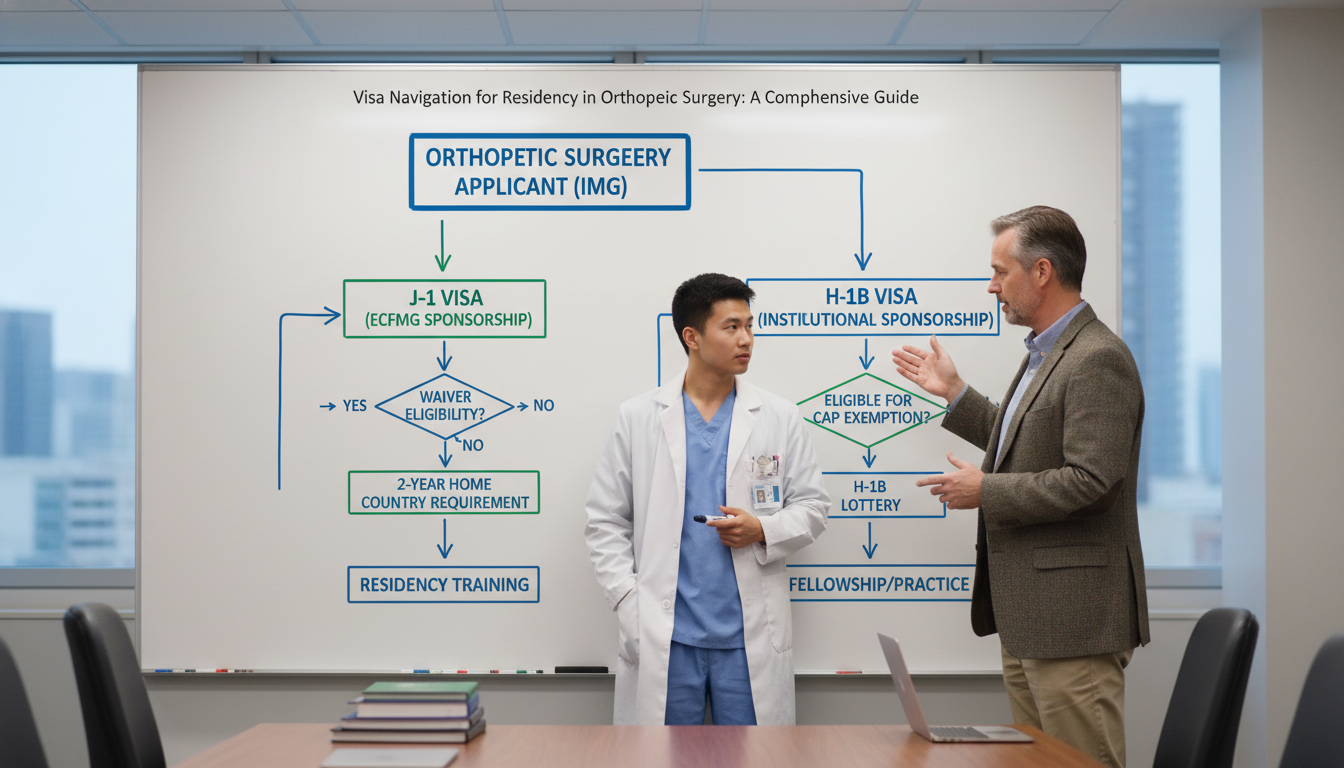
For IMGs, two primary visa types are used during graduate medical education (GME) in the U.S.:
- J-1 Exchange Visitor (ECFMG-sponsored)
- H-1B Temporary Worker (employer-sponsored)
Each has major implications for your training and career trajectory.
J-1 Visa for Orthopedic Surgery Residency
The J-1 is the most commonly used visa for IMGs in residency and fellowship. For orthopedic surgery, it is often the only visa some programs will sponsor.
Key characteristics:
- Sponsored by ECFMG, not directly by the residency program
- Specifically for graduate medical education
- Tied to your participation in an accredited training program
- Requires you to return to your home country for 2 years after training or obtain a waiver
Advantages for orthopedic IMGs:
Widest availability
- Many orthopedic surgery programs that take IMGs will accept J-1 but not H-1B.
- Easier for programs administratively, since ECFMG manages much of the process.
Suitable for multiple training stages
- Can be used for residency plus one or more orthopedic subspecialty fellowships (sports, spine, trauma, hand, joints, etc.), as long as ECFMG eligibility and time limits are respected.
Predictable for training
- As long as you remain in good standing in your program and meet ECFMG requirements, extensions from year to year are usually straightforward.
Challenges and limitations:
Two-Year Home Country Physical Presence Requirement
- After completing all J-1–sponsored training (residency and fellowships), you must either:
- Spend 2 years physically in your home country, or
- Obtain a J-1 waiver (commonly via service in a designated shortage area, often primary care or general specialties).
For orthopedic surgeons, finding J-1 waiver jobs can be more challenging than for primary care, though some waiver positions do exist.
- After completing all J-1–sponsored training (residency and fellowships), you must either:
Transition to practice is less flexible
- To start an attending job in the U.S. immediately after training, you usually must:
- Secure a J-1 waiver position (e.g., Conrad 30–type roles if available for ortho in that state), or
- Leave the U.S. for 2 years and then return on a different visa.
- To start an attending job in the U.S. immediately after training, you usually must:
Limited dual-intent recognition
- J-1 is not a true dual-intent visa (unlike H-1B). Pursuing permanent residency (green card) while on J-1 can be complex until the two-year requirement is resolved or waived.
Practical considerations for orthopedic aspirants:
- If you plan to do multiple fellowships (e.g., trauma and sports), J-1 is often the logistically simpler and more available option for training.
- However, you must plan very early for how you will handle the 2-year requirement or waiver process once training ends.
H-1B Visa for Orthopedic Surgery Residency
The H-1B is a temporary work visa that recognizes dual intent (you may pursue permanent residency later). For orthopedic surgery residency, it is less common but highly valuable if you can secure it.
Key characteristics:
- Employer-sponsored: your residency program or hospital must file the petition
- Requires that you already have passed USMLE Step 3 by the time of H-1B filing in most states
- Initially granted for up to 3 years, extendable to a maximum of 6 years in total
- Allows dual intent, making future green card pathways easier
Advantages for orthopedic IMGs:
No two-year home-country requirement
- Unlike J-1, you can complete residency (and, in some cases, fellowship) and then:
- Transition directly to an attending position on H-1B (with a new employer), and
- Move toward employer-sponsored permanent residency (e.g., EB-2) more smoothly.
- Unlike J-1, you can complete residency (and, in some cases, fellowship) and then:
Favorable for long-term U.S. practice
- Especially helpful if your goal is to build a long-term orthopedic career in the U.S. without an enforced return home.
Dual intent
- You can clearly plan for green card strategies during fellowship or early years of practice.
Challenges and limitations:
Fewer programs sponsor H-1B for orthopedic surgery
- Many ortho programs exclude H-1B due to:
- Higher administrative burden and legal costs
- Step 3 requirement timing
- Concerns about the 6-year maximum given ortho + potential fellowships
- Many ortho programs exclude H-1B due to:
Step 3 timing is critical
- For H-1B, you typically must:
- Pass USMLE Step 3 before visa filing, often before residency start (July 1), and sometimes even before rank lists are due.
- This timeline is tight, especially for IMGs just finishing med school or internship abroad.
- For H-1B, you typically must:
The 6-year cap and extended training
- Orthopedic residency (5 years) + fellowship (1–2 years) can approach or exceed the H-1B 6-year limit.
- Some trainees maintain J-1 for residency/fellowship, then later use H-1B only in independent practice to preserve years.
Practical example:
- An IMG matched into a 5-year orthopedic residency on H-1B. By PGY-4, they decide to do a 1-year sports medicine fellowship also on H-1B:
- Residency (5 years) + fellowship (1 year) = 6 years total.
- They must plan carefully with immigration counsel and their future employer if they want additional H-1B time or transition to a green card.
Choosing Between J-1 vs H-1B for Orthopedic Surgery
For many orthopedics-bound IMGs, the primary strategic question is: J-1 vs H-1B. There is no universal right answer; it depends on your profile, goals, and realistic program options.
Factors to Consider
Competitiveness and Program Availability
- In orthopedics, many programs:
- Do not accept IMGs at all, or
- Accept them only on J-1
- A smaller subset are open to H-1B sponsorship
If you insist on H-1B only, you might reduce your already limited ortho match pool substantially.
Practical takeaway:
- Investigate each target program’s stance on “residency visa” sponsorship:
- J-1 only
- J-1 and H-1B
- No visa sponsorship
- In orthopedics, many programs:
Your Step 3 Status
- If you have not taken or passed Step 3 by the time of application:
- J-1 is realistically the primary path for your first match cycle.
- If you have Step 3 passed early:
- You are more competitive for H-1B–sponsoring orthopedic programs.
- If you have not taken or passed Step 3 by the time of application:
Your Long-Term Career Plans
- If your primary goal is to return to your home country as an orthopedic surgeon:
- J-1 is often simpler and well aligned with eventual home-country practice.
- If your goal is long-term U.S. practice and possible permanent residency:
- H-1B, when available, provides more straightforward avenues after training.
- But you may need to compromise on the number or prestige of programs you can apply to, given orthopedic competitiveness.
- If your primary goal is to return to your home country as an orthopedic surgeon:
Risk Tolerance and Flexibility
- Opting for H-1B-only applications:
- May strengthen your long-term immigration position if you match,
- But dramatically reduces your number of potential ortho programs.
- Being open to J-1:
- Expands your program list,
- But requires careful planning for J-1 waiver or eventual two-year return.
- Opting for H-1B-only applications:
Common Real-World Strategies
Strategy 1: Open to J-1 or H-1B (maximize match chance)
- Apply to all orthopedic programs that:
- Accept IMGs, and
- Sponsor either J-1 or H-1B.
- Accept that you may end up on J-1, then:
- Plan early for fellowship + waiver options if you want to stay in the U.S.
- Apply to all orthopedic programs that:
Strategy 2: H-1B priority (long-term U.S. plan)
- Take and pass USMLE Step 3 early.
- Focus applications on programs that offer H-1B in orthopedic surgery.
- Consider:
- Applying to preliminary surgical years or research positions to strengthen your profile and allow time to pass Step 3, then apply again more strongly positioned for H-1B.
Strategy 3: J-1 for training, later H-1B for practice
- Use J-1 for residency and any desired fellowships.
- After training:
- Obtain a J-1 waiver job (ideally in orthopedic surgery if available in your specialty/region),
- Work on an H-1B with that employer while they pursue your green card.
How Visa Status Shapes Your Ortho Match Strategy
Your visa needs influence nearly every step of the orthopedic residency application and match process.
Step 1: Researching Programs’ Visa Policies
Before building your application list, verify:
- Does the program:
- Sponsor visas at all?
- Sponsor only J-1?
- Sponsor H-1B (and have a track record of doing so)?
- Does the program:
- Have current or recent orthopedic residents who are IMGs?
- List visa information clearly on their website or FREIDA profile?
Action tips:
- Use FREIDA, program websites, and email or call coordinators to clarify:
- “Do you consider IMGs?”
- “What residency visa options do you sponsor for orthopedic surgery residents (J-1 vs H-1B)?”
- Keep a spreadsheet tracking:
- Program name
- IMG friendliness (Y/N)
- Visa sponsorship type
- Any special notes (e.g., Step 3 required for H-1B)
Step 2: Timing of Exams and Documentation
Your exam timing must match your visa strategy:
For J-1:
- USMLE Step 1 and Step 2 CK are essential for ECFMG certification.
- Step 3 is not required for J-1, but may help your competitiveness in orthopedics.
For H-1B:
- In most cases, USMLE Step 3 must be passed before H-1B petition filing.
- Some programs require Step 3 before ranking an IMG for an H-1B position.
- Given how early orthopedics interviews and rank lists occur, this usually means:
- Step 3 must be passed by late fall or early winter of the application cycle, or even sooner.
Practical example timeline:
- Graduate from med school abroad in June Year 0
- Complete internship abroad Year 0–1
- Take Step 3 during Year 1 (before application in September Year 1)
- Apply to orthopedic residency for a Year 2 July start with H-1B possible
Step 3: Communicating Your Visa Needs Early
- Use your ERAS application to accurately specify your citizenship, current status, and visa needs.
- If a program’s policy is unclear:
- Address it politely via email once you are invited for an interview:
- “I am an IMG who will require visa sponsorship. Could you please confirm whether your program sponsors J-1 and/or H-1B visas for orthopedic surgery residents?”
- Address it politely via email once you are invited for an interview:
Demonstrating clarity and honesty about your visa needs can build trust and reduce unpleasant surprises later.
Step 4: Ranking Strategy with Visa in Mind
When preparing your rank list:
- Consider both:
- Program quality, fit, case volume, and subspecialty exposure
- Visa type and long-term implications
Some questions to ask yourself:
- Am I comfortable with a J-1 and the two-year requirement or waiver process later?
- Is this program’s willingness to sponsor H-1B reliable (e.g., do they currently have H-1B residents)?
- Will my visa type affect my ability to:
- Do a fellowship at a top program?
- Start practice promptly after training?
In orthopedics, where matching at all is challenging, many IMGs prioritize simply matching—even on J-1—then plan to solve the long-term immigration piece later.
Beyond Residency: How Visa Affects Fellowship & Early Orthopedic Career
Orthopedic surgery frequently includes one or more fellowships, and the visa you use in residency can constrain or expand your options later.
Fellowship on J-1
- Many U.S. orthopedic fellowships are open to J-1 holders.
- ECFMG will continue sponsoring J-1 for accredited fellowships as long as:
- You remain in good standing, and
- You haven’t exceeded the allowed duration for clinical training (usually sufficient for residency + 1–2 fellowships).
However:
- Once all your J-1 training is done:
- The two-year home-country requirement kicks in (unless you obtain a waiver).
Planning questions:
- Will the fellowship institution also support J-1?
- Are you considering multiple fellowships (e.g., trauma then spine)? You must ensure you can maintain continuous J-1 status through each.
Fellowship on H-1B
Fellowships for orthopedics may or may not support H-1B:
- Some academic centers are comfortable with H-1B for subspecialty fellows.
- Others rely exclusively on J-1 for international fellows.
Concerns:
- H-1B 6-year limit may significantly constrain how much training you can undertake if starting residency already on H-1B.
- You might need:
- To switch from H-1B to J-1 for fellowship (complex and not always feasible), or
- To prioritize the single fellowship most aligned with your long-term goals.
Transition to Practice and the J-1 Waiver Question
If you finish orthopedic training on J-1 and want to stay in the U.S.:
- You will typically need a J-1 waiver position:
- Often in medically underserved or shortage areas.
- Historically more available for primary care, but some orthopedic opportunities exist depending on region and state policy.
Once you get a waiver:
- You usually work 3 years in the waiver position under:
- An H-1B sponsored by that employer
- During which they may sponsor you for a green card.
If you don’t get a waiver:
- You must return to your home country for a total of 2 years before you can come back on another visa (like H-1B or immigrant visa).
Practical Planning Checklist for Orthopedic IMG Applicants
Use this as a stepwise guide while you prepare for the ortho match.
1. Clarify Your Long-Term Goals
- Do you intend to:
- Return home after training?
- Build a long-term orthopedic career in the U.S.?
- Are you planning on:
- One fellowship?
- Multiple fellowships?
- An academic career vs private practice?
This will shape your tolerance for J-1 vs H-1B trade-offs.
2. Map Your Exam Strategy
- Complete Step 1 and Step 2 CK as early as possible.
- Decide if you will:
- Attempt Step 3 before your first application cycle (necessary for most H-1B paths), or
- Focus on matching via J-1 in your first attempt and consider Step 3 later.
3. Build a Realistic Program List
- Filter orthopedic programs by:
- Visa sponsorship (J-1, H-1B, both, or none)
- Past acceptance of IMGs
- Geographic preferences and personal constraints
- Maintain an updated spreadsheet; policies can change year to year.
4. Communicate Clearly with Programs
- When invited for interviews, politely clarify:
- “For planning purposes, may I ask which visa types your program currently sponsors for orthopedic residents?”
- Be fully honest about:
- Your citizenship
- Current U.S. immigration status, if any (F-1, B-1/B-2, etc.)
- Your need for sponsorship
5. Consult an Immigration Attorney Early
- Especially if:
- You have complex prior U.S. status (e.g., F-1 with OPT, previous J-1, pending immigrant petition), or
- You are deciding whether to pursue H-1B from the start in a long training path like orthopedics.
- An attorney can:
- Evaluate your full history
- Project whether H-1B duration will suffice for residency plus fellowship
- Outline green card strategies compatible with your training path
(Note: This article is for educational purposes only and is not legal advice. Always consult a qualified immigration attorney for case-specific guidance.)
FAQs: Visa Navigation for Orthopedic Surgery Residency
1. As an IMG, can I match into orthopedic surgery residency in the U.S. if I need a visa?
Yes, but it is very competitive and your options are more limited. Some programs take IMGs on J-1, and a smaller number sponsor H-1B. You need a targeted strategy: strong scores, U.S. orthopedic electives or research, and a carefully curated list of visa-friendly programs.
2. Is it better to aim for J-1 or H-1B for orthopedic surgery residency?
“Better” depends on your goals and constraints. J-1 is more widely supported and may give you more program options in a competitive field. H-1B provides more straightforward long-term U.S. career and green card pathways but requires early Step 3 and significantly narrows your program list. Many orthopedic IMGs remain open to both, then plan around the visa type after match.
3. Can I do an orthopedic fellowship in the U.S. after residency on a J-1 visa?
Yes. ECFMG commonly continues J-1 sponsorship for ACGME-accredited orthopedic fellowships as long as you remain within time limits and continue in approved training. Remember that once all J-1 training is complete, the two-year home-country requirement applies unless you obtain a J-1 waiver.
4. If I complete orthopedic residency on H-1B, will I have enough time left for fellowship and then practice?
You have a total of 6 years on H-1B in the U.S. A 5-year orthopedic residency already uses most of this period. Adding a 1-year fellowship often consumes the full 6 years. To continue working afterward, you’ll typically need either:
- A pending or approved green card (which can extend H-1B beyond 6 years in some cases), or
- A change in status strategy designed with an immigration attorney.
Because of this, long training paths like orthopedics require particularly careful H-1B planning.
By understanding the visa landscape early—especially the nuances of J-1 vs H-1B in the context of a long, competitive specialty—you can approach the orthopedic surgery residency application process with realistic expectations, stronger strategy, and fewer surprises.