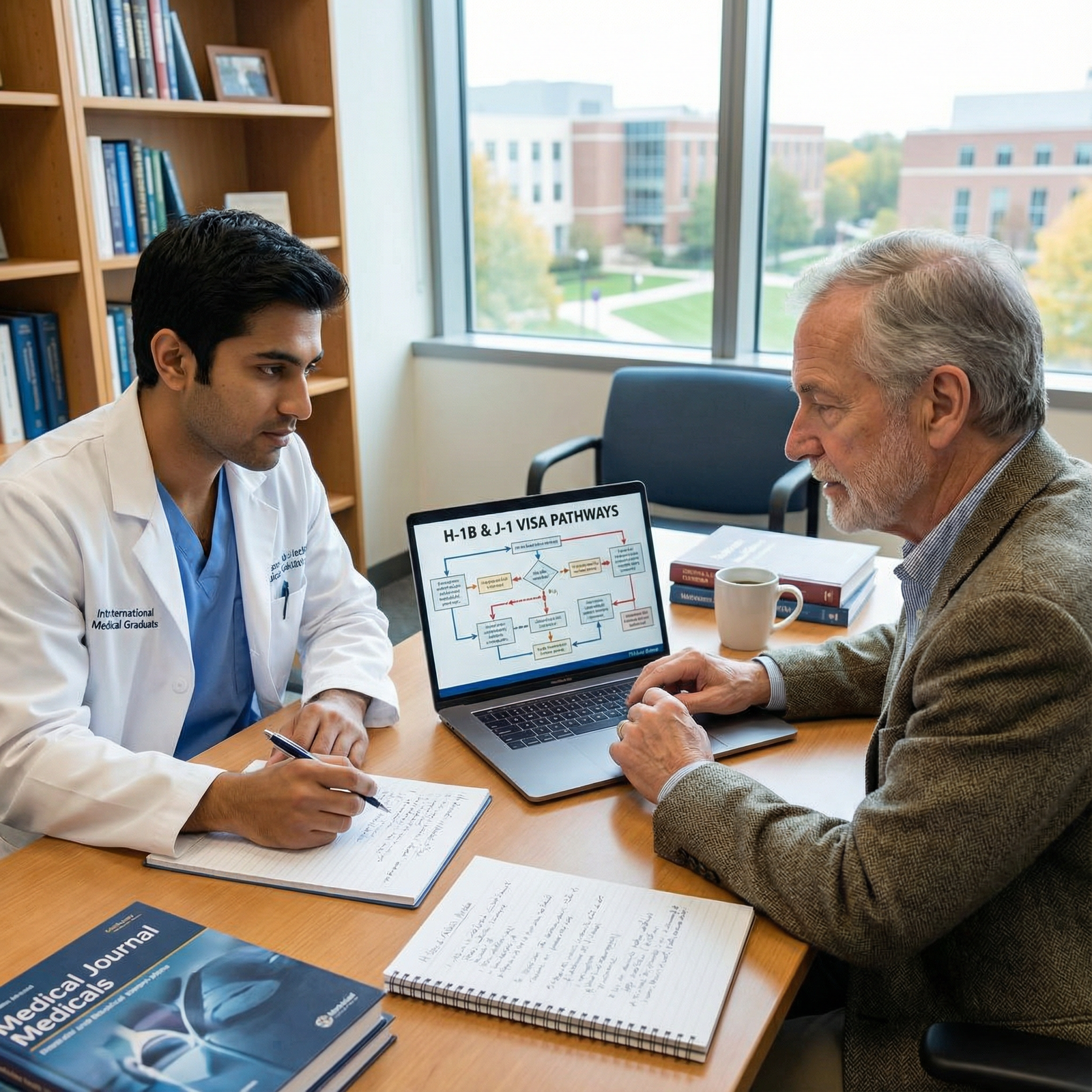
Navigating visas while planning a plastic surgery residency in the United States is complex, high‑stakes, and often confusing—especially for international medical graduates (IMGs). The integrated plastics match is among the most competitive in all of residency training, and misunderstandings around residency visa requirements can silently undermine an otherwise strong application.
This guide walks you through the key visa pathways, how they intersect with plastic surgery residency programs, and practical steps to keep your journey on track.
Understanding the Landscape: Plastic Surgery Residency and Visas
Plastic surgery in the U.S. is offered through:
- Integrated Plastic Surgery Residency (Integrated Plastics Match) – a 6-year program beginning directly after medical school.
- Independent Plastic Surgery Residency – a 3-year training path after completion of prerequisite surgery training (e.g., general surgery). This pathway is now smaller but still relevant for some IMGs.
For IMGs, two realities shape visa strategy:
Plastic surgery is ultra‑competitive.
- US MD seniors dominate integrated plastics positions.
- IMGs (US-IMGs and non-US IMGs) match in smaller numbers.
- Programs are risk‑averse and often prefer applicants whose visa status is straightforward and predictable.
Visa policy is program‑dependent.
- Some programs sponsor only J‑1.
- Others accept H‑1B for residency.
- A minority restrict all trainees to US citizens or permanent residents.
- Policies for H‑1B vs J‑1 can change year to year.
Key implication: You must plan visa strategy together with an honest assessment of competitiveness in plastic surgery and an understanding of which programs align with your status.
Core Visa Options for Plastic Surgery Residency
The most relevant visa categories for plastic surgery residency are:
- J‑1 (Exchange Visitor Physician)
- H‑1B (Temporary Worker in Specialty Occupation)
- F‑1 (Student) with OPT, as a bridge in certain situations
- Less commonly: O‑1, TN (for Canadians/Mexicans), and E‑2/E‑3, which can affect long‑term planning.
J‑1 Visa for Residency: The Default Pathway for IMGs
The J‑1 physician visa, sponsored by the Educational Commission for Foreign Medical Graduates (ECFMG), is the most common visa for IMGs entering GME (graduate medical education).
Key features:
- Purpose: Graduate medical education or training (residency/fellowship).
- Sponsorship: ECFMG, not the individual hospital.
- Duration: Up to 7 years total for clinical training (occasionally extended under strict criteria).
- Requirement: Return to home country (or last permanent residence) for two years after training unless you obtain a waiver.
J‑1 Pros for Plastic Surgery Residency
- Widely accepted: Most university and academic medical centers accept or prefer J‑1 for IMGs.
- Standardized process: ECFMG sponsorship is familiar to GME offices.
- Quicker setup: Often easier institutionally than creating a new H‑1B line.
J‑1 Cons for Plastic Surgery Residency
- Two‑year home residency requirement (HRR):
- After your integrated plastics residency (6 years), and possibly a fellowship, you must return home for 2 years or secure a waiver.
- This can delay US-based practice, subspecialty fellowships, or permanent residence plans.
- Limited duration: A 6-year integrated plastic surgery residency uses almost all of your 7-year cap, leaving little room for extra fellowships.
- Waiver is not guaranteed:
- J‑1 waiver programs (e.g., Conrad 30) are usually for primary care and certain hospital‑based specialties in underserved areas.
- Plastic surgery positions in J‑1 waiver-eligible sites are rarer, though not impossible (e.g., academic or regional centers serving large underserved populations).
When J‑1 Makes Strategic Sense for Plastics
- You are early in the process and open to:
- Returning to your home country for at least 2 years after training, or
- Practicing in the U.S. under a waiver in a location that may not be your ideal geography or practice type.
- Your primary goal is maximizing the chance of any U.S. plastics training, and visa flexibility matters more than permanent immigration timing.
- You plan to apply widely, including to programs that only sponsor J‑1.
H‑1B Visa for Residency: More Control, More Complexity
The H‑1B visa is a dual‑intent, employment-based visa used by some residency programs for trainees.
Key features:
- Sponsorship: Individual institution sponsors you as a “temporary worker in a specialty occupation.”
- Exempt from cap: Most teaching hospitals are cap‑exempt, avoiding the H‑1B lottery.
- Duration: Up to 6 years in most cases, with extensions possible in certain green card stages.
- Dual intent: You can pursue permanent residency (green card) while on H‑1B without the 2-year HRR complication of J‑1.
H‑1B Pros for Plastic Surgery Residency
- No two-year home return requirement: You can transition directly from residency to:
- Fellowship,
- Attending H‑1B employment, or
- Green card processes.
- Predictable for long programs: A 6-year integrated plastics program fits entirely within the 6-year H‑1B cap, assuming good planning.
- Better aligned with long‑term U.S. practice plans: Particularly helpful if you anticipate private practice or academic work in the U.S. immediately after training.
H‑1B Cons for Plastic Surgery Residency
- Not universally sponsored:
- Many integrated plastic surgery residency programs do not sponsor H‑1B for PGY-1.
- Independent plastics (starting at PGY-6+) programs may be somewhat more open, but policies vary.
- USMLE Step requirements:
- Most programs sponsoring H‑1B for residents require all USMLE Steps passed, including Step 3, before starting residency.
- Achieving a strong Step 3 performance before the match is a significant time and financial investment.
- Institutional workload and cost:
- Legal fees, compliance burden, and HR policy differences can make some GME offices reluctant to sponsor H‑1B.
- Less flexible moving between GME programs:
- Transfers or extensions across institutions mean new petitions and timelines.
When H‑1B Makes Strategic Sense for Plastics
- You are highly competitive for integrated plastics (e.g., strong US clinical training, top scores, strong research, or US MD).
- You have a clear plan to settle in the U.S. long-term and want to avoid the J‑1 2-year HRR.
- You are willing to:
- Complete USMLE Step 3 early.
- Target a smaller list of programs known to sponsor H‑1B.
- Work closely with institutional legal teams on timelines.
F‑1 with OPT and Other Less-Common Pathways
Some IMGs may already be in the U.S. on F‑1 student visas (e.g., MD/PhD, MPH, MS, research programs).
F‑1 + OPT (Optional Practical Training):
- Commonly used as a 12‑month work authorization after completing a degree.
- Not typically used as the main visa to perform residency (hospitals prefer J‑1/H‑1B).
- More often, F‑1 -> OPT is used to:
- Bridge a gap year (e.g., research before match).
- Work in research positions to strengthen your CV for integrated plastics.
Other visas affecting strategy:
- TN (Canadians and Mexicans): Rarely used directly for residency, but may shape long-term path.
- O‑1 (extraordinary ability): Occasionally used for exceptional clinician-scientists or high-profile surgeons, more common post‑residency.
- E‑2/E‑3 or Dependent Visas (H‑4, L‑2): Your spouse or family’s status may give you work authorization or a faster path to residency eligibility.

J‑1 vs H‑1B in Plastic Surgery: How to Choose Strategically
The J‑1 vs H‑1B decision is not only about immigration law—it’s about aligning your training, competitiveness, and long-term goals.
1. Match Competitiveness and Risk Tolerance
For integrated plastics, the bar for matching is extremely high. Limiting yourself to a small subset of H‑1B-only programs can significantly reduce your chances.
- If you are marginal to moderately competitive:
- Applying only to H‑1B programs is usually risky.
- Strongly consider J‑1 to broaden your options.
- If you are highly competitive (e.g., US MD, high scores, strong publications in plastic surgery, robust LORs from U.S. faculty):
- You might be able to strategically target H‑1B-sponsoring programs.
- However, most strong applicants still include J‑1-friendly programs to avoid over-restriction.
2. Long-Term Career Goals
Ask yourself:
- Do I need to practice in the U.S. immediately after training?
- Am I open to a temporary or long-term career in my home country or another country?
- Am I comfortable working in a J‑1 waiver position in an underserved or rural area if necessary?
If your absolute priority is permanent U.S. practice with maximum flexibility post‑residency, H‑1B is more aligned with your goals. But you need to weigh that against the risk of not matching at all if you narrow your program list too much.
3. Time Horizon and Fellowship Plans
Integrated plastic surgery is a 6-year path. Many plastics residents also pursue:
- Hand surgery
- Microsurgery
- Craniofacial surgery
- Aesthetic fellowship
J‑1 implications:
- Your 6-year integrated program may nearly exhaust the 7-year J‑1 cap.
- Fellowship on J‑1 might be impossible unless:
- You get a cap exception, or
- You do fellowship in your home country.
- Transitioning to fellowship on H‑1B after completing J‑1 can be complex because of the 2-year HRR.
H‑1B implications:
- You might be able to do residency + fellowship both on H‑1B if:
- Timelines are managed carefully.
- You have a sponsor willing to file petitions.
- Certain green card steps (PERM, I‑140) are initiated early enough for extensions beyond 6 years, if needed.
4. Program-Specific Realities
For visa navigation, program policy is king. A perfect theoretical visa plan is useless if programs simply don’t sponsor that visa.
Actions:
- Check each program’s website for IMG visa options, specifically whether they support:
- J‑1 only
- J‑1 and H‑1B
- No visa sponsorship
- Email the program coordinator or GME office if unclear. Use specific language:
“Does your integrated plastic surgery residency sponsor H‑1B visas for incoming PGY-1 residents?” - Keep an updated spreadsheet noting:
- Visa type(s) allowed
- Requirements (Step 3, ECFMG certificate, deadlines)
- Historical acceptance of IMGs
Practical Visa Strategy for Different IMG Profiles
The “right” residency visa strategy depends heavily on your personal situation. Here are practical scenarios:
Scenario 1: Non-US IMG, Medical School Outside the U.S., No Prior U.S. Visa
Profile:
- Final-year medical student or recent graduate abroad.
- Considering the integrated plastics match.
- No current U.S. immigration status.
Recommended approach:
Prioritize match feasibility.
- Plastics is ultra-competitive; plan a backup specialty, even if you are strongly committed to plastics.
- Understand that many IMGs first match into general surgery or preliminary surgery and later pursue independent plastics.
Target J‑1 primarily.
- It maximizes the number of programs you can apply to.
- Programs are familiar with the ECFMG J‑1 process for non-US IMGs.
Strengthen your profile:
- Secure US clinical experience (electives/observerships in surgical or plastic surgery departments).
- Build plastic surgery research, ideally with U.S. mentors.
- Obtain strong letters from U.S. faculty.
Keep H‑1B in mind, but don’t rely on it.
- If you later become exceptionally competitive and pass Step 3 early, you can selectively target H‑1B programs — but don’t make it your only path.
Scenario 2: US-IMG (Caribbean or International School Graduate) with Strong USMLE Scores
Profile:
- US citizen or permanent resident? → You don’t need a residency visa at all.
- If not a citizen/PR but already in the U.S. on another status (F‑1, etc.):
Recommended approach:
- If you are not a citizen or green card holder:
- Determine if your current status (e.g., F‑1) can transition directly to J‑1 or H‑1B.
- If your competitiveness is strong (top 10–20% of applicants, several plastics publications), consider:
- Preparing USMLE Step 3 early.
- Applying to both H‑1B-friendly and J‑1 programs.
- If you are a US citizen or green card holder:
- Visa issues for residency largely disappear.
- Instead, focus 100% on maximizing your competitiveness in the integrated plastics match (research, networking, US rotations).
Scenario 3: IMG Already in the U.S. on F‑1 (Research or Master’s/PhD)
Profile:
- Doing a research year, MPH, or PhD in the U.S.
- On an F‑1 visa with access to CPT/OPT.
Recommended approach:
Use your time to build a plastics-focused profile:
- High‑impact publications with plastic surgery faculty.
- Presentations at plastic surgery meetings (ASPS, ASMS, etc.).
- Shadowing or research with integrated plastics departments.
For visa planning:
- You can transition from F‑1 to:
- J‑1: Standard ECFMG physician sponsorship.
- H‑1B: If a program explicitly sponsors it and you pass Step 3 early.
- Many F‑1 students overestimate the role of OPT for residency. Most major teaching hospitals will:
- Accept you as a resident only under J‑1 or H‑1B.
- View OPT as a research/work bridge, not as a long-term clinical solution.
- You can transition from F‑1 to:
Communicate early with potential programs:
- If you are a valued research collaborator, faculty may push their GME office to consider H‑1B on your behalf.
- However, never assume this will happen; confirm actual policy.

Application Logistics: Aligning Visa Requirements with the Integrated Plastics Match
Step Exams and Timing
For J‑1:
- Must be ECFMG certified → requires passing USMLE Step 1 and Step 2 CK (and OET/English requirements as applicable).
- Step 3 is not required for J‑1 sponsorship.
For H‑1B:
- Many programs require:
- USMLE Step 1
- USMLE Step 2 CK
- USMLE Step 3 (passed before residency start)
- ECFMG certification for IMGs
Actionable tip:
If you are even considering H‑1B, plan your Step 3 attempt early:
- Ideally completed by September–December of the year before residency start.
- That means Step 3 preparation overlapping with ERAS and interview season.
Communicating Visa Needs in ERAS
In ERAS, you will:
- Indicate your citizenship and current visa status.
- Sometimes have fields for “Will you require visa sponsorship?”
Guidelines:
- Be honest and consistent.
- If flexible, you can write in the Additional Information section:
- “I am open to J‑1 or H‑1B visa sponsorship, depending on institutional policy.”
- Do not attempt to “hide” your need for a visa; programs will discover this and may interpret it as a red flag.
Interviews and Visa Conversations
If visa questions come up during interviews:
- Be clear about:
- Your current status (e.g., F‑1, no U.S. status yet).
- Your flexibility (e.g., open to J‑1 and H‑1B).
- Your understanding of the J‑1 vs H‑1B trade‑offs.
- Avoid sounding rigid or demanding:
- Instead of, “I will only accept H‑1B,” say:
- “My long-term goal is to practice in the U.S., so H‑1B would be ideal if your institution supports it, but I completely understand institutional limitations and am open to J‑1 where that is the standard.”
- Instead of, “I will only accept H‑1B,” say:
After Matching: Turning Your Offer into a Valid Visa
Once you match into a plastic surgery residency:
For J‑1 Residents
- The program confirms your position and start date.
- You apply through ECFMG’s OASIS system for J‑1 sponsorship.
- ECFMG issues Form DS‑2019.
- You apply at the US embassy/consulate in your home country (if outside the U.S.) for the J‑1 visa stamp.
- Upon arrival, you check in with ECFMG and the institution’s GME office.
Important:
- Keep your ECFMG and SEVIS records up to date.
- Track total J‑1 years carefully, especially if planning additional training.
For H‑1B Residents
- The institution’s legal or HR department:
- Files an H‑1B petition with USCIS.
- Requires documentation (degree, ECFMG certificate, USMLE transcripts, etc.).
- Once approved, you:
- If already in the U.S., may change status without leaving (change of status).
- If abroad, will need a visa stamp at a U.S. consulate.
Key point:
Start early. H‑1B processing (even with premium processing) can be time‑sensitive. Delays can threaten your ability to start residency on July 1.
Long-Term Planning: From Plastic Surgery Training to Practice
J‑1: The Two-Year Home Rule and Waivers
If you complete your integrated plastic surgery residency on J‑1:
- You are subject to the 2-year home residency requirement unless:
- You obtain a waiver (e.g., Conrad 30, hardship, persecution), or
- You return home for 2 years and then apply for H‑1B or immigrant visas.
For plastic surgeons, J‑1 waivers are:
- Less common than in primary care.
- More likely in:
- Large hospital systems serving underserved populations.
- Academic centers in less competitive geographic areas.
If U.S. practice is your goal, start exploring:
- Waiver options by PGY-4 or PGY-5.
- Networking with plastic surgeons in regions offering waiver positions.
H‑1B: Transition to Fellowship and Attending Roles
If you complete residency on H‑1B:
- You can often:
- Move to an H‑1B fellowship (cap-exempt institution),
- Then to an attending role (often cap-exempt academic, or cap-subject private practice if handled carefully).
- Green card processes:
- Many academic or large private practice employers will start a PERM labor certification and I‑140 during late residency or fellowship.
- With an approved I‑140, you may be eligible for H‑1B extension beyond 6 years.
Practical advice:
- In PGY‑3–PGY‑4, start talking to:
- Institutional legal counsel,
- Potential employers,
- Immigration attorneys (independent) to map a timeline.
- Don’t wait until your H‑1B year 5 or 6 to begin green card planning.
FAQs: Visa Navigation for Plastic Surgery Residency
1. Is it realistic to pursue an integrated plastic surgery residency as an IMG needing a visa?
It is difficult but not impossible. Integrated plastic surgery is one of the most competitive specialties in the U.S., and only a small number of IMGs match each year. Needing a residency visa (J‑1 or H‑1B) adds complexity, but strong applicants with:
- Exceptional scores,
- Robust research portfolios (especially in plastics),
- Strong US letters of recommendation,
- US clinical exposure,
can still be considered. Many IMGs ultimately pursue general surgery or another pathway first, then apply to the independent plastic surgery match.
2. Which visa is “better” for plastic surgery residency: J‑1 or H‑1B?
Neither is universally “better”; it depends on your priorities:
J‑1 is more widely available and easier to obtain but comes with the:
- 2‑year home residency requirement,
- 7‑year total training cap.
H‑1B offers more flexibility to stay in the U.S. after training and to pursue permanent residency but:
- Is sponsored by fewer programs,
- Usually requires Step 3 before residency,
- Involves more institutional effort and cost.
For many IMGs, J‑1 is the most realistic route into U.S. plastic surgery training; H‑1B may be a viable option for the most competitive candidates or in specific program contexts.
3. Can I start residency on J‑1 and later switch to H‑1B to avoid the two-year rule?
In general, no. The moment you receive J‑1 sponsorship for physician training, you are subject to the 2‑year home residency requirement. Switching to H‑1B later does not erase this requirement. To work in the U.S. as a physician after completing J‑1-based training, you must either:
- Fulfill the 2‑year home requirement, or
- Obtain a J‑1 waiver through a recognized route (e.g., Conrad 30, hardship, persecution).
4. How can I find out which plastic surgery residency programs sponsor H‑1B visas?
There is no single authoritative list updated yearly. To identify programs:
- Check each program’s website for GME or visa policies.
- Contact the program coordinator or GME office directly and ask:
- “Do you sponsor H‑1B visas for incoming PGY‑1 integrated plastic surgery residents?”
- Speak with current or recent residents, especially IMGs, about their visa status and experience.
- Keep a personal spreadsheet tracking J‑1 vs H‑1B options, requirements, and policies for each program you’re considering.
Thoughtful visa planning—integrated with your academic profile, competitiveness, and long-term career goals—can significantly improve your chances of both matching into plastic surgery and building a sustainable surgical career in the United States.