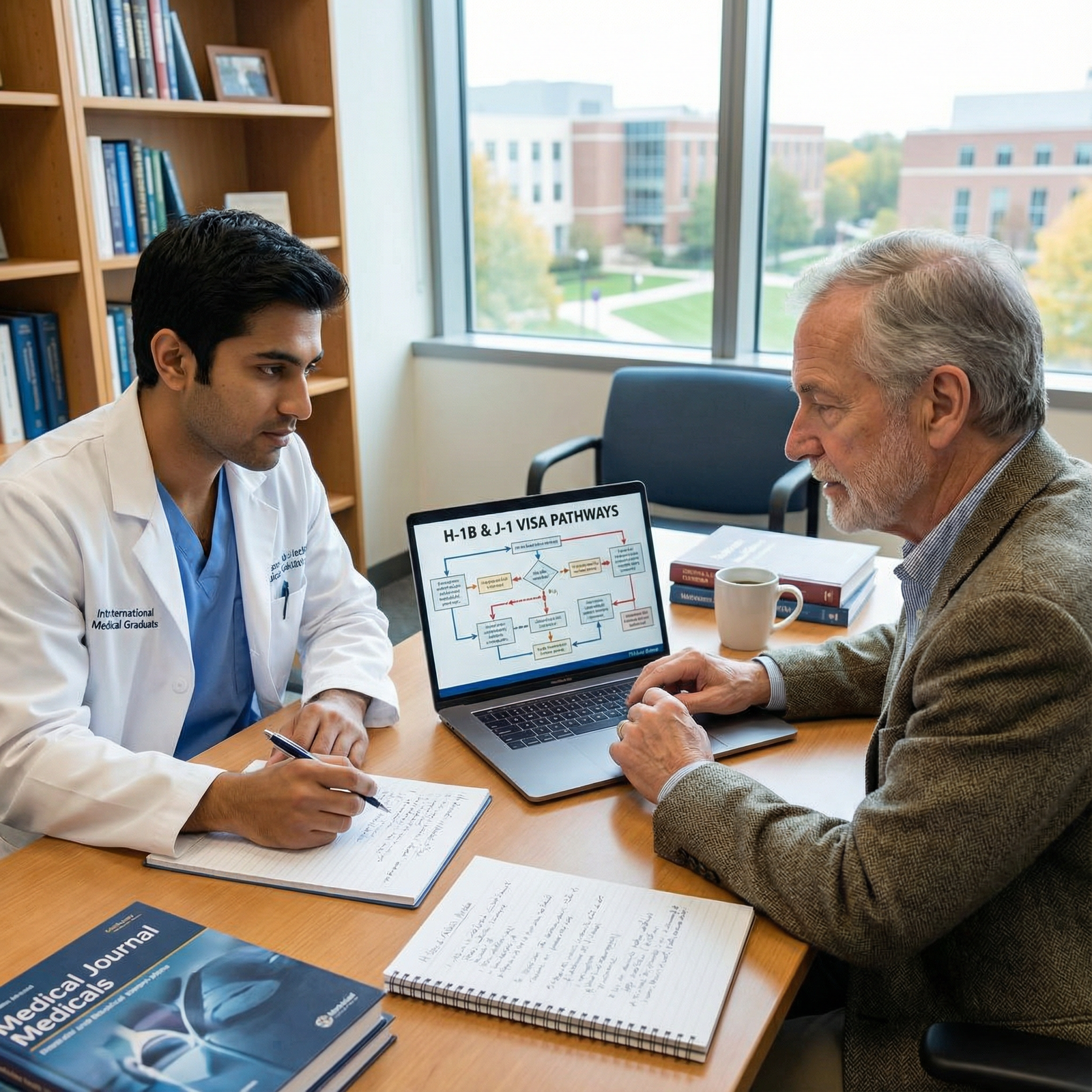
Understanding the Visa Landscape for Rural Midwest Residency Programs
Choosing a residency in the rural Midwest—particularly in states like Iowa and Nebraska—can be a strategic move for international medical graduates (IMGs). Programs in these regions often have strong community ties, diverse clinical exposure, and sometimes more flexibility with visa sponsorship than highly competitive urban academic centers.
To take advantage of these opportunities, you must understand how visa navigation works for residency, especially the particulars of J-1 vs H-1B, how IMG visa options differ, and what is realistic in the context of rural Midwest residency programs.
This guide focuses on:
- Common visas for residency (J-1 and H-1B) -How Iowa and Nebraska programs typically approach visa sponsorship
- Practical strategies for selecting target programs
- Long-term planning if you want to stay in the U.S. after training
Throughout, the emphasis is on the realities of Iowa Nebraska residency programs and similar rural Midwest settings.
Core Visa Types for Residency: What IMGs Need to Know
1. J-1 Visa for Medical Residency
The J-1 visa (Exchange Visitor) is the most common route for IMGs in U.S. graduate medical education.
Key features:
- Sponsored by the Educational Commission for Foreign Medical Graduates (ECFMG), not by the individual residency program.
- Requires you to return to your home country for a cumulative two years after training, unless you obtain a waiver.
- Typically valid for the duration of your residency and fellowship, renewable annually.
Eligibility basics:
- Valid ECFMG certification
- A contract/offer from an ACGME-accredited residency or fellowship
- Proof of sufficient funding (usually your salary is enough)
- Proof of appropriate English proficiency (part of ECFMG certification process)
Annual timeline:
- Match in March → Program issues contract → ECFMG sponsorship application begins in spring
- Visa processed in early summer → Arrive in the U.S. July (or per contract start date)
Pros of J-1 for rural Midwest residency:
- Widely accepted: Many Iowa Nebraska residency programs default to J-1.
- Administrative burden is lower for programs: ECFMG manages much of the process.
- J-1 waiver programs (especially Conrad 30) are often aligned with rural practice, which matches the needs in the Midwest.
Cons of J-1:
- Two-year home-country physical presence requirement after training unless you secure a waiver.
- Some limitations on moonlighting and employment outside the training site.
- Later transition to other statuses (e.g., green card) can be more complex.
For the rural Midwest, the J-1 is doubly significant because many J-1 waiver jobs are located in rural or medically underserved areas, including parts of Iowa, Nebraska, Kansas, and the Dakotas.
2. H-1B Visa for Residency
The H-1B is an employment-based temporary worker visa for specialty occupations.
Key features:
- Directly sponsored by the residency program or hospital (not ECFMG).
- No automatic two-year home-residency requirement.
- Dual intent: You can pursue permanent residency (green card) while on H-1B.
- Typically issued in up to three-year increments, can be extended (usually up to six years, with some exceptions).
Eligibility basics for residency:
- USMLE Step 3 usually required at the time of petition (varies slightly by state/institutional policy, but most insist on it).
- Valid ECFMG certification for IMGs.
- State medical license or at least eligibility for training license, depending on state rules.
- Employer (program/hospital) willing to handle and fund the H-1B process.
Pros of H-1B for IMGs:
- No J-1 home-country 2-year rule.
- Flexible for later green card sponsorship.
- Sometimes seen as a better long-term pathway for those planning to stay in the U.S.
Cons of H-1B:
- Many rural Midwest residency programs do not sponsor H-1B due to complexity, cost, or institutional restrictions.
- Requires Step 3 before start date, meaning earlier exam planning.
- Less common in some states and community-based settings, especially where institutional policies favor J-1 only.
In Iowa and Nebraska, many community and rural-focused programs are J-1 friendly but H-1B restrictive. Some larger academic centers (e.g., in Des Moines, Omaha, or affiliated with big university systems) may offer H-1B on a case-by-case basis, but this is not universal.
J-1 vs H-1B: Choosing the Right Path for Rural Midwest Residency
For IMGs targeting Iowa Nebraska residency and similar rural Midwest programs, the J-1 vs H-1B decision is partly personal, partly driven by what programs actually offer.
How Programs Decide: Institutional Policies Matter
Residency visa policies are typically set at the hospital/health system level, not individually by each program director. You may see the following patterns:
“J-1 only, no H-1B”
Common in many community hospitals and smaller rural systems due to limited legal resources and cost concerns.“J-1 and H-1B considered”
More likely at university-affiliated or larger teaching hospitals in urban centers that still serve rural catchment areas.“U.S. citizens/permanent residents only”
Still exists, especially in very small hospital-based programs without an established IMG pipeline.
In the rural Midwest residency context, the most common IMG visa option will be J-1, with H-1B available in a limited subset of programs.
Strategic Considerations: J-1 vs H-1B for Your Career
You might favor J-1 if:
- You are open to working in a rural or underserved area after residency for a few years (which is exactly where many J-1 waiver jobs are).
- You want the widest possible choice of programs in places like Iowa, Nebraska, and nearby states.
- You can accept the possibility of a required return home if you do not get a waiver position (though waivers are common in many underserved areas).
You might favor H-1B if:
- You are strongly opposed to any home-country return requirement.
- You already have a clear path for long-term immigration (e.g., family-based green card or employer willing to sponsor early).
- You are primarily targeting larger, academic, or urban-affiliated centers that are known to support H-1B.
Reality check for rural Midwest residency:
- If you insist on H-1B only, you will dramatically narrow your list of programs in the rural Midwest.
- If your main goal is to match in a strong clinical program in Iowa or Nebraska, you should stay open to J-1 sponsorship.
J-1 Waivers and Post-Residency Options in the Rural Midwest
The J-1 home residency requirement can be waived in specific situations, and this is where the rural Midwest becomes a major advantage for IMGs.
Common J-1 Waiver Pathways
- Conrad 30 Waiver Program (State Department of Health)
- Federal Interested Government Agency (IGA) waivers
- Examples: VA, HHS, Delta Regional Authority, Appalachian Regional Commission (not Midwest-specific, but some overlapping regions)
- Hardship or persecution waivers (more complex, legally intensive)
For most residents training in the rural Midwest, the Conrad 30 route is the most relevant.
Conrad 30 in Iowa and Nebraska
Each state can recommend up to 30 J-1 waiver physicians per year, typically for service in Health Professional Shortage Areas (HPSAs) or Medically Underserved Areas (MUAs).
Iowa Conrad 30:
Historically favors primary care and certain specialties willing to work in rural areas. Demand is moderate—not as competitive as some coastal states—but you should still apply early in the cycle.Nebraska Conrad 30:
Strong focus on underserved/rural practice, often open to both primary care and some specialties with shortages. Nebraska’s large rural areas often create steady demand for IMGs.
Key implications:
- Doing your residency in Iowa or Nebraska can help build connections with employers who regularly sponsor J-1 waivers, especially small towns and critical-access hospitals.
- If your goal is U.S. long-term practice, the rural Midwest is naturally aligned with the J-1 waiver system: underserved need + state Conrad 30 programs.
Typical Path: J-1 Resident → Rural Waiver Job → H-1B → Green Card
A common pathway for IMGs on a J-1 in the rural Midwest:
- Residency/Fellowship (J-1) in Iowa, Nebraska, or nearby.
- Secure a J-1 waiver job in a rural or underserved area, often in the same region.
- Employer sponsors you for H-1B for the waiver position.
- After 3 years of waiver service, many employers sponsor you for a green card.
- You continue in the same or similar job while your permanent residency is processed.
This sequence is particularly workable in the Midwest, where community hospitals, FQHCs, and rural clinics have a long history of relying on IMGs and supporting these transitions.
Targeting Rural Midwest Residency Programs: Practical Visa Strategy
1. Researching Program Visa Policies Early
When building your list of Iowa Nebraska residency and other rural Midwest programs:
- Check FREIDA, program websites, and ERAS descriptions for:
- “Visa sponsorship: J-1 only”
- “J-1 and H-1B visas sponsored”
- “No visa sponsorship”
- If unclear, email the program coordinator with a short, direct question:
“Does your program sponsor J-1 and/or H-1B visas for IMGs?”
Keep a spreadsheet with columns for:
- Program name
- City/state
- Rural vs urban/suburban
- Visa policy (J-1 only, J-1/H-1B, none)
- Notes on IMG friendliness (how many IMGs in current residents, etc.)
For rural Midwest programs, you will likely find that:
- A good number accept J-1.
- A smaller subset offers H-1B.
- A few do not sponsor visas at all.
2. Planning USMLE Timeline with Visa in Mind
If you want to keep H-1B as an option:
- Aim to complete USMLE Step 3 at least 6–9 months before your intended residency start date.
- This often means taking Step 3:
- During a research year in the U.S.
- During a gap year between graduation and Match
- For J-1 only applicants, Step 3 timing is more flexible (you can take it during residency), but having Step 3 done still makes you a stronger candidate, especially for competitive rural programs.
3. Choosing Specialty and Location Wisely
In the rural Midwest, certain specialties are more likely to be open to IMGs and supportive of visas:
- Family Medicine
- Internal Medicine
- Pediatrics
- Psychiatry
- General Surgery (in some settings)
- OB/GYN in underserved rural areas
These align with the greatest workforce shortages and are also the specialties most commonly supported by Conrad 30 waiver positions later.
If you are highly specialized or aiming for a narrow subspecialty, balancing that with a desire to stay in a rural Midwest location long-term may require more strategic planning.
4. Communicating About Visa During Interviews
For residency interviews in Iowa, Nebraska, and surrounding rural areas:
You do not need to lead with visa questions in the first minutes, but you should clarify at some point, especially if information online is ambiguous.
Ask professionally and briefly:
- “Can you confirm which visa types your institution currently sponsors for residents?”
- “Have you had J-1 or H-1B residents in recent years?”
Evaluate how comfortable and familiar the program appears with supporting IMG visa options. Programs with a long history of IMGs often:
- Have standardized processes.
- Provide clear instructions post-Match.
- Offer guidance on next steps, including J-1 waiver discussions later in training.
Long-Term Planning: From Residency Visa to Permanent Status
For J-1 Residents in the Rural Midwest
A long-term strategy might look like:
- Match into a rural Midwest residency (e.g., Iowa Nebraska residency program) on a J-1.
- Build a strong performance record and network with hospitals, clinics, and FQHCs serving rural communities.
- By PGY-2 or PGY-3, start exploring potential J-1 waiver employers:
- Ask your faculty if graduates commonly go to J-1 waiver positions.
- Attend job fairs (many Midwest-focused ones highlight waiver-friendly jobs).
- Once you accept a waiver job:
- Employer applies for J-1 waiver via state Conrad 30 or other applicable route.
- After approval, transition to H-1B status for that job.
- During those three years, work with your employer’s attorney on green card sponsorship, often via EB-2 or EB-3 categories.
Rural Midwest employers are often motivated to keep you long-term, which can translate into strong support for your permanent residency process.
For H-1B Residents
If you are on an H-1B in residency:
- You can remain on H-1B for subsequent jobs without a two-year home-country requirement.
- You may still choose to work in rural areas—many physicians do so for lifestyle reasons or recruitment incentives—but it’s not tied to a waiver obligation.
- Plan green card timelines early so that you do not hit the 6-year H-1B limit without having an I-140 approved (which allows extensions).
Common Pitfalls and How to Avoid Them
Assuming all programs sponsor all visas
- Reality: Many rural programs are J-1 only. Always verify.
Taking Step 3 too late
- If you want H-1B, taking Step 3 after Match may be too late for some programs. Plan ahead.
Ignoring home-country requirement implications
- If you choose J-1, understand that you are committing to either:
- A J-1 waiver path (often in rural/underserved U.S. practice), or
- Returning to your home country for two years.
- If you choose J-1, understand that you are committing to either:
Not leveraging the strengths of rural Midwest systems
- Iowa and Nebraska have built-in advantages for IMGs: demand in rural areas, established J-1 waiver pathways, and typically good work-life balance in many communities.
Relying solely on hearsay or social media
- Policies change frequently. Always confirm with official sources: program websites, coordinators, and state health department waiver pages.
FAQs: Visa Navigation for Rural Midwest Residency Programs
1. Do most rural Midwest residency programs sponsor visas for IMGs?
Many do, but not all. In Iowa and Nebraska, a significant number of community and university-affiliated programs are J-1 friendly, especially in primary care fields. H-1B sponsorship is more limited and often concentrated in larger teaching hospitals or university systems. Always confirm each program’s policy individually.
2. Is it easier to get a J-1 waiver job if I train in the rural Midwest?
Often yes. Training in a rural Midwest residency exposes you to local health systems, rural hospitals, and clinics that frequently use J-1 waiver physicians. You build connections with potential employers and gain experience with rural practice, which makes you an attractive candidate for Conrad 30 or other waiver positions in Iowa, Nebraska, and surrounding states.
3. Should I avoid J-1 because of the two-year home residency requirement?
Not necessarily. In fact, for IMGs who are open to rural or underserved practice, the J-1 + waiver + H-1B + green card path is a well-established and realistic route. If you are determined never to work in a designated shortage area or your long-term plans are uncertain, you might lean toward H-1B. But if your priority is to match in a good program and you are open to rural service, J-1 can be an excellent choice—especially in the Midwest.
4. How can I find out if Iowa or Nebraska Conrad 30 slots are competitive?
Each state health department publishes information on their Conrad 30 program on their official websites, including:
- Eligible practice locations
- Any specialty preferences
- Application timelines and whether slots filled last year
Competition varies by year and specialty, but Iowa and Nebraska typically do not reach the extreme pressure seen in some large coastal states. Reviewing recent reports and speaking to current residents and program alumni is very helpful for understanding local trends.
By understanding the J-1 vs H-1B landscape, aligning your strategy with the realities of Iowa Nebraska residency programs, and planning early for IMG visa options, you can navigate residency and post-training immigration steps more confidently. The rural Midwest offers not just training opportunities, but a practical long-term pathway for IMGs who are ready to serve communities that truly need them.