
Understanding the Visa Landscape for Caribbean IMGs in Pediatrics
For a Caribbean IMG aiming for a pediatrics residency in the United States, your visa strategy is just as important as your USMLE scores and letters of recommendation. Visa navigation can influence where you match, what jobs you can hold during and after residency, and how easily you can remain in the U.S. to practice pediatrics.
This guide breaks down visa options specifically through the lens of a Caribbean medical school residency applicant in pediatrics—whether you’re at SGU, Ross, AUC, Saba, or another offshore program. It will help you understand the J-1 vs H-1B decision, timeline considerations, how visa status interacts with the peds match, and what to ask programs during interviews.
You’ll see terms like Caribbean medical school residency, SGU residency match, pediatrics residency, peds match, residency visa, IMG visa options, and J-1 vs H-1B woven in throughout, so you can connect this information to what you’re seeing on program websites and forums.
1. Big Picture: Where Visas Fit in Your Pediatrics Residency Journey
Why visa planning matters early
As a Caribbean IMG, your path to a U.S. pediatrics residency typically follows this sequence:
- Preclinical and clinical years at your Caribbean school
- USMLE Step 1 and Step 2 CK (and possibly OET/Step 3 later)
- Clinical electives/cores in the U.S.
- ERAS application and interviews
- NRMP peds match
- Visa processing
- Start of residency (usually July 1)
Visa issues mainly affect:
- Programs you can apply to: Some sponsor only J-1; some only H-1B; some both; some neither.
- Competitiveness: Some programs limit IMG visas; others are very IMG-friendly.
- Your post-residency career: J-1 IMGs usually need a waiver job in an underserved area; H-1B IMGs have different pathways.
Starting in MS3/MS4 is ideal. Waiting until after the peds match to think about your residency visa is too late.
The three most common status categories
As a Caribbean IMG doing pediatrics, you’ll almost always be in one of three categories when it’s time to start residency:
- F-1 student transferring from a U.S. school (less common for Caribbean grads unless you were already in the U.S. for another degree)
- J-1 physician sponsored by ECFMG for GME
- H-1B temporary worker in a specialty occupation (for residency)
There are also less common routes (e.g., green card, TN for Canadians, E-2/E-3 family status), but for most Caribbean IMGs, the real decision is J-1 vs H-1B for residency.
2. Core Visa Options for Caribbean IMGs in Pediatrics
A. J-1 Physician Visa (ECFMG-Sponsored)
The J-1 clinical visa is the most common residency visa for IMGs.
Key features:
- Sponsor: ECFMG (Educational Commission for Foreign Medical Graduates)
- Program requirement: Must be in an ACGME-accredited pediatrics residency or fellowship
- Duration: For the full length of accredited training, as long as you remain in good standing and renew annually
- Two-year home residence requirement (212(e)):
- After training, you are generally required to return to your home country (or last country of permanent residence) for 2 years
- Alternatively, you can obtain a J-1 waiver (e.g., through a shortage-area job, often called a “waiver job”)
- Dependents: J-2 status (spouses can usually apply for work authorization in the U.S.)
Pros for a Caribbean IMG in pediatrics:
- Widely accepted by pediatrics programs, including many academic and community programs.
- Often the default residency visa choice for IMGs, so the process is well understood by GME offices.
- Does not require Step 3 to start residency.
- Lower financial/legal burden on the residency program compared to H-1B.
- Strong alignment with programs that have a long history matching Caribbean grads (e.g., patterns seen in many SGU residency match outcomes).
Cons:
- The two-year home residence requirement is the biggest issue:
- You usually cannot transition directly from a J-1 to H-1B or green card in the U.S. without either:
- Spending 2 continuous years physically in your home country, or
- Securing a J-1 waiver job after residency/fellowship.
- You usually cannot transition directly from a J-1 to H-1B or green card in the U.S. without either:
- Specialty choice after residency can be constrained:
- Many J-1 waiver jobs are in primary care or underserved areas, which might mean general pediatrics in rural/inner-city settings.
- Your employment options are more limited right after training, compared with someone who trained on H-1B and already has an employment-based green card process underway.
B. H-1B Visa (Temporary Worker in Specialty Occupation)
The H-1B is the second major option for IMGs in residency and fellowship.
Key features:
- Sponsor: The employing institution (e.g., your pediatrics residency program)
- Requirements:
- USMLE Step 3 usually required before the petition
- ECFMG certification
- Job offer with specified wage
- Dual intent: You can actively pursue permanent residency (green card) while on H-1B.
- Duration: Up to 6 years total (including time spent at all H-1B employers).
Pros:
- No automatic 2-year home residence requirement like the J-1.
- More flexibility to transition to permanent jobs in the U.S. post-residency.
- Compatible with the green card process (employer-sponsored or sometimes self-sponsored in specific categories).
- Attractive if you see your long-term career in the U.S. and want to avoid the J-1 waiver route.
Cons:
- Fewer pediatrics residency programs sponsor H-1B for PGY-1, especially for Caribbean IMGs. Many explicitly list only J-1 sponsorship.
- Programs incur higher cost and administrative effort, plus wage and compliance requirements.
- You must typically pass Step 3 and have results available in time for filing—this is a tight timeline for many IMGs.
- H-1B time is capped at 6 years (unless you have an active green card process). Long training paths (e.g., peds + multiple fellowships) can run into time constraints.
C. Other Statuses (Less Common but Worth Knowing)
- Green card (permanent resident):
- If you already have a green card (through family, DV lottery, or employment), you are not considered an “IMG visa” case. Programs will treat you similar to U.S. grads for visa issues.
- TN (for Canadian citizens only):
- Some Canadian Caribbean IMGs may use TN after residency for work, but TN is not commonly used for residency training itself.
- Dependent statuses (H-4, L-2, etc.):
- If your spouse/parent has a work visa, you might be able to train as a dependent, but many programs still prefer the standard J-1 physician route for clarity.
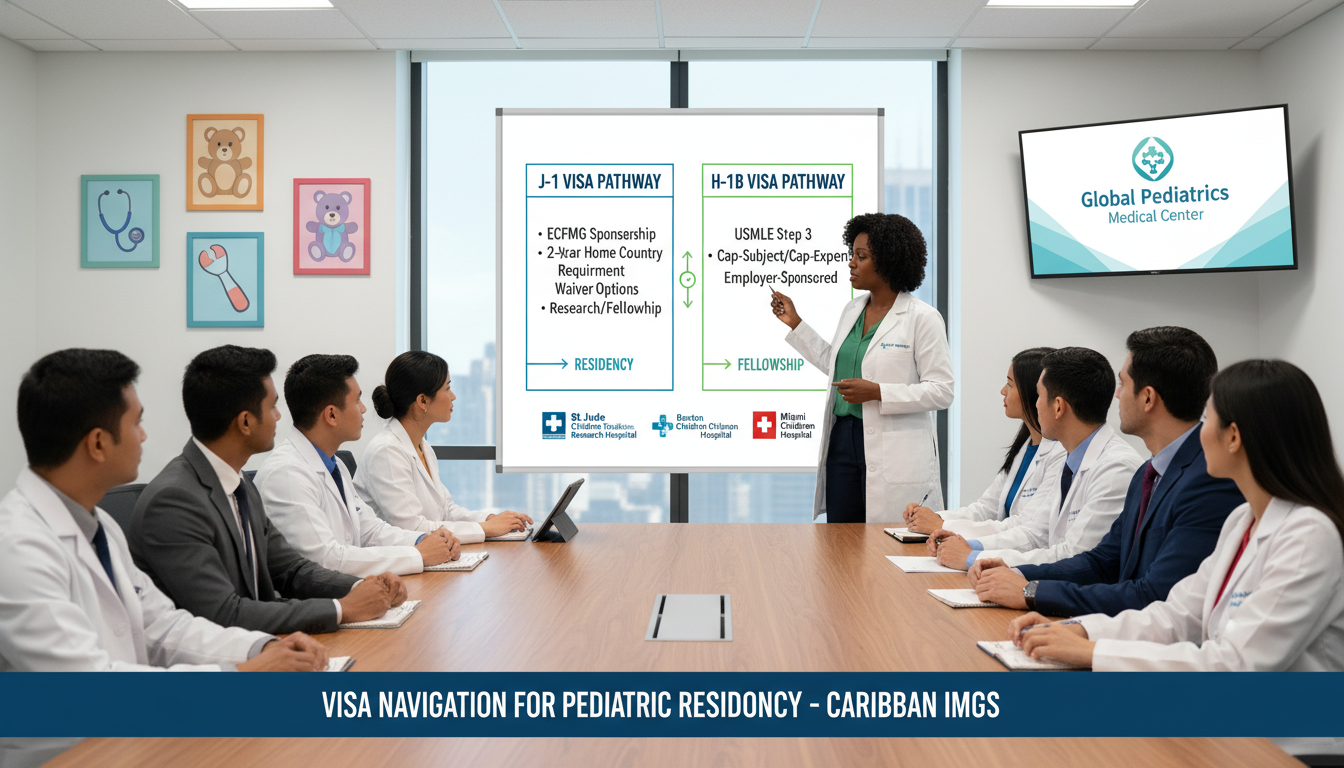
3. J-1 vs H-1B: Strategic Comparison for Pediatrics
Choosing between J-1 vs H-1B is one of the biggest decisions in your residency visa planning. For a Caribbean IMG focused on pediatrics, the right answer often depends on your long-term goals, your exam timeline, and how flexible you are about location and type of future practice.
Availability in Pediatrics Programs
- Many peds programs: J-1 only
- Some programs: J-1 and H-1B
- A minority: No visa sponsorship (only citizens/green card holders)
In practice:
- A Caribbean medical school residency applicant in pediatrics who insists on H-1B only will have a smaller pool of programs.
- Caribbean IMGs from well-known schools (e.g., SGU, AUC, Ross) sometimes match H-1B at IMG-friendly peds programs, but the default expectation in pediatrics remains J-1 sponsorship.
Career Plans After Pediatrics Residency
Ask yourself:
- Do you plan to return to your home country or Caribbean region soon after training?
- If yes, the J-1’s 2-year home requirement may not be a major obstacle.
- Do you want to stay long-term in the U.S. as a pediatrician, perhaps in a major city or academic center?
- If yes, H-1B may give you more straightforward pathways, though it is harder to secure.
For many Caribbean IMGs, a realistic strategy may be:
- Accept J-1 for residency at a strong pediatrics program.
- Plan for a J-1 waiver job in underserved pediatrics after residency (and possibly fellowship).
- Transition to more preferred locations or academic roles after waiver completion.
Training Length and Visa Timelines
Pediatrics training pathways:
- General pediatrics residency: 3 years
- Common fellowships (e.g., neonatology, pediatric cardiology, PICU): usually 3 additional years
On J-1:
- ECFMG can extend J-1 status for each ACGME-accredited training segment as long as you remain in good standing and do not exceed overall time limits.
- You can complete both residency and fellowship on the J-1, then pursue a waiver job once all training is finished.
On H-1B:
- You have 6 years total unless you have started a green card process that allows extensions beyond 6 years.
- 3 years of peds residency + 3-year fellowship = 6 years, leaving little buffer.
- Long fellowships or sequential fellowships may require careful timing and early green card planning.
Competitiveness and Application Strategy
From a peds match perspective:
- Listing “J-1 and H-1B accepted” in your ERAS application (if truly flexible) may increase your options.
- However, applying broadly with J-1 openness significantly increases the number of programs that might interview you.
- If your Step scores or application profile are borderline, insisting on H-1B only can make things harder.
Example scenario:
- A Caribbean IMG from SGU with solid scores and U.S. letters in pediatrics is applying for the peds match.
- They are open to both J-1 and H-1B, but they know many “SGU residency match” partner hospitals use J-1.
- They indicate visa flexibility in ERAS and emphasize their strong interest in underserved or community pediatrics (which aligns with many J-1-heavy programs).
- This candidate likely ends up with more interviews than a similar applicant who will only consider H-1B.
4. Timeline and Process: How Visa Planning Fits into the Peds Match
A. Before You Apply (MS3–Early MS4)
Key tasks:
- Clarify your visa history and eligibility
- Any prior J-1 (even non-medical)?
- Any home-residency obligations already in place?
- Plan USMLE Step 3 (if you want H-1B)
- To start peds residency on an H-1B, many programs expect Step 3 passed by early spring of the match year.
- Research program policies
- Use FRIEDA and program websites:
- “J-1 only”
- “J-1 and H-1B”
- “No visa sponsorship”
- Make a list of programs in each category.
- Use FRIEDA and program websites:
B. ERAS Application Season
On ERAS and personal statements:
- Be honest and consistent about your residency visa needs.
- If flexible, state: “I am eligible for and open to both J-1 and H-1B sponsorship.”
- Tailor your narrative to show long-term commitment to pediatrics, especially if J-1 with a future waiver job is likely.
Letters and experiences:
- Emphasize U.S. pediatric clinical experience and quality letters—these carry significant weight for Caribbean medical school residency applicants. A strong application makes programs more willing to sponsor whichever visa they typically use.
C. During Interviews: What to Ask About Visas
When you interview for a pediatrics residency, you should ask targeted, professional questions about visas.
Examples:
- “How many international graduates with J-1 or H-1B have you trained in the past five years?”
- “Does your institution sponsor H-1B for incoming PGY-1 pediatric residents?”
- “If I match here on a J-1, have recent graduates successfully obtained J-1 waivers in pediatrics after training?”
- “Do you support residents who want to pursue fellowship on the same visa status?”
Keep the tone neutral and informed. You’re not negotiating a visa on interview day; you’re collecting information about their track record so you can rank programs intelligently.
D. After the Match: Visa Paperwork and Start Date
Once you match:
For J-1:
- The program’s GME office initiates the ECFMG sponsorship process.
- You submit forms, proof of finances (if required), and supporting documentation.
- You attend the visa interview at a U.S. consulate in your home country (or country of residence).
- J-1 processing is usually relatively predictable if started early.
For H-1B:
- The institution’s legal team prepares the H-1B petition.
- You provide Step 3 results, credentials, and documents.
- Many programs use premium processing to ensure timely approval.
- Timing is more sensitive; delays can jeopardize your July 1 start.
Planning tip: As a Caribbean IMG, make sure your passport is valid, you have accurate documentation from your medical school, and you respond quickly to any document requests from GME or legal offices.

5. Life During and After Residency: How Your Visa Shapes Your Path
A. During Pediatrics Residency
On J-1:
- You must remain in full-time GME training.
- Moonlighting is usually restricted and requires ECFMG and institutional approval.
- Address changes and institutional changes must be reported and approved.
- You renew annually with ECFMG through your program.
On H-1B:
- You work only for the sponsoring employer at the approved location(s).
- Any major change in duties or site requires an amendment.
- Moonlighting may be possible but usually needs a separate H-1B petition for the second employer.
B. Fellowship Training in Pediatrics
If you want to subspecialize (e.g., neonatology, pediatric cardiology, heme-onc):
J-1:
- Most pediatric fellowships accept J-1 and are familiar with ECFMG sponsorship.
- Your overall strategy often becomes: peds residency → fellowship(s) → J-1 waiver job.
H-1B:
- Some fellowships sponsor H-1B, others prefer J-1.
- You must keep careful track of your 6-year limit and consider starting a green card process during fellowship if possible.
C. After Residency/Fellowship: J-1 Waivers vs H-1B Transitions
For J-1 IMGs:
- You are subject to the 2-year home residence requirement unless you obtain a waiver.
- Common waiver routes in pediatrics include:
- State Conrad 30 programs (many states consider pediatrics in shortage areas)
- Federal programs (e.g., VA, certain underserved programs)
- You typically work 3 years in a designated underserved area as a pediatrician to fulfill the waiver.
For H-1B IMGs:
- After training, you can transition directly to an attending pediatric position on H-1B (cap-exempt or cap-subject, depending on the employer).
- You can start or continue a green card process with your employer.
- While you’re not forced into underserved settings by visa rules, many pediatric opportunities still cluster there, especially early in your career.
6. Practical Tips and Common Pitfalls for Caribbean IMGs
Tips to Strengthen Your Visa-Related Position
Aim for strong exam performance
- Higher Step scores and strong pediatrics evaluations give you more leverage and options, especially H-1B-sponsoring programs.
Document everything early
- Keep copies of your passport, prior visas, I-20/DS-2019/I-94 (if any), and all USMLE score reports.
- These will be needed for both J-1 and H-1B processing.
Know your school’s track record
- Many Caribbean schools publish match lists. Review where graduates have matched in pediatrics and which IMG visa options they’ve used.
- For example, look at prior SGU residency match outcomes in pediatrics and see which programs repeatedly take their grads—and what visas those programs offer.
Stay flexible on geography and practice type
- Being open to underserved, community, or smaller-city programs can increase your chances of both matching and later securing a waiver or H-1B employer.
Consult an immigration attorney early if your case is complex
- Prior J-1 for research, prior overstay, multiple status changes, or dual citizenship can complicate things.
- Do not rely solely on forum advice; get professional input.
Common Pitfalls to Avoid
Ignoring visa policies when building your peds program list
- Applying broadly is good, but including many “no visa” programs wastes resources.
Leaving Step 3 too late if H-1B is your goal
- If you want H-1B from PGY-1, strategize Step 3 timing carefully so your score is available in time.
Assuming you can easily switch from J-1 to H-1B later without consequences
- The 2-year home residence requirement is serious. You generally need a waiver before you can change nonimmigrant status or get an immigrant visa.
Not asking programs about their actual experience with IMG visas
- A program might list “H-1B sponsorship possible,” but in practice they rarely do it. Ask during interviews for real numbers and recent examples.
Underestimating the emotional and logistical load of visa issues
- Visa delays or denials can be stressful. Building in buffer time, staying organized, and having backup plans are crucial.
FAQs: Visa Navigation for Caribbean IMGs in Pediatrics
1. As a Caribbean IMG, is it realistic to get H-1B for a pediatrics residency?
It’s possible but more limited. Some pediatrics programs do sponsor H-1B, particularly IMG-friendly academic or large community hospitals, but many prefer J-1 for PGY-1. You’ll need strong credentials, timely Step 3 completion, and a targeted list of programs known to sponsor H-1B. Most Caribbean IMGs in pediatrics ultimately train on J-1.
2. If I train on a J-1, can I still stay in the U.S. long-term as a pediatrician?
Yes, but you’ll likely need a J-1 waiver first, typically through a 3-year job in a designated shortage area (often community pediatrics in rural or underserved urban settings). After completing your waiver obligation, you can usually transition to other positions and pursue a green card. Many J-1 pediatricians ultimately settle permanently in the U.S. this way.
3. Should I mention my visa preference (J-1 vs H-1B) in my peds personal statement?
Usually, no. The personal statement should focus on your motivation for pediatrics, clinical experiences, and future goals—not immigration details. You can indicate your visa eligibility and flexibility in ERAS fields and discuss specifics with program coordinators or during interviews.
4. I’m a Caribbean IMG with lower Step scores. Does choosing H-1B over J-1 hurt my chances?
Potentially, yes. Being H-1B-only narrows your program pool significantly. If your scores or overall profile are less competitive, insisting on H-1B may reduce your interview invitations. In that situation, being open to J-1 can be a practical way to enhance your peds match prospects and then plan strategically for a waiver and long-term career afterward.
Navigating IMG visa options while aiming for a pediatrics residency from a Caribbean medical school is complex, but with early planning, realistic expectations, and targeted applications, you can align your immigration path with your professional goals. Your choice between J-1 vs H-1B, your flexibility on location and practice, and your understanding of post-residency options will shape not only where you match, but how you build a sustainable career in pediatrics in the U.S.