Entering the diagnostic radiology match as a Caribbean IMG involves navigating not just applications and interviews, but also complex U.S. immigration rules. Visa strategy can directly influence where you match, which programs rank you, and your long‑term career options. This guide walks you through visa navigation for residency as a Caribbean IMG interested in diagnostic radiology, with a focus on practical steps and realistic scenarios.
Understanding the Big Picture: Why Visa Strategy Matters for Radiology IMGs
Diagnostic radiology is a competitive specialty, and as a Caribbean medical school graduate, you often face two simultaneous hurdles:
- Residency competitiveness (USMLE scores, letters, research, etc.)
- Sponsorship barriers (some programs have limited or no capacity to sponsor visas)
For Caribbean IMGs, especially those targeting diagnostic radiology, visa planning is not an afterthought; it must be integrated into your:
- School selection (e.g., SGU, Ross, AUC, Saba)
- USMLE timeline
- Clinical rotations
- Program selection and ERAS strategy
Key realities for Caribbean medical school residency applicants
- Many U.S. diagnostic radiology programs prefer or require U.S. citizenship or permanent residency.
- A significant proportion of IMG‑friendly radiology programs only sponsor J‑1 visas, not H‑1B.
- Some radiology programs will not rank applicants needing visa support at all.
- Visa status can affect moonlighting, fellowships, and long‑term practice location, especially if you later change specialties or plan to do an interventional radiology fellowship.
Understanding these constraints early—ideally in your second or third year of medical school—helps you chart a realistic path toward the diagnostic radiology match.
Core Visa Types for Caribbean IMGs in Diagnostic Radiology
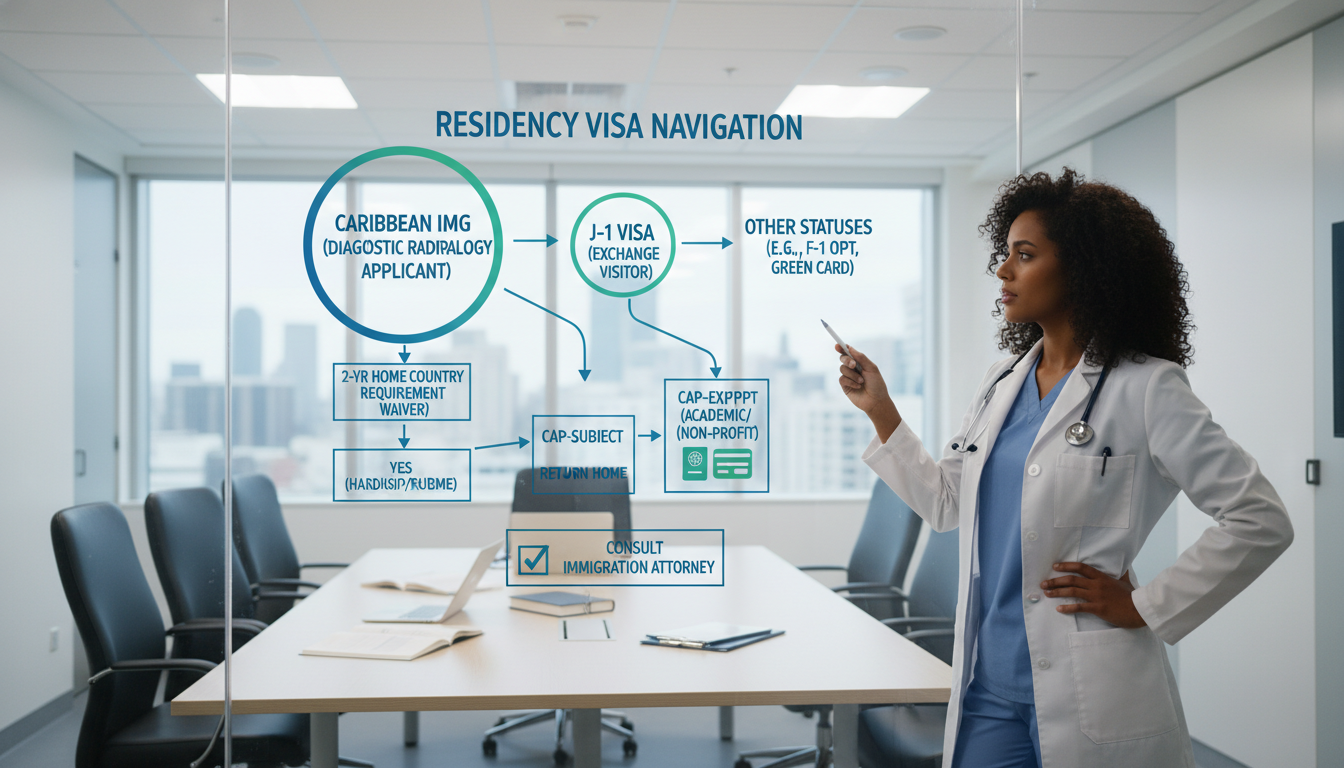
The two main residency visa pathways for IMGs in the U.S. are J‑1 and H‑1B. There are others (EADs, green cards, etc.), but for most Caribbean IMGs, the main decision point is J‑1 vs H‑1B.
1. The J‑1 Exchange Visitor Visa (ECFMG‑Sponsored)
The J‑1 physician visa is the most common residency visa for IMGs.
Key features:
- Sponsor: ECFMG (Educational Commission for Foreign Medical Graduates).
- Purpose: Graduate medical education (residency and fellowship).
- Maximum duration: Up to 7 years for training, including fellowships, if approved.
- Two‑year home residency requirement (212(e)): After training, you must return to your home country for two years OR obtain a J‑1 waiver (e.g., Conrad 30, hardship, persecution) before changing to certain other statuses (H‑1B, L‑1, permanent residency).
For a Caribbean IMG in diagnostic radiology:
Pros:
- Widely accepted: Many IMG‑friendly radiology programs only sponsor J‑1.
- Clear structure: ECFMG has a standardized process; residency offices are familiar with it.
- Often quicker to process than H‑1B.
Cons:
- Two‑year home requirement limits immediate transition to long‑term U.S. work or H‑1B without a waiver.
- Moonlighting options may be more restricted depending on program and state.
- Waiver jobs may be more available in primary care than in highly specialized radiology roles, though radiology waiver jobs do exist (often in underserved or rural areas).
2. The H‑1B Temporary Worker Visa (Employer‑Sponsored)
The H‑1B is a work visa for specialty occupations. Some radiology programs sponsor it for residents and fellows, but fewer programs do so compared with internal medicine or family medicine.
Key features:
- Sponsor: The residency program (employer).
- Requirements: Typically require:
- USMLE Step 3 passed before visa filing (often before rank list deadline).
- Ability to meet state licensing/permit rules (varies by state).
- Duration: Up to 6 years total (including all H‑1Bs with any employer).
- No automatic home residency requirement like the J‑1.
For a Caribbean IMG in diagnostic radiology:
Pros:
- No 2‑year home residency requirement.
- Smoother path to long‑term U.S. practice and permanent residency.
- Often more flexibility for moonlighting (subject to program and hospital policies).
Cons:
- Fewer radiology programs sponsor H‑1B, especially for categorical positions.
- More complex and expensive for programs: legal fees, filing fees, timing constraints.
- You must typically have Step 3 done early, which is challenging for many Caribbean students.
3. Other Statuses: EADs, Green Cards, and More
Some Caribbean IMGs may already be in the U.S. under different statuses:
- U.S. permanent residents (green card holders): No visa issues; fully competitive with U.S. grads from an immigration standpoint.
- DACA or other EAD (Employment Authorization Document) holders: Options are evolving; you must confirm with each program whether they can employ residents under your specific status.
- Spousal visas: If married to a U.S. citizen or resident, you may have paths to adjust status; this can change your residency visa calculus.
Your residency visa strategy should be coordinated with any ongoing or anticipated immigration petitions (family-based, employment-based, etc.).
J‑1 vs H‑1B in Diagnostic Radiology: Choosing the Right Path
For a Caribbean IMG specifically targeting diagnostic radiology, the J‑1 vs H‑1B decision involves both short‑term match chances and long‑term career planning.
Program Behavior in Radiology Residency Match
- Many U.S. radiology departments have a strong preference for U.S. grads and residents without visa needs.
- Of the programs that consider IMGs, a substantial subset:
- Sponsor only J‑1.
- Are not willing to navigate H‑1B complexities for residents, especially in smaller programs.
- Some large academic centers (and a few community programs) do sponsor H‑1B, but this is not universal.
When you review programs for your diagnostic radiology match list, always verify:
- Do they consider IMGs?
- Do they sponsor visas for residents?
- If yes, which type: J‑1 only, H‑1B only, or both?
How Visa Choice Affects Your Match Competitiveness
J‑1 Route:
- Maximizes the number of programs you can apply to as an IMG needing sponsorship.
- More likely to be compatible with IMG‑friendly radiology programs.
- Often the more pragmatic path if your USMLE timeline makes an early Step 3 unrealistic.
H‑1B Route:
- Shrinks your program list but may help at certain institutions that are comfortable with H‑1Bs.
- Can slightly increase your long‑term attractiveness to some employers after training, since you sidestep the J‑1 waiver requirement.
- Requires earlier Step 3 and sometimes more robust academic credentials, since programs that will sponsor H‑1B often have higher thresholds.
For many Caribbean IMGs with a strong clinical profile but no early Step 3, choosing J‑1 for residency is the most realistic pathway into diagnostic radiology.
Long‑Term Implications for Radiology Careers
If you match on a J‑1:
- After residency and any radiology fellowships (e.g., neuroradiology, IR, body imaging), you:
- Must either return to your home country for two years, or
- Obtain a J‑1 waiver job in the U.S. that fulfills the requirement.
- J‑1 waiver positions in radiology:
- Are less plentiful than in primary care but do exist, often in rural or underserved regions.
- May provide substantial negotiating leverage (sign‑on bonuses, loan repayment) due to workforce needs.
- After completing a waiver commitment, you can transition to H‑1B or permanent residency and then work anywhere.
If you match on an H‑1B:
- You don’t face the 2‑year home rule.
- Your 6‑year H‑1B cap must accommodate:
- Radiology residency (4 years, after 1 preliminary year in medicine or surgery if also on H‑1B),
- possible fellowship (1–2 years),
- initial employment (unless you switch directly into a green card process).
- Planning is crucial: many physicians transition to employer‑sponsored green cards (EB‑2/EB‑3) during fellowship or early attending years.
Step‑by‑Step Visa Planning Timeline for Caribbean IMGs
Integrate visa planning into each phase of your Caribbean medical school residency journey, especially if you aim for diagnostic radiology.
Pre‑Clinical Years (Basic Sciences)
Research visa basics early
- Understand the difference between J‑1 vs H‑1B.
- Learn how ECFMG sponsorship works for J‑1.
- Review typical IMG visa options and how they affect long‑term careers.
Confirm your ultimate career goals
- If you’re certain about extended U.S. practice with minimal restrictions, you may want to:
- Explore pathways to permanent residency or secondary citizenships (e.g., family petitions).
- Consider taking Step 3 early if aiming for H‑1B‑friendly radiology programs.
- If you’re certain about extended U.S. practice with minimal restrictions, you may want to:
Select electives with visa strategy in mind
- Target U.S. clinical rotations in hospitals that:
- Have radiology departments with a history of IMG involvement.
- Are part of institutions that sponsor J‑1 and/or H‑1B for residents.
- Target U.S. clinical rotations in hospitals that:
Clinical Years and USMLE Steps
Step 1 and Step 2 CK performance
- Competitive Step scores are vital for diagnostic radiology.
- Visa needs add another layer: marginal scores + visa requirement make the radiology match significantly harder.
- Strong exam performance can offset some visa concerns in the eyes of program directors.
Early decision on Step 3 timing
- If you’re seriously considering H‑1B, you must plan for:
- Taking and passing Step 3 before rank lists are certified (often by Jan–Feb of the match year).
- This may require:
- Finishing Step 2 CK early.
- Careful scheduling of clinical rotations.
- Balancing study time with electives and sub‑internships.
- If you’re seriously considering H‑1B, you must plan for:
Clinical rotations in radiology and related fields
- Seek U.S. letters of recommendation from radiologists, which are especially valuable in:
- SGU residency match and other Caribbean medical school residency outcomes.
- Use rotations to ask residents and faculty:
- Which visas does your program sponsor?
- How many IMGs in current or past classes?
- Any recent Caribbean IMG success stories (e.g., SGU residency match into radiology)?
- Seek U.S. letters of recommendation from radiologists, which are especially valuable in:
ERAS Application and Match Season
Clarify your visa needs in ERAS
- Accurately state whether you need visa sponsorship.
- Avoid ambiguity; misrepresentation can backfire later.
Strategic program list construction
- Filter programs by:
- Visa sponsorship (J‑1 vs H‑1B vs none).
- Past acceptance of Caribbean IMGs or SGU graduates.
- Use tools like:
- FREIDA
- Program websites
- Alumni networks from your Caribbean school
- Aim for a balanced list:
- Majority J‑1‑friendly programs (if that’s your main pathway).
- Select H‑1B‑sponsoring programs if you’re Step 3‑ready and competitive.
- Filter programs by:
Interviews: discussing visa needs confidently
- Be prepared with brief, clear answers:
- “Yes, I will require ECFMG‑sponsored J‑1 visa support for residency.”
- “I have completed Step 3 and would be eligible for H‑1B sponsorship; I understand your institution’s policies may vary.”
- Show you’ve done your homework:
- Awareness of J‑1 requirements.
- Openness to J‑1 waiver opportunities in underserved areas if appropriate.
- Be prepared with brief, clear answers:
Ranking programs
- Rank by fit and training quality, but factor in:
- Visa type sponsored.
- Location and potential future J‑1 waiver employment opportunities (if J‑1).
- Institutional support for IMG visa issues.
- Rank by fit and training quality, but factor in:

Practical Scenarios and Strategy Tips for Caribbean IMGs in Radiology
Scenario 1: SGU Graduate Targeting Diagnostic Radiology, No Step 3 Yet
- You are a St. George’s University (SGU) graduate with:
- Strong Step 1 and Step 2 CK scores.
- U.S. clinical experience including an elective in radiology.
- You have not taken Step 3 and cannot realistically do so before the match season.
Strategy:
- Focus primarily on J‑1‑sponsoring radiology programs.
- Emphasize:
- Strong exam scores.
- Positive radiology letters.
- Any research or presentations, especially imaging‑related.
- Expand your application list:
- Include community programs and smaller academic centers known to take Caribbean IMGs.
- Consider back‑up options:
- Transitional/preliminary medicine year + reapplication to radiology.
- Related specialties (e.g., internal medicine with a plan for later nuclear medicine or other imaging‑related paths, if radiology proves unattainable).
Scenario 2: Caribbean IMG with Early Step 3, Considering H‑1B
- You completed Step 3 during your fourth year and passed.
- You’re open to both J‑1 and H‑1B but would prefer H‑1B for long‑term flexibility.
Strategy:
- Create two tiers of programs:
- Tier 1: Radiology programs that sponsor H‑1B and accept IMGs.
- Tier 2: Radiology programs that sponsor J‑1 only but are reliably IMG‑friendly.
- During interviews:
- Mention your Step 3 completion and readiness for H‑1B if asked.
- Communicate flexibility: willing to accept J‑1 if that’s the only option at a strong training site.
- Be realistic:
- Even with Step 3, some programs will not sponsor H‑1B for residents due to internal policy.
- Prioritize training quality and match probability over visa type alone, especially in a competitive specialty.
Scenario 3: Planning Beyond Residency – Fellowship and Employment
As a diagnostic radiology resident on J‑1:
- Plan early for:
- Fellowship visas (usually continuation of J‑1).
- Possible waiver jobs after training.
- Network with:
- Radiology attendings who previously completed J‑1 waivers.
- Recruiters and legal counsel experienced in J‑1 waiver placements for radiologists.
- Consider geographic flexibility:
- Waiver roles may be in smaller cities or rural communities, but can offer strong compensation and case diversity.
As a resident on H‑1B:
- Monitor your H‑1B time usage:
- Preliminary year + 4 years DR + 1–2 years fellowship can approach or exceed 6 years.
- Coordinate with:
- Your institution’s legal team.
- Potential employers and immigration attorneys for early green card sponsorship (often EB‑2).
Actionable Advice: How to Optimize Your Visa and Match Strategy
Start visa education early in medical school.
- Treat visa planning as part of your academic and career planning—not something to handle after you match.
Document everything.
- Maintain organized records of:
- Passports, prior visas, I‑94s.
- ECFMG certification documents.
- Exam score reports.
- These are crucial for both J‑1 and H‑1B processes.
- Maintain organized records of:
Use your Caribbean school’s resources aggressively.
- Many Caribbean schools (especially SGU) have:
- Dedicated residency and immigration advisors.
- Data on SGU residency match outcomes in radiology and which programs have historically sponsored visas.
- Seek alumni:
- Caribbean IMGs currently in diagnostic radiology residency in the U.S.
- Ask specifically about their residency visa experiences.
- Many Caribbean schools (especially SGU) have:
Be honest and clear about your visa status.
- In ERAS and interviews, any inconsistency can raise red flags.
- Programs want to know:
- Whether you’re eligible for ECFMG‑sponsored J‑1.
- Whether you already hold another status.
- Whether you plan to sit for Step 3 (if relevant to H‑1B).
Don’t obsess over visa type at the expense of training quality.
- Completing a strong diagnostic radiology residency in the U.S.—even on J‑1 with a future waiver—is often more valuable than:
- Remaining unmatched while chasing H‑1B‑only programs.
- Your long‑term career trajectory will be shaped first by your clinical excellence and reputation, then by immigration strategy.
- Completing a strong diagnostic radiology residency in the U.S.—even on J‑1 with a future waiver—is often more valuable than:
FAQs: Visa Navigation for Caribbean IMGs in Diagnostic Radiology
1. As a Caribbean IMG, is it realistic to match into diagnostic radiology if I need a visa?
Yes, it is possible, but expectations must be realistic. You’ll likely need:
- Strong USMLE scores (often well above minimum pass thresholds).
- U.S. clinical exposure with radiology‑related letters of recommendation.
- A broad but targeted program list focused on IMG‑friendly and J‑1‑sponsoring programs.
- Flexibility about location and type of program (community vs academic).
Many Caribbean IMGs, including SGU graduates, have successfully achieved a diagnostic radiology match; however, the combination of radiology’s competitiveness and visa barriers makes careful planning essential.
2. Do most radiology programs sponsor J‑1 or H‑1B?
Most IMG‑friendly diagnostic radiology programs that sponsor at all will offer J‑1. A smaller subset are willing to sponsor H‑1B, and even fewer will do so routinely for incoming residents.
If your priority is maximizing the number of programs that can rank you, preparing for a J‑1 is usually the more practical approach. If you have Step 3 completed early and a strong profile, you can selectively pursue H‑1B‑sponsoring programs as well.
3. Is it worth rushing Step 3 before the match to try for an H‑1B?
Only if it does not compromise your overall application quality. Consider:
- Step 3 rushed and failed is worse than not having Step 3 at all.
- Many radiology programs will not sponsor H‑1B regardless of your Step 3.
- If you already have competitive Step 1 and Step 2 CK scores, plus strong clinical credentials, it may be more strategic to:
- Focus on maximizing your ERAS application and interview performance.
- Target J‑1‑friendly programs.
- Keep Step 3 for later (e.g., intern year) unless clearly beneficial.
Discuss timing with advisors at your Caribbean medical school who have specific data on Caribbean medical school residency outcomes in diagnostic radiology.
4. What happens after residency if I’m on a J‑1 visa in diagnostic radiology?
After residency (and any fellowships) on a J‑1:
- You are subject to the two‑year home residency requirement, unless you obtain a J‑1 waiver.
- Common waiver strategies for radiologists:
- Conrad 30 positions in underserved or rural areas.
- Federal agency waivers (e.g., VIA, DoD) in limited situations.
- After fulfilling the waiver obligation (usually 3 years in an underserved area), you can:
- Transition to H‑1B and seek permanent residency.
- Ultimately practice anywhere in the U.S.
Planning early for this phase—networking, understanding state‑specific Conrad 30 policies, and talking with radiologists who have gone through the process—is critical.
By understanding your residency visa options, aligning them with the realities of the diagnostic radiology match, and planning years in advance, you can significantly improve your chances of both matching and building a sustainable radiology career in the United States as a Caribbean IMG.