
International medical graduates (IMGs) from Caribbean medical schools bring valuable perspectives and skills to U.S. residency programs—especially in a diverse, fast-growing city like Houston. But securing a residency position is only half the battle. For a Caribbean IMG, understanding and successfully navigating visa options for residency is just as critical as a strong application.
This guide focuses on visa navigation for residency for Caribbean IMGs in Houston, with a special lens on major academic centers like the Texas Medical Center and popular Houston residency programs. Whether you’re coming from SGU, Ross, AUC, Saba, or another Caribbean school, this article will help you:
- Understand J-1 vs H-1B for residency
- Anticipate requirements of Houston programs and the Texas Medical Center
- Plan timelines and documents
- Avoid common visa pitfalls that can jeopardize your Caribbean medical school residency match
Understanding Your Starting Point as a Caribbean IMG
Before diving into visa types, it’s important to clarify where Caribbean IMGs typically stand in the U.S. immigration landscape.
1. Caribbean IMG status basics
Most Caribbean medical schools (e.g., SGU, Ross, AUC, Saba) enroll many U.S. citizens and permanent residents, but also a substantial number of non‑U.S. citizens/non‑green card holders. Your visa strategy differs dramatically depending on your status:
U.S. citizen or permanent resident (green card holder)
- You do not need a residency visa.
- You apply through ERAS/NRMP like any U.S. graduate.
- Some application challenges as an IMG remain (e.g., program filters), but not immigration-related.
Non‑U.S. citizen, non‑green card holder (true international IMG)
- You must secure an appropriate visa for GME (graduate medical education).
- The two primary paths:
- J‑1 visa (sponsored by ECFMG)
- H‑1B visa (employment visa sponsored by the residency program)
This article is primarily for the second group: Caribbean IMGs who are non‑U.S. citizens needing a visa for residency in Houston.
2. Why Houston is a special context for visa planning
Houston, anchored by the Texas Medical Center (TMC)—the largest medical complex in the world—hosts dozens of residency and fellowship programs. That scale comes with both opportunities and constraints:
- High volume of IMG‑friendly programs in internal medicine, pediatrics, family medicine, psychiatry, and more.
- Institutional policies within large systems (e.g., Baylor, UTHealth, Methodist, HCA, HCA-affiliated community programs) about sponsoring J‑1 vs H‑1B.
- Competitive applicant pool that includes U.S. MDs, DOs, and IMGs from all over the world, including many Caribbean medical school residency applicants.
Because Houston programs see so many IMGs each year, they usually have clear visa policies—which is an advantage if you do your homework early.
J‑1 vs H‑1B for Residency: Core Differences Caribbean IMGs Must Know
For most Caribbean IMGs, the pivotal decision is understanding the implications of J‑1 vs H‑1B visas for residency. Your future job options—especially if you hope to stay in Texas—may depend on this choice.
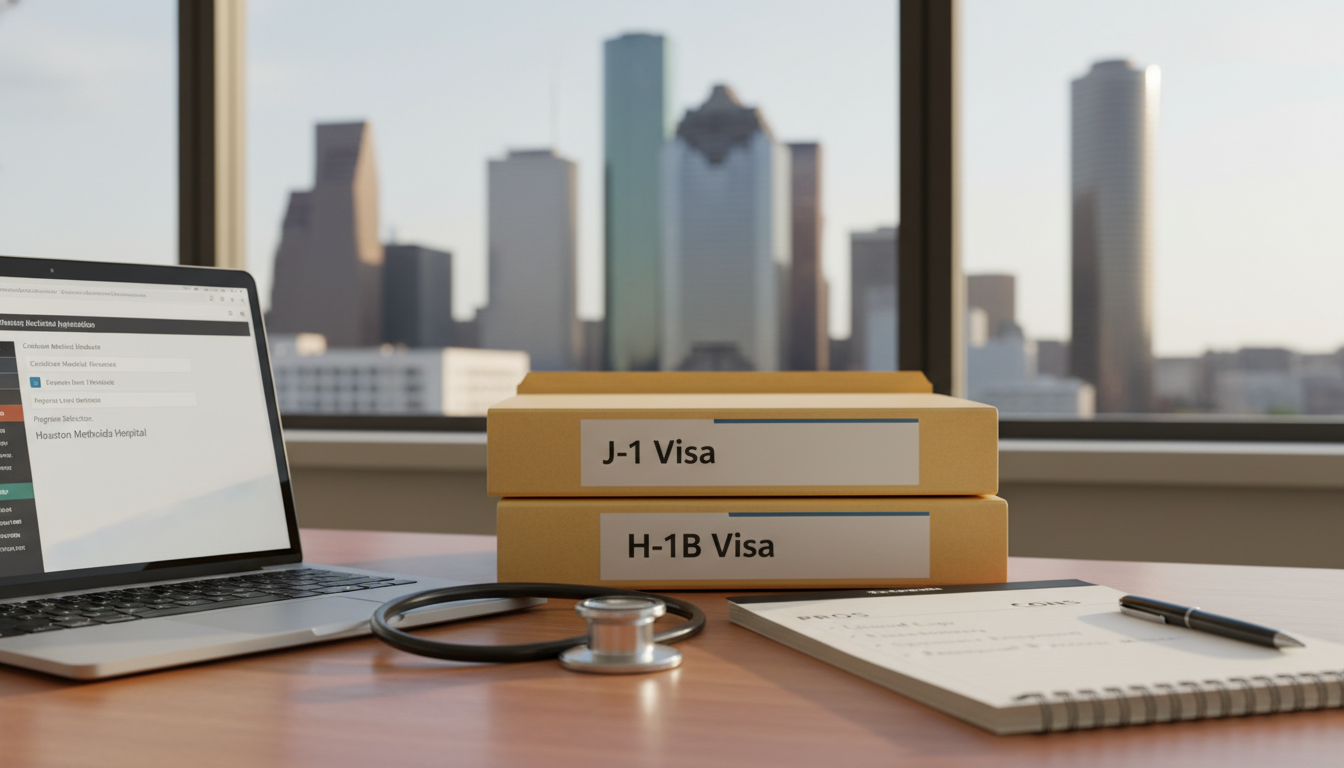
1. J‑1 visa for residency (ECFMG‑sponsored)
What it is
A J‑1 Exchange Visitor Visa sponsored by ECFMG specifically for graduate medical education. You are considered a trainee rather than a traditional employee.
Key features:
- Sponsor: ECFMG (not the residency program directly).
- Duration: Up to 7 years total for all U.S. GME (residency + fellowship).
- Funding requirement: Must show that your stipend + any personal funds are sufficient.
- Two‑year home country physical presence requirement:
- After finishing training, you are generally required to return to your home country for 2 years before you can:
- Change to H‑1B in the U.S.
- Get a green card (with some exceptions and waivers).
- This is the single biggest long‑term implication.
- After finishing training, you are generally required to return to your home country for 2 years before you can:
Advantages for Caribbean IMGs:
- Widely accepted: Many Houston and Texas Medical Center residency programs are comfortable sponsoring J‑1 visas.
- Simpler for programs: The administrative burden is lighter than H‑1B, so more programs are willing to accept J‑1 candidates.
- Faster setup: Once matched, the ECFMG J‑1 process is relatively standardized.
Disadvantages:
- Home return requirement: Unless you qualify for a J‑1 waiver job after training, you may need to leave the U.S. for two years.
- Fellowship and job planning: Some employers prefer candidates without J‑1 restrictions; you may be limited to waiver‑eligible positions after training.
- No dual intent: J‑1 is not a dual‑intent visa (unlike H‑1B, which is more compatible with pursuing a green card down the line).
2. H‑1B visa for residency (Employment‑based)
What it is
An employment visa for specialty occupations. In the residency context, the hospital/program is the H‑1B sponsor and you are an employee.
Key features:
- Sponsor: The residency program institution (hospital, university, etc.).
- Licensing: Typically requires you to have passed all USMLE Steps (including Step 3) before H‑1B can be filed.
- Dual intent: You can hold H‑1B status while pursuing permanent residency (green card).
- No two‑year home return requirement: This is the major difference from J‑1.
Advantages:
- No mandatory home country return after residency.
- Easier pathway to stay in the U.S. long term, move to fellowships, and transition into attending jobs.
- Attractive if you plan to develop a long‑term career in the U.S., especially in a state like Texas that values continuity in underserved areas.
Disadvantages:
- Not all programs sponsor H‑1B: Many Houston programs restrict visas to J‑1 only because H‑1B is complex and costly.
- Step 3 requirement: You typically need to complete USMLE Step 3 early, ideally before ranking programs, to be a credible H‑1B candidate.
- Cap issues: Some institutions are cap‑exempt, but others are not. Even in cap‑exempt contexts, legal complexity is higher.
3. How Houston residency programs typically handle J‑1 vs H‑1B
Policies vary by institution, but general patterns in Houston residency programs:
- Large academic centers (many in Texas Medical Center):
- Often J‑1 friendly; may or may not sponsor H‑1B depending on specialty and institutional policy.
- Some departments (e.g., internal medicine, neurology) might accept H‑1B selectively for highly qualified candidates.
- Community and HCA‑affiliated programs:
- Many accept J‑1; some do not sponsor H‑1B at all.
- Policies can change yearly based on administrative leadership.
Action step:
When researching programs in Houston, explicitly verify:
- “Do you sponsor J‑1 visas for IMGs?”
- “Do you sponsor H‑1B visas for residency?”
- “Is completion of USMLE Step 3 required for H‑1B sponsorship?”
Check each program’s website and, if needed, email the coordinator well before ERAS season.
Residency Visa Strategy for Caribbean IMGs: Step‑by‑Step
Your visa is not a separate process tacked on at the end—it should shape your planning from pre‑clinical years onward, especially if you’re aiming for Houston residency programs or the Texas Medical Center residency ecosystem.

1. Pre‑clinical and clinical years: Laying the groundwork
Even as a second‑year or during core clerkships, you can take steps that directly affect your visa flexibility later:
- Excel academically to make yourself competitive in a crowded IMG market.
- Aim for strong USMLE (or now Step 2 CK) scores—especially critical for SGU residency match and other Caribbean medical school residency outcomes.
- Plan your USMLE Step timing with visas in mind:
- If you might pursue H‑1B, target taking Step 3 early, ideally by late fall of the application cycle (or earlier).
- Choose U.S. clinical rotations in Texas or Houston if possible:
- Demonstrates locality interest.
- Helps secure letters from faculty familiar with Houston residency programs.
2. Application year: Aligning program list with visa goals
When it’s time to build your ERAS list, be extremely intentional:
- Categorize programs by visa policy:
- J‑1 only
- J‑1 + H‑1B
- No visa sponsorship
- For Houston, look at:
- UTHealth Houston
- Baylor College of Medicine
- Houston Methodist programs
- HCA Houston Healthcare–affiliated residencies
- Other Texas Medical Center residency programs and community sites
If J‑1 is your primary route:
- You have broader program options.
- Priority is confirming that the program accepts ECFMG J‑1 sponsorship and is IMG-friendly.
If H‑1B is your primary goal:
- Front‑load your application list with programs that explicitly sponsor H‑1B.
- Mention your Step 3 status in your personal statement or CV.
- Be realistic: as a Caribbean IMG, H‑1B sponsorship may be competitive and limited.
3. After the match: Visa processing timeline
Once you match into a Houston program:
For J‑1 (ECFMG‑sponsored)
Typical sequence:
- Program issues a contract or offer letter.
- You submit necessary materials to ECFMG for J‑1 sponsorship:
- ECFMG certification
- Proof of funding (salary + any supplemental funds if needed)
- Valid passport
- Signed training contract
- ECFMG issues Form DS‑2019.
- You use DS‑2019 to schedule a visa interview at a U.S. consulate/embassy.
- After visa approval, you enter the U.S. and begin orientation.
Timing tips:
- Start paperwork immediately after match day.
- Monitor ECFMG communications closely; delays can jeopardize your ability to start on time.
For H‑1B (Program‑sponsored)
Typical sequence:
- Program confirms willingness to sponsor H‑1B.
- You provide:
- USMLE Step 1, Step 2 CK, and Step 3 results
- Medical school diploma and transcripts
- ECFMG certification
- Valid passport & prior immigration documents, if any
- Program’s legal office or outside counsel files Labor Condition Application (LCA) and H‑1B petition.
- Once approved (I‑797), you apply for an H‑1B visa at a U.S. embassy/consulate, unless changing status in the U.S.
Timing tips:
- H‑1B processing often takes longer; premium processing may be needed.
- Ensure Step 3 is passed early enough to avoid bottlenecks.
Long‑Term Considerations: After Residency in Houston
While you’re focused on matching into a Houston residency program now, visa decisions will shape your future options in Texas and beyond.
1. If you train on a J‑1 visa
You will face the two‑year home country physical presence requirement unless you obtain a J‑1 waiver.
Common J‑1 waiver paths:
Conrad 30 Waiver Program:
- Each U.S. state can sponsor up to 30 J‑1 physicians per year to work in underserved areas.
- Texas is popular for waivers due to large rural and underserved populations.
- Typically tied to a 3‑year service contract in a designated area.
Federal programs:
- VA (Veterans Administration)
- HHS (Health and Human Services) for certain specialties and research roles
- These may provide waiver routes outside Conrad 30.
If you hope to stay in Texas:
- Start networking with employers in underserved parts of Texas during your PGY‑2/PGY‑3 year.
- Seek mentorship from former J‑1 physicians in your program who completed waivers.
2. If you train on an H‑1B visa
Your focus shifts from waiver issues to maintaining and transferring H‑1B status or transitioning to a green card.
Key points:
- Many hospitals and groups in Texas are familiar with H‑1B transfers and employment‑based green cards.
- You’ll still need an employer willing to sponsor you; this can be competitive, but you are not constrained by a two‑year home return rule.
- For fellowship, some programs also sponsor H‑1B; others may require you to switch to J‑1—so consider fellowship goals when choosing your residency visa type.
Practical Tips for Caribbean IMGs Targeting Houston
1. Match and visa: learning from Caribbean peers
If you’re from SGU, Ross, AUC, Saba or similar, look at SGU residency match and other published match lists, focusing on:
- Programs in Houston and the wider Texas area.
- Whether alumni matched there on J‑1 or H‑1B (sometimes you can find this through alumni networks or LinkedIn).
- Specialties that appear particularly IMG‑friendly (e.g., internal medicine, family medicine, pediatrics, psychiatry).
Use alumni to answer program‑specific questions:
- “Did your Houston program sponsor J‑1 only or also H‑1B?”
- “Were there any issues with visa timing before orientation?”
- “Any red flags or things you’d do differently as a Caribbean IMG?”
2. Be transparent and proactive with programs
During interviews (and sometimes in pre‑interview emails):
- Clarify:
- “As an IMG requiring visa sponsorship, would I be eligible for J‑1, H‑1B, or both at your institution?”
- Show that you understand the basics:
- Acknowledge Step 3 timing if asking about H‑1B.
- Express flexibility (e.g., “I am open to J‑1 sponsorship and understand the associated obligations”).
Programs appreciate candidates who:
- Have done their homework on IMG visa options.
- Are realistic, professional, and proactive about their status.
3. Organize your documents early
For whichever residency visa you pursue, keep a digital file (cloud + backup) with:
- Passport (valid at least 6–12 months beyond residency start).
- All USMLE score reports.
- ECFMG certificate.
- Caribbean medical school diploma and transcripts.
- Prior visa records (B‑1/B‑2, F‑1, previous J‑1 or H‑1B, etc.).
- Curriculum vitae (CV) updated regularly.
Delays in locating or notarizing documents can put your residency start at risk—especially when embassies have limited appointment slots.
4. Consider your “home country” definition for J‑1
For J‑1 purposes, your “home country” is generally tied to:
- Your country of citizenship, sometimes country of last permanent residence.
- As a Caribbean IMG, this might be:
- A Caribbean nation (e.g., Jamaica, Trinidad & Tobago, Grenada).
- Another country where your family resides if that’s your official residence.
This matters because:
- The two‑year return requirement applies to that country.
- J‑1 waiver options sometimes depend on bilateral agreements or specific conditions related to your home country.
If your situation is complex (dual citizenship, long‑term residence elsewhere), consider consulting an immigration attorney familiar with physician visas.
Common Pitfalls and How to Avoid Them
1. Assuming any program will “figure out” your visa later
Reality:
- Visa sponsorship is often a binary filter before programs even review your file.
- Many Houston programs specifically do not sponsor H‑1B—even for outstanding applicants.
Solution:
- Explicitly research visa policies for each target program before applying.
- Avoid listing many “no‑visa” programs on your ERAS list if you need sponsorship.
2. Taking Step 3 too late if you want H‑1B
If you sit for Step 3 in the spring of your match year:
- Your score might arrive too late for programs to commit to H‑1B.
- Legal teams need lead time for petitions.
Solution:
- If serious about H‑1B, plan Step 3 by summer or early fall of the application season.
- At minimum, make sure you can say during interviews: “I have passed or am scheduled to take Step 3 by [early date].”
3. Overlooking the J‑1 two‑year rule’s long‑term impact
Some IMGs treat J‑1 as a short‑term solution without realizing:
- It restricts ability to:
- Get an H‑1B or green card directly after training, unless you get a waiver.
- Move freely between the U.S. and certain types of employment.
Solution:
- Think ahead: Where do you see yourself practicing in 5–10 years?
- If your goal is long‑term practice in Texas, learn about:
- Conrad 30 in Texas.
- Federal waiver options.
- Demand for your future specialty in underserved areas.
4. Ignoring the importance of consistency and honesty
Visa forms, ERAS, interview responses, and embassy interviews must all be:
- Consistent in dates, activities, and explanations.
- Honest about your intentions and history (prior U.S. visits, overstay, visa denials).
Any discrepancy can cause:
- Visa delays or denials.
- Scrutiny that could jeopardize your residency start.
Final Thoughts for Caribbean IMGs Aiming for Houston
For a Caribbean IMG targeting Houston residency programs—especially within the Texas Medical Center residency network—visa navigation is not an afterthought; it’s a central strategic pillar of your entire journey.
Key takeaways:
- Understand the real implications of J‑1 vs H‑1B early.
- Align your exam timing, program list, and networking with your visa goals.
- Leverage Caribbean school alumni (SGU, Ross, AUC, Saba, etc.) who’ve successfully navigated SGU residency match or other Caribbean medical school residency paths in Houston.
- Stay organized, communicate clearly with programs, and when in doubt, seek professional legal guidance.
If you approach visas with the same preparation and discipline you apply to your exams and rotations, you can build a sustainable training and career path in Houston, not just a short‑term residency solution.
FAQ: Visa Navigation for Caribbean IMGs in Houston
1. As a Caribbean IMG, is J‑1 or H‑1B better for a residency in Houston?
There is no universal “better” option.
- J‑1 is more widely available and accepted by many Houston programs, making it the more realistic route for many Caribbean IMGs.
- H‑1B offers more long‑term flexibility (no two‑year home return, dual intent), but fewer programs sponsor it and you generally need Step 3 early.
Base your choice on: your competitiveness, program policies, long‑term plans to stay in the U.S., and willingness to work in underserved areas for a J‑1 waiver.
2. Do most Houston residency programs sponsor visas for Caribbean IMGs?
Many major Houston programs do sponsor visas, but policies vary:
- Numerous Texas Medical Center residency programs accept J‑1.
- A subset will consider H‑1B, usually with strict prerequisites (e.g., Step 3 passed).
- Some community or private programs may not sponsor any visas.
You must check each program’s website or confirm with the coordinator—never assume sponsorship.
3. I’m a Caribbean IMG with U.S. citizenship. Do I still need to worry about a residency visa?
No. If you are a U.S. citizen or permanent resident, you do not require a residency visa. You apply like a U.S. graduate, though you may still face some IMG‑related filters. However, the immigration challenges described (J‑1, H‑1B, IMG visa options) do not apply to you.
4. Can I switch from J‑1 to H‑1B during or after residency in Houston?
Switching directly from J‑1 to H‑1B without addressing the two‑year home return rule is generally not allowed. You must either:
- Fulfill the two‑year home country presence requirement, or
- Obtain a J‑1 waiver (e.g., through Conrad 30 or federal programs) and then move to H‑1B status.
If you anticipate wanting H‑1B after training, plan ahead for waiver options and employment in underserved areas, especially in Texas.