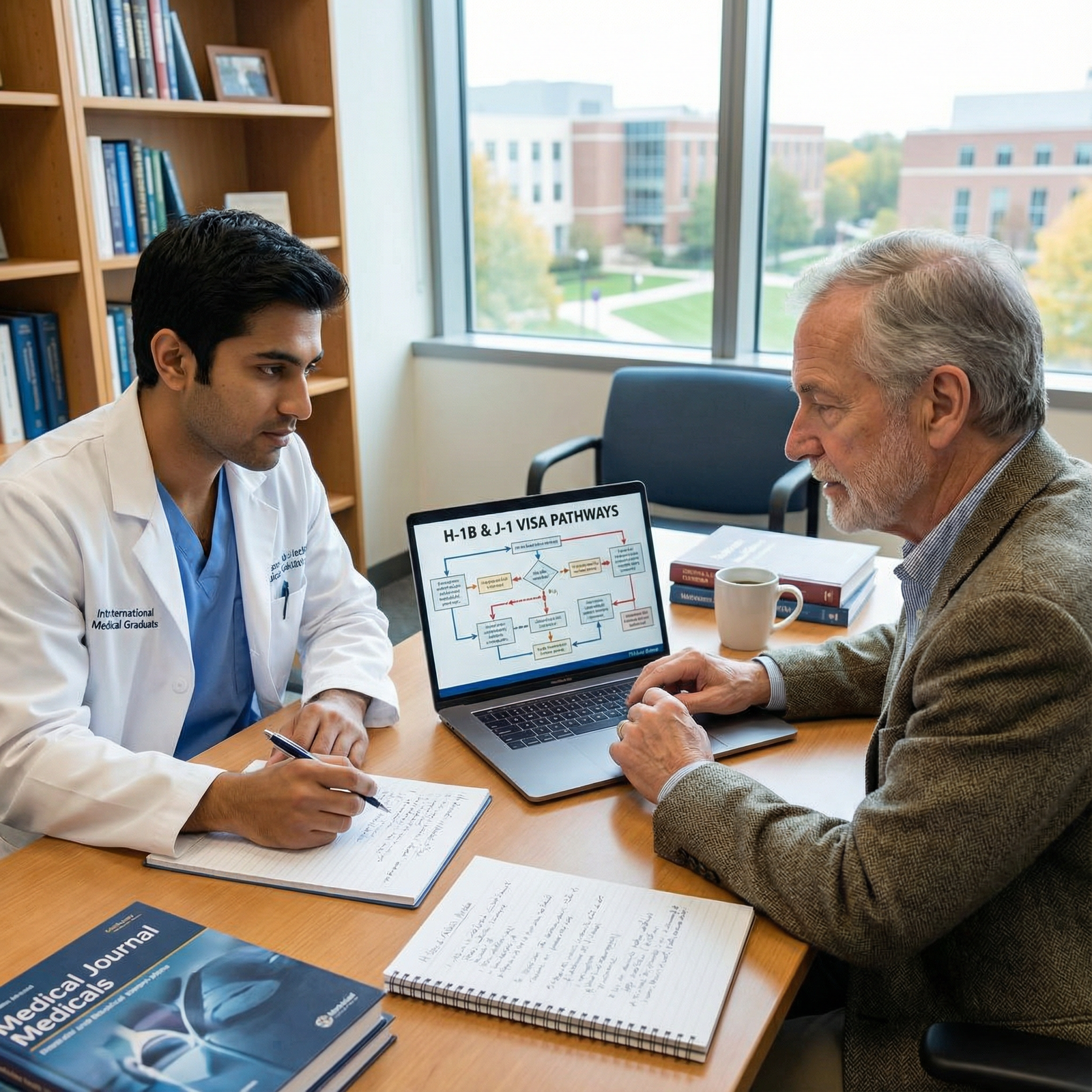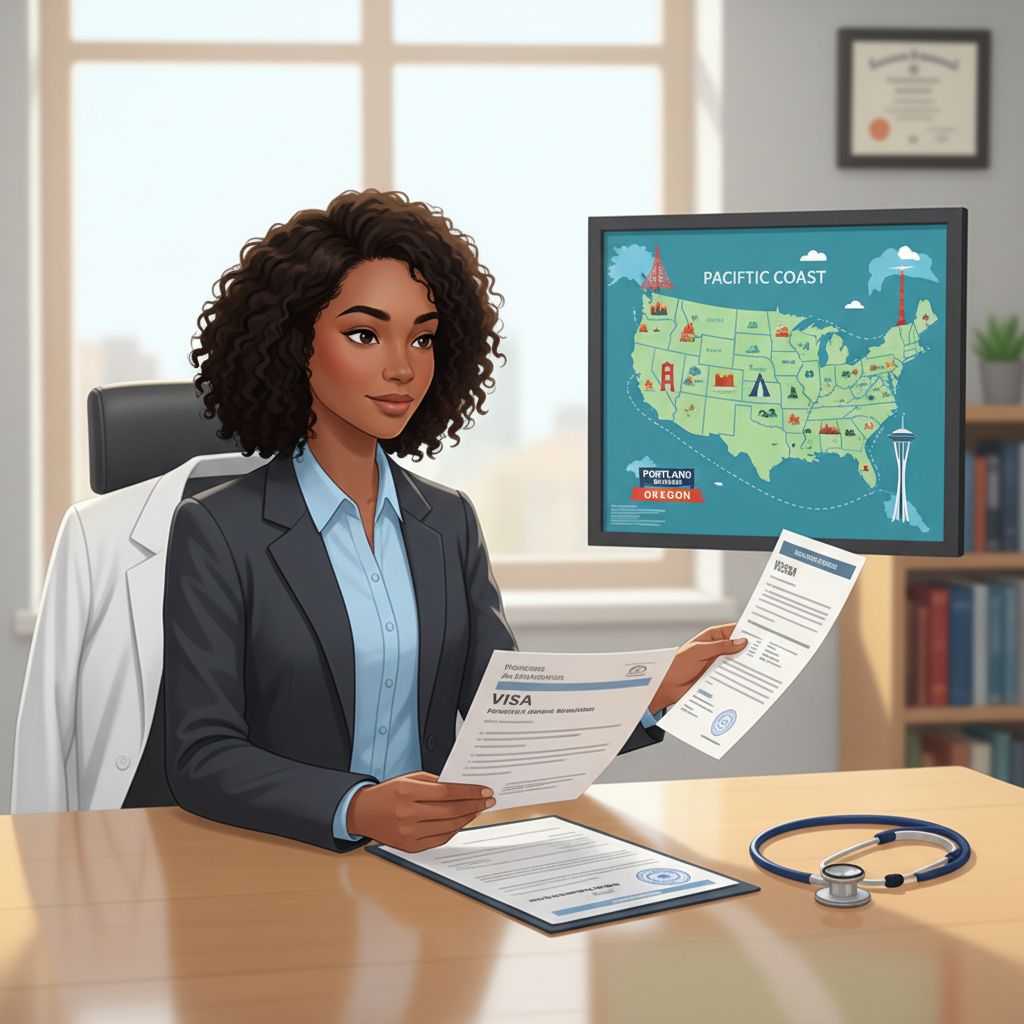
Understanding the Visa Landscape for Caribbean IMGs on the Pacific Coast
For a Caribbean IMG targeting the Pacific Coast—especially California, Oregon, and Washington—visa strategy is just as important as your USMLE scores or clinical performance. Programs in this region are highly competitive and often have strict policies about sponsorship, so early, informed planning is critical.
In this context, “visa navigation” means:
- Knowing which visas are realistic for you (J-1 vs H-1B vs alternatives)
- Understanding how visa type affects your match strategy
- Aligning your goals (e.g., long-term practice in the US or return home) with U.S. immigration rules
- Choosing programs (e.g., California residency programs, west coast residency opportunities) that actually sponsor the visa you need
This article focuses on:
- Caribbean medical school residency candidates (e.g., SGU, AUC, Ross, etc.)
- Applying to Pacific Coast programs (with emphasis on California residency programs, but also Oregon and Washington)
- Navigating residency visa options and understanding J-1 vs H-1B and related pathways
Core Visa Options for Caribbean IMGs: J-1 vs H-1B and Beyond
The two main visa categories for residency are J-1 (Exchange Visitor) and H-1B (Temporary Worker – Specialty Occupation). As a Caribbean IMG, nearly all your realistic residency visa scenarios fall under one of these.
J-1 Visa: The Default Route for Most Caribbean IMGs
For most international graduates in U.S. residency, the J-1 visa sponsored by ECFMG is the most common path. Many Pacific Coast programs, including a significant number of California residency programs, only sponsor J-1.
Key features of the J-1 for residency:
- Sponsor: ECFMG (Educational Commission for Foreign Medical Graduates), not the individual hospital
- Purpose: Graduate medical education (residency/fellowship)
- Duration: Typically length of training + 30 days
- Two-year home residence requirement (212(e)):
- You must return to your home country or country of last permanent residence for a total of two years after finishing training unless you obtain a waiver
- You cannot change easily to H-1B or permanent residency without addressing this requirement
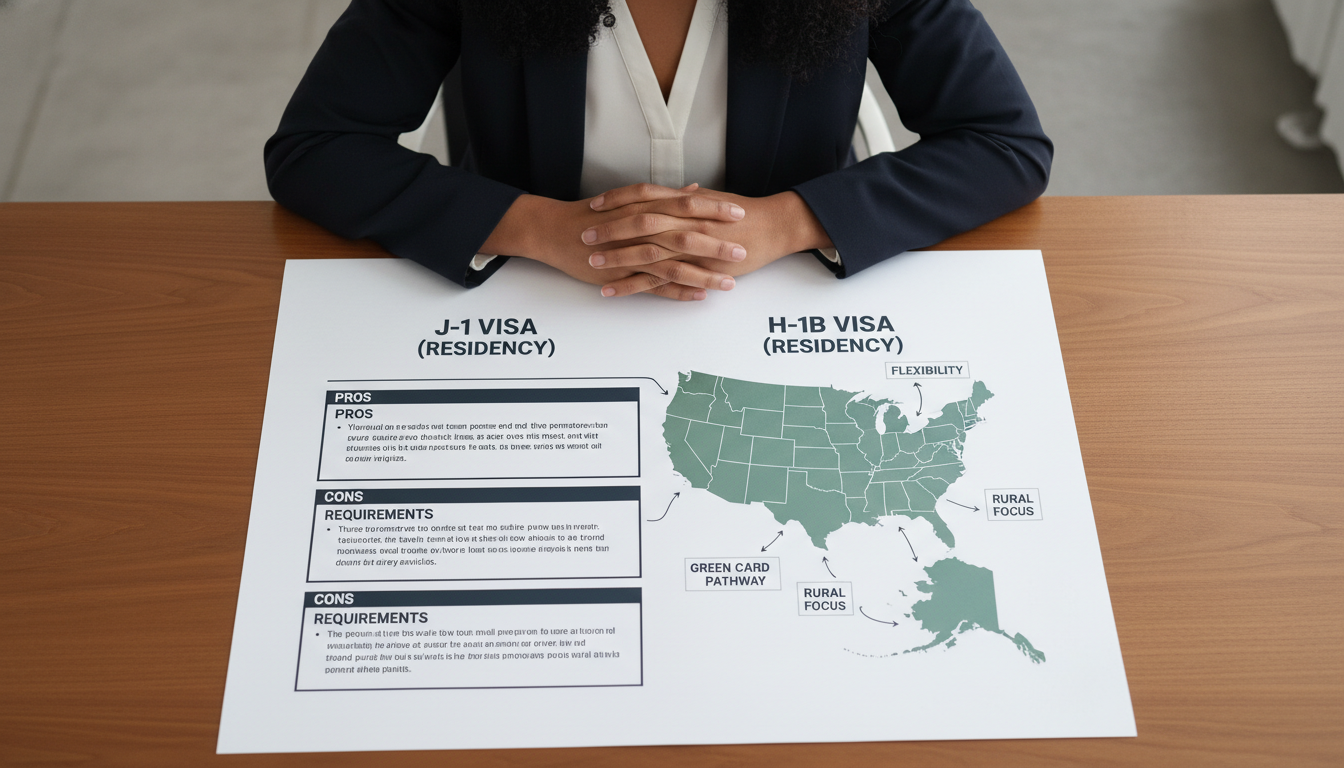
Pros of J-1 for Caribbean IMGs:
- Widely accepted: Many west coast residency programs describe themselves as “J-1 only”
- Streamlined: ECFMG provides standardized documentation and clear guidelines
- Flexible across institutions: Easier to transition between programs/fellowships with continued J-1 sponsorship
Cons of J-1:
- Two-year home residency requirement can be a major barrier if your goal is long-term US practice
- Dependents are on J-2, with more limited work options (must apply separately for employment authorization)
- You are more dependent on ongoing ECFMG sponsorship for extensions, change of institutions, or fellowships
H-1B Visa: Attractive but Harder to Get on the Pacific Coast
H-1B is the work visa route: you are employed as a resident physician in a “specialty occupation.” It is less common than J-1 among Caribbean medical school residency graduates, especially in California.
Key features of H-1B for residency:
- Sponsor: The hospital/institution (not ECFMG)
- Duration: Typically up to 6 years total, usually given in 3-year increments
- No two-year home requirement: You can transition to other H-1B roles or pursue a Green Card pathway without the J-1 two-year obligation
Pros of H-1B:
- No 2-year home residency requirement
- Stronger platform for permanent residency sponsorship (employer-based Green Card)
- Dependents on H-4 can often more easily transition to employment-authorized statuses if needed
Cons of H-1B for Caribbean IMGs on the Pacific Coast:
- Not all programs sponsor; many California residency programs explicitly say “J-1 only”
- Requires USMLE Step 3 passed before visa application (often before rank lists are submitted)
- Institutional legal/HR costs are higher, so hospitals sometimes limit H-1B usage
- May limit ability to switch specialties or extend training beyond the 6-year cap
Practical reality on the Pacific Coast:
- Many California residency programs in internal medicine, pediatrics, and family medicine sponsor J-1 only
- Some larger academic centers in California, Oregon, and Washington may sponsor H-1B—often in:
- Internal Medicine
- Psychiatry
- Neurology
- Some subspecialties
- Competitive fields (like dermatology, radiology, ophthalmology, orthopedics) are less likely to sponsor H-1B for IMGs, especially Caribbean graduates
Other Less Common Pathways
While J-1 and H-1B are the dominant residency visa categories, a few other scenarios sometimes apply:
Green Card (Permanent Resident) Before Residency
- If you are already a US Permanent Resident (through family, asylum, diversity visa, etc.), you do not need a residency visa
- This dramatically simplifies your match options on the Pacific Coast
EAD via Another Status
- You might have work authorization via:
- Asylum-pending or granted status
- TPS (Temporary Protected Status) in rare cases
- Certain family-based categories
- If so, programs may not need to sponsor a visa, but you must be very clear with them about the nature and validity of your EAD
- You might have work authorization via:
O-1 Visa (Extraordinary Ability)
- Rarely, highly accomplished IMGs (substantial research, national/international recognition) obtain O-1 visas
- Not a mainstream route for most Caribbean IMGs, especially at the residency level
Matching Strategy: Aligning Visa Choice with Pacific Coast Programs
The visa you target directly shapes your application strategy. For a Caribbean IMG interested in west coast residency programs, you must build your ERAS list with visa reality in mind, not just program prestige or location.
Step 1: Clarify Your Long-Term Goal
Before picking a visa strategy, ask:
- Do you plan to live long-term in the US, or are you open to returning to your home country after training?
- Are you prepared to work in an underserved/rural area after residency to obtain a J-1 waiver (if needed)?
- How strongly do you want to train specifically in California vs anywhere in the US Pacific Coast or beyond?
If your top priority is training in California residency programs, you may need to accept the J-1 as your most realistic pathway, since H-1B sponsoring IM-friendly programs on the Pacific Coast are limited.
If your top priority is avoiding the J-1 two-year home requirement and securing a long-term US pathway, you might:
- Focus on H-1B–friendly programs, even if that means:
- Expanding beyond California to other regions
- Being more flexible about specialty or program type
- Consider taking USMLE Step 3 early to be a competitive H-1B candidate
Step 2: Research Program Visa Policies Thoroughly
For each west coast residency program you consider:
Check the program’s website (often under “Eligibility” or “FAQ”):
- “We sponsor J-1 visas only”
- “We sponsor both J-1 and H-1B visas”
- “We do not sponsor visas”
Confirm via email if unclear. You can write something like:
“I am a Caribbean IMG requiring visa sponsorship. Could you confirm whether your program sponsors J-1, H-1B, or both for residency positions?”
Pay attention to California-specific nuances:
- Some California residency programs are housed in health systems that do not support H-1B for house staff, even if the university side does
- University programs (e.g., UC-system, large academic centers) are more likely than small community programs to have infrastructure for H-1B
Step 3: SGU Residency Match and Other Caribbean School Outcomes
If you are at a large Caribbean school like SGU:
- Review SGU residency match reports (or those of your school) for:
- Which Pacific Coast programs historically match Caribbean grads
- Which of those programs consistently take IMGs on J-1 vs H-1B
- These reports often list program names and states; cross-reference with each program’s current visa policy
Example:
- If SGU residency match data shows recurrent matches at “X University Internal Medicine, California,” you can:
- Check if that program has a history of sponsoring H-1B (some school-level advising offices track this)
- Or confirm that they regularly take J-1 visa residents from Caribbean schools
Step 4: Tailor Your Program List by Visa Category
Build three tiers in your ERAS application list:
Tier 1: Pacific Coast programs that sponsor your preferred visa
- If J-1: Many California, Oregon, and Washington programs will fit here
- If H-1B: Fewer programs; likely more concentrated in academic centers
Tier 2: Programs outside the Pacific Coast that sponsor your preferred visa
- Broadens your odds, especially if you insist on H-1B
Tier 3: Safety programs with flexible policies
- Smaller or community programs that:
- Explicitly state they welcome IMGs
- Have a history of Caribbean IMG residents
- Are okay with J-1 sponsorship
- Smaller or community programs that:
Balancing your “dream” west coast residency targets with realistic visa-sponsoring institutions is key to avoiding a mismatch between your expectations and the system’s constraints.
Deep Dive: J-1 Visa Pathway and Waiver Options
If you match on a J-1, your visa journey doesn’t end with residency. You must plan for the two-year home residency requirement or strategize a J-1 waiver if you want to stay in the U.S.
Life on a J-1 During Residency
During your residency (and fellowship, if applicable):
- ECFMG issues DS-2019 documents annually
- You must maintain:
- Valid passport
- Timely renewal of J-1 status
- Full-time participation in ACGME-accredited training
- Your dependents (J-2) can:
- Live with you in the US
- Apply for Employment Authorization (EAD), but approval is not automatic
For Caribbean IMGs in California residency programs:
- J-1 is the most common arrangement, and program coordinators are used to working with ECFMG
- Your day-to-day training is generally the same as for US citizens, but you must be aware of timeline constraints if planning a fellowship (extensions, DS-2019 timing, etc.)
The Two-Year Home Residency Requirement (212(e))
After finishing all J-1 training (residency + fellowship):
- You are subject to 212(e): you must spend two years physically present in your country of nationality or last permanent residence
- Until this is fulfilled or waived, you generally cannot:
- Change to H-1B within the U.S.
- Obtain certain immigrant visas (e.g., permanent residency via employment) easily
J-1 Waiver Options for West Coast–Bound Caribbean IMGs
Most physicians who trained on J-1 and want to stay in the US pursue a J-1 waiver job instead of going home for two years. Common waiver types include:
Conrad 30 Waiver (State Sponsorship)
- Each state can sponsor up to 30 J-1 waiver positions per year
- Typically requires:
- A job offer in a medically underserved or health professional shortage area (HPSA/MUA)
- A 3-year commitment under H-1B status serving that community
- Pacific Coast implications:
- California: Large, complex state; high interest; competitive; not all specialties are equally favored
- Oregon & Washington: Fewer positions but sometimes more manageable competition; strong focus on rural and primary care
Federal Waivers
- Offered through agencies like:
- VA (Department of Veterans Affairs)
- HHS (for certain primary care roles)
- Often still located in underserved areas, but may be connected to federal systems
- Offered through agencies like:
Hardship or Persecution Waivers
- If you can show that returning home would cause exceptional hardship to a US citizen/LPR spouse/child or that you would face persecution
- These are case-specific, legally complicated, and require an experienced immigration lawyer
Strategy tip for Caribbean IMGs in California:
If you go the J-1 route, think early about your post-residency waiver job:
- Are you open to working in rural Northern California, inland counties, or underserved urban clinics?
- Would you consider Oregon or Washington for your waiver job, then potentially move back later?
Your willingness to serve in an underserved setting for a few years often makes the J-1 path workable long-term.

H-1B Pathway: Requirements and Realistic Use for West Coast Residency
If you aim to avoid the J-1 two-year home requirement, H-1B is your main alternative—but it comes with its own hurdles.
Requirements to Start Residency on an H-1B
For an H-1B residency visa, you generally must:
Have passed USMLE Step 3 before your H-1B petition is filed
- Practically, this means before rank lists or at latest before the start date
- As a Caribbean IMG, you must plan Step 3 well ahead of Match season
Have a valid ECFMG certification
**Secure a program that:
- Sponsors H-1B
- Has the budget and institutional approval
- Is willing to undertake legal filing and costs**
Qualify under the H-1B professional criteria:
- Residency is considered a specialty occupation
- Sponsoring institution often is cap-exempt (university-affiliated), avoiding the H-1B lottery
H-1B in California and the Pacific Coast
On the Pacific Coast, H-1B use for residency is:
- Less common in pure community programs, especially in California
- More common in:
- University-affiliated internal medicine programs
- Large academic centers with strong IMG histories
- Certain subspecialty-heavy institutions
Strategic considerations:
- You may need to sacrifice geographic exclusivity (e.g., not only California) to have a good chance at H-1B
- Applying only to west coast residency programs that sponsor H-1B can be risky given the small pool and competitiveness
- Some Caribbean IMGs adopt a hybrid strategy:
- Apply broadly for J-1- and H-1B–sponsoring programs
- Accept J-1 if matched in an ideal California residency program
- Prefer H-1B if accepted where visa sponsorship is offered and aligns with long-term plans
Practical Roadmap: Step-by-Step Visa Navigation Plan for Caribbean IMGs
To bring it all together, here’s a practical stepwise approach tailored for a Caribbean IMG targeting the Pacific Coast.
Year Before Application (4th Year of Medical School / Clinical Rotations)
Clarify Goals:
- Decide your priority:
- “California residency programs at any visa type”
- Or “Long-term US stay with no J-1 home requirement, even if outside California”
- Decide your priority:
Academic & Exam Planning:
- Complete USMLE Steps 1 and 2 CK with strong scores
- If aiming for H-1B:
- Plan Step 3 by early application cycle (ideally by September of your application year)
Gather Information:
- Review Caribbean medical school residency outcomes (e.g., SGU residency match reports)
- Identify Pacific Coast programs that:
- Have historically matched Caribbean IMGs
- Clearly state visa sponsorship policies
ERAS Application Season
Program List Construction:
- Categorize programs by:
- Location: Pacific Coast vs other regions
- Visa: J-1 only, J-1 and H-1B, no sponsorship
- Ensure you have:
- Enough J-1–friendly west coast residency programs
- If aiming for H-1B, a robust list of H-1B–sponsoring programs (likely across multiple states)
- Categorize programs by:
Personal Statements & Communication:
- You generally don’t need to mention visa preferences in your main personal statement
- You may clarify via email if a program specifically asks, or if you are requesting H-1B in a program that offers multiple options
Interviews:
- Be ready to discuss:
- Your visa needs honestly
- Your willingness to go on J-1 vs H-1B
- Future plans (e.g., serving underserved areas, long-term US practice), if asked
- Be ready to discuss:
Rank List and Post-Match
Ranking Strategy:
- Rank programs based on overall fit, but with visa constraints understood:
- If a program won’t sponsor the visa you require, you cannot realistically rank it
- Avoid ranking “no-sponsorship” programs if you absolutely need sponsorship
- Rank programs based on overall fit, but with visa constraints understood:
Post-Match Visa Process:
- If J-1:
- Work with ECFMG and your GME office on DS-2019 and supporting documents
- If H-1B:
- Confirm Step 3 status and documentation
- Coordinate with the institution’s legal/HR office on timely petition filing
- If J-1:
Planning Ahead:
- If on J-1: Begin learning about Conrad 30 and other waiver options during residency, especially in PGY-2/PGY-3
- If on H-1B: Discuss longer-term employment and potential Green Card paths with mentors and, eventually, an immigration attorney
FAQs: Visa Navigation for Caribbean IMGs on the Pacific Coast
1. As a Caribbean IMG, is J-1 or H-1B better for a west coast residency?
“Better” depends on your goals. For California residency programs, J-1 is often more realistic because many institutions only sponsor J-1. If your priority is long-term US settlement without a two-year home requirement, H-1B is more attractive—but fewer Pacific Coast programs offer it, and you’ll need USMLE Step 3 early. Many Caribbean IMGs accept J-1 to secure a strong residency, then later pursue a J-1 waiver job.
2. Do California residency programs sponsor H-1B visas for IMGs?
Some do, but they are a minority. Large academic centers and certain internal medicine, psychiatry, or neurology programs may sponsor H-1B. Many California residency programs explicitly state “J-1 only” or “we sponsor J-1 visas sponsored by ECFMG”. Always verify each program’s visa policy on its website and, if unclear, via direct email.
3. I’m from a Caribbean medical school like SGU. Does the SGU residency match data help with visa planning?
Yes. SGU residency match reports (and similar data from other Caribbean medical schools) can show which Pacific Coast or California programs regularly take Caribbean IMGs. From there, you can:
- Check each program’s current visa policy
- Ask your school’s advising office or alumni what visa categories those graduates used (J-1 vs H-1B) This helps you target programs that both match Caribbean IMGs and sponsor the visa you need.
4. If I match on a J-1 visa in California, can I still stay in the US long-term?
Yes, but you must address the two-year home residency requirement. The common path is to secure a J-1 waiver job (e.g., via Conrad 30 or a federal program) after training, typically in an underserved area, under an H-1B for 3 years. Many physicians who trained in California later do J-1 waiver jobs in rural or underserved parts of California, Oregon, Washington, or other states, then transition to long-term US practice or pursue permanent residency.
By planning your residency visa strategy as carefully as your exam timeline, you significantly improve your chances of both matching on the Pacific Coast and building a sustainable, long-term career in the United States as a Caribbean IMG.