Understanding the Visa Landscape for Caribbean IMGs in the DMV Region
If you are a Caribbean medical school graduate aiming for residency in Washington, DC, Maryland, or Virginia, visa strategy is just as important as your USMLE scores and clinical performance. Programs in the DMV region are diverse: academic powerhouses, community hospitals, and VA centers—each with distinct policies on sponsoring IMGs.
As a Caribbean IMG, you are often considered “US-oriented” (especially if you did core rotations in the US), which many DMV programs like. But your residency visa status can still make or break an otherwise strong application.
In this article, you’ll learn:
- The main visa options (J‑1 vs H‑1B) and how they apply to Caribbean IMGs
- How DMV (DC/MD/VA) programs typically handle visas, with practical examples
- How your school (e.g., SGU or other Caribbean schools) and your ECFMG status fit into the visa process
- Residency application strategies tailored to your visa goals
- Common pitfalls and how to avoid last‑minute visa surprises
Throughout, we’ll keep the focus on the DMV region and the realities faced by Caribbean IMGs—especially those coming from a Caribbean medical school residency track like SGU, AUC, Ross, Saba, etc.
Core Visa Options: J‑1 vs H‑1B for Caribbean IMGs
The big decision for most IMGs is J‑1 vs H‑1B. Understanding the differences early—in MS3/MS4 or at the start of your application season—lets you build a realistic list of DC residency programs and Maryland/Virginia options.
The J‑1 Visa: The Default Path for Most IMGs
The J‑1 Exchange Visitor (Physician) visa is sponsored by ECFMG, not by the individual residency program. In practice, this makes it the most common pathway for Caribbean IMGs entering residency in the DMV.
Key features of the J‑1 visa:
- Sponsor: ECFMG (Educational Commission for Foreign Medical Graduates)
- Purpose: Graduate medical education (residency/fellowship)
- Validity: Typically extended year by year for the duration of your ACGME‑accredited training
- Work setting: Restricted to your training program; moonlighting is limited and regulated
- Two‑year home residency requirement (212(e)):
- After you finish training, you must either:
- Return to your home country (citizenship or last permanent residence) for a total of 2 years, or
- Obtain a waiver (e.g., Conrad 30, federal agency waiver, hardship/persecution waiver) before changing to H‑1B or permanent residence
- After you finish training, you must either:
For most Caribbean IMGs, J‑1 is:
- Easier to get approved
- Widely accepted across many DC, Maryland, and Virginia residency programs
- Well‑understood by GME offices
Pros of J‑1 for Caribbean IMGs:
- Most IMG‑friendly programs in DMV sponsor J‑1 without hesitation
- Less institutional cost and paperwork than H‑1B, making programs more willing to accept IMGs
- ECFMG provides clear guidelines and support documents
- Flexible for multiple training steps (residency + fellowship) as long as within overall duration limits
Cons of J‑1:
- Two‑year home residency requirement after training unless you secure a waiver
- Your employment is tightly tied to your training program (less flexibility)
- Transition to long‑term work and green card often depends on J‑1 waiver jobs—commonly in underserved or rural areas (though there are some DMV‑area options)
The H‑1B Visa: Attractive but Harder to Obtain
The H‑1B (specialty occupation) visa allows you to work as a resident physician while accruing time that can count toward future green card paths. But many DMV programs do not sponsor H‑1B, or do so only selectively.
Key features:
- Sponsor: The residency program (your employer)
- Requirements:
- Passed USMLE Step 3 before filing the petition (practical requirement for most GME H‑1Bs)
- Meet specific institutional policies and deadlines
- Validity: Generally up to 6 total years (often 3 years initial + extension)
- No automatic two‑year home residency requirement (unlike J‑1)
- Cap‑exempt: Most teaching hospitals and universities are exempt from the regular H‑1B lottery cap
Pros of H‑1B for Caribbean IMGs:
- No J‑1 two‑year home residency requirement
- Your training time can potentially be used toward employment‑based permanent residency (depending on your long‑term plan)
- Smoother transition to attending positions that also use H‑1B or support green cards
Cons of H‑1B:
- Fewer DMV programs are open to H‑1B for residents
- Requires Step 3 before visa filing—tight timeline for Caribbean graduates
- Higher legal and filing fees for the program, so they may prefer J‑1
- Less flexibility if your training path changes (e.g., switching specialties, repeating a year at a different institution)
J‑1 vs H‑1B: Which Should You Target?
For most Caribbean IMGs aiming for Caribbean medical school residency matches (e.g., SGU residency match outcomes) in the DMV region:
- J‑1 will be your main and often only viable option.
- H‑1B is realistic if:
- You can pass Step 3 early (ideally by fall of application year)
- You are applying to programs known to sponsor H‑1B in DC/MD/VA
- You have a long‑term plan that strongly benefits from starting on H‑1B (e.g., specific green card strategy, fewer moves)
A smart approach is to be open to J‑1, but if you are well‑prepared (Step 3 done, strong profile), selectively target H‑1B‑friendly programs as well.

How the DMV Region (DC/MD/VA) Handles Visa Sponsorship
The DMV region includes:
- Washington, DC: Large academic centers, children’s hospital, VA hospital
- Maryland: Major university programs (e.g., Baltimore), community hospitals, suburban centers close to DC
- Virginia: Academic hubs (e.g., Richmond, Charlottesville), Northern Virginia and suburban DC hospitals, community programs
Each program has its own stance on IMG visa options, and these policies can significantly affect your strategy.
General DMV Trends for Caribbean IMGs
J‑1 more common than H‑1B
Across most DC residency programs and Maryland/Virginia institutions, J‑1 is the default for IMGs. GME offices are familiar with ECFMG sponsorship, and many program websites state “J‑1 only” or “J‑1 and H‑1B (limited).”Academic centers more flexible, but selective
Large teaching hospitals and university‑based programs in the DMV sometimes sponsor H‑1B, but:- They may reserve H‑1B for exceptional candidates (top scores, strong research, etc.).
- They often require Step 3 before rank list certification, not just before starting residency.
Community programs often J‑1 only
Community‑based Maryland Virginia residency programs may be more IMG‑friendly overall, yet still J‑1‑only due to resource constraints.VA hospitals have additional constraints
Many Veterans Affairs programs require US citizenship or permanent residency for training positions. For Caribbean IMGs on a residency visa, pure VA‑based programs may be off the table, but integrated programs (university hospitals + VA rotations) may still sponsor J‑1 or H‑1B through the university employer.
Practical Examples (Hypothetical but Realistic Scenarios)
Example 1: Internal Medicine in Baltimore, MD
A university‑affiliated internal medicine program in Baltimore states:- Accepts IMGs
- Sponsors J‑1 visas
- H‑1B is “case-by-case” and requires Step 3 by January of the match year
A Caribbean IMG with strong scores, solid US clinical experience, and Step 3 already passed applies. She indicates willingness for both J‑1 and H‑1B. The program ranks her highly; GME later confirms they can support H‑1B for her.
Example 2: Community Family Medicine in Northern Virginia
A community program suburbs of DC says:- IMG‑friendly but “J‑1 only”
- Does not sponsor H‑1B due to cost and administrative burden
A Caribbean IMG from SGU applies. Step 3 is not required pre‑match. They match, and ECFMG handles J‑1 sponsorship smoothly.
Example 3: Washington, DC Psychiatry Program
An academic psychiatry program in DC specifies:- Sponsors J‑1 only
- Requires ECFMG certification by the start date, not necessarily at time of application
A Caribbean IMG with a pending Step 2 CS substitute (or OET if applicable, depending on the era), and awaiting ECFMG completion, can still apply and later complete the J‑1 process.
These illustrate why reading each program’s visa policy and matching that with your situation is critical, especially in the DMV region.
Step‑by‑Step: Visa Preparation Timeline for Caribbean IMGs
To succeed with your Caribbean medical school residency plans in the DMV, you must synchronize your visa strategy with your USMLE and ERAS timeline.
1. Early in Clinical Years (MS3 / Early MS4)
Clarify your long‑term goal:
- Are you okay with a J‑1 and possibly a J‑1 waiver job in a non‑urban area after training?
- Or do you strongly prefer a path that avoids the two‑year return requirement (leaning you toward H‑1B)?
Talk to your Caribbean medical school’s advisors (e.g., SGU, AUC, Ross):
- Ask about SGU residency match statistics in the DMV
- See which DC residency programs and Maryland/Virginia residency sites commonly take graduates from your school
- Ask specifically about those programs’ visa policies
Plan USMLE timing:
- For J‑1 only: prioritize high Step 1/2 scores; Step 3 can wait until residency or late MS4.
- For possible H‑1B: aim to complete Step 3 by fall of your application year.
2. ERAS Application Season (June–September)
Research visa policies on each program’s website:
- Does the program:
- Accept IMGs?
- Sponsor J‑1?
- Sponsor H‑1B for residents?
- Are there notes like “J‑1 only” or “US citizenship/green card required”?
- Does the program:
Tailor your program list:
- If you are open to J‑1:
- Include a broad range of DMV programs that sponsor J‑1.
- If you want H‑1B:
- Create a specific subset of programs explicitly stating H‑1B sponsorship.
- Still include J‑1 programs for safety, unless you have a separate status (e.g., green card) making that unnecessary.
- If you are open to J‑1:
Highlight your visa readiness in applications:
- If you already passed Step 3, note this in your CV and personal statement, especially when targeting H‑1B programs.
- For J‑1: emphasize ECFMG progress and your familiarity with J‑1 obligations, without overemphasizing immigration in your main narrative.
3. Interview Season (October–January)
Ask strategic, non‑confrontational questions:
- To residents and coordinators:
- “Do you have current residents on J‑1 or H‑1B visas?”
- “For IMGs, what is the usual visa your program sponsors?”
- To program directors (if appropriate):
- “I’m an IMG on a non‑immigrant status; does your program typically sponsor J‑1 or H‑1B for residents?”
- To residents and coordinators:
Clarify any confusing website information:
Some websites are outdated; if you are seriously interested in a program, confirm details with the coordinator or GME office.
4. Rank List and Post‑Match
Rank realistically with visas in mind:
- If you must have H‑1B (due to personal or legal reasons), don’t rank high a program that is clearly J‑1 only.
- If you are flexible, prioritize clinical fit, training quality, and support systems, using J‑1 as the default.
After Match – J‑1 process:
- Work closely with your program and ECFMG to complete:
- DS‑2019 application
- Statement of need from your home country
- Proof of financial support (usually your contract)
- Schedule visa interview at a US embassy/consulate if you are abroad.
- Work closely with your program and ECFMG to complete:
After Match – H‑1B process:
- Program’s legal office files an H‑1B petition on your behalf.
- You may need to provide:
- Licensing/permit details
- Degree and ECFMG certification
- USMLE Step 3 proof
- Timing is tight: delays in paperwork can threaten your ability to start on time, so respond promptly to any requests.
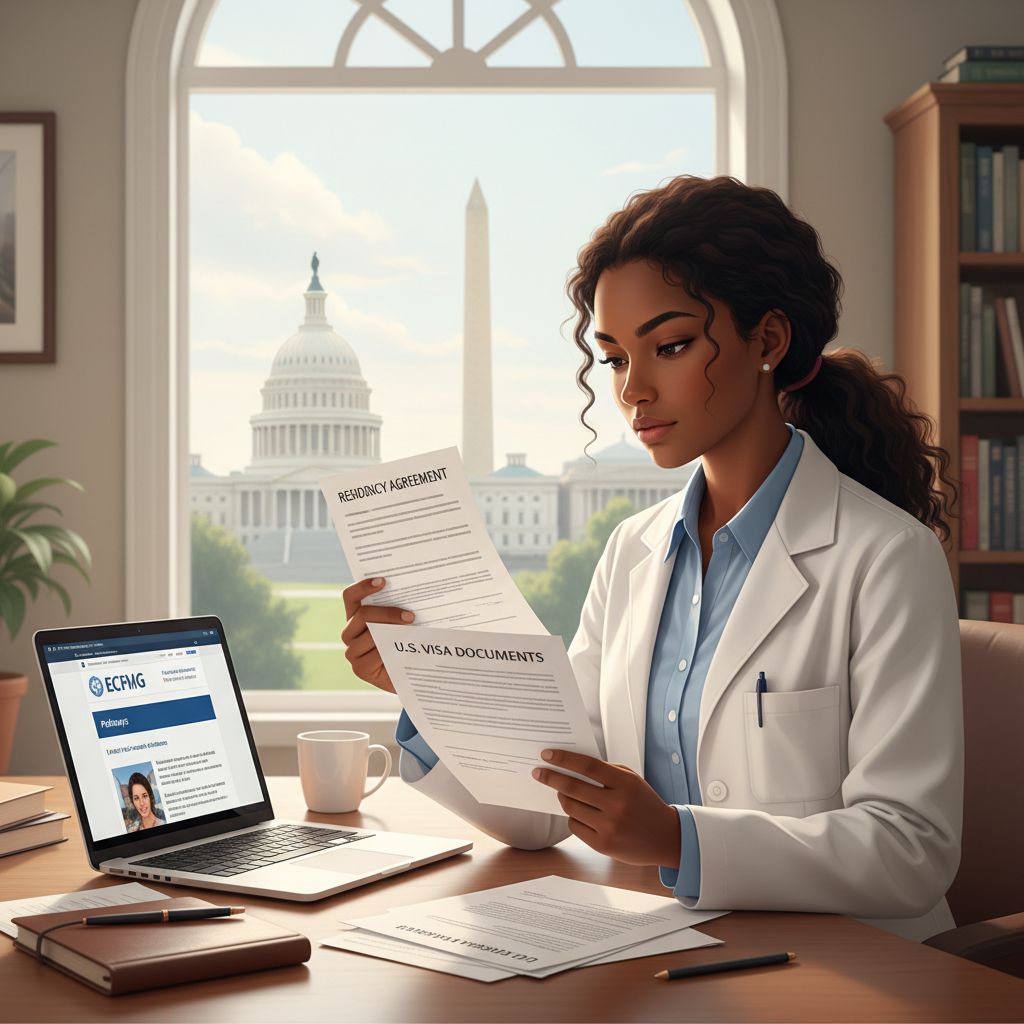
Special Considerations for Caribbean IMGs: SGU, Other Schools, and DMV Programs
Caribbean IMGs—especially from larger schools like St. George’s University (SGU)—have some unique strengths and challenges in the DMV visa context.
How Your Caribbean School Affects Your Options
Established relationships with DMV programs:
Schools like SGU, AUC, Ross, and Saba often have a track record of sending graduates to DC residency programs and Maryland/Virginia residency sites. Programs familiar with Caribbean IMGs may be more comfortable sponsoring J‑1 and sometimes H‑1B.SGU residency match outcomes:
While yearly data changes, Caribbean schools frequently publish match lists. Reviewing where recent graduates matched in Washington, DC, Maryland, and Virginia can show:- Which specialties and programs are open to Caribbean IMGs
- Whether those programs commonly sponsor visas (most often J‑1)
US clinical rotations in DMV:
If you did core or elective rotations in DC, Maryland, or Virginia:- You may have letters from local attending physicians.
- You can demonstrate familiarity with the region’s patient population and health systems.
Although not a visa factor directly, this makes programs more willing to invest in your residency visa sponsorship.
Navigating Status Changes: From Student to Resident
Caribbean IMGs may be in different immigration situations during medical school:
- F‑1 students in the US (less common for offshore Caribbean schools, more common for US‑based programs)
- Visitors or no current US status if residing in the Caribbean or another country
- Other statuses (e.g., dependent visas, etc.)
Regardless of your current status, once you match:
- You transition to J‑1 or H‑1B as your primary work/training visa for residency.
- Prior US status often has limited impact on GME decisions, but may influence consular interviews and forms.
Actionable tip: Keep a clean immigration history—no overstays, status violations, or unauthorized work. These can jeopardize J‑1 or H‑1B approval, even if a program wants you.
Planning for Life After Residency: J‑1 Waiver and Beyond
If you take the J‑1 route, begin thinking early about:
J‑1 waiver jobs:
- Commonly in federally designated Health Professional Shortage Areas (HPSAs) or Medically Underserved Areas (MUAs).
- The Conrad 30 program (run at the state level) can offer waivers for IMGs agreeing to work in underserved areas for several years.
- Some parts of Maryland and Virginia qualify; DC options can be more limited and competitive.
Transition to H‑1B or green card after waiver:
- Many J‑1 waiver jobs use H‑1B to employ you post‑residency.
- Some employers sponsor permanent residency once you start working as an attending.
If you begin residency on H‑1B, you’ll still need to:
- Navigate H‑1B extensions (if training lasts more than three years).
- Coordinate transitions between residency and fellowship (often changing institutions and filing a new H‑1B petition).
- Plan with future employers about green card timing and category (EB‑2/EB‑3).
Common Pitfalls and How to Avoid Them
Even strong Caribbean IMGs can run into avoidable visa problems. Being aware of these pitfalls will protect your DC/MD/VA residency goals.
Pitfall 1: Ignoring Program Visa Policies
Some applicants apply blindly, only to be rejected because the program simply cannot sponsor their preferred visa.
Solution:
- Verify each program’s stated policy on J‑1 vs H‑1B before applying.
- If it’s unclear, email the program coordinator with a concise question.
- Don’t assume all academic centers will sponsor H‑1B, or that all community programs will accept J‑1.
Pitfall 2: Delaying Step 3 When Targeting H‑1B
Programs cannot file H‑1B petitions without Step 3 in most jurisdictions, and many require it well before July 1.
Solution:
- If H‑1B is important for your future, schedule Step 3 as soon as you’re eligible.
- Aim to have your Step 3 result by the middle of interview season or at least by program rank deadline.
Pitfall 3: Misunderstanding the Two‑Year Home Requirement
Some IMGs think the J‑1 two‑year requirement automatically blocks them from ever working in the US again. Others assume it can be waived easily in any location.
Reality:
- You can stay in the US after J‑1 with the correct waiver and job.
- Waiver options depend on:
- Your home country’s policy on statements of need and no-objection letters
- Availability of Conrad 30 slots in states like Maryland or Virginia
- Federal agency waiver possibilities
- It’s manageable but must be planned, not left to the last minute.
Pitfall 4: Poor Communication With GME and ECFMG
Delays in sending documents, missing signatures, or incomplete forms can hold up your J‑1 or H‑1B process.
Solution:
- Respond quickly to all document requests.
- Keep digital copies of key documents: medical diploma, ECFMG certificate, USMLE transcripts, passport, etc.
- For J‑1: learn ECFMG requirements from their official website and prepare in advance.
Frequently Asked Questions (FAQ)
1. As a Caribbean IMG, should I aim for J‑1 or H‑1B for residency in DC/MD/VA?
Most Caribbean IMGs in the DMV match on J‑1 visas because:
- Many programs sponsor J‑1 routinely
- H‑1B is limited to specific programs and requires Step 3 early
If you have a strong immigration reason to avoid the two‑year J‑1 home requirement and are able to pass Step 3 quickly, you can strategically target H‑1B‑friendly programs. But be prepared that your pool of options will be smaller, and J‑1 remains the more realistic default.
2. How do I find out if a specific DC, Maryland, or Virginia program sponsors my visa type?
Start with the program’s website, usually under “Eligibility & Requirements” or “International Medical Graduates” sections. Look for phrases like:
- “We sponsor J‑1 visas through ECFMG.”
- “H‑1B visa sponsorship available for exceptional candidates with USMLE Step 3.”
- “We cannot sponsor visas” or “US citizens/green card holders only.”
If unclear, email the program coordinator with a short question:
“Dear [Name], I’m an international medical graduate. Could you please confirm if your program sponsors J‑1 and/or H‑1B visas for residents?”
3. I’m an SGU (or other Caribbean) graduate. Does that help with visa sponsorship in the DMV?
Indirectly, yes. Schools like SGU often have established relationships with DC, Maryland, and Virginia residency programs. These programs:
- Know the curriculum and typical preparedness of Caribbean graduates
- May have a history of sponsoring J‑1s for your school’s alumni
- Sometimes use match lists from schools to reassure their GME office about visa sponsorship
It doesn’t guarantee sponsorship, but it can smooth the path, especially for J‑1 visas.
4. If I start residency on a J‑1, can I later switch to H‑1B without returning home for two years?
You cannot simply switch from J‑1 physician status to H‑1B within the US unless:
- You fulfill the two‑year home residency requirement, or
- You obtain a waiver of that requirement (e.g., Conrad 30, federal agency waiver, hardship/persecution waiver).
Many IMGs finish residency on J‑1, obtain a J‑1 waiver job (often in an underserved area), then move to H‑1B with that employer. Planning this trajectory early in residency helps align your career and immigration goals.
Caribbean IMGs can and do match into excellent DC residency programs and Maryland/Virginia residency positions every year. Understanding J‑1 vs H‑1B, reading program policies carefully, and planning your visa strategy as seriously as your exam schedule will give you a major advantage as you navigate residency in the DMV region.