
Understanding the Landscape: Visas and County Hospital Residency Programs
County hospital residency programs—often major safety net hospitals—play a unique role in U.S. graduate medical education. They care for underserved populations, manage high acuity and high volume, and often have a strong social justice or community-centered mission. For international medical graduates (IMGs), these programs can be excellent training environments, but they also present specific challenges and opportunities when it comes to visa navigation.
In this article, you’ll learn:
- How county and safety net hospital residency programs typically handle visa sponsorship
- The core differences between J-1 vs H-1B for residency
- Common IMG visa options and how they affect your match strategy
- Practical steps to improve your chances of securing both a residency position and a visa
- How visa planning intersects with long-term career goals (fellowship, practice, and waivers)
Throughout, we’ll focus on the realities of county hospital residency and safety net hospital residency environments, which can differ significantly from large private academic systems.
1. Why County and Safety Net Hospitals Matter for IMGs
County hospitals (sometimes labeled as public or municipal hospitals) and other safety net hospitals form the backbone of healthcare for uninsured, underinsured, and vulnerable populations in the U.S. Examples include:
- Big urban county systems affiliated with public universities
- Standalone county hospitals with community-based residencies
- Safety net hospitals that serve as the primary training site for university or community residency programs
Why they are attractive to IMGs
High patient volume and pathology
- County hospitals often see a wide spectrum of disease severity and rare conditions.
- IMGs seeking strong clinical exposure and hands-on experience often gravitate here.
Mission-driven culture
- Many IMGs come from resource-limited settings and resonate with the mission of caring for underserved communities.
- Programs may value bilingual or multicultural applicants, which many IMGs naturally bring.
Historically more open to IMGs (varies by program)
- Some county hospital residency programs have a long tradition of IMG recruitment.
- Others, however, may be constrained by funding, state or county employment rules, or institutional visa policies.
Why visas are sometimes harder at county hospitals
While some county hospital programs are IMG-friendly, others face real constraints:
- Government/County employer rules:
County HR policies sometimes restrict sponsorship of certain visa types (commonly H-1B). - Budget limitations:
H-1B sponsorship can be more expensive and administratively demanding than J-1, leading some programs to accept J-1 only. - Union and civil service rules:
In a few jurisdictions, residency positions are categorized under public employee classifications that complicate or slow visa processing.
Action point:
When reviewing a county hospital residency, do not assume that its mission-driven nature guarantees flexible visa support. Always verify exact visa sponsorship policies at the program level.
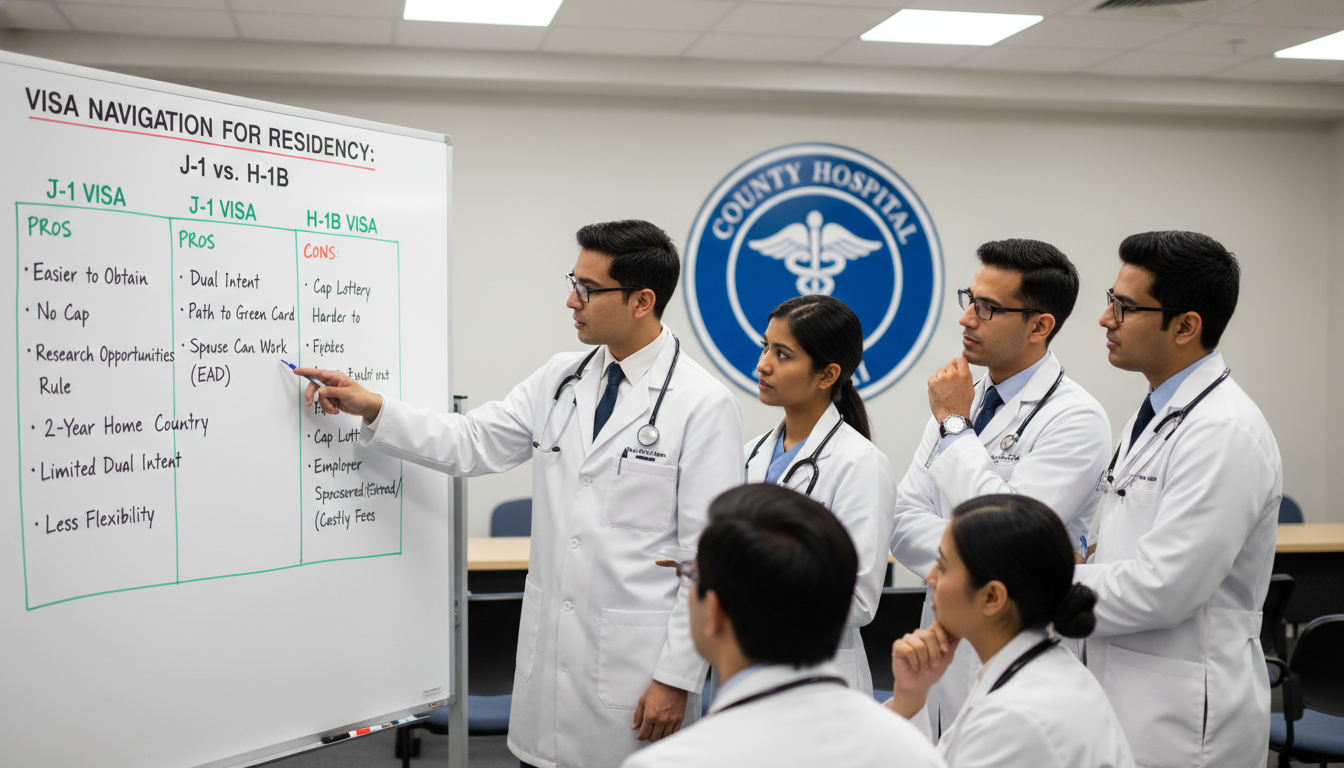
2. Core Visa Options for Residency: J-1 vs H-1B in County Settings
For most IMGs pursuing U.S. residency, the primary visa options are:
- ECFMG-sponsored J-1 visa (Exchange Visitor Category)
- H-1B visa (Temporary Worker in a Specialty Occupation)
Some IMGs may have other paths (e.g., green cards, EAD through asylum, dependent visas like J-2 or H-4), but from a residency perspective, the central strategic choice is usually J-1 vs H-1B.
J-1 Visa for Residency: The Default for Many County Hospitals
The J-1 is the most common residency visa for IMGs in the U.S. It is sponsored by ECFMG, not the hospital directly. This is especially attractive to county hospital residency programs because:
- The administrative work is largely managed by ECFMG.
- There is no cap (unlike the H-1B annual cap).
- It is widely used and well-understood by GME offices.
Key requirements for J-1 residency visa:
- Valid ECFMG certification
- Passing required USMLE or COMLEX exams
- A contract/offer from an ACGME-accredited program
- Proof of financial support (usually your residency salary is sufficient)
- Adequate English proficiency
- Country-specific restrictions rarely interfere but are possible in a few cases
Benefits of J-1 in county hospital residency:
- Many safety net hospital residency programs prefer or accept only J-1 for IMGs.
- No institutional cap or lottery; if ECFMG approves and the embassy issues the visa, you can start.
- Streamlined, predictable process year to year.
Major limitation: The 2-year home residency requirement
The biggest downside: Upon completion of your training, you are usually subject to the two-year home-country physical presence requirement (INA §212(e)). That means:
- You must return to your home country for two years OR
- Obtain a J-1 waiver (most commonly a clinical waiver in an underserved area, such as a Conrad 30, VA, or other federal program).
This requirement heavily shapes long-term planning, especially for those who want to stay in the U.S. for fellowship and eventual practice.
H-1B for Residency: Less Common but Highly Strategic
The H-1B visa can be used for residency, but it is generally more complex and more expensive for programs. In county or safety net hospital residencies, you’ll encounter a mixed landscape:
- Some county programs sponsor H-1B routinely.
- Others do not sponsor H-1B at all (often due to HR, legal, or budget constraints).
- A subset may say “J-1 preferred, H-1B considered in exceptional circumstances.”
Key requirements for H-1B residency visa:
- USMLE Step 3 passed (most states and institutions require this before H-1B filing)
- Valid ECFMG certification
- Program must be willing to sponsor and pay legal/filing fees
- You must meet state licensure/permit requirements (which often require Step 3 anyway)
Benefits of H-1B:
- No two-year home-country requirement.
- Easier transition to long-term employment in the U.S. after training.
- Potentially smoother path to permanent residency (green card) without a J-1 waiver.
Limitations in county hospital settings:
- Some county employers are ineligible or unwilling to file H-1B due to funding source or HR rules.
- Administratively heavier: requires LCA (Labor Condition Application), petition filing, and sometimes premium processing costs.
- Not all residencies qualify as cap-exempt; though many teaching hospitals associated with universities are.
Action point:
If you strongly prefer an H-1B path, prioritize county hospital residency programs clearly stating “H-1B sponsored” on their websites or in emails. Do not assume you can “convince them later.”
3. How County Hospital Policies Affect Your Visa Options
Even when two residency programs look similar on paper, their institutional context matters. A university-based program that primarily trains at a county hospital may have very different visa options from a county-employed program that simply partners with a medical school.
Common visa policy models in county settings
University-sponsored program at a county clinical site
- Residents are employees of the university or academic health system, not the county.
- Visa sponsorship typically follows the university’s standard GME policy.
- Often more flexible and more likely to offer both J-1 and H-1B options, though not guaranteed.
County-employed residents, county-run GME office
- Residents are directly hired by the county hospital.
- Visa policy may be driven by county HR/Legal, not physicians.
- Programs may be J-1 only or have very limited H-1B capacity due to civil service or budget rules.
Hybrid models
- Residents technically employed or paid partly by a medical school foundation but primarily work at the county hospital.
- Visa policies may be a negotiated compromise and can change with contracts.
Practical steps to assess a program’s visa stance
When you research county hospital residency or safety net hospital residency programs, do the following:
Check the program website carefully
Look for a “Visa Information” or “IMG Applicants” section. Key language to watch for:- “We sponsor J-1 visas only” → J-1 only
- “We sponsor J-1 visas; we do not sponsor H-1B” → J-1 only
- “We can sponsor J-1 and may consider H-1B for exceptional candidates” → limited H-1B
- “We sponsor both J-1 and H-1B visas” → more open, but still confirm details.
Email the program coordinator or GME office early
Example email (adapt this to your situation):Dear [Program Coordinator Name],
I am an international medical graduate planning to apply to your [specialty] residency program. I am very interested in your county hospital training environment. Could you please clarify your current policies on visa sponsorship for incoming residents?
Specifically:
– Do you sponsor J-1 visas through ECFMG?
– Do you sponsor H-1B visas for residency? If so, are there any additional requirements such as USMLE Step 3 by rank list deadline?Thank you very much for your time and guidance.
Sincerely,
[Your Name], MDAsk current residents (especially IMGs)
- Use email, LinkedIn, or social media.
- Ask what visa they are on and how supportive the program is with paperwork and timelines.
Monitor for changes year to year
Visa policies can change with:- New GME director
- County budget shifts
- Institutional leadership changes
- Union or HR rule adjustments
Action point:
Keep a spreadsheet tracking each program’s visa policy: J-1 only, J-1 + H-1B, or no sponsorship. This will guide where to invest application fees and energy.
4. Strategizing Your Application: Aligning Visa Goals with County Hospital Programs
Visa planning should begin well before ERAS opens. Your goal is to align your IMG visa options with realistic program-specific policies and your long-term career plans.
Step 1: Clarify your personal visa priorities
Ask yourself:
- Are you willing to accept J-1 with the obligation to pursue a J-1 waiver job or to return home for two years?
- Is avoiding the 2-year home requirement a top priority, making H-1B your preferred route?
- Do you already have another status (green card, citizen, EAD) that makes visa less central?
Be honest: Many IMGs say they “prefer H-1B” but apply mostly to J-1 only programs. That’s not wrong, but it means your real priority might be “match somewhere strong,” not “H-1B at any cost.”
Step 2: Build a program list based on visa preferences
A sensible approach for most IMGs is a tiered strategy:
Tier A: County/academic programs that clearly sponsor H-1B and J-1
- Ideal for those strongly preferring H-1B.
- Often require Step 3 by rank list or even by interview.
Tier B: Strong county hospital residency programs that sponsor J-1 only
- Excellent training environments; may have more IMG history.
- Accept the J-1 path and plan early for waivers.
Tier C: Community or smaller programs with variable policies
- Investigate individually; sometimes more flexible than big systems.
Action point:
If H-1B is important, allocate a meaningful portion (at least 30–40%) of your applications to programs that explicitly sponsor H-1B, including those with county training sites but university employment.
Step 3: Time your exams strategically
Visa choices are tightly linked to exam completion:
For J-1:
Residency programs generally require passing Step 1 and Step 2 CK and ECFMG certification before starting. Step 3 is not required for the J-1 resident visa but is helpful for later J-1 waivers and H-1B transitions.For H-1B:
Most county and safety net hospital residency programs that offer H-1B require USMLE Step 3 before filing the petition—and often before they rank you.
Timeline example for H-1B-focused applicant:
- Year N–1 (spring–summer): Finish Step 1 and Step 2 CK.
- Year N–1/N (late fall–winter): Take and pass Step 3.
- Year N (July–September): Apply through ERAS, indicating Step 3 passed.
- Year N (March): Program has all exams done and can plan H-1B filing for July start.
If you cannot complete Step 3 before ranking, your realistic options at most county hospital residencies are J-1 programs or rare exceptions.

5. Life After Match: Visa Logistics and Long-Term Planning
Once you match into a county hospital residency, visa navigation continues. The details differ for J-1 and H-1B, but both require careful coordination with your program and GME office.
Post-Match for J-1 Residents
ECFMG sponsorship process
- Your program initiates your J-1 application through ECFMG’s OASIS/EVNet system.
- You submit required documents (passport, financial info, contracts, etc.).
- ECFMG issues a Form DS-2019; you schedule a visa interview at the U.S. embassy.
Coordinates with start date
- County hospitals, like other programs, need you cleared by GME, occupational health, and HR.
- J-1 processing usually aligns well if you respond quickly.
Keep track of J-1 limits
- There’s a maximum duration for J-1 clinical training (usually 7 years, with exceptions).
- Plan ahead if you anticipate a long path: e.g., internal medicine → cardiology → interventional cardiology.
Plan early for J-1 waivers
- As you progress (often in PGY-2 or PGY-3), explore waiver options:
- Conrad 30 state waiver positions (often rural or underserved urban).
- VA, HHS, or other federal programs that support underserved care.
- County and safety net hospital mentors can be invaluable for guidance; many have alumni who took J-1 waiver routes.
- As you progress (often in PGY-2 or PGY-3), explore waiver options:
Post-Match for H-1B Residents
Petition filing and timing
For residency positions, many teaching hospitals (including those tied to public universities) are cap-exempt. That means:
- They can file H-1B outside the annual April lottery.
- Visa start dates can align more flexibly with July 1.
However, some county institutions may be more constrained or less experienced with this process. Expect:
- Requests for additional documents (diplomas, ECFMG certificate, Step 3 results, etc.).
- Possible recommendation to use premium processing to meet start dates.
Maintain status and plan for transitions
- If you change specialty or continue in fellowship at a different institution, you’ll likely need a new H-1B petition or transfer.
- Many academic fellowships are also cap-exempt, which can simplify things.
Long-term pathway
- H-1B often facilitates a smoother route to employment and permanent residency (e.g., EB-2 or EB-3 sponsorship) compared to J-1, which typically requires a waiver job first.
- County hospitals often serve underserved areas; some may sponsor H-1B and even permanent residency for their graduates.
Action point:
Once matched, schedule an early meeting with your GME office’s visa specialist to map out exact timelines and document requirements. Missing a deadline can jeopardize your ability to start PGY-1 on time.
6. Common Pitfalls and Practical Tips for IMGs Targeting County Hospital Residencies
Pitfall 1: Ignoring “J-1 only” language
Assuming you can persuade a J-1 only county hospital residency to make an exception for H-1B is usually unrealistic. Their constraints are often structural (HR, funding, law), not just preference.
Tip:
Take “J-1 only” seriously. Apply if J-1 is acceptable to you; if not, direct your resources elsewhere.
Pitfall 2: Taking Step 3 too late
For H-1B-focused applicants, taking Step 3 after interviews or after rank list submission can significantly limit your options.
Tip:
If H-1B is a priority, schedule Step 3 so your pass is visible in ERAS by interview season.
Pitfall 3: Underestimating processing time
Getting a visa always takes longer than you think—especially if you’re in a country with high security clearance burdens or limited embassy capacity.
Tip:
- Respond to all ECFMG or GME document requests promptly.
- Keep your passport up to date and valid for at least the entire training period, if possible.
- Monitor local U.S. embassy appointment availability and follow their instructions carefully.
Pitfall 4: Not connecting visa choices to long-term goals
Choosing J-1 vs H-1B will directly impact:
- Your ease of transitioning to fellowship.
- Whether you must do a waiver job in an underserved area.
- How and when you can pursue permanent residency.
Tip:
- Talk with senior IMGs, mentors, or immigration counsel about 5–10 year trajectories.
- Understand that a county hospital residency plus a J-1 waiver in a rural or inner-city clinic can be an incredibly meaningful—and sometimes required—step in your journey.
FAQ: Visa Navigation for County Hospital Residency Programs
1. Do most county hospital residency programs sponsor J-1 or H-1B?
Many county and safety net hospital residencies default to J-1 sponsorship because it is simpler administratively and runs through ECFMG. Some, particularly those affiliated with universities or large academic systems, also sponsor H-1B. The exact mix varies widely by institution and specialty. Always verify at the individual program level and avoid generalizing from one county program to another.
2. If a county program says “J-1 only,” can I still ask for H-1B?
You can ask politely, but in most cases, “J-1 only” reflects institutional policy or legal/HR constraints rather than personal preference. It is rare for such programs to make one-off exceptions for H-1B, particularly in public or county settings. If you absolutely need H-1B, prioritize programs that clearly state they sponsor both J-1 and H-1B.
3. Is it easier to get J-1 or H-1B for residency in terms of approval?
From the program’s standpoint, J-1 is generally easier because ECFMG handles much of the process and there is no lottery or cap. For you, J-1 approval depends mainly on meeting ECFMG and embassy requirements. H-1B requires more legal steps (LCA, petition, fees) and is dependent on the institution’s eligibility and willingness. However, many teaching hospitals are cap-exempt, which makes H-1B for residency more predictable than H-1B in the private sector.
4. I matched on J-1 in a county hospital residency. Can I later switch to H-1B?
Switching from J-1 to H-1B during or after residency is possible but complex and must be evaluated carefully:
- If you are subject to the J-1 2-year home requirement, you generally must either return home for two years or obtain a J-1 waiver before you can change to H-1B status in the U.S.
- Some IMGs pursue H-1B after completing a J-1 waiver job or after fulfilling the home-country requirement.
This area is nuanced and depends on individual circumstances. It’s wise to consult an immigration attorney familiar with physician visas before making major decisions.
Thoughtful visa planning—especially around J-1 vs H-1B—combined with targeted applications to the right county hospital residency and safety net hospital residency programs, will significantly strengthen your overall residency visa strategy. By understanding each program’s constraints, timelines, and long-term implications, you can make informed choices that align both with your training goals and your future in the U.S. healthcare system.