
County and safety net hospitals are some of the most IMG-friendly training environments in the United States. Yet for a non-US citizen IMG, visa questions can feel like the biggest barrier between you and those opportunities. Understanding your residency visa options—especially in county hospital residency programs—can dramatically reduce stress, help you target the right programs, and avoid preventable delays or denials.
This guide walks you step-by-step through visa navigation as a foreign national medical graduate applying to county and safety net hospital residency programs.
Understanding the Training Landscape: Why County and Safety Net Hospitals Matter for IMGs
County and safety net hospital residency programs are often among the most receptive to international medical graduates. Knowing how they work—and where visa decisions fit in—will help you plan strategically.
What Are County and Safety Net Hospitals?
- County hospitals are publicly funded institutions run by city or county governments.
- Safety net hospitals care for disproportionate numbers of uninsured, underinsured, and vulnerable patients. Many county hospitals are also safety net hospitals.
Common features:
- High patient volume and acuity
- Diverse, often underserved populations
- Strong emphasis on service, public health, and advocacy
- Heavy exposure to “bread-and-butter” and complex pathology
- Historically more open to hiring IMGs compared with some private academic centers
Because of physician workforce needs and their service missions, these programs frequently:
- Rank IMGs highly
- Have a track record of sponsoring residency visas
- Value multilingual and multicultural skills
Why Visa Policy Is So Central in These Programs
County and safety net programs often face:
- Budget constraints
- Institutional policies shaped by public or state rules
- Dependency on federal funding (Medicare/Medicaid, public grants)
Visa sponsorship decisions must align with:
- Hospital legal/compliance policies
- Graduate Medical Education (GME) office capabilities
- Institutional risk tolerance for immigration processes
Implication for you as a non-US citizen IMG:
- Some programs only sponsor J-1 visas
- Some programs sponsor both J-1 and H-1B but only for certain specialties or in limited numbers
- A smaller subset does not sponsor any visas and expects EAD/green card/US citizen status
You cannot change a hospital’s sponsorship policy. But you can:
- Target programs that match your visa profile
- Prepare documents early to meet tight deadlines
- Communicate clearly with program coordinators and GME offices
Core Visa Options for Residency: J-1 vs H-1B in County Hospital Programs
Most foreign national medical graduates in US residency will be on J-1 or H-1B status. Understanding J-1 vs H-1B is the foundation of smart planning.
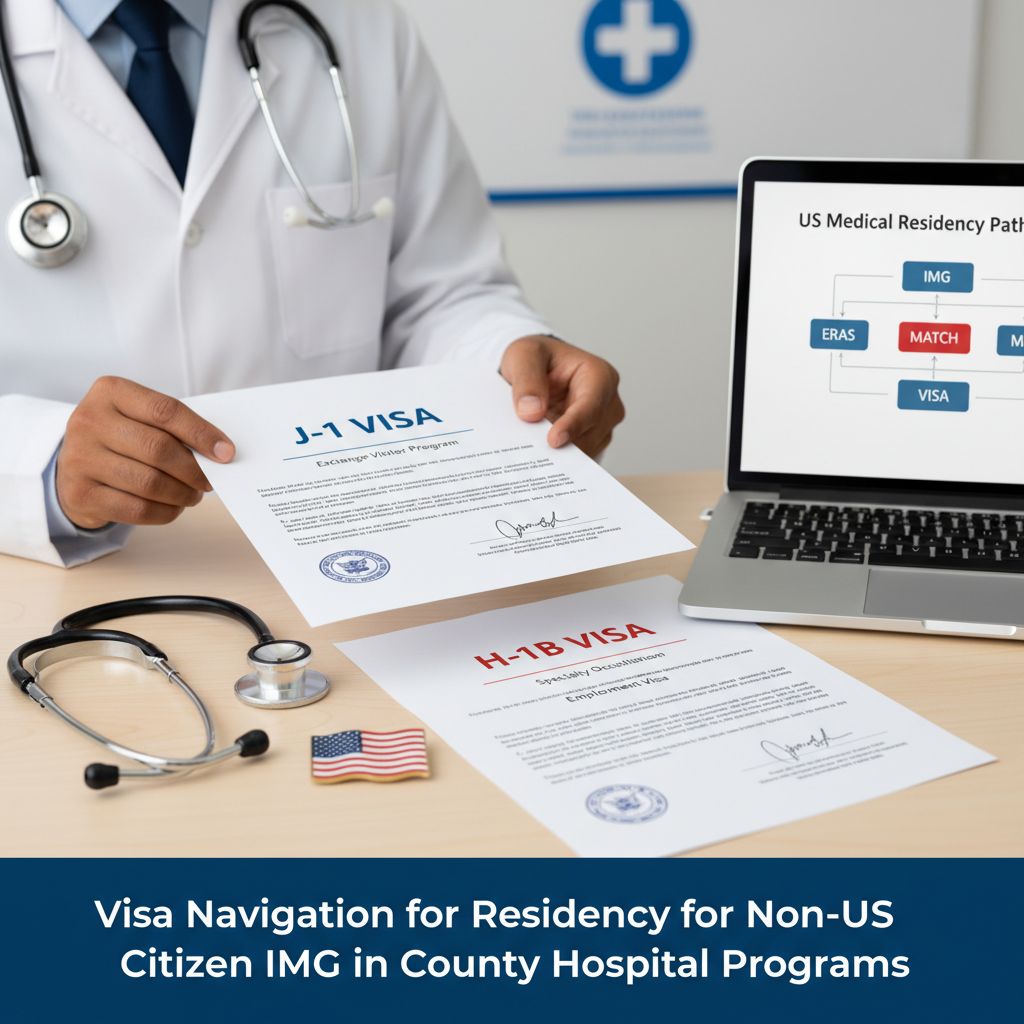
J-1 Physician Visa (ECFMG-Sponsored)
The J-1 exchange visitor physician visa is the most common residency visa for IMGs in county and safety net hospital residency programs.
Key Features:
- Sponsored by ECFMG, not directly by the hospital
- Used for graduate medical education and training (residency and fellowship)
- Time-limited (typically up to 7 years for clinical training)
- Requires return to home country or waiver after training
Eligibility Basics:
- Valid ECFMG certification
- Confirmed ACGME-accredited residency or fellowship position
- Passing USMLE or COMLEX equivalents as required for ECFMG cert
- Statement of Need from your home country’s Ministry of Health or equivalent authority
The 2-Year Home Residence Requirement (INA 212(e))
Most J-1 physicians are subject to a two-year home-country physical presence requirement after training. You must:
- Return to your home country for a cumulative two years, OR
- Obtain a J-1 waiver (commonly through a Conrad 30 or similar underserved-area waiver program) before changing to H-1B, L-1, or permanent residency (green card) in the US
For many non-US citizen IMGs, this is the single most important long-term planning issue.
Why County Hospitals Often Prefer J-1:
- Administrative process is centralized via ECFMG, reducing institutional burden
- No prevailing wage calculations or complex USCIS petitions
- Predictable templates and timelines
- Alignment with service mission: many J-1 waivers later involve work in underserved areas, which overlaps with safety net hospital priorities
As a result, many county hospital residency programs are “J-1 only.” This is not necessarily a disadvantage; it simply shapes your long-term trajectory.
H-1B Visa for Residency
H-1B is a temporary worker visa in a specialty occupation. A minority—but important subset—of county programs will sponsor H-1B for residents.
Key Features:
- Employer-sponsored (the hospital or university files the petition)
- Dual intent: easier transition to green card later
- Does not carry the J-1 two-year home-return requirement
- Tied to prevailing wage and institutional salary/benefits policies
Common Eligibility Requirements in Residency Programs:
- Full ECFMG certification prior to H-1B filing
- Completion of USMLE Step 3 before the petition is submitted
- License or eligibility for a training license in the state of the program
- Sufficient timeline for H-1B processing before residency start date
Because county/safety net hospitals run on tight financial and administrative margins, they may be cautious about H-1B due to:
- Legal fees and compliance workload
- Need to meet prevailing wage standards
- Risk of RFE (Request for Evidence) or petition delays
- Institutional policies discouraging non-J-1 pathways
Many programs that technically allow H-1B will:
- Cap the number of H-1B residents per year, OR
- Only offer H-1B to continuing trainees (e.g., completing residency then staying for fellowship)
J-1 vs H-1B: Strategic Considerations for Non-US Citizen IMGs
When you evaluate county hospital residency programs, think beyond “Which visa is better?” and instead ask:
1. What are my long-term goals?
- Want maximum flexibility to stay in the US and pursue a green card?
- H-1B may align better, but is harder to obtain.
- Comfortable serving in medically underserved areas post-residency?
- J-1 + waiver can be a strong path, and county-focused careers align naturally with this.
2. What is realistic for my current profile?
- No USMLE Step 3 yet by Match season?
- H-1B options shrink; you may need to prioritize J-1-sponsoring programs.
- Limited time before residency start date due to visa or graduation delays?
- J-1 often has more predictable, structured processing through ECFMG.
3. What does this specific program actually offer?
Always verify:
- “We sponsor visas” does not mean they sponsor both J-1 and H-1B.
- Program FAQ or coordinator emails should specify: “J-1 only”, “J-1 and H-1B”, or “No visa sponsorship.”
Step-by-Step Visa Planning During the Match Cycle
Visa navigation intersects with almost every phase of your residency journey. Here’s how to integrate it into your planning.
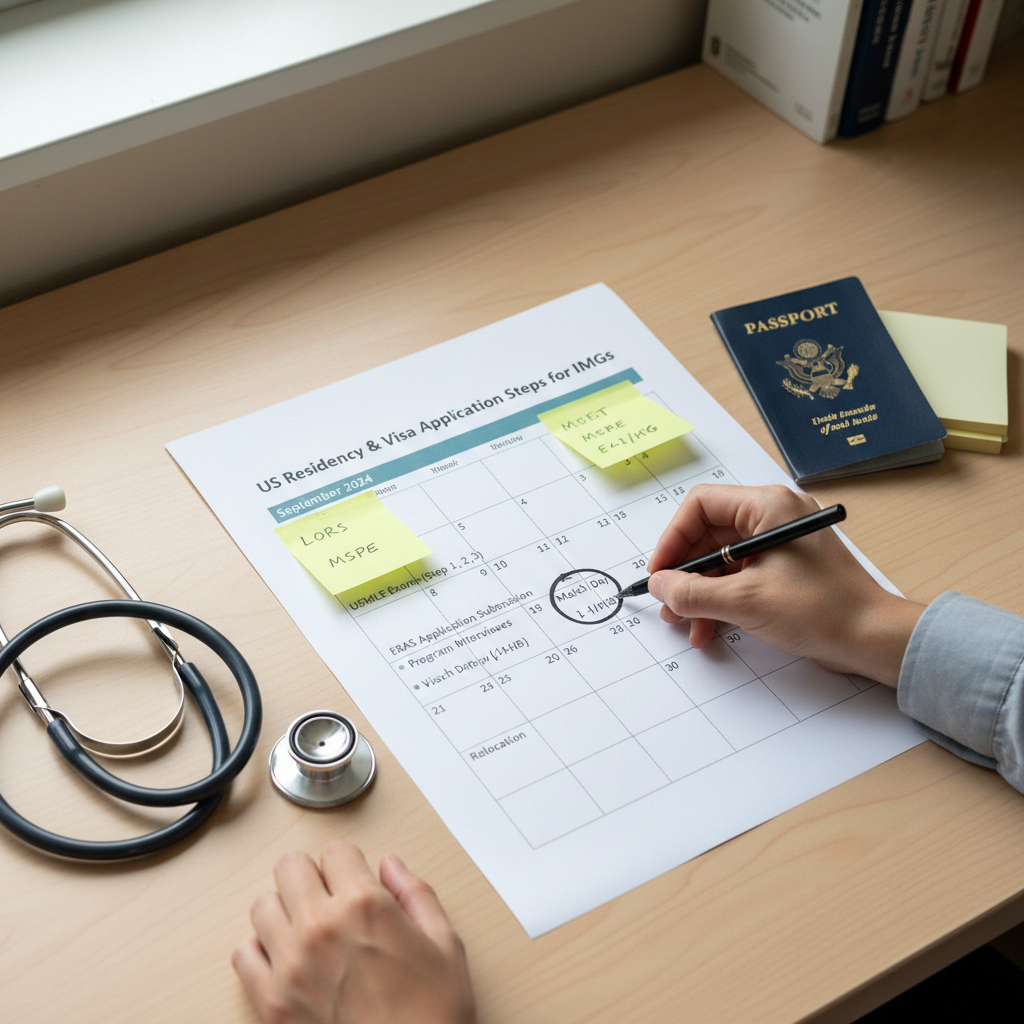
1. Before You Apply: Laying the Foundation
A. Clarify Your Visa Eligibility Status
Ask yourself:
- What is my current status? (Abroad, F-1, J-1 research, other)
- Am I or have I ever been on J-1 in the US before?
- If yes, are you subject to any existing 212(e) requirement?
- Do I have, or can I feasibly obtain, USMLE Step 3 by early spring?
These factors deeply affect H-1B feasibility.
B. List Your Realistic Visa Pathways
Example scenarios:
Scenario 1: IMG Abroad, No Prior US Visa
- Most Flexible: J-1 physician via ECFMG
- H-1B possible but will require fast Step 3 and early legal work
Scenario 2: IMG on F-1 in US (Master’s, MPH, etc.)
- May use OPT, but most residencies still prefer J-1 or H-1B
- J-1 physician still typical route; F-1 does not convert automatically
Scenario 3: Prior J-1 in Research
- You might already be subject to a J-1 home-residence requirement, which can complicate switching to J-1 physician or H-1B
- Must review with immigration counsel if uncertain
C. Target Programs Intentionally
In ERAS and FREIDA:
- Filter or search for:
- “Accepts J-1”
- “Accepts J-1 and H-1B”
- “Does not sponsor visas” (avoid these unless you have independent work authorization)
- County and safety net hospitals commonly list:
- “J-1 only” or
- “J-1, sometimes H-1B with stipulations”
Strategic approach:
- If Step 3 is not done or will be late:
- Apply heavily to J-1 friendly county hospitals
- If Step 3 is complete early and you strongly prefer H-1B:
- Include a mix of H-1B-sponsoring county programs plus broader programs
- Still apply to J-1 programs as a safety net unless you have a compelling reason not to
2. During Interview Season: Asking the Right Questions
Programs may not always clearly describe visa policies in their public materials. During interviews—especially at county and safety net hospitals—you should tactfully clarify.
Appropriate Questions to Ask:
- “Could you please clarify what types of visas your program sponsors for residents?”
- “Is your program J-1 only, or do you also sponsor H-1B for categorical residents?”
- “If H-1B is possible, what are the requirements regarding Step 3 and timing?”
- “Do you have recent experience sponsoring visas for non-US citizen IMGs?”
Red flags:
- Vague answers like “We’ll see what we can do” without any specifics
- Contradictory information between faculty and coordinators
- No clear history of sponsoring non-US citizen IMGs in recent years
Better signs:
- “We are J-1 only, and we work closely with ECFMG every year.”
- “We sponsor J-1 for everyone; H-1B is reserved only for fellows/non-categorical positions.”
- “We do both J-1 and H-1B, but H-1B requires Step 3 by January and institutional legal approval.”
3. After the Match: Executing the Visa Process
Once you match into a county hospital residency, timelines become critical.
A. For J-1 (ECFMG-Sponsored) Residents
Typical sequence:
- Receive offer letter / contract from your residency program.
- Program confirms your details to ECFMG.
- You submit:
- ECFMG online application for J-1 sponsorship
- Statement of Need from your home country
- Evidence of financial support (your stipend usually satisfies this)
- Required identity and educational documents
- ECFMG issues a DS-2019
- You schedule your visa interview at a US consulate, if outside the US
Practical tips:
- Start gathering your Statement of Need early; some Ministries of Health are slow.
- Maintain a scan of your passport, diploma, ECFMG cert, etc. ready to upload.
- Stay in close communication with your program coordinator about any delays.
B. For H-1B Residents in County and Safety Net Hospitals
Sequence (simplified):
- Program confirms they are willing to sponsor an H-1B for you.
- Hospital legal or HR team:
- Determines prevailing wage
- Files Labor Condition Application (LCA) with the Department of Labor
- Prepares and files Form I-129 H-1B petition with USCIS
- If abroad: once approved, you attend a visa interview for H-1B stamping
- If in the US on another status: you may pursue change of status without leaving
Practical constraints common in county hospitals:
- Institutional rules sometimes require all H-1B petitions to be filed at a central university/health system level, which can create bureaucratic delays.
- Introduction of prevailing wage can sometimes complicate resident salary structures.
Because of these realities, many county hospital programs limit H-1B to:
- Senior-level trainees (e.g., fellows)
- Residents continuing at the same institution after a J-1 waiver
- Highly exceptional cases
Long-Term Planning: Life After Residency at a County or Safety Net Hospital
Your choice of residency visa has consequences beyond training.
If You Train on a J-1 Visa
Most J-1 physicians must either:
- Fulfill the two-year home-country requirement, OR
- Obtain a J-1 waiver by agreeing to work in designated shortage or underserved areas
Common J-1 waiver paths:
- Conrad 30 state programs
- Federal programs (e.g., Veterans Affairs, HHS) in eligible settings
- Some county or safety net hospitals themselves qualify as waiver employers, especially in rural or high-need urban areas
Advantages for a county-hospital-focused career:
- Your training experience aligns well with the safety net mission, making you an attractive candidate for waiver-eligible positions.
- Many J-1 waiver jobs are in community hospitals, FQHCs, or public systems that value training at county hospitals.
Challenges:
- Limited flexibility in location/specialty immediately after residency
- Need to satisfy specific service and contract requirements to maintain waiver status
- Immigration processes for green card must be carefully coordinated with waiver obligations
If You Train on an H-1B Visa
Post-residency options:
- Continue at the same institution with H-1B extension (if they sponsor)
- Transfer H-1B to another employer (e.g., group practice, hospital)
- Begin or continue a green card process (PERM, I-140) without worrying about 212(e)
Advantages:
- More direct route to permanent residency if employer willing
- No mandatory two-year home return or waiver requirement
Challenges in county/safety net contexts:
- Not all public hospitals or county systems are comfortable sponsoring permanent residency.
- Budget constraints may limit their willingness to support legal fees or long-term H-1B employment.
Therefore, even on H-1B, you should:
- Discuss long-term plans with potential employers early
- Understand whether they typically sponsor green cards for foreign-trained physicians
Practical Strategies and Common Pitfalls for Non-US Citizen IMGs
Actionable Strategies
Map Your Visa Profile Early
- Write down your:
- Current/previous US visas
- Whether you’re subject to 212(e) from any past J-1
- Testing status (especially Step 3)
- Use this to decide if your primary path is more likely J-1 or H-1B.
- Write down your:
Group Programs by Visa Type Create three lists:
- Group A: County/safety net programs (J-1 only)
- Group B: County/safety net programs (J-1 + H-1B)
- Group C: No visa sponsorship or unclear policies (lowest priority)
Communicate Clearly but Professionally
- In pre-interview emails or during interviews, be transparent:
- “As a non-US citizen IMG, I will require J-1 or H-1B sponsorship. Does your program sponsor J-1 only, or both J-1 and H-1B for categorical residents?”
- Avoid demanding language; aim for clarification, not negotiation.
- In pre-interview emails or during interviews, be transparent:
Stay Ahead of Documentation
- Keep digital copies (PDFs) of:
- Passport
- Medical diploma and transcripts
- ECFMG certificate
- USMLE score reports
- Any prior DS-2019 or I-20 (if applicable)
- For J-1, start working on Statement of Need logistics even before Match.
- Keep digital copies (PDFs) of:
Use Expert Help When Needed
- GME offices at county hospitals often have designated immigration contacts—use them.
- For complex histories (prior J-1, J-2, F-1, or asylum), consult an experienced immigration attorney.
Common Pitfalls to Avoid
Assuming visa sponsorship based on rumors or old data
- Visa policies can change yearly with institutional leadership or legal advice. Always verify for the current cycle.
Waiting too long on Step 3 if you want H-1B
- Many H-1B-sponsoring county programs need Step 3 passed by January–February to file on time.
Ignoring the 2-year J-1 home requirement
- Even if you feel “I’ll worry later,” your future self will thank you for understanding waiver options now.
Not disclosing prior US visa history
- Incomplete or inconsistent information can cause major delays or denials. Be precise and honest.
Over-focusing on visa type over training quality
- Visa status is crucial, but your education, board eligibility, and job prospects also depend heavily on program quality and fit. Aim for a balanced decision.
FAQ: Visa Navigation for Non-US Citizen IMGs in County Hospital Residency Programs
Q1: As a non-US citizen IMG, is it easier to get into a county hospital residency program on J-1 or H-1B?
For most IMGs, J-1 is easier and more common, especially in county and safety net hospitals. These institutions often have streamlined relationships with ECFMG and prefer the standardized J-1 system. H-1B positions exist but are fewer, more administratively complex, and often require Step 3 early plus institutional approval.
Q2: I strongly prefer H-1B over J-1. Should I avoid J-1-only county hospital programs?
Not necessarily. Avoiding J-1-only programs will significantly shrink your options, particularly among safety net hospitals. If you are a strong candidate with early Step 3 and clearly H-1B-sponsoring programs on your list, you may prioritize them. However, many successful IMGs complete training on J-1 and then obtain J-1 waivers in underserved areas—often continuing the same county/safety net mission.
Q3: Can I switch from J-1 to H-1B during or right after residency without going home for two years?
Only if you first obtain a J-1 waiver of the two-year home residence requirement. Most physicians do this by accepting a qualifying job in a designated health professional shortage area (e.g., through a Conrad 30 waiver). Without a waiver, you generally cannot change to H-1B or get a green card without fulfilling the two-year home-country presence.
Q4: How can I quickly check whether a specific county hospital program will sponsor my visa?
Start by:
- Reviewing the program’s website (often a “Eligibility & Visa” or “International Applicants” section).
- Checking their entry in FREIDA or ERAS for visa information.
- If unclear, emailing the program coordinator with a direct question:
“As a non-US citizen IMG, I will require visa sponsorship. Could you please let me know whether your program sponsors J-1, H-1B, both, or neither for categorical residents?”
Document the responses for your own planning and use them to refine your rank list.
Navigating residency visas as a foreign national medical graduate can be complex, but county and safety net hospitals remain among the most welcoming destinations for non-US citizen IMGs. By understanding your IMG visa options, the realities of J-1 vs H-1B, and the specific constraints of county hospital residency programs, you can approach the Match with a realistic strategy—and build a career aligned with serving the patients who need you most.