
Understanding the Visa Landscape for Dermatology Residency
Dermatology is one of the most competitive specialties in the U.S. residency system. For international medical graduates (IMGs), the challenge is doubled: you must excel in the derm match while simultaneously mastering complex residency visa rules. Navigating IMG visa options, understanding J-1 vs H-1B, and planning long-term immigration strategy are just as important as your exam scores and letters of recommendation.
This guide focuses specifically on visa navigation for dermatology residency applicants—what you can realistically expect, how to read program policies, and how to align your visa strategy with a successful dermatology career in the U.S.
We will cover:
- How visas intersect with dermatology’s competitiveness
- The core residency visa categories (J-1, H‑1B, and others)
- J‑1 vs H‑1B for dermatology: pros, cons, and myths
- Strategic planning for derm match as an IMG
- Post‑residency options and the 2‑year home requirement
Throughout, remember: immigration law and institutional policies change. Always check current official sources (ECFMG, NRMP, USCIS) and consult an experienced immigration attorney for individualized advice.
Why Visa Strategy Matters More in Dermatology
Dermatology residency positions are limited, highly sought after, and often skewed toward U.S. graduates. Visa sponsorship adds another layer of complexity.
1. Fewer Programs Open to IMGs and Visa Sponsorship
Compared with many other specialties:
- A smaller proportion of dermatology residency programs sponsor visas at all.
- Among visa-friendly programs, many only sponsor J‑1, and a smaller subset sponsors H‑1B.
- Some programs explicitly do not consider any applicants requiring visa sponsorship, even if they are very strong candidates.
This means your derm match list must be informed not only by academic fit but by clear visa feasibility.
2. Timing and Competitiveness
Dermatology is often pursued as:
- Direct application after graduation (less common for IMGs), or
- After completing a preliminary or transitional year in medicine or surgery.
Your visa pathway can influence:
- Whether you qualify for Step 3 before residency (important for H‑1B)
- Whether a preliminary year program and a dermatology program have consistent visa policies
- How attractive you appear to programs that must sponsor and pay visa-related fees
Ignoring visa considerations may result in ranking programs you cannot legally train in or creating complex transitions (J‑1 to H‑1B) that programs are not willing to support.
3. Long-Term Career Planning
Dermatology practice in the U.S. often involves:
- Outpatient private practice settings
- Academic positions
- Cosmetic-focused practices
Your visa choice can impact:
- Ease of transition to employment after residency/fellowship
- Ability to remain in the U.S. long term
- Options to pursue fellowships (e.g., dermatopathology, Mohs surgery) without constant visa disruptions
Core Visa Options for Dermatology Residents
For most IMGs, dermatology residency in the U.S. comes down to J‑1 vs H‑1B. Other pathways (e.g., permanent residency, other non-immigrant categories) exist but are much less common at the time of match.
1. J‑1 Visa (ECFMG-Sponsored Exchange Visitor Visa)
The J‑1 physician visa is the most common visa for IMGs in GME overall and the default for many dermatology programs.
Key features:
- Sponsored by ECFMG, not directly by the program
- Renewable annually for the duration of standard training, including fellowships, as long as you are in good standing
- Does not require USMLE Step 3 prior to residency
- Comes with a two-year home-country physical presence requirement (often called the “2-year home rule”) after you finish all training unless it is waived
Pros for Dermatology:
- Widely accepted: Many dermatology residency programs that sponsor visas will only sponsor J‑1.
- Predictable: ECFMG handles much of the process, and academic centers are used to managing J‑1 paperwork.
- Flexible for training: Allows you to complete dermatology plus fellowships within the standard training period.
Cons and Limitations:
- 2-year home-country requirement at the end of training, unless you secure a waiver (e.g., Conrad 30, hardship, persecution).
- You cannot freely transition to other non-immigrant statuses inside the U.S. without addressing this requirement.
- For dermatology—often urban and competitive—there may be fewer J‑1 waiver jobs than in primary care or rural specialties.
2. H‑1B Visa (Temporary Worker in Specialty Occupation)
The H‑1B is a dual-intent work visa that some dermatology programs sponsor for residents.
Key features:
- Employer-sponsored by the hospital or institution, not ECFMG
- Requires USMLE Step 3 passed before visa petition filing (and often before rank list certification)
- Typically granted in up to 3-year increments, with a maximum stay of 6 years (clock includes any prior H‑1B time)
- Considered dual intent, allowing you to pursue permanent residency (green card) during H‑1B status
Pros for Dermatology:
- No automatic 2-year home requirement after training
- Generally easier transition to post-residency employment in the U.S.
- Attractive for those aiming for long-term U.S. practice without mandatory return
Cons and Limitations:
- Fewer derm programs sponsor H‑1B, particularly for first-year dermatology residents.
- Step 3 must be passed early—often before ERAS deadlines or rank list deadlines.
- Costly and administratively heavier for the program (legal fees, filing fees), which discourages some departments.
- The 6-year limit can be an issue if you do a long sequence of training (prelim year + derm + fellowship) and later need more H‑1B time for employment without a green card in process.
3. Other Less Common Pathways
While J‑1 and H‑1B dominate, you may encounter special situations:
Green Card (Permanent Resident):
- If you are already a U.S. permanent resident, visa sponsorship is not needed.
- Some applicants obtain a green card through family, employment, or the Diversity Visa lottery before or during residency.
Other Non-Immigrant Categories (F‑1 OPT, O‑1, etc.):
- F‑1 (with OPT) may be used briefly after U.S. medical school, but most residency programs still transition you to J‑1 or H‑1B.
- O‑1 (extraordinary ability) is rare at the residency level but may be relevant later in an academic career.
For planning the derm match, focus primarily on J‑1 vs H‑1B and keep other options as potential long-term strategies.
J‑1 vs H‑1B in Dermatology: Strategic Comparison
Your residency visa choice is not simply a legal question; it’s a career strategy question. Dermatology’s competitiveness and practice patterns make some aspects of J‑1 vs H‑1B especially important.
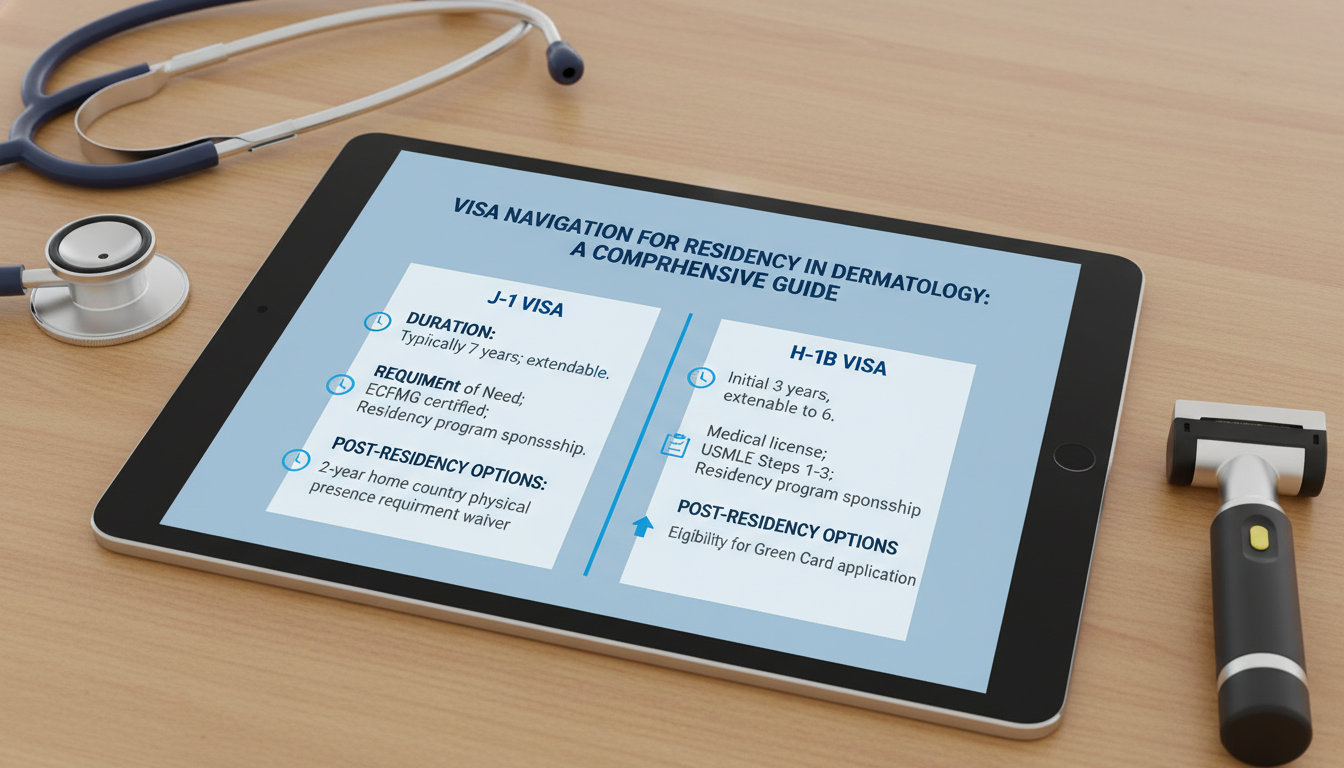
1. Eligibility and Front-End Requirements
J‑1:
- No Step 3 requirement for visa sponsorship
- Requires:
- ECFMG certification
- A signed contract or official offer from an accredited residency program
- Often more accessible for IMGs who are still preparing Step 3 or do not have enough time to schedule it before the match cycle.
H‑1B:
- Must have Step 3 passed before the program can file your H‑1B petition.
- Timing is critical: you may need your Step 3 result before rank list certification or even ERAS deadlines, depending on program policy.
- Requires licensing requirements of the state (often at minimum a training or limited license).
Derm Strategy Tip:
If you are aiming for H‑1B in dermatology, plan Step 3 early—ideally complete it at least 6–9 months before the ERAS application deadline to have flexibility and avoid disqualification from H‑1B-only opportunities.
2. Program Preferences in Dermatology
Patterns (not universal, but common):
- Many academic dermatology programs that take IMGs default to J‑1 because it is simpler and standardized.
- Some prestigious or high-volume centers may not sponsor H‑1B for residents at all, even though they might for attending physicians.
- A smaller subset of derm programs explicitly offer H‑1B sponsorship, but they may reserve it for exceptional candidates or those already in the system.
Because dermatology is extremely competitive, some programs feel they do not need to take on extra administrative/financial burdens; they can easily fill positions without H‑1B applicants.
3. Duration and Training Path
Dermatology training structure (typical):
- 1 year of preliminary or transitional training (internal medicine, surgery, transitional year)
- 3 years of dermatology residency (PGY-2 to PGY-4)
- Optional fellowship(s) (1–2 additional years)
J‑1:
- Can cover entire continuum of GME, including prelim year + dermatology + fellowships, as long as it falls within ECFMG’s maximum duration policies (usually enough for standard dermatology paths).
- Each year renewed with institutional support and documentation.
H‑1B:
- Limited to 6 total years, inclusive of any prior H‑1B employment or training.
- Prelim year + derm (3 years) = 4 years total; add a 1–2 year fellowship and you may approach the limit.
- If you anticipate a longer training path plus potential delays or research years, time planning is essential.
4. Post-Residency Options and 2-Year Home Requirement
J‑1:
- Default: After finishing all training (including fellowships), you must either:
- Return to your home country for 2 years, or
- Obtain a J‑1 waiver (e.g., Conrad 30 waiver job in a designated underserved area, VA or federal agency waiver, hardship/persecution waiver).
- Dermatology J‑1 waiver jobs can be harder to find than primary care positions; many underserved area programs prioritize primary care or psychiatry.
H‑1B:
- No automatic home requirement.
- You may continue in H‑1B employment after residency/fellowship if an employer sponsors you.
- You may also pursue employment-based green card pathways more directly.
- For highly sought-after urban dermatology practices, H‑1B is often an easier sell than a J‑1 waiver requirement.
Derm Strategy Tip:
If your long-term goal is to practice in a major U.S. city or private cosmetic dermatology practice, H‑1B may align better with your post-training plans. If you are open to serving in underserved or rural areas, a J‑1 to waiver pathway can be perfectly viable.
5. Family and Lifestyle Considerations
J‑1:
- Spouses and children on J‑2 can often work (with employment authorization) and study.
- But the 2-year home requirement may affect the entire family’s long-term planning.
H‑1B:
- Dependents on H‑4 can study; some H‑4 spouses may obtain work authorization if certain green card milestones are reached.
- Paths to green card and stability for the family can be more straightforward if you have continuous H‑1B status and employer sponsorship.
Practical Steps: Building a Visa-Savvy Dermatology Application Strategy
Visa navigation should be woven into your overall derm match plan from the beginning, not left to the end.

1. Clarify Your Visa Profile Early
Ask yourself:
- Are you currently on any U.S. visa (F‑1, J‑1 research, etc.)?
- Are you eligible for J‑1 sponsorship through ECFMG (i.e., ECFMG-certified by the time of training)?
- Could you realistically complete Step 3 in time to be competitive for H‑1B–sponsoring programs?
- Are you open to returning to your home country for 2 years, or strongly committed to a U.S. long-term plan?
Define your ideal and acceptable visa scenarios:
- Ideal: e.g., H‑1B for dermatology plus potential fellowship
- Acceptable: J‑1 for dermatology residency, then J‑1 waiver path
- Non-starter: E.g., return home for 2 years if that is not feasible due to family or career constraints
2. Research Dermatology Program Visa Policies Thoroughly
For each dermatology residency program:
- Check the program website under “Eligibility,” “International Medical Graduates,” or “Visa Sponsorship.”
- Note the exact language:
- “We sponsor J‑1 only”
- “We sponsor J‑1 and H‑1B depending on candidate”
- “We do not sponsor visas”
- Cross-check with:
- FREIDA (AMA database)
- Program FAQs
- Recent residents’ backgrounds (IMGs? Countries of origin? Visa hints from alumni profiles)
If the website is unclear, you can (politely) email the program coordinator with a concise question:
“I am an IMG planning to apply for dermatology residency. Could you please confirm whether your program sponsors visas, and if so, which types (J‑1, H‑1B)?”
Track this data in a spreadsheet:
- Program name
- Visa types sponsored
- Past IMG presence
- Notes on competitiveness / academic environment
3. Align Step 3 Timing with Visa Goals
If you are even considering H‑1B:
- Register and schedule Step 3 as early as realistically possible.
- Aim to have scores available before ERAS opening (or at least before rank lists are finalized).
- Be aware: some states have residency or other eligibility requirements for Step 3—plan for where you will be eligible to sit for it.
If you cannot take Step 3 in time, you may decide:
- To focus exclusively on J‑1–friendly programs for your first application cycle, OR
- To postpone your application one year to complete Step 3 and become competitive for H‑1B.
4. Consider Bridge Paths: Prelim or Research Years
Because dermatology is so competitive, many IMGs:
- Complete a preliminary year in internal medicine or surgery
- Engage in U.S.-based research (often on J‑1 research or F‑1, if in a degree program)
From a visa perspective:
- If you do a prelim year on J‑1, then transfer to dermatology also on J‑1, that can be straightforward.
- If you do a prelim year on H‑1B, make sure your prelim program and future derm program are both open to H‑1B; otherwise you may be forced to switch to J‑1 later.
- Research positions may be under a different category of J‑1 (research scholar), so transitioning to J‑1 clinical (ECFMG) involves additional steps—plan ahead.
Bridge years can help:
- Strengthen your derm application (publications, U.S. letters, networking)
- Give you time to pass Step 3
- Clarify which visa path is more realistic
But they also consume visa time (for H‑1B) and may create additional transitions.
5. Build a Visa-Compatible Rank List
When you build your rank list in NRMP:
- Filter out programs that categorically do not sponsor your needed visa.
- Prioritize programs that are known to:
- Sponsor your visa type reliably
- Have a history of successfully onboarding IMGs on that visa
- Balance program prestige with visa reality—ranking top-tier programs that will not sponsor your visa above solid, visa-friendly programs can be risky.
For derm match, IMGs often benefit from:
- Casting a wide net among visa-friendly programs
- Considering less geographically popular locations that may be more open to IMGs and visa sponsorship
- Ranking every program where you would truly be willing and able to train legally and practically
After the Match: Visa Processing and Long-Term Planning
Once you match into dermatology (or a prelim year with a categorical derm spot afterward), your focus shifts from strategy to execution.
1. J‑1 Processing (If Applicable)
If matched with J‑1 sponsorship:
- Your program will send you instructions to begin the ECFMG J‑1 application.
- You will upload required documents (contracts, financial support, passport, etc.) to your ECFMG account.
- After ECFMG approves, they will issue a Form DS-2019, which you use to schedule your visa interview at a U.S. consulate (if outside the U.S.).
Important:
- Keep track of annual renewal deadlines; your GME office usually helps, but you must submit your part on time.
- Understand any employment limits (e.g., moonlighting restrictions) based on J‑1 rules.
2. H‑1B Petition (If Applicable)
If matched with H‑1B sponsorship:
- The institution’s HR/legal office and possibly external immigration attorneys will prepare your H‑1B petition.
- You may need to provide:
- Diploma and transcripts
- ECFMG certificate
- USMLE score reports
- Evidence of Step 3
- Passport and immigration history
- Timing is critical; H‑1B approval must align with your July 1 (or similar) start date.
Note: Many residency programs are cap-exempt from the H‑1B annual lottery because they are affiliated with universities or nonprofit research organizations. This is a significant advantage compared with many private employers.
3. Planning Post-Residency Moves
During dermatology residency:
- Talk with your program director and mentors about typical job paths for recent graduates.
- For J‑1 residents: start learning about J‑1 waiver employers in dermatology as early as PGY-3 or PGY-4; the search can take time.
- For H‑1B residents: discuss with potential employers whether they:
- Will transfer/sponsor your H‑1B
- Are willing to start green card processing early
For dermatology, some common post-training scenarios:
- Academic positions at university hospitals (often H‑1B or O‑1, possibly leading to green card sponsorship)
- Group private practices that may have varying levels of comfort with visa sponsorship
- Cosmetic-focused practices in large cities, where employers may be less familiar with J‑1 waiver obligations
FAQs on Visa Navigation for Dermatology Residency
1. Is it realistic for an IMG needing a visa to match into dermatology?
Yes, but it is challenging. You must excel in all the usual derm match metrics (USMLE scores, research, strong letters, U.S. clinical exposure) and carefully target reality-based visa-friendly programs. Many successful IMGs match into dermatology on J‑1, and a smaller number on H‑1B. Strategic planning and program selection are essential.
2. Should I delay applying to dermatology until I finish Step 3 to improve my H‑1B chances?
It depends on your profile and risk tolerance:
- If you are a highly competitive candidate and strongly prefer H‑1B, delaying one year to complete Step 3 may open more options.
- If your application is marginal and you are mainly targeting J‑1 programs anyway, delaying might not significantly change your outcomes.
Consider discussing this decision with trusted mentors and, if possible, an immigration attorney to understand timing implications.
3. Can I switch from J‑1 to H‑1B after starting dermatology residency?
Switching from J‑1 (ECFMG) to H‑1B during residency is possible but complex:
- Many programs are reluctant to change visa types mid-training.
- You may still be subject to the 2-year home requirement if it has already been triggered by your J‑1.
- USCIS and immigration law have specific rules around J‑1 to H‑1B transitions.
If this is part of your long-term vision, clarify before you start whether your program would even consider such a change later.
4. Are there IMG visa options that avoid both J‑1 and H‑1B issues entirely?
The main alternative is to enter residency as a permanent resident (green card holder) or U.S. citizen. Some IMGs obtain green cards through:
- Family-based sponsorship
- Employment outside of GME
- Diversity Visa lottery
- Marriage to a U.S. citizen or permanent resident
However, these paths are often unpredictable and time-consuming. For most applicants in the derm match, the practical choice remains J‑1 vs H‑1B.
Visa navigation for dermatology residency is not just paperwork—it is a foundational element of your career trajectory. By understanding IMG visa options, realistically assessing J‑1 vs H‑1B, and integrating visa considerations into every stage of your derm match strategy, you can significantly improve both your chances of matching and your long-term professional stability in the U.S.