
Understanding Visa Navigation for Kaiser Permanente Residency Programs
Visa navigation is a central concern for international medical graduates (IMGs) targeting Kaiser residency positions. Kaiser Permanente residency programs are highly regarded for their integrated health system, strong outpatient focus, and emphasis on quality improvement—and they attract many IMGs every year. However, each Kaiser Permanente region and specialty may follow different policies regarding sponsorship, especially when it comes to J‑1 vs H‑1B visas.
This article explains how visa sponsorship typically works for Kaiser Permanente residency programs, how to interpret program websites and policy statements, and how to strategically plan your residency visa pathway as an IMG. While policies change, the framework and strategies described here will help you ask the right questions and make informed decisions.
Important disclaimer: Visa and institutional policies change frequently. Always confirm the most current details directly with individual Kaiser residency program coordinators, official program websites, and qualified immigration counsel.
1. Overview of Visa Options for IMGs in Kaiser Residency Programs
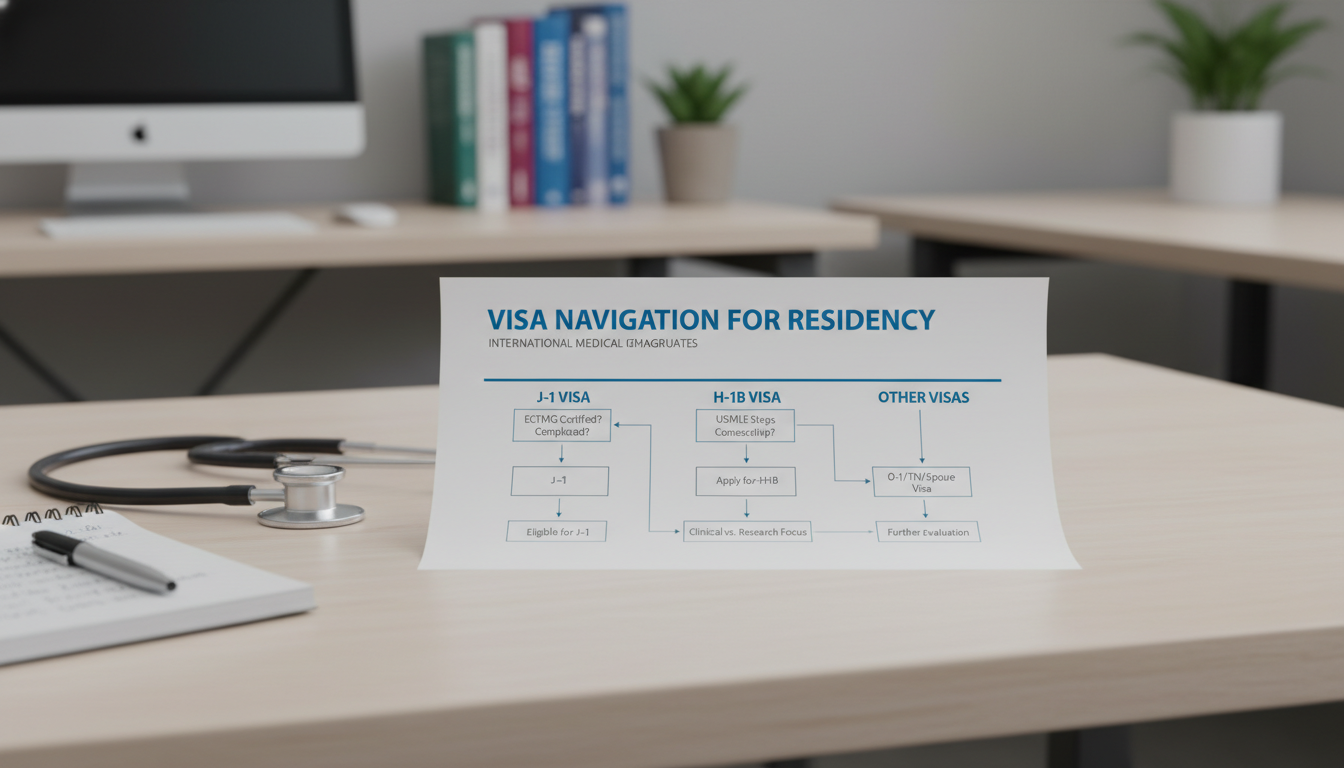
Most IMGs targeting Kaiser Permanente residency programs will need one of three main immigration pathways:
- Educational Commission for Foreign Medical Graduates (ECFMG)-sponsored J‑1 visa
- Employer-sponsored H‑1B visa
- U.S. permanent residency (green card) or other work authorization (e.g., EAD through another category)
1.1 The J‑1 Visa in Kaiser Residency Context
The J‑1 physician visa is the most common IMG visa for graduate medical education in the United States and is managed through ECFMG.
Key features for Kaiser residency applicants:
- Sponsoring entity: ECFMG, not Kaiser Permanente directly
- Eligibility: Valid ECFMG certification and a contract/offer from an ACGME-accredited residency or fellowship
- Duration: Typically the length of the residency plus any approved extensions, up to 7 years in most cases
- Two-year home residence requirement (212(e)): Most J‑1 physicians must return to their home country for two years after training, unless they obtain a waiver (e.g., Conrad 30, federal agencies)
How this plays out at Kaiser:
- Many Kaiser Permanente residency and fellowship programs accept J‑1 visas because the administrative burden is handled by ECFMG.
- Some programs are J‑1 only, explicitly stating they do not sponsor H‑1B visas.
- The J‑1 is usually the most accessible pathway for IMGs aiming for Kaiser residency slots, especially in competitive regions like California.
1.2 The H‑1B Visa in Kaiser Permanente Residency Programs
The H‑1B visa is a temporary professional worker visa that some U.S. teaching hospitals and systems use for residents and fellows.
Key points:
- Employer-sponsored: Kaiser Permanente must act as the H‑1B petitioner.
- Requirements:
- USMLE Step 3 passed before petition filing (timing is critical)
- Valid ECFMG certification
- State eligibility for a training license
- Dual intent: Allows you to pursue permanent residency while on the visa.
- No two‑year home requirement: Unlike the J‑1, there is no 212(e) rule.
How this affects Kaiser residency applicants:
- Some Kaiser residency programs do sponsor H‑1B, but:
- It may be limited to certain specialties or an exception rather than the rule.
- Often reserved for highly competitive candidates or specific program needs.
- Other Kaiser programs explicitly say “no H‑1B sponsorship”.
- Given the complexity, costs, and timing, not every Kaiser Permanente site will commit to new H‑1B sponsorship annually.
1.3 Comparing J‑1 vs H‑1B in the Kaiser Context
For Kaiser residency applicants, here’s how J‑1 vs H‑1B typically compares in practice:
J‑1 Pros:
- Widely accepted by most teaching hospitals, including many Kaiser Permanente programs
- ECFMG manages much of the process
- Predictable timelines for most programs
- Often the “default” option for IMGs
J‑1 Cons:
- Two‑year home country requirement after training, unless a waiver is secured
- Waiver jobs may limit your initial post‑residency job choices (often in underserved or rural areas, though some are in urban/near-urban locations)
- Less flexibility if your long-term goal is to settle immediately in the U.S. in a specific city
H‑1B Pros:
- No 2‑year home return requirement
- Dual intent facilitates a smoother transition to a green card
- More flexibility for immediate post‑residency practice location
H‑1B Cons in Kaiser Programs:
- Not all Kaiser residency programs sponsor H‑1B
- Requires Step 3 early, which may be challenging for some IMGs
- Higher legal and filing costs for the employer
- Petition caps and timing can complicate start dates (though many residency positions qualify for cap-exempt status through affiliated academic institutions)
For many IMGs specifically targeting Kaiser residency positions, the practical reality is:
- Plan on J‑1 as the baseline,
- Treat H‑1B as a bonus option where clearly supported by program policy and your timeline (USMLE Step 3 and document readiness).
2. Kaiser Permanente Residency Structure and Its Impact on Visa Policies
Kaiser Permanente is not a single hospital; it’s a large integrated system with multiple regions and affiliated teaching institutions. Visa policies can vary substantially by:
- Region (e.g., Northern California, Southern California, Washington, Hawaii, Colorado, Mid-Atlantic States)
- Program type (Internal Medicine vs Dermatology vs Emergency Medicine)
- Academic affiliations (e.g., USC, UCLA, Stanford, local universities)
2.1 Kaiser Program Types and Sponsoring Institutions
Kaiser residency programs typically fall into one of these structures:
Kaiser as the primary sponsoring institution
- ACGME-accredited program with Kaiser Permanente as the GME sponsor.
- Visa policies determined largely by Kaiser’s GME office and local legal/HR.
University-sponsored, Kaiser-affiliated rotations
- The residency is officially sponsored by a university (e.g., a UC campus or another academic medical center).
- Kaiser hospitals serve as training sites, but the sponsoring university sets visa policy.
Joint or consortium arrangements
- Shared governance structures.
- Visa pathways may be influenced by multiple institutional policies.
For you as an applicant, this means:
- Always identify who the ACGME sponsoring institution is.
Visa policy often follows that institution’s standard rules. - Check both:
- The Kaiser residency website, and
- The university GME/visa page, if applicable.
2.2 Regional Differences in Visa Support
Although public policy pages do not always spell out every nuance, some general tendencies have been observed (subject to change):
- California (Northern & Southern):
- Many Kaiser Permanente residency programs accept J‑1.
- H‑1B sponsorship may exist but is often limited or selective; some programs explicitly state they do not sponsor H‑1B.
- Pacific Northwest / Washington:
- Historically open to J‑1; H‑1B options vary by program and institutional partnerships.
- Colorado, Hawaii, Mid‑Atlantic States, Georgia:
- Most often J‑1 friendly, but H‑1B sponsorship should be considered program-dependent, not region‑wide.
Do not assume that “Kaiser Permanente residency” automatically means the same visa policy in every location. The only reliable path is to check each program individually.
3. Step‑by‑Step Visa Strategy for IMGs Targeting Kaiser Residency
3.1 Step 1: Clarify Your Long-Term Career and Immigration Goals
Before zeroing in on visa types, be clear about your priorities:
- Do you aim to permanently settle in the U.S. as quickly as possible?
- Are you open to working in underserved or rural areas after training (for J‑1 waiver jobs)?
- How quickly can you realistically pass USMLE Step 3?
- Do you have existing ties or pathways (e.g., a pending green card, spouse with work visa, asylum, etc.)?
Your answers shape your approach:
- If you are flexible on post‑residency location and primarily want quality training at a Kaiser program, J‑1 is often perfectly acceptable and realistic.
- If avoiding the 2‑year home requirement is critical, then you must:
- Target programs actively supporting H‑1B, or
- Rely on non-residency visas (e.g., green card, EAD) you can secure independently.
3.2 Step 2: Research Kaiser Residency Visa Policies Early
Before applying through ERAS:
List all Kaiser Permanente residency programs in your specialty of interest (from AAMC FREIDA, Kaiser GME websites, and program directories).
For each program, check:
- Program website: Look for “Eligibility and Visa Information,” “For International Medical Graduates,” or “Application Requirements.”
- GME Office page: Many regions have a centralized GME site clarifying residency visa policies.
- University affiliate site (if applicable): Confirm whether the university’s policies govern visas.
If unclear or not explicitly stated:
- Email the program coordinator with a concise, professional query (see sample templates in Section 5).
Create a spreadsheet that includes:
- Program name and location
- Sponsoring institution
- Accepts J‑1? (Yes/No/Unclear)
- Sponsors H‑1B? (Yes/No/Case-by-case)
- Notes (e.g., “Step 3 required by Feb,” “prefers U.S. clinical experience,” etc.)
This map will guide which Kaiser residency programs align with your visa needs.
3.3 Step 3: Time Your Exams and Documents to Match Visa Pathway
For J‑1 visa:
- USMLE Step 1, Step 2 CK, OET (if still required by ECFMG rules at your application time) completed before applying for ECFMG certification.
- Have your ECFMG certification or be on track to complete it prior to program start.
- Ensure your passport will remain valid for the duration of training.
- Keep all education documents (diploma, transcripts) ready for ECFMG and consular processing.
For H‑1B visa (if targeting H‑1B-friendly Kaiser programs):
- Aim to pass USMLE Step 3 before January–February of the year you plan to start residency.
- Maintain excellent documentation continuity (previous visa/I-94 records if you’re already in the U.S., prior residency attempts, etc.).
- Be prepared to pay certain personal costs (like exam fees and document translation), although the employer is legally obligated to pay key H‑1B petition costs.
3.4 Step 4: Build a Programs List Optimized for Your Visa Reality
Once you know which Kaiser residency programs:
- Accept J‑1, and
- Potentially sponsor H‑1B, and
- Fit your profile (scores, YOG, clinical experience),
Build a tiered application list:
- Tier A: Kaiser programs whose visa policy perfectly matches your goals (e.g., H‑1B friendly, or J‑1 with strong support for waiver counseling and post-residency planning).
- Tier B: Kaiser programs that accept J‑1 but offer excellent training even if J‑1 is your only realistic option.
- Tier C: Non‑Kaiser programs where visa policy is strongly favorable, as a backup to ensure you match somewhere.
Use this list to balance institutional prestige, training quality, geographic preference, and visa feasibility.
4. J‑1 Waivers and Post‑Residency Planning After Kaiser Training
If you join a Kaiser residency on a J‑1 visa, you must consider what happens after training.
4.1 The Two‑Year Home Country Requirement
Most J‑1 physicians are subject to INA 212(e), meaning:
- You must return to your home country for a total of two years before you can:
- Obtain an H‑1B visa
- Obtain L visa
- Adjust status to permanent resident (green card) within the U.S.
Unless you obtain a J‑1 waiver.
4.2 Common J‑1 Waiver Pathways
The most widely used waiver options include:
Conrad 30 State Waiver Programs
- Requires working in a designated underserved area (HPSA/MUA) in a specific state for typically 3 years on an H‑1B visa.
- Each state has 30 slots per year, and specialties and locations vary.
- Some states are very competitive; others under‑utilize their slots.
Federal Agency Waivers
- E.g., waivers through the Department of Health and Human Services, Veterans Affairs, or other federal agencies.
- Often tied to serving specified populations or working at specific facilities.
Hardship or Persecution Waivers
- Based on demonstrating exceptional hardship to a U.S. citizen/permanent resident spouse/child or risk of persecution if you return.
- More complex to document and adjudicate.
4.3 How Kaiser Residency Experience Helps with Waivers
Training in a Kaiser Permanente residency can support your J‑1 waiver journey by:
- Strengthening your clinical reputation and competitive profile for jobs that qualify for J‑1 waiver positions.
- Providing experience in integrated care, population health, and quality improvement, which many underserved clinics or systems value.
- Building connections with attendings and alumni who might know of waiver‑eligible job opportunities.
However, it’s important to know:
- Kaiser Permanente itself is not typically a J‑1 waiver employer post‑residency, especially in California metropolitan areas, which are often not designated shortage areas.
- You may need to leave the Kaiser system temporarily after training for 3 years to complete a waiver job and later try to rejoin Kaiser (or another system) as an attending.
4.4 Planning Early During Residency
Start thinking about waiver strategies by:
- PGY‑1/PGY‑2:
- Educate yourself on your state’s Conrad 30 rules and timelines.
- Attend any GME information sessions about care in underserved areas or immigration pathways.
- PGY‑2/PGY‑3:
- Network with Kaiser alumni who went through J‑1 waivers.
- Reach out to potential employers in HPSA/MUA regions well in advance (9–18 months before completion).
- Consult an immigration attorney familiar with physician waivers.
This level of foresight transforms the J‑1 from a perceived limitation into a structured progression: Kaiser residency → waiver job → long‑term U.S. practice.
5. Communicating with Kaiser Residency Programs About Visas
Clear, professional communication with residency programs is crucial, especially where residency visa policies are not fully transparent online.
5.1 When and How to Ask
When to ask:
- Ideally before applying to avoid wasted applications.
- At the latest, before ranking programs if information is still unclear.
How to ask:
- Use direct, concise email to the program coordinator, copying the program email if listed.
- Avoid long personal stories in the first email; focus on specific visa questions.
5.2 Sample Email: General Visa Inquiry to a Kaiser Residency
Subject: Visa Sponsorship Question – [Your Name], Prospective Applicant
Dear [Program Coordinator’s Name],
My name is [Your Name], an international medical graduate from [Your Country/Medical School]. I am very interested in applying to the [Program Name] at [Kaiser Permanente Region/Institution] for the [upcoming match year].
I would be grateful if you could kindly clarify your current visa sponsorship policy for categorical residents:
– Do you accept ECFMG-sponsored J‑1 visas?
– Do you sponsor H‑1B visas for incoming residents (assuming USMLE Step 3 is completed in time)?I understand policies can change, and I only wish to ensure that my application aligns with your program’s eligibility criteria.
Thank you very much for your time and assistance.
Sincerely,
[Your Full Name]
[AAMC ID]
[Email / Phone]
5.3 Sample Email: Follow-up for H‑1B Feasibility
If the program states that H‑1B is “case-by-case”:
Subject: H‑1B Visa Clarification – [Your Name], Applicant
Dear [Program Coordinator’s Name],
Thank you for clarifying that your program may consider H‑1B visa sponsorship on a case‑by‑case basis. I would like to confirm that I have already passed USMLE Step 3 and hold current ECFMG certification.
In light of this, would an H‑1B visa be a feasible option for an incoming PGY‑1 resident in your program, or do you generally prefer J‑1 visas? Any additional guidance would be very helpful as I plan my visa strategy and application list.
With appreciation,
[Your Name]
Always keep the tone respectful, concise, and solution-oriented.
6. Practical Tips and Common Pitfalls for IMGs Targeting Kaiser Residency
6.1 Practical Tips
Document everything
- Save emails from program coordinators outlining visa policies.
- Keep copies of test scores, ECFMG documents, and passport pages organized.
Be realistic about competitiveness
- Kaiser residency programs—especially in California—are competitive.
- Combine your interest in Kaiser Permanente residency with a broad list of other programs that support your visa type.
Stay updated
- Immigration policies and institutional decisions on J‑1 vs H‑1B can change year to year.
- Confirm policies again if more than one application cycle passes.
Consult professionals
- A qualified immigration attorney is essential for complex situations (previous visa denials, status changes, J‑1 waivers, special circumstances).
- Program coordinators can guide you on institutional policy but cannot give you personalized legal advice.
Network with current and former residents
- Reach out via LinkedIn, alumni groups, or professional associations.
- Ask about their experiences with visas and how the program supported them.
6.2 Common Pitfalls to Avoid
Assuming all Kaiser residency programs share one visa policy
Each program can differ significantly. Verify individually.Delaying USMLE Step 3 if you’re serious about H‑1B
If H‑1B is central to your plan, treat Step 3 as urgent.Ignoring the post‑residency phase
Especially on J‑1, you must plan ahead for waivers and future employment.Over‑restricting your applications
Limiting yourself only to H‑1B‑sponsoring Kaiser programs might dramatically reduce your chances of matching. Use a balanced approach, with J‑1 pathways included if compatible with your goals.
FAQ: Visa Navigation for IMGs in Kaiser Permanente Residency Programs
1. Do Kaiser residency programs sponsor both J‑1 and H‑1B visas?
Many Kaiser Permanente residency programs accept J‑1 visas, as ECFMG sponsorship is standard for IMGs. H‑1B sponsorship is more variable: some programs offer it routinely, some on a case‑by‑case basis, and some not at all. Policies differ by region and specialty, so you must check each program’s current stance directly.
2. If I start a Kaiser residency on a J‑1 visa, can I later change to H‑1B during residency?
Changing from J‑1 to H‑1B during residency is uncommon and complex. Most J‑1 physicians complete their training on the J‑1, then either:
- Return to their home country for 2 years, or
- Obtain a J‑1 waiver job (often in an underserved area), switching to H‑1B for the waiver employment period.
If you’re already in J‑1 status, discuss any change-of-status plans with an immigration attorney before assuming such a change is possible.
3. Is it harder to match into Kaiser Permanente as an IMG because of visa issues?
Kaiser residency programs are competitive overall, but being an IMG alone does not exclude you. The main additional challenge is ensuring your visa needs align with program policy. Many IMGs successfully match into Kaiser Permanente programs on J‑1 visas each year. Strengthening your application (scores, clinical experience, letters, and communication skills) remains crucial.
4. Should I avoid J‑1 and only pursue H‑1B for Kaiser programs?
Not necessarily. While the H‑1B has advantages (no 2‑year home requirement, dual intent), limiting yourself only to H‑1B programs can significantly narrow your opportunities, especially within Kaiser. For many IMGs, a strategy that includes J‑1‑accepting Kaiser residency programs—and a clear post-residency waiver plan—offers the best balance between training quality, match probability, and long‑term immigration goals.