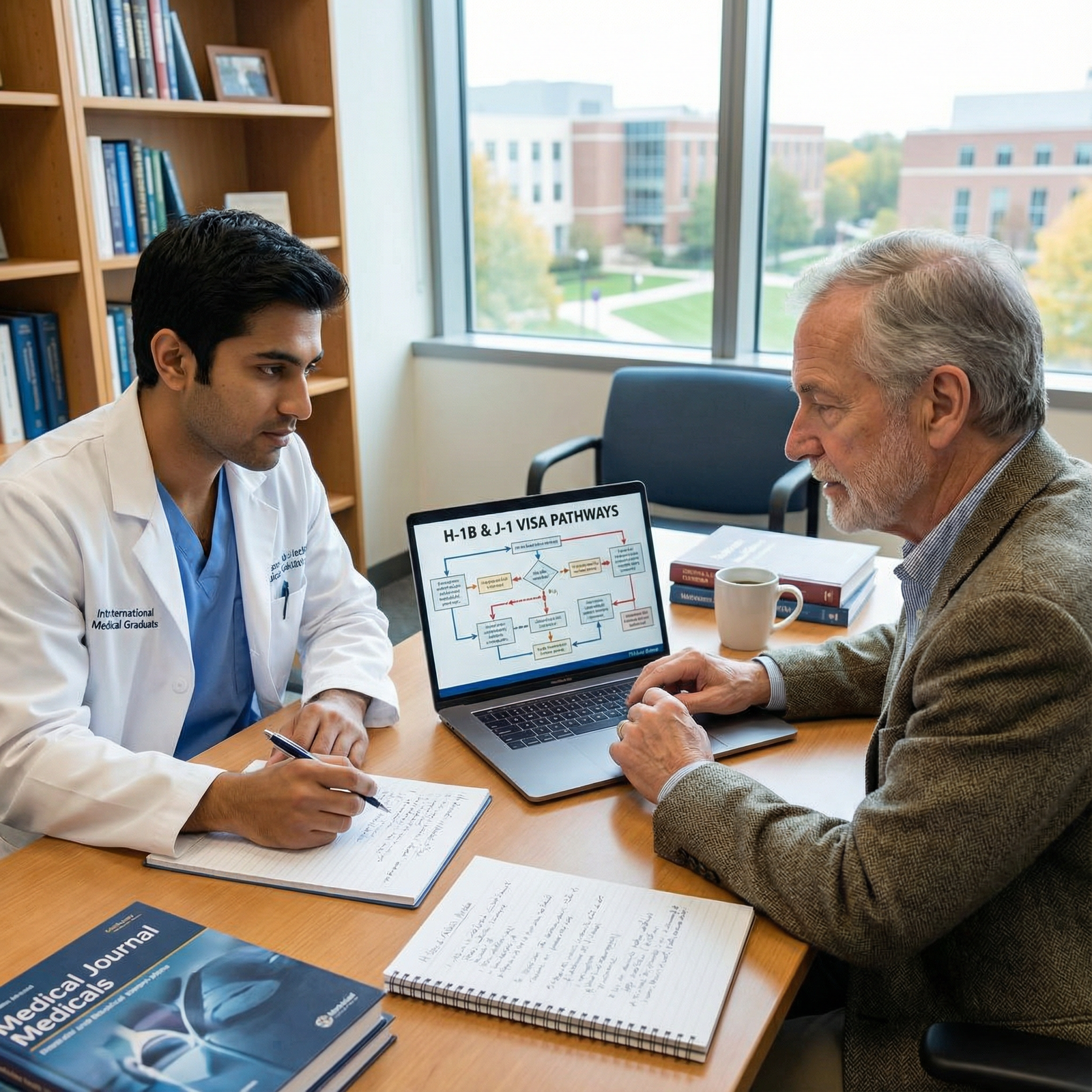
Understanding the Visa Landscape for Non‑US Citizen IMGs in Cleveland
For a non-US citizen IMG aiming for residency in Cleveland, visa navigation is just as critical as scoring well on USMLE or crafting a strong ERAS application. Cleveland is home to several major teaching institutions—most notably Cleveland Clinic, University Hospitals Cleveland Medical Center, and MetroHealth—which all welcome international graduates but operate under strict US immigration rules.
You will constantly see two terms: “non-US citizen IMG” and “foreign national medical graduate.” In this context, they’re essentially the same: a physician who completed medical school outside the US and does not have US citizenship or permanent residency. This group must secure a residency visa to begin training, and your visa strategy should be planned well before you submit your ERAS application.
This guide walks through the main IMG visa options, how Cleveland residency programs (including Cleveland Clinic residency programs) typically handle them, and the most important decisions you must make about J-1 vs H-1B and long-term planning.
Major Visa Types for Residency: J‑1 vs H‑1B (and Others)
For clinical residency and fellowship, there are three primary paths:
- J‑1 Physician Visa (Exchange Visitor Program)
- H‑1B Temporary Worker Visa
- Alternative statuses (e.g., F‑1 with OPT, O‑1) – uncommon and very case-specific
Most foreign national medical graduates in residency are sponsored on J‑1 or H‑1B, so we’ll focus on those.
J‑1 Physician Visa: The Default Path for Most IMGs
The J‑1 physician visa is administered nationally through the Educational Commission for Foreign Medical Graduates (ECFMG). In almost all cases, the residency program itself does not act as the immigration sponsor; ECFMG does. This centralization explains why J‑1 is the most common visa for IMGs across the US, including in Cleveland.
Key features of the J‑1 physician visa:
- Sponsor: ECFMG
- Purpose: Graduate medical education (residency/fellowship)
- Duration: Up to the length of training, usually capped at 7 years total (with some exceptions)
- Employment location: Only at the ECFMG-approved training site(s)
- Work scope: Direct patient care in the approved residency/fellowship program
- Research moonlighting: Limited; must follow program and ECFMG rules
The 2‑Year Home Residency Requirement (INA 212(e))
The biggest issue for a non-US citizen IMG is the 2-year home-country physical presence requirement. Most J‑1 physicians are subject to this rule:
- After completing J‑1–sponsored training, you must return to your home country (country of nationality or last legal permanent residence) for a total of at least two years before you can:
- Apply for an H‑1B visa
- Apply for an L visa
- Apply for US permanent residency (green card)
You can still visit the US during this period on other temporary visas (like B1/B2 in some cases), but you cannot change status in the US to H‑1B or adjust to a green card until the requirement is satisfied or waived.
Pros of J‑1 for IMGs:
- Widely accepted: Most academic and community programs in Cleveland are set up for J‑1 sponsorship.
- Centralized process: ECFMG ensures standardized documentation, DS-2019 issuance, and compliance.
- Often simpler for programs: Since ECFMG is the sponsor, programs face less administrative/immigration burden.
- Predictable timelines: Well-established process, especially for large centers like Cleveland Clinic and University Hospitals.
Cons of J‑1 for IMGs:
- 2-Year Home Requirement: This is the primary drawback, affecting your long-term career and immigration strategy.
- Limited employment flexibility: Tied closely to the training program and location.
- Waiver dependence: To stay in the US and work after residency, you often need a J‑1 waiver job (e.g., Conrad 30 programs).
H‑1B Visa for Residency: Less Common, Higher Bar
The H‑1B is a temporary worker visa for “specialty occupations” that require at least a bachelor’s degree, but in medicine it is generally used for those performing direct patient care. For residency, H‑1B sponsorship is more complex and less common than J‑1, but it may be strategically advantageous for some IMGs.
Key features of the H‑1B for residency:
- Sponsor: The residency program (hospital/health system) files the petition.
- Educational requirement: You must already have ECFMG certification and typically must have passed USMLE Step 3 before they file.
- Duration: Initially up to 3 years, extendable to a total of 6 years (with possible extensions if in green card process).
- Work location: You must work at the locations listed in the petition (often multiple sites can be included).
- No 2-year home requirement: Unless you previously held J‑1 subject to 212(e).
Pros of H‑1B for IMGs:
- No automatic 2-year home country return requirement.
- Better suited if you plan to pursue a green card directly through employment after residency.
- Often more flexibility to transition into attending roles on H‑1B after residency.
Cons of H‑1B for IMGs:
- Not all Cleveland residency programs offer H‑1B sponsorship.
- Requires USMLE Step 3 passed early (before Match or at least before the petition).
- More paperwork, legal fees, and institutional policies (some programs avoid H‑1B for these reasons).
- Cap issues: Some institutions are cap-exempt (e.g., many academic centers), but others are not.
J‑1 vs H‑1B: High‑Level Comparison
| Feature | J-1 Physician Visa | H-1B Visa for Residency |
|---|---|---|
| Main Sponsor | ECFMG | Individual residency/fellowship program |
| Commonality for IMGs | Most common nationwide | Selective; depends on institution |
| Step 3 Requirement | Not required for visa | Typically required before petition filing |
| 2-Year Home Requirement | Yes, usually | No (unless prior J‑1 subject to 212(e)) |
| Long-Term Green Card Path | Must handle J‑1 waiver or home return first | More direct; can transition to employment-based |
| Administrative Burden | Lower for program | Higher for program |
| Training Length Flexibility | Generally up to 7 years total | Up to 6 years (with extensions if in green card) |
For a non-US citizen IMG applying to Cleveland residency programs, you should be clear about:
- Which programs sponsor which visa types, and
- How that aligns with your long-term career and immigration goals.
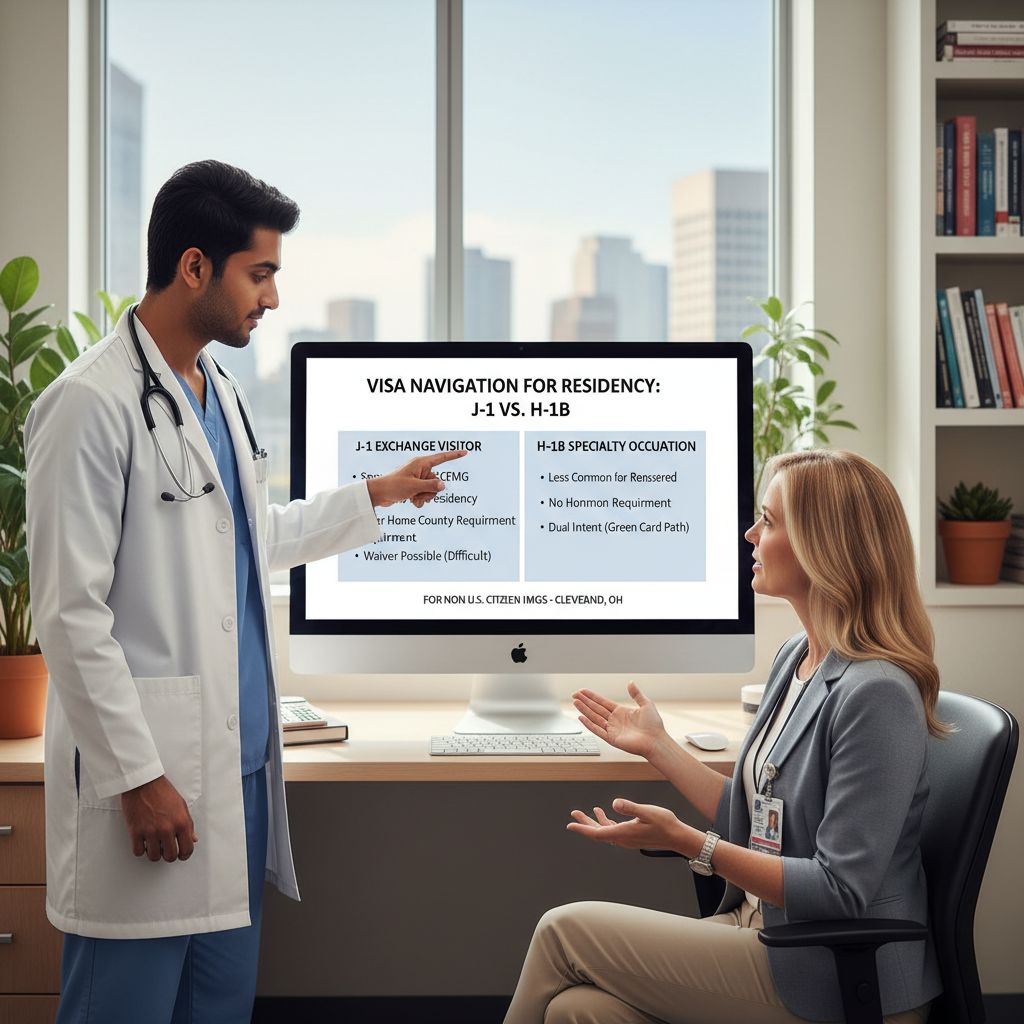
Visa Policies at Cleveland Residency Programs
Cleveland is a major medical hub in the Midwest, so you’ll see a broad spectrum of opportunities for a foreign national medical graduate. However, each institution has its own visa policies, which can significantly shape your options.
1. Cleveland Clinic Residency Programs
Cleveland Clinic residency and fellowship programs are some of the most competitive in the country. As a non-US citizen IMG, you need to understand their stance on J‑1 vs H‑1B before applying.
While specific policies can change, historically:
- Many Cleveland Clinic residency programs:
- Sponsor J‑1 visas via ECFMG for eligible IMGs.
- Are more selective about H‑1B sponsorship; some programs do, others do not.
- Some subspecialty fellowships may be more open to H‑1B, particularly in high-demand fields, but policies are program-specific.
Actionable strategy:
- Visit each specific Cleveland Clinic residency program webpage (e.g., internal medicine, general surgery, neurology).
- Look for their “Eligibility & Visa” or “International Medical Graduates” section.
- If unclear, email the program coordinator early in the season and ask directly:
- “Do you sponsor J‑1 and/or H‑1B visas for non-US citizen IMGs?”
- “Is USMLE Step 3 required by the time of ranking or by the time of contract for H‑1B sponsorship?”
2. University Hospitals Cleveland Medical Center
As a major academic center affiliated with Case Western Reserve University, University Hospitals (UH) also trains many IMGs.
Common patterns seen at institutions like UH:
- Broad acceptance of J‑1 visas via ECFMG.
- Variable acceptance of H‑1B, often department-dependent.
- Sometimes, a formal statement on the website specifying their preferred visa category.
In many academic programs, J‑1 remains the default; H‑1B may be considered only for exceptional or specific cases or only when departmental policy supports it.
3. MetroHealth, VA, and Other Cleveland Hospitals
Cleveland’s GME ecosystem includes:
- MetroHealth Medical Center (affiliated with Case Western)
- Louis Stokes Cleveland VA Medical Center
- Community hospitals and regional systems around the Cleveland area
Their approach to IMG visa options can range from:
- J‑1 only
- J‑1 with limited H‑1B
- Occasionally, no visa sponsorship at all (requiring EAD/green card/US citizenship)
Always confirm:
- Check FREIDA or program websites for “Visa Sponsorship.”
- Cross-check by emailing the program coordinator for the most current policy.
Why Programs Limit or Prefer Certain Visas
Understanding the program’s perspective helps you communicate effectively:
- Administrative burden & cost: H‑1B requires attorney fees, filing fees, and closer tracking of immigration compliance.
- Timeline constraints: H‑1B filings have USCIS processing timelines; if USMLE Step 3 is late, the program may not be able to complete H‑1B in time.
- Institutional policies: Some hospitals set a uniform rule (e.g., “J‑1 only”) to keep processes standardized.
For you as a non-US citizen IMG, this means:
- Do not assume a prestigious institution like Cleveland Clinic residency will automatically offer H‑1B.
- Filter programs early by their visa policies so you don’t waste applications on programs that cannot support your needs.
Step-by-Step Visa Planning Timeline for Non‑US Citizen IMGs
To navigate IMGs visa options successfully, you need to align your exam, application, and documentation timeline. Below is a strategic roadmap for those targeting Cleveland residency programs.
1. 18–24 Months Before Match: Clarify Long‑Term Goals
Before you decide between J‑1 vs H‑1B, think about:
- Do you strongly want to stay long-term in the US after training?
- Are you open to returning to your home country for a few years?
- Would you be comfortable working in a rural/underserved area if needed for a waiver?
- Are you aiming for highly competitive fields (e.g., dermatology, plastic surgery) where certain visas might be harder to secure?
If long-term US practice is vital and you want to avoid the 2-year home requirement, H‑1B may be preferable, but remember:
- Your options will be more limited.
- You must pass USMLE Step 3 early.
If you prioritize maximizing the number of potential programs and are open to waiver paths or eventual home-country return, J‑1 brings more flexibility in the Match phase.
2. 12–18 Months Before Match: Prepare Documentation
For all IMG visa paths:
- Secure a valid passport (with several years of validity).
- Ensure your ECFMG certification process is on track:
- Primary source verification of your medical degree.
- Passing Step 1 and Step 2 CK.
- Keep your medical school transcripts, diploma, and clinical experience letters organized and easily accessible.
For potential H‑1B candidates:
- Plan and schedule USMLE Step 3 well before Match (ideally 6–9 months before).
- Verify that your state medical training license or limited permit requirements can be met in time (varies by state and institution).
- Research which Cleveland residency programs sponsor H‑1B and note their policies.
3. ERAS Application Season: Communicate Visa Needs Clearly
When submitting ERAS:
- Indicate your citizenship and visa needs accurately.
- In your ERAS application or personal statement, you usually don’t need a detailed immigration narrative, but you can:
- Briefly mention flexibility (e.g., “Open to both J‑1 and H‑1B sponsorship”).
- Highlight that you have ECFMG certification and Step 3 passed if applicable.
- For programs that list only J‑1 sponsorship, do not push aggressively for H‑1B during interviews; instead, treat it as a J‑1-track opportunity.
Email communication example to a Cleveland program:
Subject: Visa Sponsorship for Non-US Citizen IMG – [Your Name]
Dear [Program Coordinator’s Name],
I am an international medical graduate and non-US citizen planning to apply to your [specialty] residency program this season. Could you please confirm whether your program sponsors J‑1 visas, H‑1B visas, or both for residency trainees?
For reference, I am ECFMG-certified and have [have/have not] completed USMLE Step 3.
Thank you very much for your time and assistance.
Sincerely,
[Your Name, Credentials]
This short email gives programs the key facts they need and helps you refine your application list.
4. After Match: Visa Processing with Your Cleveland Program
Once you Match:
If on J‑1:
- Your program’s GME office will coordinate with ECFMG to initiate your DS‑2019.
- You must provide:
- Proof of ECFMG certification.
- Appropriate finances and health insurance coverage (as per J‑1 rules).
- Any required supporting documents (transcripts, training contracts).
- You then apply for a J‑1 visa at the US consulate in your home country, attending a visa interview.
If on H‑1B:
- Your program’s HR/GME office and their immigration attorney will:
- File a Labor Condition Application (LCA) with the Department of Labor.
- Prepare an H‑1B petition (Form I‑129) with supporting documents.
- You must supply:
- Proof of passing USMLE Step 3.
- Evidence of medical degree, ECFMG certification, and any state licensing.
- After USCIS approval (I‑797 notice), you apply for the H‑1B visa at the US consulate, unless changing status from within the US.
Careful attention to timelines is crucial so that your visa is issued in time for your GME start date (often July 1).

Post‑Residency Planning: J‑1 Waivers, H‑1B Transitions, and Cleveland Opportunities
Visa navigation does not end when you start residency; in many ways, it becomes even more important as you plan your post-residency career.
If You Trained on J‑1: Navigating the 2‑Year Requirement
After finishing residency or fellowship on J‑1, you typically have three main options:
Return to Home Country for 2 Years
- Straightforward compliance with the 2-year rule.
- After this, you can pursue US visas (including H‑1B) or a green card if you wish to return.
Seek a J‑1 Waiver Job (e.g., Conrad 30)
- Many states have “Conrad 30” programs that allow each state to sponsor up to 30 J‑1 waivers per year for physicians who agree to work in medically underserved areas.
- You typically work for 3 years in a designated site under H‑1B status instead of going back home.
- After completing this obligation, the 2-year requirement is waived, and you can pursue a green card or other immigration options.
- Ohio has its own Conrad 30 program, and Cleveland-area or regional employers may qualify, particularly in underserved communities surrounding major cities.
Other Waiver Types
- Federal programs (e.g., VA, HHS, Appalachian Regional Commission).
- Hardship or persecution-based waivers—very case-specific and typically requiring legal counsel.
If you are set on a long-term career in or near Cleveland, start exploring:
- Which Cleveland-area systems hire physicians on J‑1 waivers.
- Whether they have a history of supporting Conrad 30 placements in Ohio or neighboring states.
If You Trained on H‑1B: Transition to Attending and Green Card
If you complete residency in Cleveland on H‑1B:
- You can often extend H‑1B for an attending position with:
- The same employer (e.g., Cleveland Clinic or UH).
- A new employer (with a new H‑1B petition).
Because many academic hospitals are cap-exempt, they can continue to sponsor H‑1B without being limited by the national lottery system. From there:
- Employers can start a green card process (e.g., EB‑2 or EB‑3):
- PERM labor certification.
- I‑140 petition.
- Adjustment of Status (I‑485), if visas are current for your country of chargeability.
Attention to timing is crucial so you do not hit the 6-year H‑1B limit before being eligible for extensions based on I‑140 approval.
Example Scenarios for a Non‑US Citizen IMG in Cleveland
Scenario 1: J‑1 Path with Ohio Conrad 30 Waiver
- You match into internal medicine residency at Cleveland Clinic on a J‑1 visa.
- You complete a 3-year residency plus a 3-year cardiology fellowship (total 6 years).
- You secure a Conrad 30 J‑1 waiver job in an underserved community hospital about 1 hour from Cleveland.
- You work 3 years on an H‑1B at that site, satisfying waiver conditions.
- After that, you pursue a green card through your employer.
- Long-term, you remain in the Cleveland region as a cardiologist.
Scenario 2: H‑1B Path to Academic Attending
- You pass USMLE Step 3 early and match into neurology residency at University Hospitals on H‑1B.
- You complete a 4-year residency, then 2-year fellowship, all on extended H‑1B at the same institution (cap-exempt).
- During fellowship, UH begins your employment-based green card.
- Your I‑140 is approved, allowing H‑1B extension beyond 6 years if needed.
- You continue as an academic neurologist at Case Western/UH with stable immigration status.
Practical Tips and Common Pitfalls for IMGs Targeting Cleveland
Do:
- Start visa planning early—before you submit ERAS.
- Keep a spreadsheet of Cleveland residency programs with columns for:
- Visa types sponsored
- Step 3 requirements
- IMGs accepted historically
- Discuss visa status briefly, only when appropriate, during interviews (e.g., if asked or when clarifying H‑1B eligibility).
- Maintain clear records of:
- ECFMG certification
- USMLE transcripts
- Any prior US visa statuses
Avoid:
- Assuming all Cleveland residency programs are visa-friendly.
- Waiting too long to take USMLE Step 3 if you’re aiming for H‑1B.
- Ignoring the 2-year home requirement implications when choosing J‑1.
- Relying solely on outdated forum posts—policies change; always confirm with programs.
FAQs: Visa Navigation for Non‑US Citizen IMGs in Cleveland
1. Do Cleveland Clinic residency programs sponsor H‑1B visas for non‑US citizen IMGs?
Policies vary by department and year. Many Cleveland Clinic residency programs primarily sponsor J‑1 visas via ECFMG, while some may consider H‑1B for highly qualified applicants who have USMLE Step 3 completed. You must check each program’s official website and, if needed, email the coordinator for the most current information.
2. As a foreign national medical graduate, is it harder to Match in Cleveland if I need a visa?
You do face an additional barrier, but many Cleveland institutions are accustomed to training IMGs on J‑1 (and occasionally H‑1B) visas. Your competitiveness will depend more on:
- USMLE scores and clinical performance,
- ECFMG certification timing,
- Strong letters and relevant US clinical experience. Visa needs may limit some programs but do not automatically exclude you.
3. Should I prioritize H‑1B over J‑1 when applying to Cleveland residency programs?
Not necessarily. While H‑1B avoids the 2‑year home requirement and may ease long-term immigration, it also reduces the number of programs you can realistically apply to, especially if you cannot complete Step 3 early. Many non-US citizen IMGs successfully train and build careers via the J‑1 + waiver route, including in and around Cleveland. Your choice should be based on your long-term plans, exam timeline, and program availability.
4. Can I change from J‑1 to H‑1B during or after residency in Cleveland?
You cannot simply “convert” from J‑1 to H‑1B inside the US if you are subject to the 2‑year home-country requirement, unless you:
- Complete the 2 years in your home country, or
- Obtain a J‑1 waiver (e.g., via Conrad 30 or another mechanism). Once the requirement is met or waived, you can pursue an H‑1B for subsequent roles (e.g., attending positions, waiver jobs, or additional training).
Visa navigation is an integral part of your journey as a non‑US citizen IMG targeting Cleveland. By understanding J‑1 vs H‑1B, clarifying each program’s policies, and planning your long-term path early, you can move through residency and beyond with far fewer surprises—and a clearer route toward the career and life you want in Cleveland.