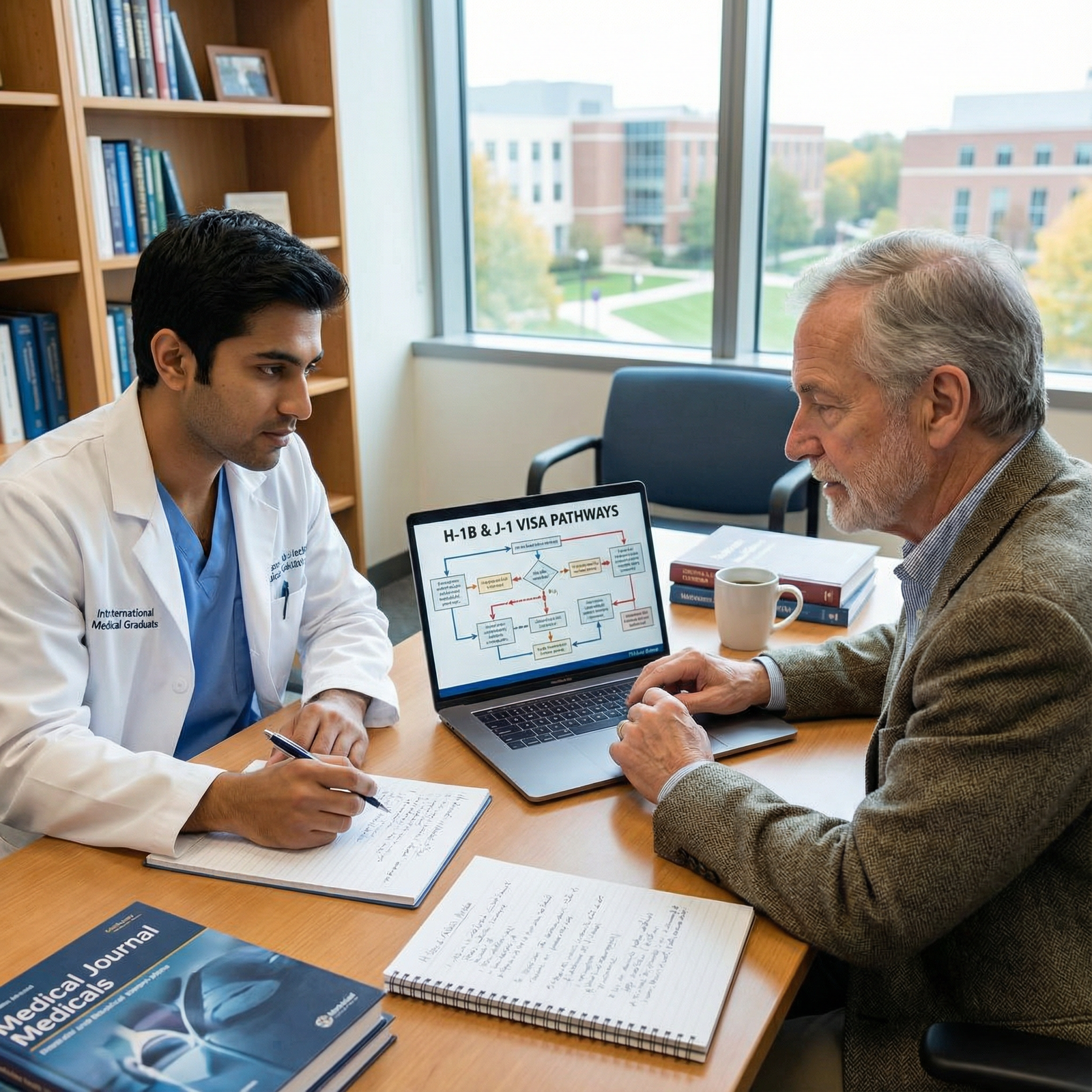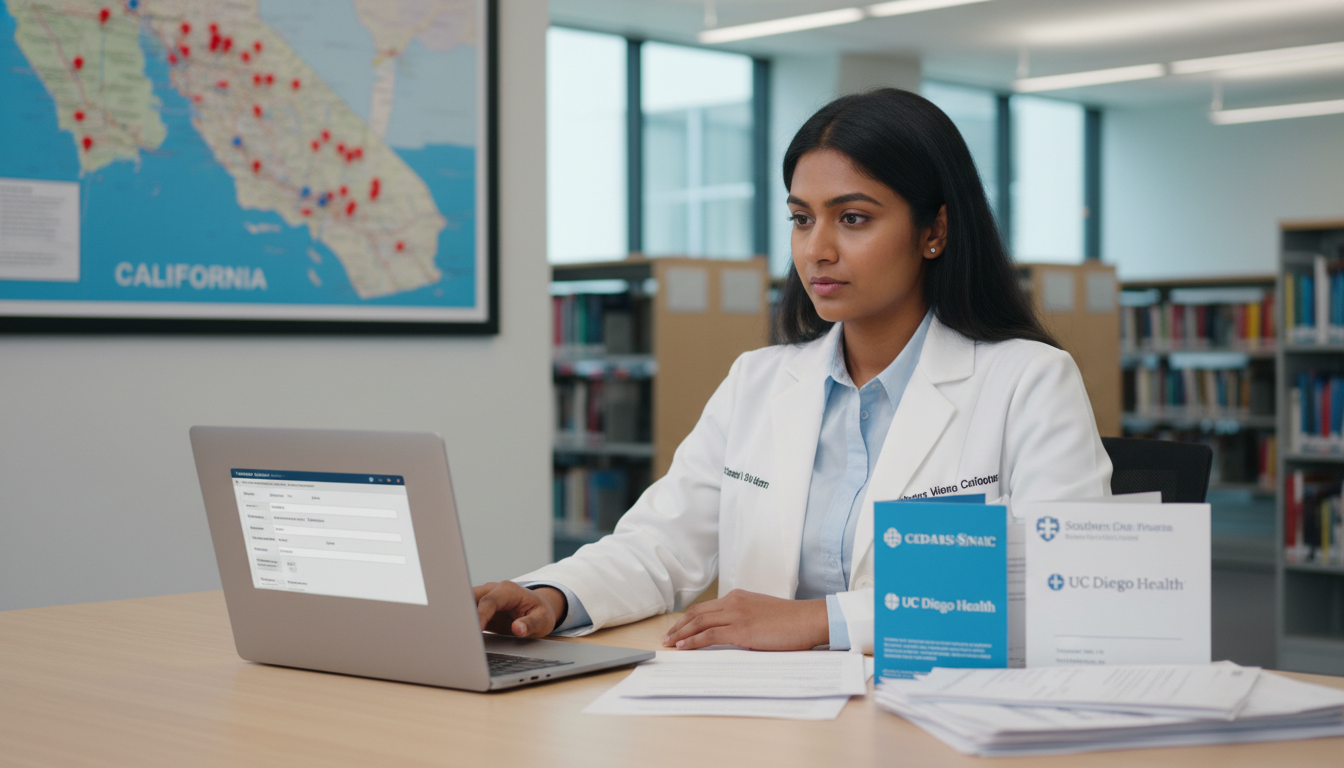
Overview: Why Visa Strategy Matters for Non‑US Citizen IMGs in Southern California
If you are a non-US citizen IMG aiming for residency in Southern California (SoCal), understanding visa navigation is as important as your USMLE scores and clinical experience. The region is highly competitive, has a dense mix of academic centers and community programs, and each institution has its own policies on sponsoring J-1 vs H-1B visas.
This guide will walk you through:
- The main IMG visa options (J‑1, H‑1B, and others) and their implications
- How Southern California residency programs typically handle visas
- How to align your exam strategy, timeline, and specialty choice with your visa goals
- Practical steps and examples for planning your path from match to post-residency waiver or green card
The goal is to help you not only get into SoCal medical training, but also position yourself for the career and immigration trajectory you want.
Core Visa Options for IMGs: J‑1 vs H‑1B and Beyond
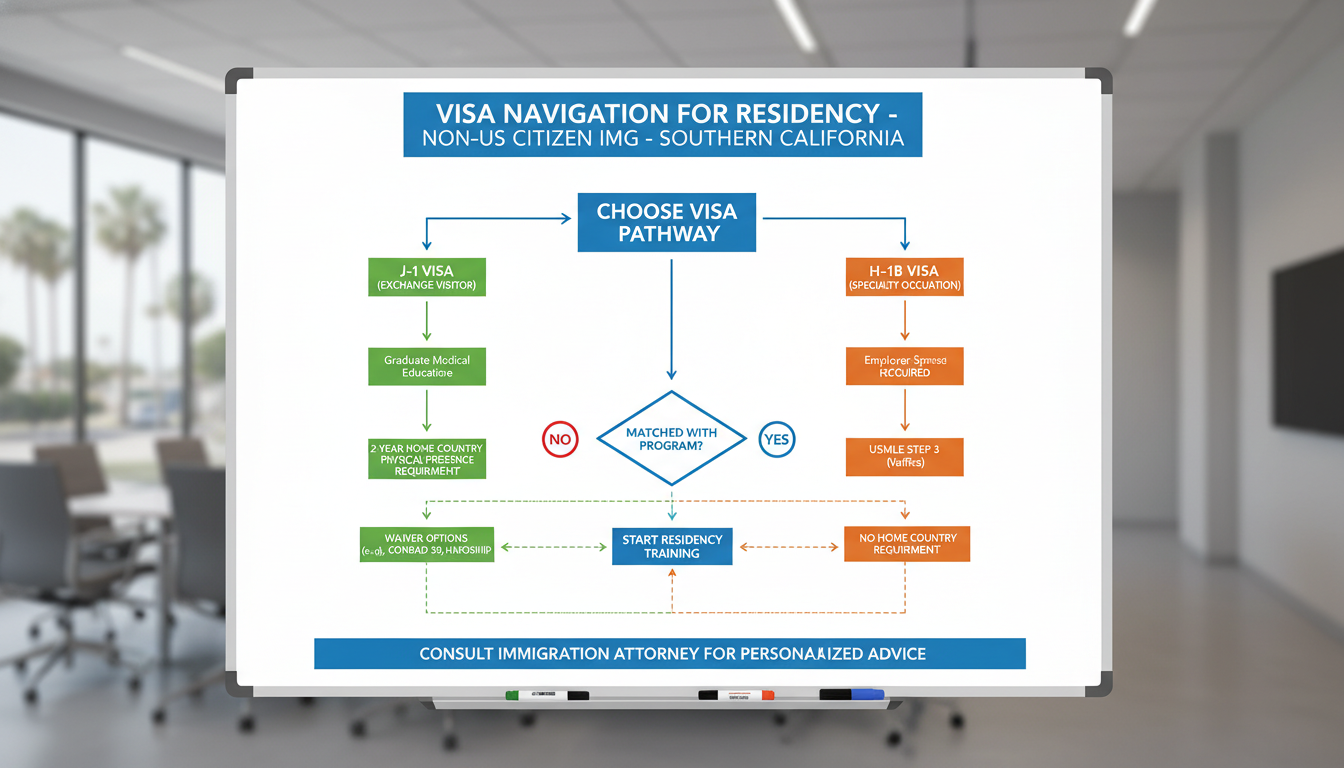
For a foreign national medical graduate, the main residency visa options are:
- J‑1 (Exchange Visitor Physician)
- H‑1B (Temporary Worker – Specialty Occupation)
- Less commonly: O‑1 (Extraordinary Ability) or family-based/other immigrant status that allows work without a new visa
J‑1 Exchange Visitor Visa: The Default Path for Most IMGs
For most non-US citizen IMGs, the J‑1 visa (sponsored by the Educational Commission for Foreign Medical Graduates – ECFMG) is the primary route for GME training.
Key features of the J‑1 for residency:
- Sponsor: ECFMG, not the hospital
- USMLE requirement: Typically at least Step 1 and Step 2 CK passed; Step 3 not required
- Duration: Up to 7 years of clinical training in total (residency + fellowship)
- Funding: You must be in an ACGME-accredited program with appropriate salary support
- Return-home requirement (212(e)): After completing J‑1 training, you must:
- Return to your home country for two cumulative years, or
- Obtain a waiver of this requirement (e.g., Conrad 30 or federal waiver program)
Pros of J‑1 for SoCal residency:
- Accepted by many more programs than H‑1B
- Less institutional cost/administrative burden than H‑1B
- Clear, standardized process through ECFMG
- Easy to switch institutions for fellowship if still within the 7-year limit
Cons and limitations:
- You must deal with the two-year home residency requirement or secure a waiver
- Less flexible for long-term US immigration planning (e.g., green card sponsorship)
- Some subspecialty fellowships may push you close to or beyond 7 years of allowable training
In Southern California, most large academic centers and many community programs are very comfortable with J‑1 sponsorship and may prefer it over H‑1B for administrative reasons.
H‑1B Visa: Attractive but Harder to Obtain for IMGs
The H‑1B is a work visa for specialty occupations. Many IMGs ask about J‑1 vs H‑1B because H‑1B can feel more aligned with long-term US practice.
Key eligibility points for residency H‑1B:
- USMLE Step 3 is usually required before H‑1B filing
- You must have passed Step 3 early enough to allow filing before July 1 start date
- Hospital must be willing to sponsor and pay legal/filing fees and manage the petition
- Most residency programs require you to have ECFMG certification before starting
Advantages:
- No J‑1 two-year home residency requirement
- Often more straightforward to transition directly to employment after training
- Easier to align with an employer that wants to sponsor a green card during or after training
Disadvantages:
- Fewer Southern California programs sponsor H‑1B for incoming PGY-1 residents
- Extra burden on the GME office: higher legal fees, more complex processing
- Timing pressure: You must pass Step 3 early (often before ranking or offering a contract)
- If your H‑1B is tied to a specific employer and sponsorship ends, you must quickly change status or leave
Other Potential Paths: O‑1 and Permanent Status
For a small subset of non-US citizen IMGs:
- O‑1 (Extraordinary Ability)
- For physicians with significant scholarly achievements (notable publications, major awards, high-level recognition)
- Rare at the start of residency; more common for experienced researchers or faculty
- Green card/PR from another basis
- Marriage to a US citizen, diversity visa lottery, employment-based petition from prior career
- In these cases, you may be able to join residency on an EAD (employment authorization document) without a separate J‑1/H‑1B, depending on your category
These alternatives are more specialized. The majority of non-US citizen IMG residency applicants in Southern California will navigate between J‑1 vs H‑1B.
How Southern California Residency Programs Handle Visas
Southern California is home to a broad spectrum of training environments:
- Large academic centers (UCLA, UC San Diego, UC Irvine, USC, etc.)
- County/public hospitals (e.g., LAC+USC, Harbor-UCLA)
- Community-based and university-affiliated hospitals
- Kaiser Permanente and other integrated systems
Each has its own policies on residency visa sponsorship.
Typical SoCal Patterns You Should Expect
J‑1-Friendly, H‑1B-Selective
Many SoCal programs are J‑1 friendly and list this openly:
- “We sponsor J‑1 visas through ECFMG”
- “We do not sponsor H‑1B visas” or “H‑1B considered only for exceptional candidates/continuing residents”
Academic vs Community Differences
- Large academic institutions:
- Often sponsor J‑1 routinely
- May sponsor H‑1B selectively for residents/fellows, especially in high-need subspecialties or for internal candidates
- Community hospitals:
- Some sponsor J‑1 only
- Some do no visa sponsorship at all (expecting EAD/green card holders only)
- A few will consider H‑1B, especially if they have longstanding IMG faculty and infrastructure
- Large academic institutions:
Public/County Programs
County hospitals and safety-net systems in SoCal often have high IMG representation and are generally very familiar with J‑1 sponsorship. H‑1B is more variable and policy-dependent.
How to Research Visa Policies for SoCal Programs
Before applying, you should systematically review visa policies. For each target program:
Check the program website
- Look specifically for a “For IMGs” or “International Applicants” page
- Note:
- Whether they accept non-US citizen IMGs
- Whether they sponsor residency visas
- Which types: J‑1 vs H‑1B
Use official program listing sources
- FREIDA or the AAMC Residency Explorer may mention visa sponsorship
- Check if they have filters for J‑1 or H‑1B sponsorship
Email the program coordinator or GME office
- If the website is unclear, send a direct, concise email:
- Introduce yourself as a non-US citizen IMG
- Ask whether they:
- Accept foreign national medical graduates
- Sponsor J‑1, H‑1B, or both for incoming PGY-1 residents
- If the website is unclear, send a direct, concise email:
Email example:
Dear [Program Coordinator Name],
I am a non-US citizen IMG planning to apply to your [Specialty] residency program. Could you please confirm whether the program accepts foreign national medical graduates and whether you sponsor residency visas, specifically J‑1 and/or H‑1B, for incoming PGY-1 residents?
Thank you for your time and assistance.
Sincerely,
[Your Name], MD
How Visa Policy Influences Your SoCal Application Strategy
- If your priority is maximizing chances to match in Southern California, being open to J‑1 sponsorship will significantly expand your program list.
- If your priority is eventual US permanent residence without a J‑1 waiver, you might:
- Target programs that specifically sponsor H‑1B
- Accept that you will be applying to a smaller subset of SoCal programs
- Plan early to complete USMLE Step 3 and meet program deadlines
For many non-US citizen IMGs, a pragmatic strategy is:
- Aim broadly for J‑1-compatible SoCal residencies to secure training
- Then plan waiver or immigration strategies during or after residency
Timing, Exams, and Documentation: Building a Visa-Smart Application
Your visa options are deeply tied to USMLE timing, documentation, and how you present yourself as a foreign national medical graduate.
Step Exams and Their Impact on Visa Choice
For J‑1:
- Mainly requires Step 1 and Step 2 CK passed and ECFMG certification
- You can match and start residency without Step 3
For H‑1B:
- Most programs insist on Step 3 passed before:
- Creating your rank list, or
- Issuing a contract
- This means you should aim to have Step 3:
- Passed by late fall of the application year if you are actively targeting H‑1B-friendly programs
- Most programs insist on Step 3 passed before:
Actionable timing example:
- If you plan to start residency in July 2027 and want H‑1B:
- Finish Step 1 and Step 2 CK by early 2026
- Schedule and pass Step 3 by October–November 2026
- Indicate “Step 3 passed” on ERAS and in communications with programs that sponsor H‑1B
Documentation Checklist for Residency Visa Preparation
Regardless of J‑1 vs H‑1B, prepare these early:
- Valid passport (at least 6–12 months beyond start date)
- Medical diploma and transcripts (official translations if needed)
- ECFMG certificate or clear path/timeline to obtain it
- USMLE score reports
- Letters of recommendation from US and home-country physicians
- Current CV with all training and employment clearly documented
For J‑1 visa processing with ECFMG, you will generally need:
- DS-2019 application paperwork from the program/ECFMG
- Proof of funding (residency contract)
- Evidence of adequate health insurance for you (and family, if applicable)
For H‑1B:
- Your employer’s immigration office or attorney will request:
- CV, diploma, ECFMG certificate
- License-in-training or eligibility proof
- USMLE Step 3 score
- Previous immigration documents if you have been in the US before

Planning Beyond Residency: Waivers, Jobs, and Long-Term Strategy
When choosing between J‑1 vs H‑1B for SoCal medical training, you must think beyond residency: Where will you practice? How will you stay in the US legally?
If You Train on a J‑1 Visa: Waiver Pathways
After J‑1 training, you are subject to the two-year home-country physical presence requirement (212(e)) unless you obtain a waiver.
Common waiver routes for physicians:
Conrad 30 Waiver (State-Based)
- Each US state can sponsor up to 30 J‑1 physicians per year to waive 212(e)
- Usually requires:
- A full-time job in a Health Professional Shortage Area (HPSA) or underserved area
- 3-year service commitment in that underserved setting
- California participates, but SoCal waiver positions can be highly competitive
Federal Agency Waivers
- Various federal agencies (e.g., VA, HHS, etc.) can sponsor waivers for physicians working in specific federal facilities or public health roles
- Often more specialized and competitive
Interested Government Agency (IGA) Waivers
- Certain state or federal entities (beyond Conrad 30) can sponsor for specific needs (research, public health, etc.)
Realistic outcomes for J‑1 SoCal residents:
- Many J‑1 IMGs who train in Southern California eventually accept jobs:
- In less saturated, more rural parts of California, or
- In other US states with greater need and more open Conrad 30 positions
- A few may obtain waivers in SoCal (e.g., certain underserved clinics or public health jobs), but these are limited.
If You Train on an H‑1B: Direct Transition to Practice
With an H‑1B residency visa, there is no two-year home residency requirement.
Common post-residency pathways:
Continue H‑1B with a new employer
- Find an attending-level job in SoCal or elsewhere
- Employer files an H‑1B transfer petition (not subject to cap if in qualifying institutions or if you are already counted toward the cap)
Green Card Sponsorship
- Many employers (especially in shortage areas) will sponsor a permanent residency (green card) through:
- PERM labor certification and EB-2/EB-3
- In special cases, EB-1 for individuals with extraordinary ability or outstanding researchers
- You can potentially start this process during later residency or fellowship if the employer (e.g., a university or hospital system) is supportive
- Many employers (especially in shortage areas) will sponsor a permanent residency (green card) through:
Practical comparison:
- J‑1 route: Easier entry into residency, more SoCal options, but requires waiver + service in an underserved area afterward.
- H‑1B route: Harder to secure for residency, fewer SoCal programs willing, but offers a more direct path to long-term practice and green card.
Strategic Considerations for SoCal-Focused IMGs
If your dream is specifically Southern California long-term, think as follows:
- Open to practicing anywhere in California/US:
- J‑1 in SoCal + waiver job in another region may be entirely acceptable.
- Need to stay in or near SoCal for family or personal reasons:
- Strongly consider planning toward H‑1B if you can realistically pass Step 3 early and target the limited number of SoCal programs that sponsor it.
- Flexible and early in your journey:
- Start with J‑1, get strong training in SoCal, then explore:
- Waiver positions in parts of California that are still reachable
- Federal or specialized waivers in or near SoCal
- Start with J‑1, get strong training in SoCal, then explore:
Consulting an immigration attorney who specializes in physicians is highly recommended once you are:
- Near the end of residency, or
- Planning a complex switch (J‑1 waiver, H‑1B transfer, green card strategy)
Practical Action Plan for Non‑US Citizen IMGs Targeting SoCal Residencies
Pulling everything together, here is a step-by-step strategy tailored to a foreign national medical graduate aiming at Southern California.
Step 1: Clarify Your Visa Priorities Early
Ask yourself:
- Is my top priority to match into a SoCal residency, even if it means J‑1 and a later service commitment?
- Or is my top priority to avoid the J‑1 home residency requirement, even if that limits my program options?
This will determine whether you:
- Cast a wide net (J‑1)
- Or narrowly focus on H‑1B-sponsoring programs and plan for early Step 3
Step 2: Build a Visa-Compatible Exam Timeline
- Aim to complete Step 1 and Step 2 CK with strong scores (to be competitive in SoCal)
- If targeting H‑1B:
- Schedule Step 3 early enough to:
- Have results available by fall of the application cycle
- Communicate your Step 3 success in ERAS and interviews
- Schedule Step 3 early enough to:
Step 3: Research and Categorize SoCal Programs by Visa Policy
Create a spreadsheet that lists:
- Program name and location
- Specialty
- J‑1 sponsorship (Yes/No)
- H‑1B sponsorship (Yes/No/Case-by-case)
- Notes from website or coordinator emails
Use this to:
- Prioritize J‑1-friendly programs for broad applications
- Identify a subset of H‑1B-friendly programs if that’s your goal
Step 4: Tailor Your Application as a Non-US Citizen IMG
To be competitive in the Southern California residency environment:
- Accumulate strong US clinical experience (hands-on if possible; observerships if not)
- Highlight:
- Any California or SoCal clinical rotations
- Family ties or reasons for staying in SoCal (if genuine)
- Language skills that help with diverse populations (e.g., Spanish, Tagalog, etc.)
In your personal statement and interviews:
- Briefly acknowledge that you are a foreign national medical graduate
- Convey that you understand the basic visa framework (but do not over-focus on it)
- Emphasize your commitment to underserved populations if you might pursue J‑1 waiver positions later
Step 5: After Match – Coordinate Visa Processing Early
Once you match into a SoCal program:
- Contact your program coordinator promptly about visa paperwork:
- Confirm whether you will pursue J‑1 sponsorship via ECFMG or H‑1B
- Ask for clear deadlines for submitting documents
- Prepare for your visa interview at the US embassy/consulate:
- Bring all required documents
- Be ready to clearly describe your training plan and intentions (you are entering for education/training, not immediate immigration)
Step 6: Think Ahead During Residency
From PGY-1 onward:
- If on J‑1, learn about:
- California’s Conrad 30 process and timelines
- Employers in SoCal and beyond that regularly hire and sponsor J‑1 waiver positions
- If on H‑1B, start speaking early with:
- Academic or community employers that might sponsor you for a long-term H‑1B and green card
- Keep all immigration documents organized:
- I-94 records, visa stamps, DS-2019s (if J‑1), H‑1B approval notices, etc.
This forward planning will prevent last-minute crises in your final year of residency.
Frequently Asked Questions (FAQ)
1. As a non-US citizen IMG, is J‑1 or H‑1B better for a Southern California residency?
Neither is universally “better”; it depends on your priorities:
- J‑1 is more widely accepted among SoCal programs and generally easier to obtain for residency. However, you must address the two-year home-country requirement later through a waiver or by returning home.
- H‑1B reduces immigration complications after training and avoids the 212(e) requirement, but fewer SoCal programs sponsor it, and you must pass USMLE Step 3 early.
If your primary goal is simply to train in SoCal medical centers, J‑1 may offer more opportunities. If you have strong scores, early Step 3, and a long-term plan to stay in the US without a waiver, H‑1B can be more advantageous.
2. Do all Southern California residency programs sponsor visas for foreign national medical graduates?
No. SoCal programs vary widely:
- Some sponsor only J‑1
- Some sponsor both J‑1 and H‑1B
- Some do not sponsor any visas and accept only US citizens or permanent residents
You must check each program’s official policy on non-US citizen IMGs, ideally both via their website and direct email to the program coordinator or GME office.
3. Can I switch from a J‑1 to an H‑1B during or after residency to avoid the two-year home requirement?
Merely switching status within the US does not remove the J‑1 two-year home-country requirement (212(e)). Even if you later obtain H‑1B, O‑1, or another status, the 212(e) obligation remains until you:
- Fulfill the two-year physical presence in your home country, or
- Obtain an official J‑1 waiver
So, switching to H‑1B later does not erase the requirement. That’s why planning for a J‑1 waiver job is crucial if you trained on a J‑1.
4. How competitive is it for a non-US citizen IMG to match into a Southern California residency?
Southern California is one of the most competitive regions in the US, especially in popular specialties (Internal Medicine, Family Medicine, Pediatrics, etc.). As a non-US citizen IMG, you will face additional scrutiny regarding:
- USMLE scores
- Recency of graduation
- US clinical experience
- Communication skills
- Visa complexity (particularly for H‑1B)
That said, many SoCal programs routinely match IMGs, particularly on J‑1 visas. To be competitive, focus on:
- Strong exam performance
- High-quality US letters of recommendation
- Clear, professional communication about your visa status and plans
- Applying broadly within the region and being realistic about your profile
By understanding the nuances of residency visa options, especially J‑1 vs H‑1B, and how they interact with Southern California residency policies, you can design a strategy that aligns both your training goals and your long-term immigration plans. As a non-US citizen IMG, deliberate planning—not just strong exam scores—will be your greatest asset in navigating SoCal medical training and beyond.