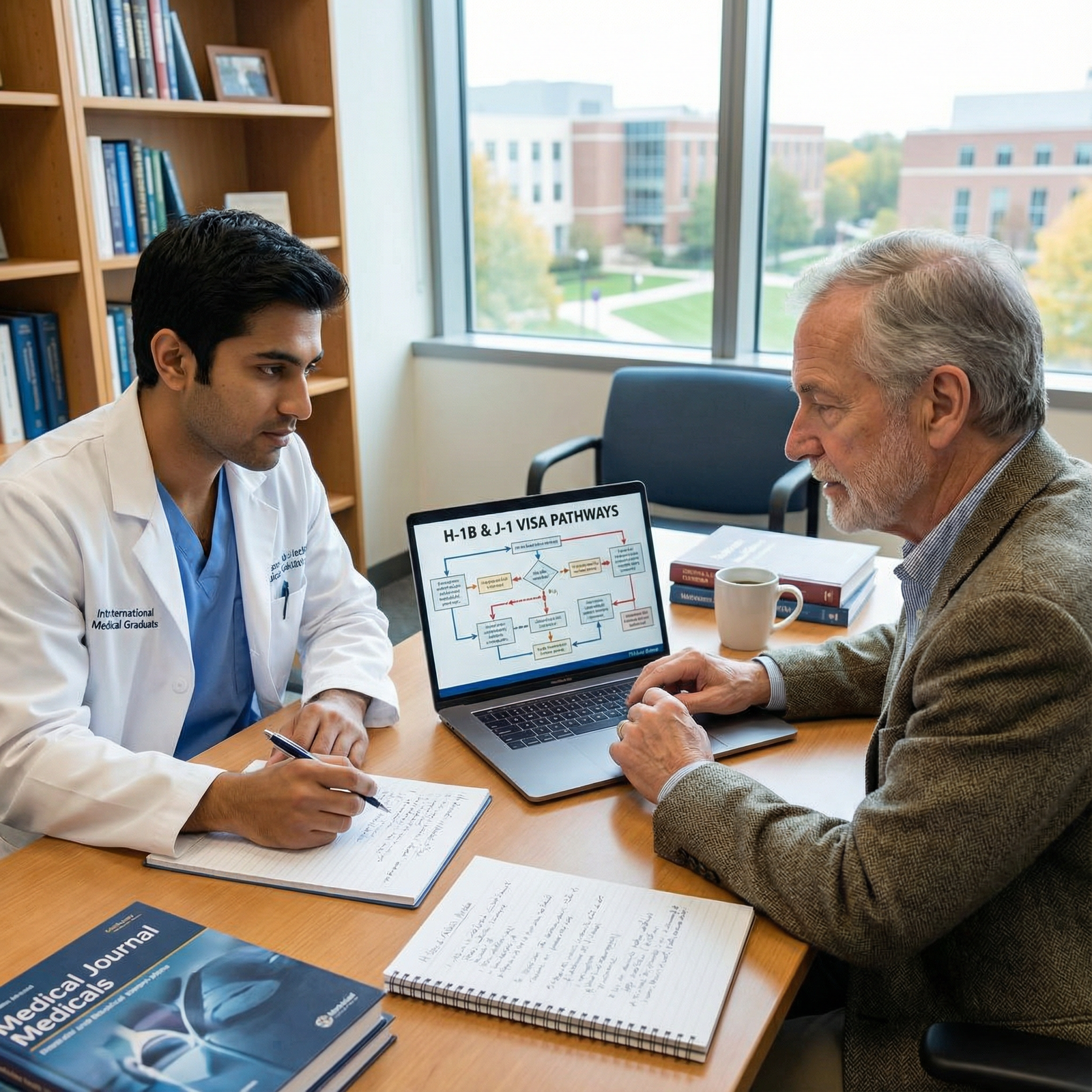
Understanding Visa Navigation in Preliminary Surgery Residency
For many international medical graduates (IMGs), a preliminary surgery year is both an opportunity and a strategic stepping-stone—toward categorical general surgery, another surgical specialty, anesthesiology, radiology, or even a non-surgical field. But the academic strategy is only half the equation. The other half is knowing how to navigate residency visas effectively.
Visa issues can dramatically shape your options, especially with prelim surgery residency positions, which are inherently time-limited and often non-renewable. This guide is designed to walk you through IMG visa options, the differences between J-1 vs H-1B, and how those choices intersect with preliminary surgery pathways.
We’ll focus on practical, application-level details so you can make informed decisions as you build your U.S. training plan.
1. The Nature of Preliminary Surgery Positions and Why Visa Strategy Matters
Before looking at visas, it’s essential to understand what makes preliminary surgery positions unique and how that influences immigration planning.
1.1 What Is a Preliminary Surgery Year?
A preliminary surgery year is a one-year (sometimes two-year) training position in general surgery without a guaranteed path to full, five-year categorical residency within that same program.
Common types of prelim surgery roles:
Designated Preliminary Positions
- Tied to a specific advanced position in another specialty (e.g., integrated pathway for radiology, anesthesiology, urology).
- The prelim year is part of a planned training pathway.
Non-Designated Preliminary Positions
- Standalone positions with no guaranteed subsequent PGY-2 spot.
- Often filled by IMGs hoping to:
- Prove clinical ability and earn strong U.S. letters.
- Transition into a categorical surgery spot (if available).
- Strengthen their CV for reapplication to another specialty.
From a visa perspective, most non-designated prelim positions are strictly 12 months, after which you must have a new training position (and often a new visa or visa extension) to remain in the U.S.
1.2 Why Visa Navigation Is More Complex for Prelim Surgery
Visa considerations are more challenging for prelim positions than for categorical ones because:
- The training period is short (often one year).
- Programs may be more hesitant to sponsor H-1B for just a single year.
- There is uncertainty after PGY-1:
- No guaranteed PGY-2 spot.
- Potential gaps between preliminary and subsequent training.
- You may need to change institutions and visa types quickly if you later match into a categorical spot.
Because of these features, you need to think about visas strategically before you rank programs in the Match or SOAP.

2. Core IMG Visa Options for Preliminary Surgery Residency
Most IMGs in U.S. graduate medical education train on one of these statuses:
- J-1 Exchange Visitor Physician Visa
- H-1B Temporary Worker Visa (Specialty Occupation)
- Less commonly for residency:
- F-1/OPT (for U.S. medical school graduates on student visas)
- O-1 (extraordinary ability; rare at residency level)
- U.S.-based statuses (green card, U.S. citizen, permanent resident)
This guide focuses on J-1 vs H-1B, since those are the main IMG visa options for a prelim surgery residency.
2.1 J-1 Visa: The Default Path for Most IMGs
The J-1 physician visa, sponsored by the Educational Commission for Foreign Medical Graduates (ECFMG), is the most common visa for residency and fellowship training.
Key Features:
- Sponsor: ECFMG (not the individual hospital; the program supports your application).
- Duration: Up to 7 years of total graduate medical education (GME) time (with annual renewals).
- USMLE requirement: Generally requires Step 1 and Step 2 CK passed and ECFMG certification before start of training (some flexibility for certification timing).
- Home-country requirement (212(e)):
- Almost all J-1 physician visas come with a two-year home-country physical presence requirement after program completion.
- You must either:
- Return home for 2 years, or
- Obtain a J-1 waiver (e.g., Conrad 30, academic, VA, or other federal program) before changing to H-1B or permanent residency.
Advantages for preliminary surgery:
- Widely accepted. Many programs that do not sponsor H-1B will still accept J-1 residents.
- Easier for short training periods. Since the visa is already structured for training, a one-year preliminary surgery year is simple to support.
- Relatively fast processing. ECFMG is experienced and has streamlined documentation requirements.
Disadvantages:
- Two-year home-country requirement can complicate long-term plans, especially if you plan to:
- Transition into highly competitive specialties that may have limited J-1 waiver jobs later.
- Remain in the U.S. without practicing in an underserved area.
- Inflexibility for non-training work. You cannot moonlight outside the approved training or easily switch employers mid-year without coordination through ECFMG.
For a prelim surgery year, the primary J-1 challenge is not the year itself—it’s how this commitment affects your future ability to work in the U.S. after training.
2.2 H-1B Visa: Attractive but Less Common for Preliminary Surgery
The H-1B visa is a temporary worker visa for “specialty occupations,” which includes physicians in residency training.
Key Features:
- Sponsor: The hospital or institution directly petitions USCIS.
- Duration:
- Typically granted for up to 3 years at a time, with a total maximum of 6 years (extensions possible in certain green card processes).
- USMLE requirement: Must have passed USMLE Step 3 before the H-1B petition can be submitted for GME use.
- No built-in home-country requirement. No automatic 2-year home stay rule.
Advantages for preliminary surgery:
- No 2-year J-1 home-country rule.
- Potentially easier transition to:
- Non-training employment after residency.
- Additional fellowship or residency training at another institution using H-1B transfers.
- Viewed by some as more favorable for a long-term U.S. career plan, especially if aiming for competitive, non-underserved academic positions.
Disadvantages for prelim surgery specifically:
- Many programs do not sponsor H-1B for a one-year prelim position:
- Legal fees and administrative burden are high for just 12 months.
- H-1B processing time and costs may not align well with short-term posts.
- You must have Step 3 passed well before Match season or SOAP.
- This can be challenging for IMGs who are still completing exams.
- If your next step after the prelim year is uncertain (for example, you don’t yet have a PGY-2 contract), an H-1B tied to a one-year position can leave you scrambling for:
- A new employer willing to transfer your H-1B quickly, or
- A change to J-1 or other status.
In practice, H-1B sponsorship is much more common for categorical surgery or other long-term training, not for one-year prelim positions. However, there are exceptions—some large university centers are willing to sponsor H-1B even for prelims if there is a structured pathway to PGY-2.
3. J-1 vs H-1B for Preliminary Surgery: Strategic Comparisons
When deciding how to approach visa planning for a prelim surgery residency, it’s helpful to think beyond “Which is better?” and ask, “Which fits my short- and long-term pathway?”
3.1 Program Policies: The Practical Starting Point
You cannot choose a visa type in a vacuum; your primary limitation is what the program is willing to sponsor.
When researching prelim surgery programs:
- Check each program’s website and FREIDA listing:
- Look for explicit language like:
- “We sponsor J-1 only.”
- “We sponsor J-1 and H-1B (for categorical only).”
- “Visa sponsorship is not available for preliminary positions.”
- Look for explicit language like:
- Email the program coordinator if unclear:
- Be specific: “Do you sponsor H-1B for preliminary surgery residents, or only for categorical positions?”
Reality check:
- Many prelim surgery programs sponsor J-1 only.
- Some will specify: “H-1B only for categorical general surgery residents.”
- A minority will sponsor H-1B for prelims, often when:
- The prelim position is designated and tied to an advanced program that expects a full multi-year pathway.
- The institution has a robust GME office and legal department used to H-1B processes.
Your strategy must adapt to what is realistically sponsorable.
3.2 Scenario-Based Comparisons
Scenario A: You plan a surgical career and hope to transition from prelim to categorical surgery.
J-1 Path:
- You complete a 1-year prelim surgery on J-1.
- You then need either:
- A categorical surgery spot on J-1 (counting toward your 7-year max), or
- A J-1 waiver job later if you finish all training on J-1.
- Risk: You may accumulate multiple years of J-1 time in surgery, and later face limited J-1 waiver job availability in your desired geographic area.
H-1B Path:
- If you can secure H-1B for a prelim year (rarer), and then later get a categorical spot on H-1B:
- No 2-year home-country rule.
- Good for long-term academic or urban practice plans.
- Risk: H-1B is harder to obtain for the prelim year. Program changes may require quick H-1B transfers.
- If you can secure H-1B for a prelim year (rarer), and then later get a categorical spot on H-1B:
Scenario B: You are using a preliminary surgery year to pivot into a non-surgical field (e.g., internal medicine, neurology, radiology).
J-1 Path:
- J-1 is generally simpler for a 1-year prelim plus a full categorical program afterwards.
- Many non-surgical fields also accept J-1 readily.
- Long-term: You will still need to navigate J-1 waivers after completing all training.
H-1B Path:
- May be attractive if you already have Step 3 and a clear plan.
- But if your prelim program doesn’t sponsor H-1B, you may have little choice.
Scenario C: You strongly prefer to avoid the 2-year J-1 home return rule.
- Consider targeting programs that sponsor H-1B for categorical positions and potentially for prelims.
- However, for a one-year prelim surgery residency, it is often not realistic to build your entire application solely around H-1B options, unless:
- You already have Step 3 passed.
- You are competitive enough to secure one of the few H-1B friendly prelim slots.
In many cases, IMGs accept a J-1 for the prelim year, understanding that they will later manage the J-1 waiver process after completing their full training.

4. Step-by-Step Planning for Visa Navigation as a Prelim Surgery Applicant
To optimize your residency visa strategy for a preliminary surgery year, you should align exam timing, application strategy, and backup plans.
4.1 Before Applying: Exams and Timing
1. USMLE Steps for Visa Flexibility
Step 1 and Step 2 CK:
- Required for ECFMG certification and, therefore, for J-1 sponsorship.
- Must be passed with sufficient time to receive certification before July start.
Step 3 (for H-1B):
- Essential if you wish to be considered for H-1B sponsorship.
- Complete it before ERAS opens or at minimum before rank lists are finalized.
- Programs may be reluctant to risk sponsoring H-1B if your Step 3 result is pending.
2. ECFMG Certification Timing
- Start the process early:
- Primary source verification can take weeks–months.
- Without ECFMG certification, J-1 sponsorship cannot finalize.
3. Anticipate Administrative Timelines
- J-1:
- ECFMG forms and DS-2019 issuance usually start spring prior to July start.
- H-1B:
- Credential evaluation, prevailing wage, petition preparation, and USCIS processing may take several months.
- Premium processing may be needed for late decisions.
4.2 Researching Programs with Visa Policies in Mind
When shortlisting prelim surgery residency programs:
Create a spreadsheet with:
- Program name, location, type (university/community), and whether prelim is designated vs nondesignated.
- Visa policies: J-1 only, H-1B eligible, “no visas,” “citizens/GC only.”
- Notes from any email communications with coordinators.
Prioritize:
- Programs that match your visa reality (e.g., if you won’t have Step 3, focus on J-1 programs).
- For those wanting H-1B, look especially at:
- Academic centers.
- Programs that explicitly mention H-1B sponsorship.
4.3 Communicating with Programs About Visa Status
During application season:
Use your ERAS application and personal statement to:
- Specify your visa needs honestly.
- Clarify that you are ECFMG certified (or will be soon).
- Mention Step 3 status if you seek H-1B.
When invited to interviews:
- Be ready to discuss:
- “What visa are you eligible for?”
- “Do you have any country-specific restrictions?”
- Keep answers concise and confident:
- “I am ECFMG certified and eligible for J-1 sponsorship; I have completed Step 3 and would also be eligible for an H-1B if your institution supports that.”
- Be ready to discuss:
Avoid making demands (e.g., “I will only accept H-1B”) unless your situation truly leaves no alternative. Many IMGs limit their opportunities by being inflexible on visa type, especially for prelim positions.
4.4 During Match and SOAP: Visa Realities
If you go through ERAS and Match:
- Review program rank lists with visa feasibility in mind.
- You don’t want to match at a program that cannot support your required visa type.
- During SOAP (if unmatched):
- Visa flexibility can be a decisive advantage.
- Many prelim surgery SOAP positions are J-1 friendly but not H-1B friendly.
- Having J-1 eligibility open can significantly increase your chances.
5. After the Preliminary Surgery Year: Visa Transitions and Long-Term Planning
The bigger visa challenge often comes after your preliminary surgery year.
5.1 Transitioning to Categorical or Another Specialty
Common pathways after a prelim surgery year:
- Categorical general surgery.
- Another surgical specialty (urology, orthopedics, ENT) via reapplication.
- Non-surgical specialties (internal medicine, radiology, anesthesia, etc.).
- Leaving clinical medicine to pursue research or non-clinical roles.
Visa considerations:
If on J-1:
- You may simply continue on J-1 for further residency or fellowship until reaching the 7-year maximum.
- Changing to H-1B during training is possible in limited scenarios but is generally discouraged by ECFMG and immigration attorneys due to 212(e) constraints.
If on H-1B:
- You must:
- Find a new employer willing to file an H-1B transfer.
- Ensure no significant out-of-status period between positions.
- A new H-1B is not necessarily “capped” if you were already counted previously through a teaching hospital (cap-exempt institution).
- You must:
5.2 Dealing with Gaps After a Prelim Year
One of the most anxiety-provoking possibilities is finishing a prelim year without a PGY-2 spot.
On J-1:
- If you do not continue in an ACGME-accredited training program, your DS-2019 will not be renewed.
- You may have a short grace period (typically 30 days) to depart the U.S. or change status.
- Research positions that are not part of clinical GME may require a J-1 research visa (a different category) or a change to another status such as F-1.
On H-1B:
- If your employment ends, so does your H-1B status (with a short 60-day grace period or until the petition expiration date, whichever is shorter).
- You must secure a new employer and file a transfer, or depart the U.S.
Planning ahead:
- Begin searching for PGY-2 openings, off-cycle positions, or categorical R re-entry options early in the prelim year.
- Maintain an updated CV and letters to move quickly if an opportunity arises.
- Some residents line up research fellowships as backups; you must clarify visa feasibility for these roles in advance.
5.3 Long-Term Career Implications: J-1 Waivers and Beyond
If you do all of your training on J-1 (prelim + categorical + fellowship):
- You will almost certainly be subject to the 2-year home-country requirement unless:
- You secure a J-1 waiver job, typically in an underserved area (e.g., through the Conrad 30 program), for at least 3 years full-time.
- You qualify for another type of waiver (academic, federal agency, etc.).
If you train on H-1B:
- You avoid 212(e).
- But your ability to remain in the U.S. often depends on:
- Finding an employer ready to sponsor H-1B again (often in cap-exempt academic or hospital settings).
- Later beginning a green card process (EB-2 NIW, EB-2 PERM, etc.).
For many prelim surgery IMGs, the visa strategy is ultimately about managing risk and preserving options, not about immediately securing a perfect long-term solution.
6. Practical Tips and Common Pitfalls for IMGs in Preliminary Surgery
6.1 Practical Tips
Confirm visa policies early.
Don’t wait until March or SOAP week to find out a program won’t sponsor your visa type.Be realistic about H-1B for a prelim year.
While attractive, H-1B is rarely sponsored for non-designated prelim surgery positions.Prioritize exam timing.
If H-1B is important to you, schedule and pass Step 3 early. Otherwise, focus on strong Step 1/Step 2 CK scores for competitive J-1 prelim positions.Use your prelim year strategically.
Regardless of visa type:- Build strong relationships with faculty.
- Secure robust letters of recommendation.
- Demonstrate reliability and professionalism to support future applications.
Consult experts.
- Talk with your program’s GME office and institutional immigration counsel.
- Use ECFMG resources on J-1.
- Consider a private immigration attorney for complex cases (dual citizenship, prior U.S. stay, etc.).
6.2 Common Pitfalls to Avoid
Assuming all programs treat visas the same.
Policies vary widely even within the same city or system.Underestimating processing time.
Late exam results or delayed ECFMG certification can derail visas.Neglecting long-term implications of J-1.
The home-country requirement and waiver job constraints can significantly shape your career geography.Over-focusing on visa type at the cost of training quality.
While visa status is crucial, a strong, reputable prelim surgery year can have a greater long-term impact than marginal visa differences—especially if only J-1 is realistically available.
FAQs: Visa Navigation for Preliminary Surgery Residency
1. Can I complete a preliminary surgery year on J-1 and then switch to H-1B for categorical training?
In most cases, no, not easily. If you have ever been on a J-1 physician visa, you are usually subject to the two-year home-country physical presence requirement (212(e)). Until you either:
- Spend 2 years physically present in your home country, or
- Obtain a J-1 waiver,
you generally cannot change status to H-1B or obtain an immigrant visa (green card). A minority of J-1 categories are exempt from 212(e), but J-1 physicians for residency/fellowship almost always are subject to it.
2. Do any programs sponsor H-1B specifically for preliminary surgery residents?
Yes, but they are uncommon. Most programs that sponsor H-1B reserve it for categorical residents or designated prelims tied to a longer pathway. Some large academic centers may sponsor H-1B for prelims if:
- The resident has Step 3 passed, and
- There is a strong expectation of continuation into an advanced spot.
Always verify each program’s current policy directly—these policies can change from year to year.
3. If I finish a preliminary surgery year on J-1 and don’t get a PGY-2 spot, can I stay in the U.S. to do research?
Possibly, but not automatically. Options may include:
- Switching to another J-1 category (e.g., J-1 research scholar) if a university research position sponsors you.
- Changing to F-1 for a degree program.
Each route has its own requirements and timing constraints. You must coordinate carefully with your GME office and potentially an immigration attorney to avoid falling out of status. There is usually only a short grace period after your clinical training ends.
4. Is it better to delay applying to prelim surgery until I have Step 3 so I can pursue H-1B?
It depends on your overall competitiveness and timing. Waiting for Step 3 might:
- Improve your chances at H-1B-sponsoring programs, but
- Delay your entry into any U.S. residency and reduce your clinical recency.
If you are getting strong interview offers at J-1 friendly programs and your primary goal is to start U.S. training, it may be wiser not to delay solely for H-1B. Many successful surgeons and specialists in the U.S. began on J-1, later managing the waiver process as part of their long-term career plan.
By understanding how J-1 vs H-1B operates within the context of a preliminary surgery residency, you can approach the Match with eyes open—balancing immediate training opportunities against long-term immigration goals. Thoughtful planning, clear communication with programs, and early attention to exam timing and ECFMG documentation will give you the best chance to both secure a prelim year and keep your future options in the U.S. as wide as possible.