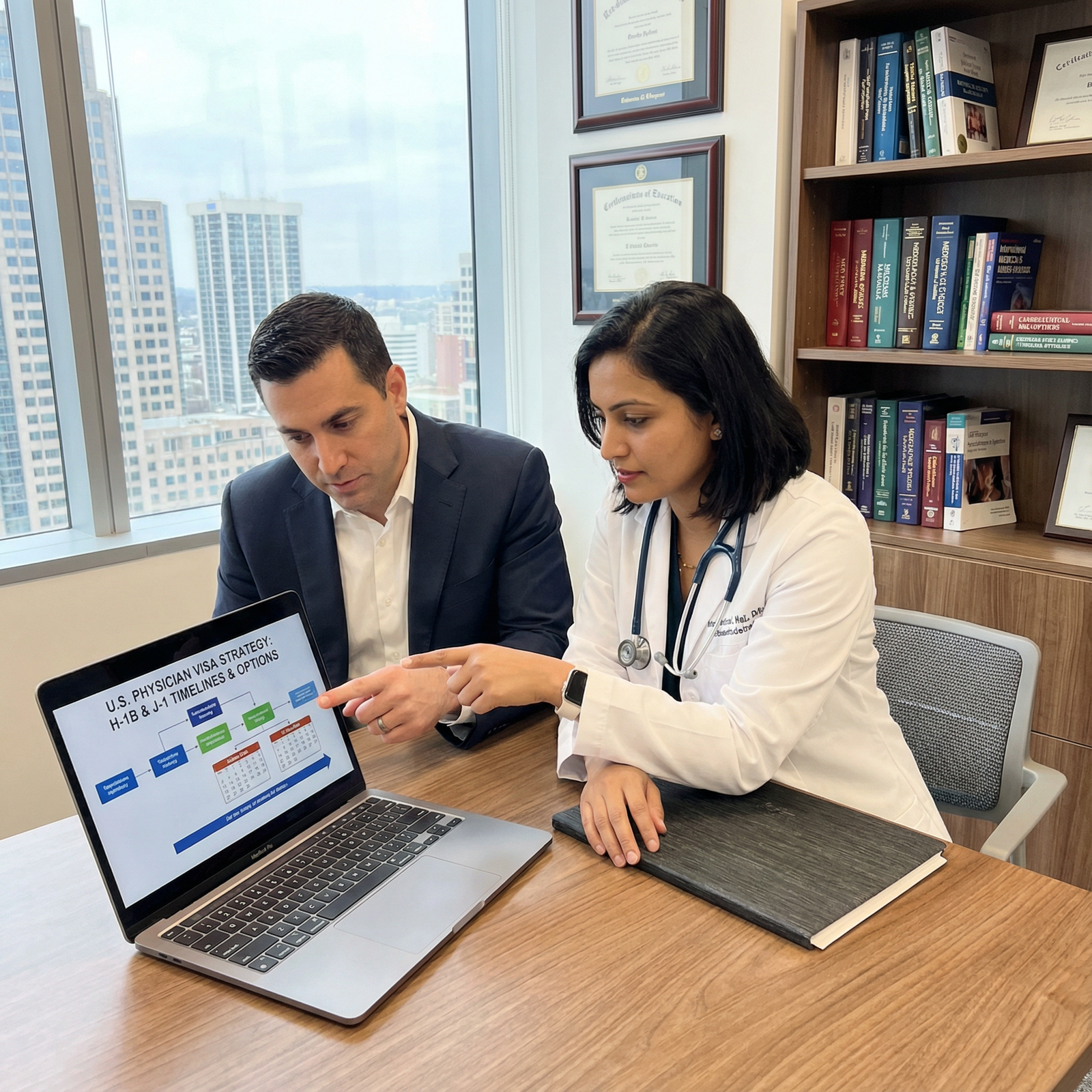
Understanding the Visa Landscape for Caribbean IMGs in Addiction Medicine
For a Caribbean IMG aiming for an Addiction Medicine career in the United States, the question isn’t just “Can I match?”—it’s also “On what visa will I train, and what does that mean for my long‑term future?”
Visa navigation is often more complex than the residency application itself. It affects which programs you can apply to, how you’re ranked, what your post‑residency options are, and even where you can ultimately practice. This is especially important if you are planning a career that includes an addiction medicine fellowship, advanced substance abuse training, or work in underserved communities.
In this guide, we’ll walk through the fundamentals of residency visas for IMGs, the key differences between J‑1 vs H‑1B, practical strategies for Caribbean medical school residency applicants (including SGU residency match considerations), and concrete planning steps for those targeting Addiction Medicine in the U.S.
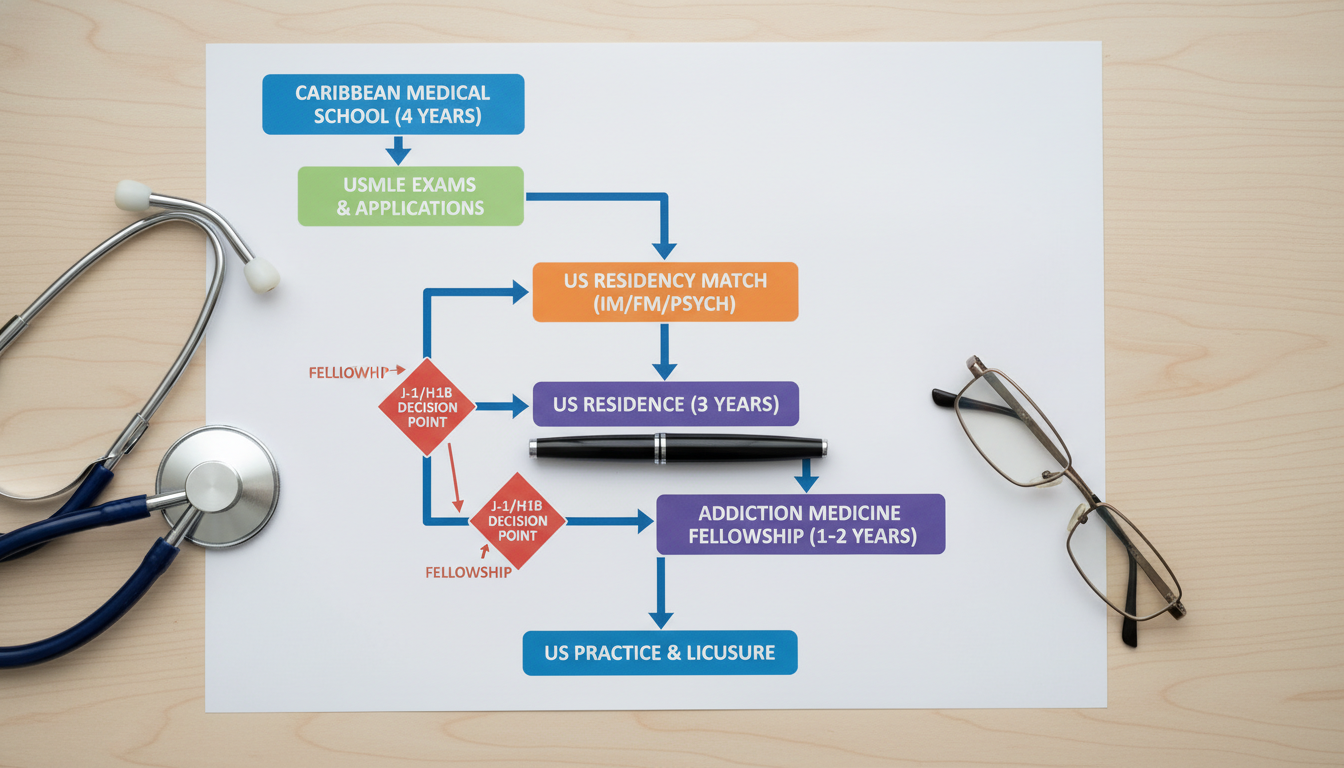
1. Big Picture: Pathway to Addiction Medicine for Caribbean IMGs
Before diving into visas, it helps to map the training path and where immigration decisions fit.
1.1 Typical Training Path in Addiction Medicine
For a Caribbean IMG, the pathway commonly looks like this:
- Caribbean medical school
- Examples: SGU (St. George’s University), AUC, Ross, Saba, etc.
- USMLE exams & ECFMG certification
- Step 1, Step 2 CK, OET, and ECFMG certification are prerequisites.
- Core residency (3–4 years)
- Common “base” specialties for Addiction Medicine:
- Internal Medicine
- Family Medicine
- Psychiatry
- Emergency Medicine
- Pediatrics (less common but possible through some tracks)
- Common “base” specialties for Addiction Medicine:
- Addiction Medicine Fellowship (1–2 years)
- ACGME‑accredited Addiction Medicine fellowship or Addiction Psychiatry fellowship.
- Independent practice in Addiction Medicine
- Possible pathways to ABPM (American Board of Preventive Medicine) certification in Addiction Medicine or ABPN (Psychiatry) with Addiction subspecialty certification (depending on track).
Visa status influences steps 3 and 4 most heavily—and sometimes your job opportunities after fellowship as well.
1.2 Key Visa Decisions in the Timeline
Your main decision points:
- Before applying to residency:
- Understand which residency visa types you’re eligible for.
- Decide whether to target J‑1 only, H‑1B only, or both.
- Build your ERAS list around programs that sponsor your preferred visa.
- During Match season:
- Clarify each program’s stance on IMG visa options.
- Consider how visa type affects your long‑term Addiction Medicine goals (fellowship, practice location, and immigration status).
- Before/following residency graduation:
- If on J‑1: Evaluate waiver options (e.g., underserved clinical work, state Conrad 30) and their compatibility with Addiction Medicine jobs.
- If on H‑1B: Plan for fellowship visas and long‑term steps toward permanent residency, if that’s your goal.
2. Core Visa Options: J‑1 vs H‑1B for Caribbean IMGs
The two major categories for Caribbean IMGs entering U.S. residency are:
- J‑1 Exchange Visitor visa (ECFMG-sponsored)
- H‑1B Temporary Worker visa (program/employer-sponsored)
Understanding their differences is crucial for planning your addiction medicine career.
2.1 J‑1 Visa for Residency
What it is:
The J‑1 is an exchange visitor visa for graduate medical education, with sponsorship through ECFMG. It is the most common visa path for IMGs in residency programs.
Key features:
- Sponsorship: ECFMG, not the individual residency program, is the official sponsor.
- Training focus: Limited to accredited GME training (residency and fellowship).
- Duration:
- Typically up to 7 years total for graduate medical education (occasionally longer by special exception).
- Often sufficient for core residency + Addiction Medicine fellowship.
- Two-year home-country physical presence requirement (212(e)):
- After you complete training, you are generally required to return to your country of last permanent residence for two years, unless you obtain a J‑1 waiver.
- This restriction affects your ability to:
- Change to H‑1B or L‑1 status inside the U.S.
- Obtain an immigrant visa/green card from within the U.S.
Pros for Caribbean IMGs:
- Widest availability: The majority of community and university programs accept J‑1 trainees.
- Predictable process: ECFMG’s J‑1 system is standardized across states and specialties.
- Good fit for addiction medicine timeline: Usually allows time for both residency and Addiction Medicine fellowship within the 7‑year limit.
Cons:
- Home-country requirement: Can complicate long‑term U.S. career plans.
- Waiver dependency: To stay in the U.S. and practice after training, you usually need a J‑1 waiver job (often in medically underserved or rural areas).
- Limited work flexibility: Primarily restricted to your training site(s); moonlighting requires specific approvals.
2.2 H‑1B Visa for Residency
What it is:
The H‑1B is a temporary worker visa for “specialty occupations” that require a bachelor’s degree or higher—in this case, your MD/MBBS and ECFMG certification.
Key features:
- Sponsorship: Your residency program directly sponsors and petitions for the H‑1B.
- Dual intent: H‑1B allows “dual intent” (you can be in temporary status while pursuing permanent residency).
- Duration:
- Generally up to 6 years total (often counted across multiple employers and roles).
- Time used for residency reduces what’s available for fellowship and employment unless you extend via green card steps.
Pros for Caribbean IMGs:
- No two-year home-country requirement: No automatic obligation to return home after training.
- Pathway to green card: Easier to transition to permanent residency than from J‑1.
- Greater job flexibility post-training: Once you have H‑1B, switching to another H‑1B employer can be simpler than dealing with J‑1 waivers.
Cons:
- Fewer programs sponsor H‑1B for residency:
- Many community programs avoid H‑1B due to higher legal costs and complexity.
- Larger academic centers sometimes sponsor H‑1B but may be more competitive.
- USMLE Step 3 requirement:
- Most programs require that you pass USMLE Step 3 before they file an H‑1B petition.
- This can be challenging timing-wise for Caribbean medical school residency applicants.
- Cap complexity:
- University/teaching hospital positions are often cap-exempt, which is good.
- But if you later move to a non-cap-exempt employer, you may face the H‑1B annual lottery.
2.3 J‑1 vs H‑1B: Which Is “Better” for Addiction Medicine?
There is no universally “better” option—only a better fit for your goals and circumstances.
You might favor J‑1 if:
- You want the broadest range of residency programs to apply to.
- You value flexibility for fellowship location, and many Addiction Medicine fellowships in your target region accept J‑1.
- You are willing to work in an underserved area for several years after training via a J‑1 waiver—something that can align well with substance abuse treatment careers, since many waiver roles are in areas with high addiction-related needs.
You might favor H‑1B if:
- You have strong exams, strong CV, and are competitive for academic programs that sponsor H‑1B regularly.
- You want to maximize your chance of remaining in the U.S. after training and pursuing permanent residency.
- Your long‑term plan includes flexibility to work in a wider range of practice settings (not limited by J‑1 waiver obligations) and potentially in non-underserved urban areas.
Most Caribbean IMGs in addiction-related fields end up training on J‑1 due to access and logistical reasons, then leverage J‑1 waiver pathways in states with high addiction burden (e.g., rural Midwest, Appalachia, certain Southern states).
3. How Visas Affect Your Residency and Fellowship Strategy
3.1 Building an ERAS List Around Visa Policies
When you’re creating your ERAS application list, you need to think in terms of “residency visa + future Addiction Medicine fellowship” rather than residency alone.
Steps to take:
- Create a spreadsheet of programs
- Columns: Program name, specialty (IM/FM/psych/EM), state, J‑1 sponsored (Y/N), H‑1B sponsored (Y/N), past Caribbean IMG residents, past match into Addiction Medicine, notes.
- Research program websites and FREIDA
- Look for explicit statements like:
- “We sponsor J‑1 visas only.”
- “We consider J‑1 and H‑1B visa applicants.”
- “We do not sponsor visas; applicants must have U.S. citizenship or permanent residence.”
- Look for explicit statements like:
- Email program coordinators when unclear
- Sample message:
- “I am an IMG from a Caribbean medical school (SGU) interested in your Internal Medicine residency. Could you please clarify whether your program sponsors J‑1 and/or H‑1B visas for residents?”
- Sample message:
- Align with your visa preference:
- If you’re open to J‑1 vs H‑1B, apply broadly to all visa-sponsoring programs.
- If you’re strongly H‑1B-focused, understand that your list will be narrower and more competitive.
3.2 SGU Residency Match, Other Caribbean Schools, and Visa Realities
Caribbean schools like SGU often publish detailed residency match lists, including visa types or hints about IMG support.
For instance:
- SGU residency match patterns show that:
- A large proportion of their graduates match Internal Medicine, Family Medicine, and Psychiatry on J‑1 visas.
- A subset match on H‑1B in academic centers with established IMG infrastructures.
- As an SGU or other Caribbean IMG, look for:
- Programs where your school has matched candidates repeatedly—these programs already understand ECFMG, Caribbean transcripts, and IMG visa options.
- Particular hospitals that frequently show up in SGU residency match results; these often have better-defined processes for J‑1 and sometimes H‑1B.
Use this to narrow your focus to “IMG‑friendly + specialty‑appropriate + visa‑sponsoring” programs.
3.3 Planning Ahead for Addiction Medicine Fellowship
Residency is only one step. Ask:
- Does my target Addiction Medicine fellowship sponsor J‑1, H‑1B, or both?
- If I’m on J‑1 in residency, will I be able to extend my J‑1 for fellowship within the 7‑year limit?
- If I’m on H‑1B in residency, will the Addiction Medicine fellowship:
- Sponsor cap-exempt H‑1B (as a university hospital)?
- Instead prefer J‑1, forcing me to change visa categories?
Many Addiction Medicine fellowships support J‑1 visas routinely. Some also support H‑1B. Before ranking residency programs, research a few Addiction Medicine fellowships in your ideal region (e.g., Northeast, Midwest) to understand what visa types they accept.

4. J‑1 Pathway in Depth: Waivers, Addiction Medicine, and Strategy
If you pursue a J‑1, the critical question becomes: How will I stay in the U.S. after training if I want to?
4.1 Understanding the J‑1 Home Residency Requirement
Upon completing your final J‑1 GME program (residency or fellowship), you’re typically subject to:
- Two-year home-country physical presence requirement
- You must spend 24 months in your country of last legal permanent residence.
- During that time, you cannot:
- Obtain an H‑1B (or L‑1) visa.
- Adjust to permanent resident status in the U.S.
- This requirement can be waived through specific mechanisms (J‑1 waiver programs).
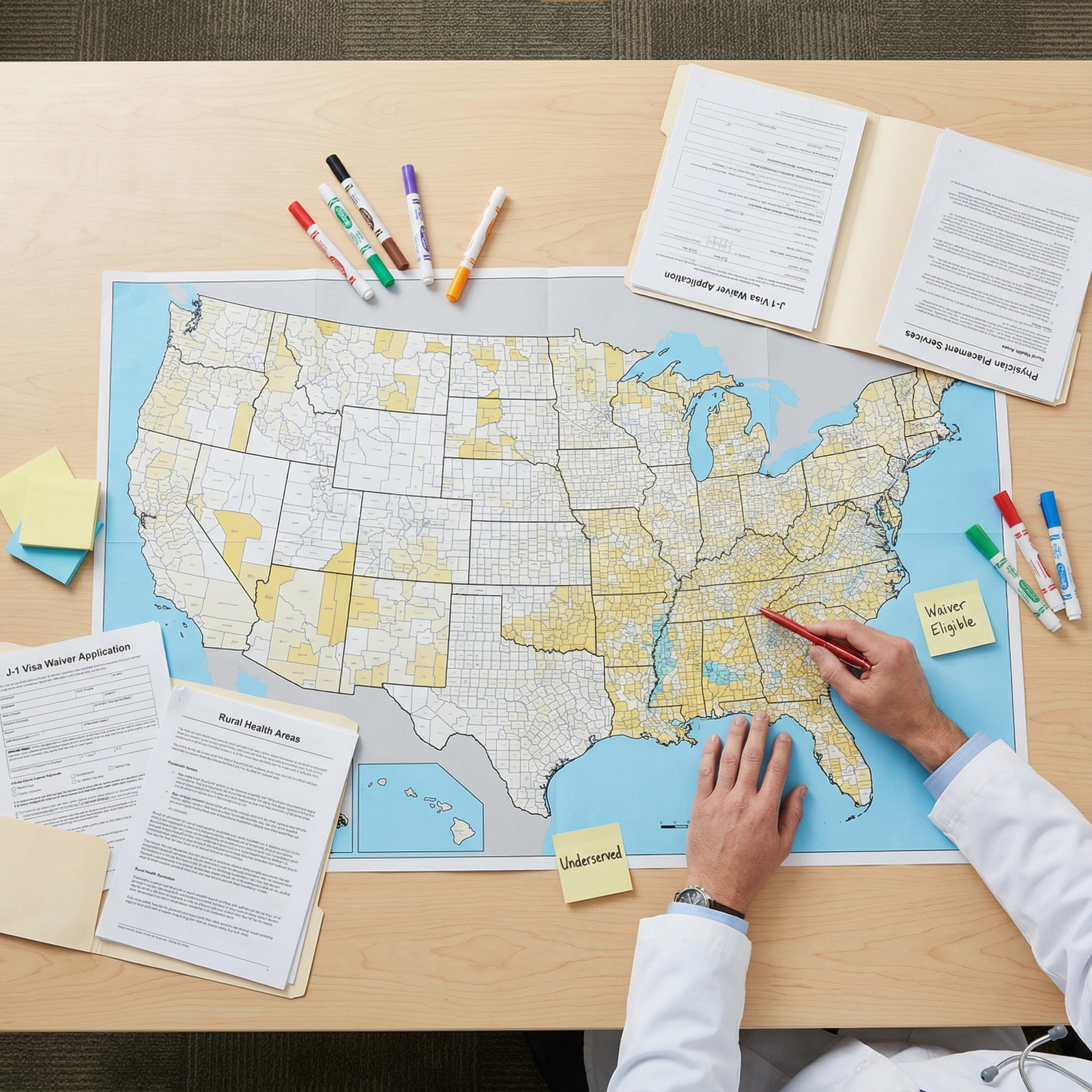
4.2 Common J‑1 Waiver Options for Addiction Medicine Physicians
The most relevant waiver mechanisms for Addiction Medicine physicians are:
Conrad 30 State Waivers
- Each state can sponsor up to 30 waivers per year for J‑1 physicians who agree to work in underserved areas.
- Often primary care (IM/FM) and Psychiatry are popular categories.
- Many waiver jobs involve significant substance use disorder treatment, especially in rural/underserved communities with high opioid use.
- You must:
- Secure a qualifying job offer.
- Commit to at least 3 years of full-time work.
- Typically be on an H‑1B visa for the waiver employment period.
Federal Government Agency Waivers
- Some federal agencies can sponsor waivers, including:
- VA (Department of Veterans Affairs)
- DHHS (Department of Health and Human Services) in some limited capacities
- Other agencies depending on program
- Addiction-related roles in federal facilities or research may qualify.
- Some federal agencies can sponsor waivers, including:
Hardship or Persecution Waivers
- More individualized and legally complex.
- Require showing extreme hardship to a U.S. citizen/permanent resident spouse/child or fear of persecution.
- Less commonly used by Caribbean IMGs unless there are unique personal circumstances.
For a Caribbean IMG in Addiction Medicine, Conrad 30 positions can be especially synergistic: many states are in urgent need of physicians to treat substance use disorders and are more open to sponsoring waivers for addiction-specialized IMGs.
4.3 Strategic Considerations
Residency Choice:
- Training in Internal Medicine, Family Medicine, or Psychiatry often gives you more waiver-eligible job options than narrower base specialties.
- Addiction Medicine expertise is an asset for underserved communities; this can strengthen waiver job negotiations.
Fellowship vs. Immediate Waiver Job:
- Some IMGs choose to:
- Finish residency on J‑1 → immediately start waiver job.
- Others:
- Complete residency on J‑1 → do Addiction Medicine fellowship on continued J‑1 → then start waiver job.
- Trade-off:
- Doing the fellowship first may enhance your professional profile but delays your waiver employment start.
- Some IMGs choose to:
Geographic Flexibility:
- Waiver jobs are often in rural or semi-rural regions, though some are in urban underserved neighborhoods.
- Being flexible about geography significantly increases your chances of:
- Finding a Conrad 30-sponsored waiver role.
- Negotiating positions with strong addiction services components.
5. H‑1B Strategy: Opportunities and Cautions for Addiction Medicine
For Caribbean medical school residency applicants who manage to secure an H‑1B, the planning focus shifts.
5.1 Getting H‑1B for Residency
Common requirements:
- USMLE Step 3 passed before the program files the petition.
- ECFMG certification at the time of visa issuance.
- Program must:
- Be willing to sponsor and pay for legal and filing costs.
- Possibly navigate institutional policy limits about H‑1B use.
Tips:
- Take Step 3 early (ideally before the residency application season or at least before rank lists) if H‑1B is a priority.
- During interviews, ask:
- “Does your program sponsor H‑1B visas for residents, or only J‑1?”
- “How many current residents are on H‑1B, and in what years?”
5.2 Transitioning to Addiction Medicine Fellowship on H‑1B
Once in H‑1B status:
- If your Addiction Medicine fellowship is at a university/teaching hospital, it’s often cap-exempt.
- Fellowship can:
- Extend your H‑1B within the 6-year limit; or
- Overlap with green card steps if your employer sponsors you early.
Be mindful:
- The 6-year H‑1B clock includes all H‑1B time (residency + fellowship + employment).
- If you spend most of those 6 years in training, your first attending job may have limited H‑1B time unless:
- You’ve initiated a green card petition early enough to qualify for time extensions beyond the 6-year limit.
5.3 Are H‑1B Jobs After Fellowship Easy to Find in Addiction Medicine?
Pros:
- There is high demand for physicians with strong substance abuse training and addiction medicine fellowships, especially in:
- Community mental health centers
- Safety-net hospitals
- Integrated behavioral health networks
- Some employers are willing to sponsor H‑1B or green cards due to workforce shortages.
Challenges:
- Not all addiction-focused positions have experience with H‑1B sponsorship.
- Some addiction treatment organizations may be private or not cap-exempt, bringing the H‑1B cap/lottery back into play.
For a Caribbean IMG planning a long-term U.S. career in Addiction Medicine, discuss future immigration sponsorship explicitly during job interviews, especially if you will need long-term H‑1B extensions and/or a green card.
6. Practical Action Plan for Caribbean IMGs Targeting Addiction Medicine
Bringing everything together, here is a stepwise plan that focuses on both residency visa navigation and your ultimate goal: a career in Addiction Medicine.
6.1 Pre‑Residency (Medical School and Pre‑Match Phase)
Clarify your long-term goal
- “I want to be an Addiction Medicine physician practicing in the U.S., ideally in [urban vs rural, region, specific population].”
- Determine how willing you are to work in underserved areas short- to medium-term.
Strengthen addiction-focused credentials
- Electives in Addiction Psychiatry, substance abuse treatment programs, methadone/buprenorphine clinics.
- Research or QI projects related to opioid use disorder, alcohol use disorder, or harm reduction.
- Volunteer or advocacy work in addiction recovery communities.
Decide on visa strategy
- If targeting H‑1B:
- Plan to take USMLE Step 3 as early as reasonably possible.
- Focus ERAS on H‑1B‑friendly academic programs.
- If open to J‑1 vs H‑1B:
- Apply broadly, then decide based on offers.
- If targeting H‑1B:
Compile a targeted ERAS program list
- Prioritize:
- Programs known to match Caribbean IMGs (e.g., via SGU residency match lists).
- Specialties that lead to Addiction Medicine fellowship (IM, FM, Psychiatry, EM).
- Programs that clearly sponsor your preferred residency visa.
- Prioritize:
6.2 During Residency
Maintain visa compliance
- Keep your DS‑2019 (for J‑1) or I‑797/I‑94 (for H‑1B) current.
- Inform your GME office of any travel or training site changes.
Build a strong Addiction Medicine profile
- Join addiction taskforces, participate in substance abuse training courses.
- Seek mentors in Addiction Medicine or Addiction Psychiatry at your institution.
- Present addiction-related cases or posters at conferences.
Start exploring fellowship programs early (PGY‑2/PGY‑3)
- Look up Addiction Medicine fellowships:
- Which visas do they sponsor: J‑1 vs H‑1B?
- Have they trained Caribbean IMGs before?
- Reach out to current fellows (especially IMGs) to ask about their visa experience.
- Look up Addiction Medicine fellowships:
If on J‑1: Plan for waivers early
- Learn which states have robust Conrad 30 programs.
- Understand which regions have high need for addiction specialists.
- Network with potential employers in those states.
If on H‑1B: Plan for post-training immigration steps
- Discuss with fellowship programs and potential employers:
- Their willingness to sponsor continuation/transfer of H‑1B.
- Plans for green card sponsorship and timing.
- Discuss with fellowship programs and potential employers:
6.3 During Addiction Medicine Fellowship
Align your clinical experience with future waiver or job goals
- Gain experience in settings similar to where you might work post‑fellowship:
- Rural clinics, FQHCs, integrated primary care/addiction sites, community mental health centers.
- Gain experience in settings similar to where you might work post‑fellowship:
Cultivate relationships with potential employers
- Many waiver jobs or H‑1B offers develop from networking:
- Rotations outside your main institution.
- Conferences and professional societies (e.g., ASAM).
- Many waiver jobs or H‑1B offers develop from networking:
Work closely with immigration counsel
- If considering a J‑1 waiver:
- Clarify timelines and documentation required.
- If continuing in H‑1B, especially near the 6-year limit:
- Make sure your employer initiates green card steps early enough to qualify for H‑1B extensions.
- If considering a J‑1 waiver:
FAQ: Visa Navigation for Caribbean IMGs in Addiction Medicine
1. As a Caribbean IMG, am I more likely to get J‑1 or H‑1B for residency?
Most Caribbean IMGs enter residency on J‑1 visas because:
- More programs accept J‑1 than H‑1B.
- Step 3 is not required before starting training.
- ECFMG handles much of the visa process, which programs are comfortable with.
However, strong applicants who pass USMLE Step 3 early and target H‑1B‑friendly academic programs can secure H‑1B residency positions. Realistically, plan primarily for J‑1, and treat H‑1B as a bonus if it works out.
2. Will a J‑1 visa stop me from doing an Addiction Medicine fellowship?
No. Many Addiction Medicine (and Addiction Psychiatry) fellowships sponsor J‑1 trainees. As long as you:
- Remain within the typical 7-year J‑1 GME limit, and
- Meet ECFMG/host institution requirements,
You can usually do both residency and Addiction Medicine fellowship on J‑1. Just be sure to confirm each fellowship’s visa policy before applying.
3. How does my visa choice affect future job opportunities in Addiction Medicine?
J‑1 route:
- After training, you’ll likely need a J‑1 waiver job, often in an underserved area.
- Many such areas have high demand for addiction specialists, so your fellowship and substance abuse training can be a strong asset.
- You may have to work 3 years in a specific location before wider mobility.
H‑1B route:
- You won’t face the two-year home requirement but will need employers willing to sponsor H‑1B and possibly green card.
- You may have more flexibility in job location and type, especially once you secure permanent residency.
4. I’m at SGU (or another Caribbean medical school). How can I use SGU residency match data to plan my visa and Addiction Medicine path?
Look closely at:
- Which programs repeatedly match SGU (or your school’s) graduates in Internal Medicine, Family Medicine, or Psychiatry.
- Which of those programs sponsor J‑1 vs H‑1B.
- Whether any graduates from those programs later match into Addiction Medicine fellowships.
Use this historical pattern to:
- Target IMG-friendly programs that have established visa processes.
- Ask alumni directly (via LinkedIn, school networks, or mentorship programs) about their residency visa, fellowship visa, and job search in Addiction Medicine.
By approaching the process with a dual lens—clinical training in Addiction Medicine and strategic visa navigation—you can design a realistic, forward-looking plan. As a Caribbean IMG, your path may be complex, but with early planning around J‑1 vs H‑1B, residency and fellowship targeting, and clear awareness of waiver and employment options, you can build a sustainable U.S. career serving patients with substance use disorders.