Understanding the Visa Landscape for Caribbean IMGs Matching in Boston
Boston is one of the most competitive and rewarding places in the United States to complete residency. With world-renowned hospitals like Massachusetts General Hospital, Brigham and Women’s, Beth Israel Deaconess, Boston Medical Center, and multiple Harvard- and Boston University–affiliated programs, it’s a highly attractive destination for Caribbean medical school graduates.
For Caribbean IMGs, success in Boston doesn’t depend only on test scores and clinical performance—it also hinges on visa strategy. Programs in Massachusetts vary widely in what they sponsor, how often they sponsor, and how comfortable they are with different visa pathways. Understanding J-1 vs H-1B, long-term immigration implications, and how this interacts with the Caribbean medical school residency journey is essential.
This article walks you through:
- Core residency visa options for IMGs
- How Boston and Massachusetts residency programs typically handle visas
- How to approach SGU residency match and other Caribbean school matches with a visa plan in mind
- Concrete steps to maximize your chances as a Caribbean IMG targeting Boston
Core Visa Options for Residency: J-1 vs H-1B for Caribbean IMGs
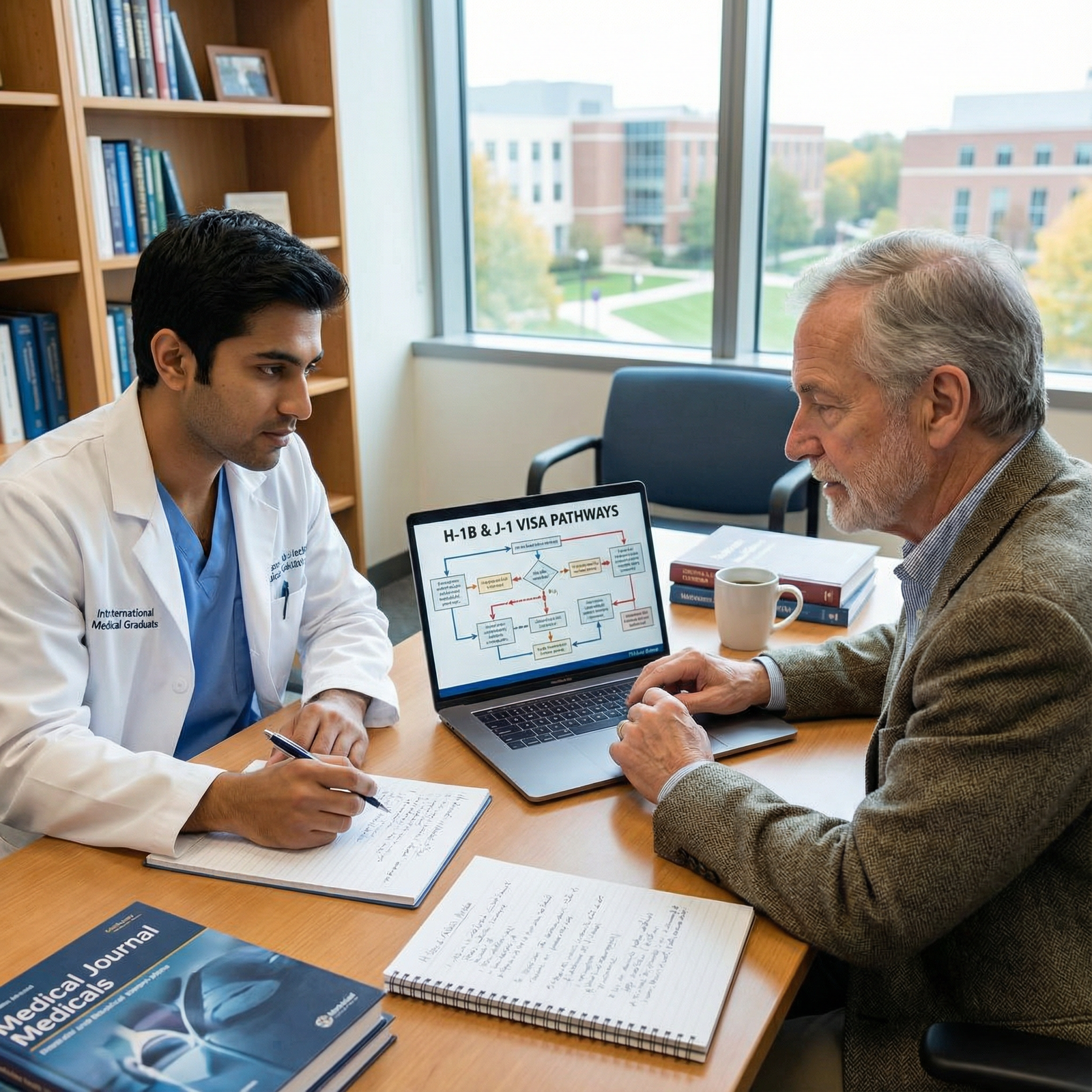
The two dominant visa pathways for international medical graduates entering US residency are the J-1 (Exchange Visitor) and H-1B (Specialty Occupation) visas. Each carries major consequences for your training, career timeline, and where you can practice after residency.
1. J-1 Visa (ECFMG-Sponsored)
The J-1 physician category is the most common visa pathway for IMGs entering residency.
Key features:
- Sponsor: Educational Commission for Foreign Medical Graduates (ECFMG), not the hospital itself.
- Purpose: Graduate medical education (residency/fellowship).
- Duration: Up to 7 years in total (in most cases), covering residency plus fellowship(s).
- Work site: Only at institutions and in positions approved for training.
- USMLE Requirements: Typically needs passing Step 1, Step 2 CK, and often Step 2 CS equivalent/English proficiency per current policy.
- Home residency requirement (212(e)):
- Most J-1 physicians are subject to a two-year home-country physical presence requirement after training.
- You must return to your country of last permanent residence for two cumulative years or obtain a waiver before you can change to H-1B or apply for permanent residence (green card).
Advantages of the J-1 for Caribbean IMGs:
- Widely accepted across US residencies, including in Boston.
- Less administrative burden for the hospital compared to H-1B.
- Predictable ECFMG process familiar to program coordinators.
Main limitation:
- The two-year home-country requirement is the biggest challenge and shapes your long-term planning. Many physicians avoid actually returning by obtaining a J-1 waiver (for example, through underserved area work), but this adds future constraints to where and how you can practice.
2. H-1B Visa (Specialty Occupation for Physicians)
The H-1B is a dual-intent visa that allows temporary work with the possibility of later pursuing a green card without leaving the US.
Key features:
- Sponsor: The residency/fellowship program (hospital or sponsoring institution).
- Purpose: Employment in a specialty occupation (e.g., physician in residency).
- Duration: Up to 6 years total (often 3-year initial approval, plus extensions).
- Work site-specific: Approval lists specific employer(s) and locations.
- USMLE Requirements:
- Must have passed USMLE Step 3 before the H-1B petition is filed.
- Must meet state medical licensing/limited licensing requirements.
Advantages for Caribbean IMGs:
- No two-year home-country requirement.
- Dual intent: You can pursue permanent residency (green card) while in H-1B.
- Helpful if your long-term goal is to stay in the US continuously without an obligation to return home or seek a waiver.
Limitations and obstacles:
- Not all Boston residency programs sponsor H-1Bs.
- Additional cost and administrative burden for the program.
- Step 3 must be completed early (ideally before the match or start date).
- Time limits (6 years total) can become tight if you have long training (e.g., internal medicine + subspecialty fellowship).
How Boston & Massachusetts Residency Programs Handle Visa Sponsorship
Boston and the broader Massachusetts residency ecosystem are fairly IMG-friendly in many specialties, but visa policies are highly program-specific. Understanding Massachusetts residency norms can give you an edge.
Boston and Massachusetts Trends for IMGs
Within Massachusetts, you’ll see a spectrum:
University-affiliated teaching hospitals (e.g., Harvard-affiliated programs, Boston University, Tufts) generally:
- Accept J-1 visas for IMGs in many programs.
- Are more selective about H-1B sponsorship, often limiting it to certain specialties or exceptional candidates.
Community-based programs in the greater Boston area may:
- Rely heavily on J-1 due to straightforward ECFMG sponsorship.
- Offer H-1B occasionally, often when a candidate has strong ties, excellent scores, or prior US training.
J-1 Sponsorship in Boston
For IMGs, J-1 is usually the default visa pathway into Boston residency programs, including:
- Internal Medicine
- Pediatrics
- Psychiatry
- Family Medicine
- Many subspecialty fellowships
Most major teaching hospitals in Boston are entirely comfortable training J-1 physicians through ECFMG:
- They understand the paperwork and annual renewal.
- Their GME offices have standard processes in place.
- They anticipate many candidates requiring J-1.
For a Caribbean IMG targeting a Caribbean medical school residency match in Boston (for example, as an SGU graduate applying to Boston IM programs), assuming a J-1 path is usually realistic and strategically safe—unless you specifically need H-1B for long-term immigration goals.
H-1B Sponsorship in Boston
H-1B sponsorship is more selective in Massachusetts residency programs:
- Some of the most prestigious Boston hospitals rarely or never sponsor H-1B for categorical residents, except perhaps in:
- Subspecialty fellowships
- Extremely competitive candidates with unique qualifications
- Others may selectively sponsor H-1B in:
- Internal medicine
- Psychiatry
- Certain surgical subspecialties provided there is:
- Solid justification
- Early completion of Step 3
- Institutional support for the cost and processing time
You’ll find differences even within the same institution—for example, the internal medicine program might entertain H-1B while pediatrics doesn’t, or vice versa.
Actionable tip:
When researching Boston residency programs, always check:
- Program’s website → “Visa Sponsorship” or “Information for International Medical Graduates.”
- FREIDA or AAMC listings for each program’s visa policies.
- Program-specific FAQs (some state: “We sponsor J-1 only” or “J-1, rarely H-1B for exceptional candidates.”)
If information is unclear, a concise email to the program coordinator can help clarify whether they:
- Sponsor J-1 only
- Sponsor both J-1 and H-1B
- Limit H-1B to certain circumstances
Strategic Planning for Caribbean IMGs: Matching to Boston with the Right Visa
Many Caribbean graduates—from SGU (St. George’s University), AUC, Ross, Saba, and similar schools—successfully match into Boston and Massachusetts residency programs each year. What differentiates those who handle visas smoothly is early, deliberate planning.
Step 1: Aligning Medical School and Visa Strategy
As a Caribbean IMG, your foundation starts before the match:
- Choose clinical rotations in the US, especially in academic centers or strong community hospitals.
- Boston rotations are ideal, but not essential; rotations in other US regions can still boost your overall profile.
- If you are at a school like SGU that has a track record of SGU residency match success in New England:
- Utilize their career services and alumni networks to identify Boston programs with a history of taking Caribbean IMGs on J-1 or H-1B.
- Ask: Which graduates matched to Boston recently, and what visas did they use?
Step 2: Decide Early: J-1 vs H-1B as Preferred Path
You don’t need a final answer during Step 1, but by the time you start your ERAS application, clarity will help guide your strategy.
You may favor J-1 if:
- Your priority is maximizing your chances of matching in Boston, including at programs that do not sponsor H-1B.
- You’re willing to:
- Potentially accept the two-year home requirement, or
- Plan proactively for a J-1 waiver (e.g., signing with a rural/underserved employer after residency).
You may favor H-1B if:
- You strongly want to:
- Avoid the two-year home residency requirement.
- Transition directly from residency/fellowship into US employment and potentially a green card.
- You have:
- Competitive credentials (strong USMLE scores, robust US clinical letters, research, etc.).
- The capacity and time to complete USMLE Step 3 before the match or at least before July 1 of your PGY-1 year.
- You’re willing to limit your program list to those that explicitly sponsor H-1B.
Step 3: Tailoring Your Boston Program List by Visa Policy
When compiling a list of Boston residency programs or Massachusetts residency opportunities:
Categorize programs:
- J-1 only
- J-1 & H-1B
- H-1B on a case-by-case basis
- No visa sponsorship (rare, but some community programs may restrict IMGs)
Balance your list:
- If you’re aiming for H-1B but open to J-1:
- Apply broadly to all J-1-friendly Boston programs.
- Highlight H-1B-capable programs as top targets.
- If you absolutely require H-1B (e.g., personal or legal reasons):
- Focus primarily on programs known to sponsor H-1B, possibly including:
- Other cities in the Northeast beyond Boston
- Less competitive specialties or geographic regions to increase odds.
- Focus primarily on programs known to sponsor H-1B, possibly including:
- If you’re aiming for H-1B but open to J-1:
Document-specific strategies:
- For H-1B-focused applications:
- Mention in your personal statement or in emails (carefully, not aggressively) that you have already passed Step 3 or are scheduled to take it and are prepared for H-1B sponsorship if the program offers it.
- For J-1:
- Ensure your documentation (ECFMG certification, proof of funding if needed, etc.) is prepared early to avoid delays.
- For H-1B-focused applications:
From Match to Start Date: Visa Logistics and Timeline in Boston
Once you match to a Boston program, your practical residency visa process begins in earnest. The timeline differs slightly for J-1 vs H-1B, but key principles are similar.
J-1 Visa Process (ECFMG) – Typical Timeline
Post-Match (March–April):
- The matched program confirms your appointment and initiates paperwork with their GME office.
- You apply through ECFMG’s OASIS/EVNet system for J-1 sponsorship.
- Collect documents: passport, medical diploma, ECFMG certification, DS-2019 request, contract/offer letter.
Spring–Early Summer:
- ECFMG reviews your application and issues Form DS-2019 if all requirements are met.
- You schedule a visa interview at the US embassy/consulate in your home country or country of residence.
Visa Interview & Entry:
- Attend the interview, present DS-2019, and supporting docs.
- Once approved, enter the US with your J-1 visa.
- Report to Boston for orientation typically in June or late June/early July.
Critical tips for Caribbean IMGs:
- Allow extra time if consular operations are slow or if your country has known backlogs.
- Keep in close contact with your program’s coordinator; Boston hospitals’ GME offices are usually experienced but still depend on you to complete your side of the process promptly.
H-1B Visa Process for Residency – Typical Timeline
Before Match or Immediately After:
- You must pass USMLE Step 3 early enough for H-1B filing.
- After the match, the GME office consults with immigration counsel.
- The hospital prepares the Labor Condition Application (LCA) and H-1B petition.
Spring–Early Summer:
- The hospital files the H-1B petition with USCIS, often with premium processing to avoid delays (programs often prefer this despite added cost).
- Once approved, if you are outside the US, you apply for an H-1B visa at a consulate.
Arrival in Boston:
- You enter the US in H-1B status close to your start date (often within 10 days before employment begins, following employer guidance).
Key challenges:
- Timing is tight—especially if Step 3 is completed late.
- Any request for evidence (RFE) from USCIS can cause anxiety and delay.
- Not all Boston programs want to deal with H-1B at the residency level, which is why discussing this early (or preferring J-1) may be strategic.

Long-Term Planning: From Residency Visa to Waivers, Fellowship, and Beyond
Your residency visa choice will affect what you can do after finishing training in Boston and how easily you can remain in the United States.
J-1 Waiver Pathways After Boston Training
If you complete residency and possibly fellowship in Boston on a J-1 visa, you are typically subject to the two-year home-country requirement unless waived.
The most common strategy is the J-1 waiver through service in an underserved area, often via:
- Conrad 30 Waiver Program (state-based)
- Federal programs (e.g., VA hospitals, certain federal agencies)
Important implications for Caribbean IMGs:
- Massachusetts itself has limited slots; competition can be high.
- Many J-1 waiver jobs are outside major academic hubs like Boston, often in:
- Rural or semi-rural communities
- Inner-city clinics
- You may have to leave Boston for 3+ years after training to meet waiver obligations.
However, after fulfilling the J-1 waiver service (typically 3 years in H-1B status at the waiver job), you can often:
- Continue in H-1B with your employer or
- Transition to a green card (if the employer sponsors you).
H-1B to Green Card: A Different Trajectory
If you complete residency in Boston on an H-1B visa:
- There is no two-year home-return requirement.
- You may:
- Enter fellowship in another H-1B position, or
- Move directly into an attending job with H-1B transfer.
Your employer (often a hospital or physician group) may sponsor you for a green card (permanent residency) through:
- Employment-based categories such as EB-2 or EB-3.
- Depending on your country of chargeability, processing times vary.
For some Caribbean IMGs, this path provides:
- Less geographic restriction after training
- More flexibility to remain in or return to Boston if you find a viable job and sponsor
Fellowship Considerations in Boston
Both J-1 and H-1B physicians successfully match to Boston-based fellowships in:
- Cardiology
- Gastroenterology
- Hematology/Oncology
- Pulmonary/Critical Care
- Endocrinology
- Psychiatry subspecialties, and more
Key considerations:
- Many fellowships use J-1 primarily (familiar and easier sponsorship).
- Some highly academic fellowships may be more open to H-1B, particularly if they anticipate helping you pursue a research or academic career.
- If you’re already in J-1, continuing on J-1 through fellowship is usually straightforward, as long as you don’t exceed the total time limit.
Practical Tips and Common Pitfalls for Caribbean IMGs Targeting Boston
1. Start Visa Planning Early
- By your third year of medical school (or equivalent), begin learning about:
- J-1 vs H-1B
- Your school’s data on visa patterns (e.g., SGU residency match reports in Boston and New England)
- Speak with:
- Career services
- Alumni who matched in Boston
- Current residents in Massachusetts
2. Prioritize Step Exams Strategically
- For J-1:
- Focus on strong Step 1 and Step 2 CK scores.
- Ensure you complete all requirements for ECFMG certification on time.
- For H-1B:
- Schedule and pass Step 3 early—ideally before submitting your ERAS application or by the time of interviews.
- Mention this strategically in applications where programs are H-1B friendly.
3. Be Honest but Tactical About Visa in Interviews
Many Boston programs will ask about your visa needs during interviews. Suggested approach:
- Be clear and concise:
- “I will require visa sponsorship. I am ECFMG-certified and planning for a J-1.”
- Or, if applicable: “I have passed Step 3 and would be eligible for H-1B sponsorship if your program offers it; I am also open to J-1.”
- Don’t lead with demands, but do answer directly. Programs appreciate transparency.
4. Watch Out for Timing Issues
Common timing pitfalls:
- Late Step 3 → makes H-1B nearly impossible for PGY-1 start.
- Delays in ECFMG documents → slow J-1 DS-2019 issuance.
- Last-minute visa interviews → risk of starting residency late.
Mitigation:
- Work backward from a July 1 start date.
- Give yourself several months’ cushion for visa processing.
- Communicate frequently with your Boston program’s GME office.
5. Consider Contingency Plans
Boston is highly competitive. As a Caribbean IMG, don’t limit yourself to one city:
- Apply broadly across the US while still prioritizing Boston and Massachusetts residency options.
- Ensure your visa strategy (especially if H-1B-focused) is not Boston-dependent—identify programs in other states that share similar visa policies.
FAQ: Visa Navigation for Caribbean IMGs in Boston
1. Do most Boston residency programs sponsor visas for Caribbean IMGs?
Many major academic programs in Boston sponsor J-1 visas for qualified IMGs, including Caribbean graduates. H-1B sponsorship is more variable and often limited. Always check each program’s policy directly—some are J-1 only, while others may accept both J-1 and H-1B.
2. As a Caribbean IMG aiming for Boston, should I prioritize J-1 or H-1B?
It depends on your goals:
- If your top priority is maximizing match chances in Boston, J-1 is usually the safer and more widely available option.
- If you strongly want to avoid the two-year home-country requirement and are ready to complete Step 3 early, H-1B is attractive—but it will limit your program options. Many Caribbean IMGs adopt a flexible approach, open to J-1 but prepared for H-1B if a sponsoring program offers it.
3. How does being a graduate from SGU or another Caribbean medical school influence visa options in Boston?
Your school (e.g., SGU, Ross, AUC) doesn’t directly change US visa laws, but it can:
- Provide match data showing which Boston programs commonly accept their graduates and what visas those grads used.
- Offer guidance from advisors familiar with SGU residency match patterns in Massachusetts.
- Connect you with alumni in Boston who can share real-world experiences with J-1, H-1B, and long-term immigration planning.
4. Can I switch from J-1 to H-1B after starting residency in Boston?
In most cases, once you begin training on a J-1 physician visa, you become subject to the 212(e) two-year home-country requirement and cannot change status to H-1B or permanent residency in the US until you:
- Fulfill the two-year home presence requirement, or
- Obtain a J-1 waiver (e.g., through underserved work or a federal waiver program) and then move to an H-1B position.
So, if avoiding the 2-year requirement is critical, you need to think about H-1B before you start residency, not after.
By understanding these pathways and aligning your visa strategy with your Boston residency ambitions, you can move from uncertainty to a clear, actionable plan. As a Caribbean IMG, early preparation, informed choices about J-1 vs H-1B, and targeted applications to Massachusetts residency programs that match your visa needs will significantly improve your chances of training—and thriving—in Boston.