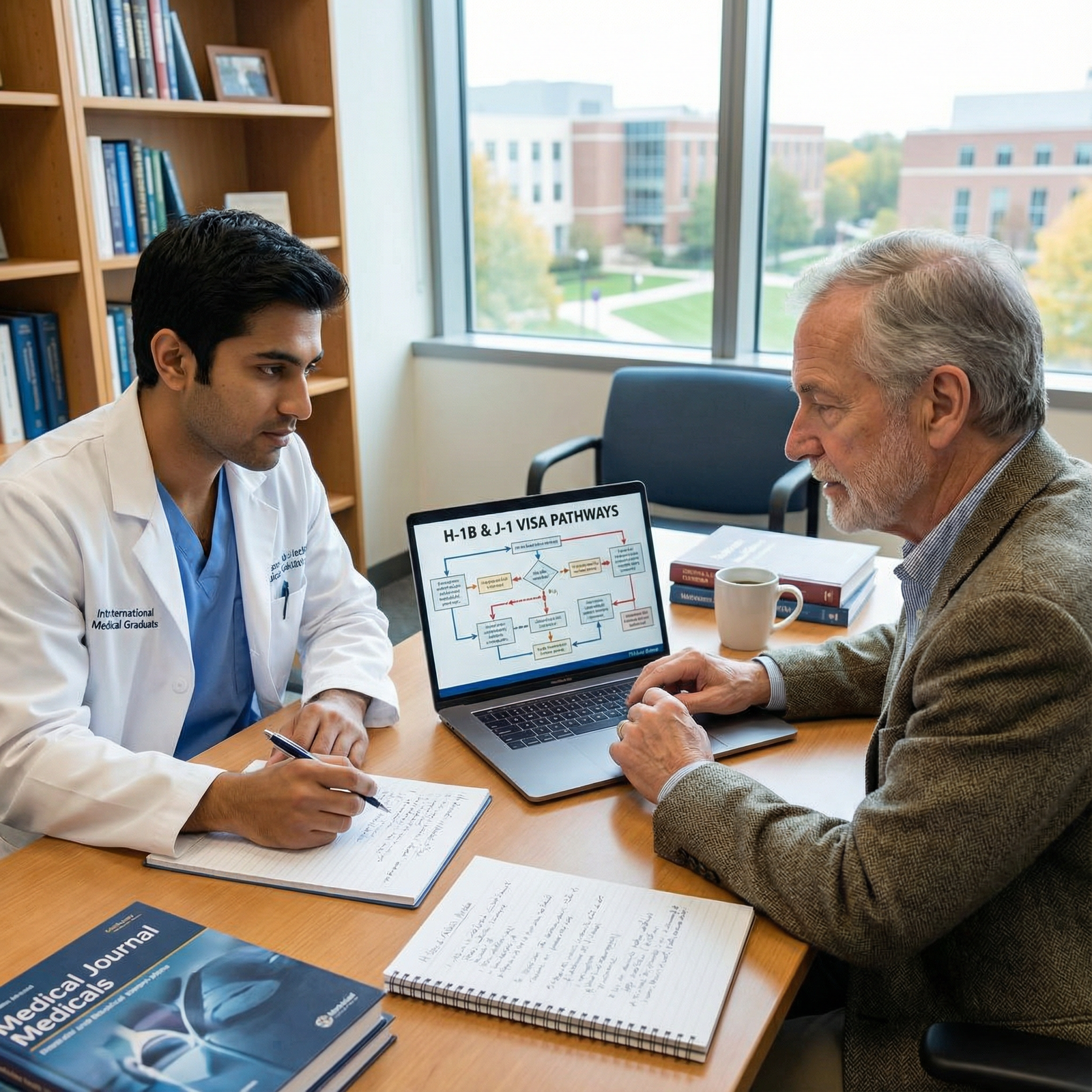
Visa navigation is one of the most confusing—and consequential—parts of applying to residency in the United States, especially in a large academic hub like Chicago. Between program preferences, federal rules, and changing immigration policies, understanding how to match into Chicago residency programs as an international medical graduate (IMG) requires clear, accurate guidance.
This article walks you step-by-step through the key visa pathways, how they intersect with Illinois residency requirements and institutional policies, and what you should do before you apply, while you’re interviewing, and after you match. The focus is specifically on visa navigation for residency programs in Chicago and the broader Illinois residency ecosystem.
Understanding the Landscape: Chicago Residency Programs and Visa Sponsorship
Chicago is one of the most IMG‑friendly metropolitan areas in the U.S., with a dense cluster of academic medical centers, community programs, and safety‑net hospitals. Major systems include:
- University of Chicago Medicine
- Northwestern Medicine (Feinberg)
- University of Illinois at Chicago (UI Health)
- Rush University Medical Center
- Advocate Health (multiple sites)
- Ascension, AMITA legacy programs, MacNeal, Mount Sinai, etc.
Each institution may have different policies regarding visa sponsorship for residents. When you’re evaluating Chicago residency programs, you need to consider:
What visa types do they sponsor?
- Only J‑1
- J‑1 and H‑1B
- Rarely, other statuses (e.g., existing EAD holders, TN for Canadians/Mexicans, etc.)
Do they require USMLE Step 3 for H‑1B sponsorship?
- Most H‑1B sponsoring programs in Chicago require Step 3 before the Match ranking deadline.
Do they have institutional limitations?
- Some academic centers sponsor H‑1B only for certain specialties (e.g., Internal Medicine, Neurology, Anesthesia) and J‑1 for others.
- Some community programs may rely exclusively on J‑1 sponsorship via ECFMG.
How many IMGs do they typically take?
- Higher historical IMG intake often correlates with more established internal processes for residency visa management.
Action step:
Before applying, create a spreadsheet listing all Chicago and broader Illinois residency programs of interest, with columns for:
- J‑1 sponsorship (Yes/No)
- H‑1B sponsorship (Yes/No)
- Step 3 requirement (and deadline)
- Historical IMG percentage
- Notes from program website / email
This will guide your ERAS application strategy and avoid wasting applications on programs that cannot support your immigration needs.
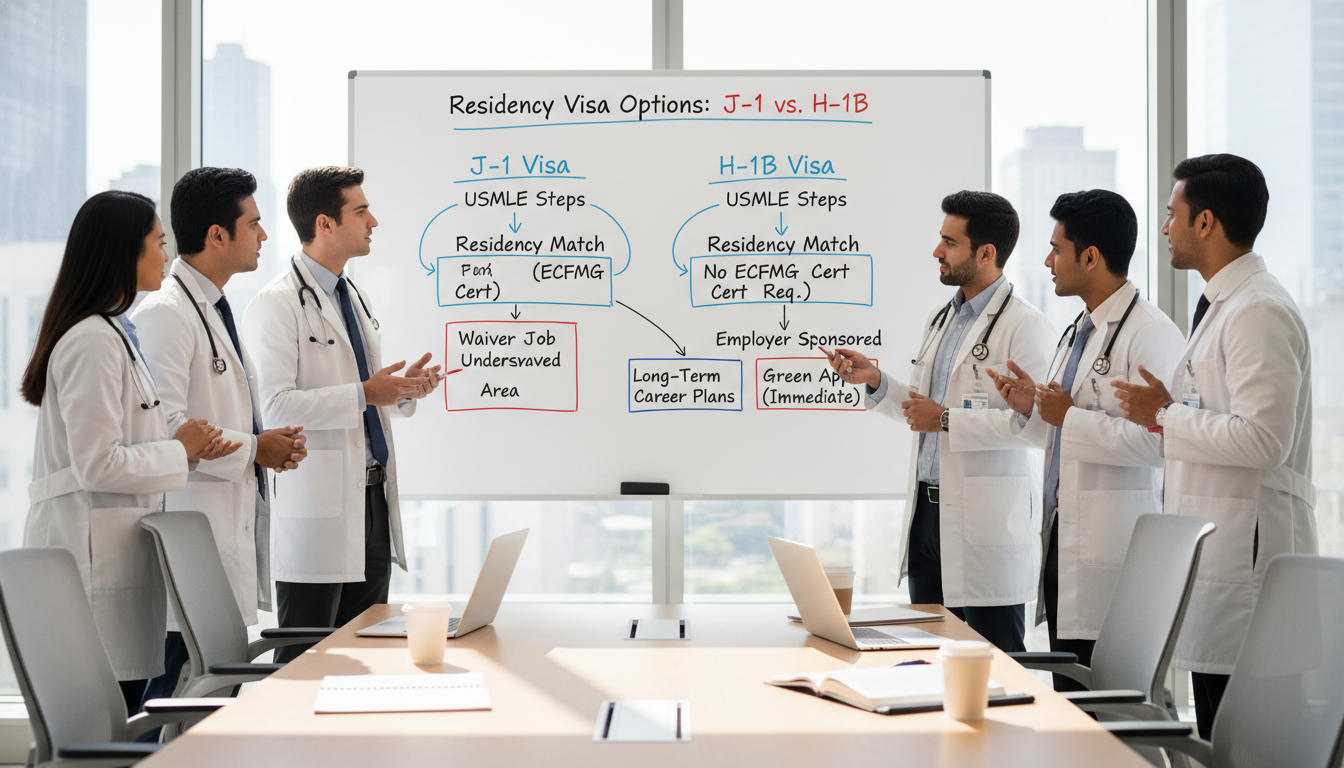
Core Visa Options for Residency: J‑1 vs H‑1B for IMGs
For most IMGs in Chicago residency programs, the practical options are:
- J‑1 Alien Physician visa
- H‑1B Temporary Worker visa (specialty occupation)
Other paths (such as F‑1 OPT, EAD via asylum, pending green card, TN, O‑1) do exist but are less common as a starting point. The critical decision for many is J‑1 vs H‑1B.
J‑1 Visa for Residency (Sponsored by ECFMG)
The J‑1 is the default visa type for residency training for IMGs in much of the U.S., including Illinois.
Key features:
- Sponsor: ECFMG (not the hospital itself)
- Purpose: Graduate medical education (GME)—residency and fellowship
- Duration: Typically up to 7 years of total training
- Full‑time training required: Must be enrolled in ACGME‑accredited program
Advantages of J‑1 for residency in Chicago:
- Widely accepted: Many Chicago residency programs sponsor only J‑1 for IMGs.
- Structured process: Programs are very familiar with ECFMG procedures; institutional GME offices handle this routinely.
- Flexibility for multiple fellowships: You can do residency plus one or more fellowships as long as you stay within the 7‑year total.
- No Step 3 requirement: You can enter residency on J‑1 without USMLE Step 3 completed (only Step 1 + Step 2 CK + ECFMG certification needed).
Major drawback: the 2‑year home residency requirement (INA 212(e)):
- Most J‑1 physicians are subject to a two‑year home country physical presence requirement after completion of training.
- This means you are expected to:
- Return to your home country for 2 years OR
- Obtain a waiver of the 2‑year requirement (common through “J‑1 waiver jobs,” especially in underserved areas)
J‑1 waiver considerations for Illinois residency:
- Many graduates of Chicago residency programs later obtain:
- Conrad 30 waivers (state‑sponsored, often in rural/underserved Illinois or other states)
- Federal waivers through agencies like the VA, HHS, or other federal programs
If you plan to stay in the U.S. long‑term, you must think ahead about:
- How J‑1 status in residency affects your options for waiver jobs, future H‑1B, and eventual green card.
H‑1B Visa for Residency in Chicago
The H‑1B is a work visa for specialty occupations requiring at least a bachelor’s degree—medicine easily qualifies. For residents, the employer (hospital/university) petitions directly.
Key features:
- Employer‑sponsored: The hospital or university is the petitioner.
- Dual intent: Unlike J‑1, H‑1B allows you to pursue permanent residency (green card) without conflict.
- Duration: Up to 6 years usually, with possible extensions if a green card process is underway.
Advantages of H‑1B for a Chicago resident:
- No 2‑year home residency requirement.
- Smoother transition to attending jobs: You can often renew or transfer H‑1B to another employer (e.g., Chicago academic centers, community hospitals, or private practice).
- Better alignment with long‑term U.S. career: If your goal is to stay in the U.S., H‑1B can simplify the path.
Disadvantages/challenges:
- Step 3 REQUIRED by almost all programs:
Most H‑1B sponsoring Chicago residency programs demand:- USMLE Step 3 passed before ranking or before petition filing.
- More complex and costly for the employer:
Legal fees, filing fees, prevailing wage compliance—some hospitals do not want this burden for residents. - Not universally offered:
Many Illinois residency programs explicitly do not sponsor H‑1B for PGY‑1 or at all. - Cap issues, sometimes:
Many big academic institutions in Chicago are cap‑exempt because they are non‑profit universities or affiliated with universities. Community hospitals may or may not be cap‑exempt. Cap‑exempt status can be crucial for avoiding the annual H‑1B lottery.
J‑1 vs H‑1B: How to Decide for Chicago Residency
When weighing J‑1 vs H‑1B for Chicago residency programs, consider:
Your long‑term plan
- Want to stay in the U.S. and work in a flexible location?
- H‑1B may be preferable, avoiding the 2‑year home residence or waiver constraints.
- Open to underserved area jobs and rural practice (often well‑paid) later?
- J‑1 with a waiver job is a viable route.
- Want to stay in the U.S. and work in a flexible location?
Your exam timeline
- If you don’t have Step 3 yet, your ability to secure an H‑1B offer for PGY‑1 is limited.
- Many residents in Chicago start on J‑1 and then consider H‑1B later for fellowship or post‑training employment.
Program availability
- Some top Chicago academic programs only sponsor J‑1 for IMGs.
- Some community or mid‑sized academic programs will sponsor H‑1B if Step 3 is done and timelines allow.
Risk tolerance
- J‑1 is predictable for residency but requires dealing with waivers later.
- H‑1B is excellent long‑term but can be harder to obtain up front and is tied tightly to a single employer.
Practical example:
A candidate from India applying to Internal Medicine residencies in Chicago has:
- Step 1, Step 2 CK, strong scores, but no Step 3.
- Interested in eventually practicing in the U.S. long‑term, open to underserved communities.
Realistic approach:
- Apply broadly to Chicago and Illinois residency programs that sponsor J‑1.
- Enter on J‑1, complete residency (and maybe fellowship).
- Later, pursue a J‑1 waiver job in Illinois or another state via Conrad 30, then move to H‑1B in that job, and pursue a green card.
Before You Apply: Planning Your Visa Strategy for Chicago
Your visa navigation plan should shape how you approach ERAS and the Match, especially in a competitive region like Chicago.
1. Clarify Your Current and Future Immigration Status
Ask yourself:
- Are you currently on F‑1 (student) status in the U.S.?
- Are you on F‑1 OPT with EAD?
- Are you abroad with no current U.S. status?
- Do you already hold a green card, U.S. citizenship, or some other work authorization (TPS, asylum EAD, etc.)?
For some applicants, residency visa is not needed because they already have work authorization. For others, it is the central issue.
Illinois residency programs often differentiate between:
- IMGs needing new sponsorship (J‑1 or H‑1B)
- IMGs with independent work authorization (EAD, green card)
Programs may favor candidates who do not require sponsorship for logistical reasons, although many Chicago programs remain very IMG‑friendly.
2. Research Chicago and Illinois Residency Visa Policies
Do not rely on old forum posts or vague rumors. Instead:
Check program websites carefully
Look for sections titled:- “International Medical Graduates”
- “Eligibility & Visa Sponsorship”
- “Requirements for IMGs”
Email program coordinators if details aren’t clear. For example:
“Dear [Coordinator Name],
I am an international medical graduate interested in your Internal Medicine residency program. Could you please confirm what visa types you sponsor for incoming residents (e.g., J‑1 only, J‑1 and H‑1B)? Additionally, if you sponsor H‑1B, is USMLE Step 3 required before ranking?
Thank you for your time.
Sincerely,
[Your Name]”
Save these responses in your spreadsheet.
3. Decide If You Will Target H‑1B–Friendly Programs
If your priority is an H‑1B residency visa:
- Plan to take USMLE Step 3 early—ideally before ERAS submission or at least before January of Match year.
- Pre‑identify Chicago programs that:
- Explicitly sponsor H‑1B
- Have previously had residents on H‑1B (check alumni LinkedIn, program Q&As, or directly ask residents)
Be realistic: J‑1 sponsorship is more common. You might increase your overall match chances by not restricting yourself only to H‑1B programs.
4. Tailor Your Personal Statement and Interview Talking Points
Visa issues should not dominate your application narrative, but you should be prepared to:
- Briefly mention your long‑term career goals in the U.S. or abroad.
- Answer questions about your flexibility regarding location after training—important if you may later need a J‑1 waiver in a shortage area.
- Clarify your understanding of J‑1 vs H‑1B if programs bring it up (some may ask your preference directly).
During the Application and Interview Season: Communicating About Visas
Once you’re in active communication with Chicago residency programs, how you discuss visa issues can influence outcomes.
1. On ERAS: Be Accurate and Consistent
- In the ERAS section on citizenship/visa:
- Indicate your current status correctly.
- If you need sponsorship, say so.
- Do not misrepresent your visa needs to gain interviews; it will create major problems later when contracts and GME paperwork begin.
2. During Interviews: Handling Visa Questions
Typical questions you might encounter:
- “What is your current immigration status?”
- “Will you need visa sponsorship for residency?”
- “Do you have a preference between J‑1 and H‑1B?”
How to respond effectively:
- Be concise and fact‑based.
- Show basic understanding without sounding like an immigration lawyer.
- Emphasize flexibility, if true, especially for programs that use mostly J‑1.
Example response:
“I am currently in my home country and would need visa sponsorship to start residency. I understand that many Chicago residency programs use the J‑1 visa through ECFMG, and I am fully prepared to train on a J‑1. If a program offers H‑1B sponsorship and my Step 3 is completed in time, I would also be open to that option, but I am flexible with either route.”
This reassures the program that:
- You will not create surprises for them later.
- You can fit into their existing system (often J‑1).
3. Asking Programs About Visa Policies (Tactfully)
If a program’s stance is unclear, you can ask during interviews or via follow‑up emails. Use neutral, professional language:
“I wanted to clarify your visa sponsorship policies for incoming residents. Do you sponsor J‑1 visas through ECFMG, and do you also support H‑1B petitions for eligible candidates who have completed Step 3?”
Avoid making it sound like you will only join the program if they sponsor H‑1B, unless that is truly non‑negotiable for you.

After the Match: From Match Day to Visa Approval in Chicago
Once you’ve matched into an Illinois residency program, the visa process becomes more concrete and deadline‑driven.
1. J‑1 Visa Process After Matching
If you matched into a program that uses J‑1 via ECFMG:
Receive and sign your contract from the residency program.
The program’s GME office initiates your J‑1 sponsorship request with ECFMG.
You will be asked to upload documents to ECFMG, such as:
- Passport
- Medical diploma
- ECFMG certificate
- Signed training contract
- Statement of need from your home country’s Ministry of Health (in many cases)
ECFMG issues a DS‑2019 form once everything is approved.
You then schedule a J‑1 visa interview at a U.S. embassy/consulate (if you are outside the U.S.).
After the visa is issued, you can enter the U.S. and start residency on the official start date.
Key timing tip:
Respond quickly to GME and ECFMG requests. Delays on your side are the most common cause of last‑minute problems.
2. H‑1B Visa Process After Matching
If you matched into an employer willing to sponsor H‑1B:
Confirm with the GME office that:
- They indeed support H‑1B for your program and PGY level.
- You meet institutional criteria (USMLE Step 3, ECFMG certification, etc.).
The institution’s legal/immigration team will:
- Determine whether the hospital is cap‑exempt or subject to the H‑1B cap.
- Collect your documents (passport, diplomas, medical license-in-progress, Step scores).
- File a Labor Condition Application (LCA) with the Department of Labor.
- File Form I‑129 with USCIS for your H‑1B.
If you are outside the U.S., after approval of the petition, you will:
- Schedule a H‑1B visa interview at the U.S. consulate.
- Enter the U.S. with your H‑1B visa stamp.
If you are inside the U.S. in another status, your employer may request change of status to H‑1B.
Complications to anticipate:
- USCIS processing times (sometimes requiring premium processing for speed).
- Licensing requirements: For H‑1B, you usually must have at least a temporary training license or clear evidence that it is in process, depending on Illinois regulations and institutional policy.
Long‑Term Planning: From Chicago Residency to Post‑Training Status
Visa navigation for residency doesn’t end when orientation starts. The choices you make now shape your options after graduation.
J‑1 Residents: Planning for Waivers and Beyond
If you are on a J‑1 in Chicago:
- Accept that you will generally be subject to the 2‑year home residency requirement after completing GME.
- To stay in the U.S., you will likely need:
- A J‑1 waiver (e.g., Conrad 30 or federal agency waiver), followed by:
- H‑1B status in a waiver job, and then:
- A green card process (often EB‑2 or EB‑3 employment‑based).
For Illinois residency graduates, common paths include:
- Applying for Conrad 30 Illinois waiver (if positions remain available in your specialty).
- Applying for Conrad 30 in other states that are more IMG‑friendly with more slots.
- Considering federal waiver options (e.g., VA, HHS‑designated programs).
Start learning about these options by PGY‑2 or PGY‑3, especially if you’re in shorter specialties (e.g., Family Medicine, Pediatrics, Internal Medicine).
H‑1B Residents: Fellowship and Employment
If you are on H‑1B during residency:
- You can often:
- Transition to H‑1B with a fellowship program (especially at a university or university‑affiliated hospital).
- Move into H‑1B attending jobs in Illinois or elsewhere without dealing with J‑1 waivers.
But you must manage:
- The 6‑year H‑1B limit if you are not yet in a green card process.
- Cap‑exempt vs. cap‑subject transitions—if you move from a cap‑exempt Chicago teaching hospital to a private practice or non‑exempt employer, you may collide with the annual H‑1B cap.
Many H‑1B physicians in Chicago begin green card sponsorship (PERM or NIW) as fellows or junior attendings to secure:
- Extensions beyond 6 years.
- A stable path to permanent residence.
Practical Tips and Common Pitfalls for IMGs in Chicago
Practical Tips
- Start early with Step 3 if you want H‑1B.
- Time your exam so results arrive before rank list deadlines.
- Maintain perfect document organization.
- Keep digital copies of all:
- USMLE score reports
- ECFMG certificate
- Passport pages
- Medical school transcripts and diploma
- Keep digital copies of all:
- Stay in close communication with your GME office.
- For Chicago residency programs, GME offices handle dozens of new visas each year—if they request something, respond quickly.
- Use reputable information sources.
- ECFMG, ACGME, official program websites, institutional international services offices.
- Avoid basing decisions solely on anonymous social media or old threads.
Common Pitfalls
Waiting too long to ask about visa policies
Discovering in February that your top‑choice Chicago program doesn’t sponsor H‑1B (or any visas) is avoidable.Assuming that J‑1 automatically means easy waiver later
Waivers are competitive and region‑specific. Planning and flexibility are crucial.Ignoring how visa type affects spouse/children
J‑2 or H‑4 dependent options differ significantly (especially work authorization).Over‑focusing on visa at the expense of program fit
A slightly less ideal visa structure in a strong Chicago training program may still be better for your long‑term career than a weaker program elsewhere with “perfect” visa terms.
FAQs: Visa Navigation for Residency Programs in Chicago
1. Do most Chicago residency programs sponsor J‑1 or H‑1B for IMGs?
Most Chicago programs that take IMGs sponsor J‑1 through ECFMG. A smaller—but significant—subset also sponsor H‑1B, usually with the requirement that you have passed USMLE Step 3 in time. Some community programs sponsor only J‑1, while larger academic centers may offer both, sometimes restricted to certain specialties.
2. Is J‑1 or H‑1B better if I want to stay in the U.S. after residency?
From a long‑term immigration standpoint, H‑1B is generally more straightforward because it:
- Has no 2‑year home residence requirement.
- Allows dual intent (easier to start a green card process).
However, many physicians successfully stay in the U.S. after J‑1 by obtaining waivers (e.g., Conrad 30) and then moving to H‑1B. Your exam timing, specialty, and flexibility about location after training will strongly influence which is “better” for you.
3. Can I switch from J‑1 to H‑1B during or after residency in Chicago?
You cannot simply switch from J‑1 to H‑1B without addressing the 2‑year home residency requirement (212(e)). Your options are:
- Complete the 2 years physically in your home country and then apply for H‑1B, or
- Obtain a J‑1 waiver (often by working in a designated underserved area), then transition to H‑1B in that waiver position.
You cannot change to H‑1B status inside the U.S. until the 2‑year requirement is waived or fulfilled.
4. I am currently on F‑1 in the U.S. (e.g., doing a U.S. masters). How does that affect my residency visa options in Chicago?
Your F‑1 status doesn’t directly change the residency visa options; you will still typically need J‑1 or H‑1B for graduate medical education. However:
- You may use OPT for research positions or prelim work before residency.
- Being in the U.S. already can make logistics (interviews, communication, documents) easier.
- Some programs may view U.S. clinical or research experience favorably.
But for your PGY‑1 start, you will usually transition from F‑1/OPT to either a J‑1 (via ECFMG) or H‑1B sponsored by your matched program.
Visa navigation is complex, but with early planning, accurate information, and clear communication with Chicago residency programs, you can align your immigration path with your training and career goals. Use your understanding of J‑1 vs H‑1B, Illinois residency patterns, and IMG visa options to make strategic decisions—from ERAS planning all the way to post‑training practice in Chicago and beyond.