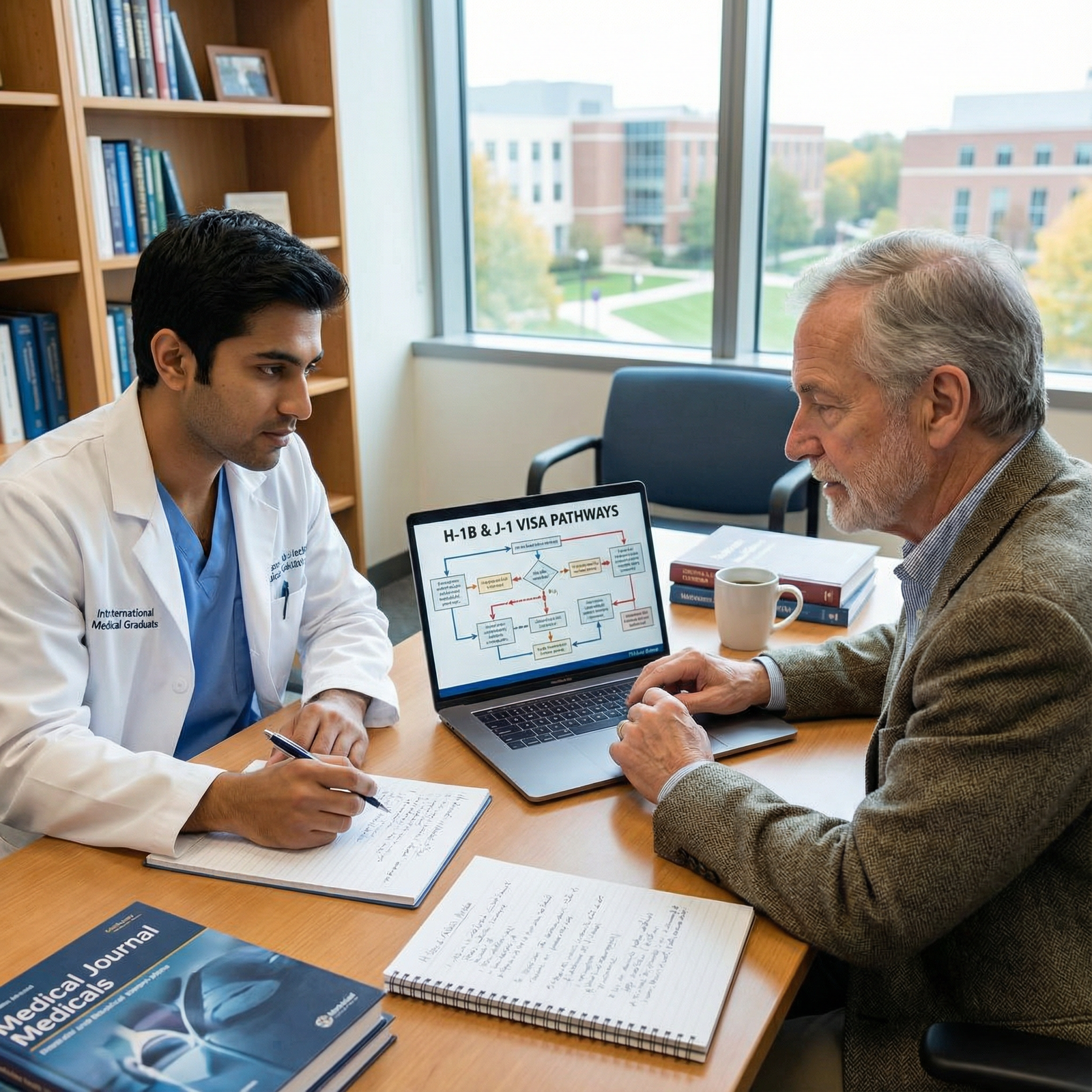
Understanding the Visa Landscape for Residency in Cleveland
Residency in Cleveland—home to nationally recognized institutions like Cleveland Clinic, University Hospitals, and MetroHealth—attracts a large number of international medical graduates (IMGs). For many, the question is not just “Can I match?” but also “How do I navigate visas for residency in Cleveland?”
This article focuses on visa navigation for residency programs in Cleveland, with special attention to:
- How Cleveland residency programs typically handle visas
- Core IMG visa options: J-1 vs H-1B
- Step-by-step guidance on residency visa planning
- Special considerations for specific program types (prelims, subspecialties, research)
The information here is educational and based on common practices as of late 2024—but always verify with the specific institution (e.g., Cleveland Clinic residency office) and your own legal counsel, as policies and laws can change.
Overview of Visa Categories for Residency in Cleveland
The Three Most Relevant Visa Categories
For most IMGs, three visa pathways come up in the context of Cleveland residency programs:
- J-1 Exchange Visitor (ECFMG-sponsored)
- H-1B Temporary Worker (Specialty Occupation)
- Green Card (Permanent Resident) or Other Immigrant Options
While some applicants may already have other statuses (e.g., F-1 with OPT, O-1, dependent visas), these three core categories shape how programs in Cleveland structure their visa policies.
1. J-1 Exchange Visitor Visa
The J-1 residency visa for IMGs is administered under ECFMG sponsorship, not directly by the hospital. This is by far the most common visa pathway for residency across the United States and is widely used by Cleveland residency programs.
Key features:
- You are sponsored by ECFMG (Educational Commission for Foreign Medical Graduates), not the hospital itself.
- The visa category is J-1 Alien Physician.
- Typically valid for the duration of ACGME-accredited training (with proper renewal each year).
- Subject to the two-year home-country physical presence requirement (the “2-year rule”), in most cases.
Why Cleveland programs like J-1 visas:
- Administrative burden is relatively low for the hospital; ECFMG handles much of the documentation.
- Predictable and standardized requirements.
- Wide familiarity among GME offices and program coordinators.
2. H-1B Specialty Occupation Visa
The H-1B for residency is an employment-based visa in which the hospital (e.g., Cleveland Clinic, University Hospitals, MetroHealth) becomes your sponsoring employer.
Key characteristics:
- Employer-sponsored; the residency program’s institution must file the petition.
- Requires you to have passed all required USMLE steps (including Step 3 in most states) before starting training.
- Typically valid up to 6 years total (including any prior H-1B time in the U.S.).
- Generally no 2-year home residence requirement, unlike the J-1.
H-1B is often especially interesting to IMGs who hope to:
- Transition directly to a green card or
- Avoid the complexity of J-1 waiver jobs after residency.
However, not all Cleveland residency programs sponsor H-1B due to cost, processing, and institutional policy limitations.
3. Green Card and Other Immigrant Status
Some IMGs may already be:
- U.S. permanent residents (green card holders)
- U.S. citizens (through naturalization or birth)
- Eligible for other immigrant categories (e.g., family-based, employment-based)
If you already hold a green card, you generally apply as a “no visa needed” applicant. Many programs in Cleveland will consider you essentially equivalent to a U.S. grad regarding visa issues.
J-1 vs H-1B: Core Differences for Cleveland Residency Programs
“J-1 vs H-1B” is one of the most searched comparisons by IMGs planning residency in Cleveland. Both visa options can lead to residency and fellowship training, but they differ significantly in logistics and long-term consequences.

Application and Sponsorship
J-1 (ECFMG-sponsored):
- Residency program offers you a position, not the visa itself.
- After you match, the GME office completes institutional forms for ECFMG.
- YOU apply through ECFMG’s OASIS/EVNet system for sponsorship.
- Requirements include primary source verification, USMLE results, contracts, and financials.
H-1B (employer-sponsored):
- Program must explicitly agree to sponsor H-1B. Not all Cleveland residency programs do this.
- The hospital works with immigration counsel to file an H-1B petition with USCIS.
- You provide documents, but the institution controls the petition.
- Timing is critical; delays can affect your ability to start on July 1.
Eligibility Requirements
J-1 residency visa requirements (simplified):
- Medical school credential verified by ECFMG.
- Valid ECFMG certification (for IMGs).
- Contract/offer from an ACGME-accredited program (e.g., a Cleveland Clinic residency).
- Adequate English proficiency.
- Proof of financial support (usually satisfied by the residency salary).
H-1B residency visa requirements (simplified):
- Valid USMLE Steps 1, 2 CK, and usually Step 3 passed before the H-1B start date.
- Employment offer from a residency program that sponsors H-1B.
- Hospital must meet prevailing wage and other labor condition requirements.
- You must not have exhausted your H-1B six-year limit.
Duration and Restrictions
J-1:
- Duration: length of accredited training + possible extensions (within ECFMG caps).
- Mandatory two-year home-country physical presence after completing training unless you obtain a J-1 waiver (through Conrad 30, VA, HHS, etc.).
- During training, you’re generally tied to that specific training program unless a formal transfer is approved.
H-1B:
- Generally, total of 6 years maximum, including any past H-1B time.
- No automatic requirement to return home for 2 years.
- Easier to transition to employment-based green card during or after residency/fellowship (especially if the institution is willing to sponsor).
Financial and Administrative Burden
In Cleveland, many programs—especially at large academic centers—prefer J-1 because:
- ECFMG handles much of the visa infrastructure.
- Lower legal and filing fee burden on the hospital.
- Simplified replication across dozens or hundreds of residents.
H-1B sponsorship is more common in:
- Fellowships than in categorical residency
- Certain high-demand specialties or
- Institutions with robust internal legal teams and a strategic interest in retaining IMGs long-term
Career and Long-Term Planning
J-1 path:
- Residency in Cleveland on J-1
- Possibly fellowship in Cleveland or elsewhere on J-1
- Post-training, you must either:
- Return to your home country for 2 years, OR
- Obtain a J-1 waiver job, usually in an underserved area (often non-urban, but sometimes urban underserved settings are eligible).
H-1B path:
- Residency (and possibly fellowship) on H-1B
- Transition to employment where:
- Employer extends H-1B, and/or
- Employer files for a green card (EB-2/EB-3), often via PERM labor certification.
Which is “better”?
There is no single best choice—your decision depends on:
- Your long-term goal (permanent settlement vs. return home vs. flexibility)
- Whether your target Cleveland residency programs support H-1B
- Your readiness (especially Step 3 timing)
- Your tolerance for the J-1 home country requirement and J-1 waiver route
How Cleveland Residency Programs Handle Visas in Practice
Cleveland is a major medical education hub with several large GME sponsors, including:
- Cleveland Clinic
- University Hospitals Cleveland Medical Center
- MetroHealth System (county/safety-net hospital)
- VA Medical Center affiliates
Each institution has its own formal policy on IMG visa options, and even within an institution, individual Cleveland residency programs may have some flexibility or additional requirements.
Typical Approaches in Cleveland
While specifics vary year to year, patterns often seen in Cleveland residency programs include:
- Broad support for J-1 visas (ECFMG-sponsored) across most ACGME-accredited residencies.
- Selective or limited H-1B sponsorship, often:
- Restricted to certain specialties
- Dependent on candidate profile (e.g., exceptional applicant, fully Step 3 ready)
- Constrained by institutional HR and legal policies
If you’re targeting a Cleveland Clinic residency, for instance, you may find that:
- Most programs are very familiar with J-1 and will list this on their websites.
- H-1B sponsorship may be available but limited to specific circumstances or programs and may not be guaranteed for all IMGs.
Where to Find Accurate, Current Visa Information
To avoid surprises, use a multi-step verification approach:
Program Websites (Official GME Pages)
- Check each program’s site under “Eligibility,” “International Medical Graduates,” or “Visa Information.”
- Look for explicit mentions like “We sponsor J-1 visas only” or “H-1B sponsorship considered on a case-by-case basis.”
FREIDA and ERAS Listings
- Many Cleveland residency programs list visa preferences on FREIDA (AMA’s residency database) and in ERAS program descriptions.
- Confirm whether they accept J-1, H-1B, both, or no visa sponsorship.
Email the Program Coordinator or GME Office
- Ask narrowly focused, professional questions:
- “Do you sponsor J-1 visas through ECFMG for international medical graduates?”
- “Does your program currently sponsor H-1B visas for residency trainees?”
- Avoid long autobiographical emails; keep it concise and specific.
- Ask narrowly focused, professional questions:
Talk to Current and Recent Residents
- Reach out via LinkedIn, alumni networks, or program social media.
- Ask directly: “Which visa types are your current IMG residents on?”
Example: Evaluating Visa Options for a Hypothetical Cleveland Internal Medicine Program
Imagine you are an IMG applying to an Internal Medicine residency in Cleveland. You discover:
- Program website states: “We sponsor J-1 visas through ECFMG.”
- No mention of H-1B on public pages.
- Current residents from abroad are listed as IMGs from various countries.
Interpretation:
- You can assume J-1 is supported and common.
- Lack of explicit H-1B information suggests:
- H-1B is either not offered or extremely limited, or
- Only considered in exceptional or previously arranged cases.
Action:
- Plan primarily around J-1, unless you confirm by email that H-1B is a real, standard option.
- If your long-term goal heavily relies on H-1B, diversify your applications to include programs across the U.S. that openly sponsor H-1B for residency.
Step-by-Step Visa Navigation for Residency in Cleveland

Step 1: Clarify Your Status and Goals Early
Before you start your ERAS applications, ask yourself:
- What is my current status? (Abroad, F-1 in U.S., other visa, etc.)
- Am I willing to accept a J-1 with a 2-year home requirement?
- Is my long-term plan to settle in the U.S. permanently, or am I open to returning home or working in underserved areas under a waiver?
If you’re firmly committed to a permanent U.S. career path and do not want the J-1 home-country requirement, you may prioritize:
- Programs in Cleveland and across the U.S. that explicitly support H-1B.
- Taking and passing USMLE Step 3 early to be H-1B eligible.
Step 2: Research Cleveland Programs’ Visa Policies Thoroughly
Create a spreadsheet for Cleveland residency programs, including:
- Program name and institution (e.g., Cleveland Clinic Neurology, MetroHealth Internal Medicine)
- Stated visa policy:
- J-1 only
- J-1 and H-1B
- No visa sponsorship
- Notes from any direct communication with program staff
- Presence of IMGs among current residents
Use this to guide:
- How many programs in Cleveland you apply to
- Whether you should treat J-1 or H-1B as your primary path
- Whether you need to expand your geographic scope beyond Cleveland
Step 3: Decide on J-1 vs H-1B Strategy
If you’re comfortable with J-1:
- Focus on strong Cleveland programs that clearly accept J-1 (e.g., many large academic centers).
- Start learning early about J-1 waiver options (e.g., Conrad 30 in Ohio or neighboring states) so the post-residency transition doesn’t catch you off guard.
If you strongly prefer H-1B:
- Schedule USMLE Step 3 as early as feasible so results are available before July 1.
- Identify Cleveland residency programs that historically sponsor H-1B:
- Look for alumni profiles stating “Current status: H-1B” or mention of H-1B in program FAQs.
- Balance your list with non-Cleveland programs that are known for H-1B sponsorship, in case local options are limited.
Step 4: Navigate ERAS and Interviews with Visa in Mind
In your ERAS application:
- Indicate your current citizenship and visa needs accurately.
- If asked about visa preference:
- You can state: “Open to both J-1 and H-1B; aware of the requirements for each,” if that is genuine.
- Avoid sounding rigid or inflexible, unless your situation absolutely demands a specific visa.
During interviews with Cleveland residency programs:
- If the program’s visa policy is unclear, ask politely near the end:
- “I’m an international medical graduate and will require visa sponsorship. Could you clarify which visa types your program currently supports for residents?”
- Do not make visa status the main theme of the interview; focus mostly on your fit and strengths, then confirm visa details succinctly.
Step 5: After the Match—Visa Processing Timeline
Once you match into a Cleveland residency program:
For J-1:
- The institution registers you with ECFMG as a trainee.
- You log into OASIS/EVNet and submit:
- Identification documents
- Medical diploma and translations (if applicable)
- Sponsorship application forms
- ECFMG reviews your application and, upon approval, issues:
- Form DS-2019
- You schedule your visa interview at a U.S. consulate (if outside the U.S.) and apply for the J-1 visa stamp.
ECFMG timelines are generally predictable, but:
- Start early and respond quickly to any ECFMG requests.
- Keep your program’s GME office informed of your progress.
For H-1B:
- The hospital’s HR or legal team files a Labor Condition Application (LCA).
- They prepare an H-1B petition (Form I-129) to USCIS, supported by:
- Your license-in-training or state eligibility
- USMLE Step 3 documentation
- Employment contract
- If you are abroad, you need consular processing once the petition is approved:
- Attend an H-1B visa interview
- Enter the U.S. in H-1B status to begin residency
H-1B processing can be time-sensitive; some institutions may use premium processing to avoid delayed starts.
Special Considerations for Cleveland IMGs
Prelim-Only and Transitional Year Positions
If you are pursuing:
- Preliminary surgery or medicine
- Transitional year programs in Cleveland
Pay particular attention to:
- Whether they sponsor J-1 or H-1B for short-duration programs (some only support J-1).
- How your next step (advanced residency) will handle visas:
- You might end up switching sponsors or visa types.
Example: You complete a transitional year in Cleveland on a J-1, then obtain an advanced residency elsewhere on an H-1B or another J-1 under the same ECFMG sponsorship.
Combined Programs and Fellowships
Some Cleveland residency programs are:
- Combined (e.g., Med-Peds, Internal Medicine–Pediatrics)
- Lead directly into a fellowship pipeline at the same institution
For combined or longer training tracks, consider:
- J-1 maximum duration—ECFMG usually accommodates multi-year training, but there are caps.
- H-1B 6-year limit—residency plus fellowship (e.g., 3 + 3 years) may approach or exceed this limit if you had prior H-1B time.
Research Tracks and Visa Status
Cleveland’s academic centers often offer:
- Research years or physician–scientist tracks
- Funded research positions linked to residency
If you consider adding a research year:
- On J-1, confirm that ECFMG will sponsor such research activities under the “alien physician” category or whether a separate J or H is required.
- On H-1B, verify whether:
- The research role is under the same employer and job description, or
- A new petition/amendment is needed.
Always coordinate with:
- Your program director
- The GME office
- The institution’s international office/immigration counsel
before making changes that might impact your residency visa status.
Practical Tips for IMGs Targeting Cleveland Programs
Start visa research 12–18 months before Match Day.
Understand which Cleveland residency programs align with your visa priorities.Be realistic about H-1B availability.
Many top-tier programs—including some in Cleveland—may prefer or restrict to J-1 in residency but be more open for H-1B in fellowship.Maintain excellent documentation.
Keep digital, clearly labeled copies of:- Passport and prior visas
- ECFMG certificate
- USMLE score reports
- Medical diploma and transcripts
Understand Ohio’s role in J-1 waivers.
If you train in Cleveland on a J-1 and later seek a waiver:- Explore Ohio’s Conrad 30 program and those in neighboring states.
- Some Cleveland graduates ultimately work in underserved areas of Ohio as part of their waiver jobs.
Leverage Cleveland’s institutional support.
Cleveland’s major training hospitals typically have:- Dedicated GME offices
- Experienced international offices
Use them: ask questions early about timelines, forms, and any unique institutional rules.
FAQs: Visa Navigation for Residency Programs in Cleveland
1. Do Cleveland residency programs sponsor visas for IMGs?
Most large academic Cleveland residency programs, including those at Cleveland Clinic, University Hospitals, and MetroHealth, do sponsor visas for IMGs, typically the J-1 residency visa via ECFMG. H-1B sponsorship varies by institution and specialty and is often more limited. Always confirm directly with each program.
2. Is H-1B commonly available for residency in Cleveland, or is it mainly J-1?
Across Cleveland, J-1 is more commonly supported for residency. Some programs may offer H-1B in specific circumstances (often requiring USMLE Step 3 and institutional approval). Fellowship programs may be more flexible with H-1B than categorical residency programs, but this is institution-specific.
3. If I match to a Cleveland Clinic residency on a J-1, can I later switch to H-1B?
Switching from J-1 to H-1B during or after training is not straightforward due to the J-1 two-year home-country requirement. In most cases, you must either:
- Fulfill the 2-year home residence, or
- Obtain a J-1 waiver before you can hold H-1B or immigrant status.
Some narrow exceptions exist, but you should not count on being able to “simply switch” from J-1 to H-1B without dealing with the 2-year rule.
4. I am currently on F-1 (with or without OPT) in the U.S. How does this affect my residency visa options in Cleveland?
Your F-1 status does not automatically turn into a residency visa. For residency in Cleveland, you will still need:
- A J-1 through ECFMG or
- An H-1B sponsored by your residency program.
However, being in the U.S. already can help with timing (e.g., scheduling exams, gathering documents) and may simplify travel logistics. You must still follow all steps for a residency-specific visa.
Visa navigation for residency programs in Cleveland is a crucial strategic component of your Match journey. By understanding J-1 vs H-1B, carefully researching Cleveland residency programs, and planning your exams and documents early, you can align your immigration pathway with your training and long-term career goals in Northeast Ohio and beyond.