
Residency in clinical informatics sits at the intersection of medicine, data, and technology—and for international medical graduates (IMGs), it also sits at the intersection of immigration law and graduate medical education. Understanding visa pathways early is critical if you hope to pursue a clinical informatics fellowship or integrated clinical informatics training in the United States.
This guide walks you through visa navigation for residency with a specific focus on clinical informatics, but most principles apply to other specialties as well. You’ll find strategy, timelines, and practical tips tailored to IMGs planning a tech-focused medical career in the U.S.
Understanding the Pathway: How Clinical Informatics Fits into Residency and Visas
Before getting into J-1 vs H-1B or IMG visa options, it helps to be very clear on where clinical informatics fits in your training path—because your visa strategy should match your training road map.
What is Clinical Informatics in the Residency Context?
In the U.S., clinical informatics is a board-certified subspecialty that focuses on:
- Designing and improving electronic health records (EHRs)
- Using health data to optimize care and population health
- Implementing decision-support tools, AI, and quality-improvement systems
- Bridging clinicians, IT teams, and administrators
For physicians, clinical informatics is usually pursued in one of two ways:
Traditional Path: Core Residency → Clinical Informatics Fellowship
- Complete a primary specialty (e.g., Internal Medicine, Pediatrics, Pathology, Emergency Medicine)
- Then complete a 2-year ACGME-accredited clinical informatics fellowship
- Many programs offer combined clinical and informatics time, with protected informatics projects
Integrated or “Parallel” Informatics Path During Residency
- Some residency programs offer tracks, electives, or scholarly concentrations in clinical informatics
- You still complete a standard residency visa pathway, then apply for fellowship or informatics-heavy roles later
Whichever route you take, your initial visa is nearly always tied to your core clinical residency, not your eventual clinical informatics fellowship. That’s why your residency visa decisions (J-1 vs H-1B) can significantly affect how easy it is to pursue a clinical informatics fellowship or work in health IT long-term.
How Clinical Informatics Interests Affect Visa Planning
Your informatics goals influence visa strategy in several ways:
- You may prefer H-1B if you want more flexibility for:
- Non-clinical paid work (e.g., advising startups, industry collaboration)
- Earlier transitions into health IT jobs or academic roles
- You may accept J-1 if:
- Your top priority is matching into a strong clinical residency, regardless of visa type
- You’re open to working in underserved areas or doing a waiver job after training
- You plan to complete residency + fellowship and return home or work outside the U.S.
You don’t need to decide everything on day one, but having a rough plan (e.g., “I want to do Internal Medicine → Clinical Informatics Fellowship → health system leadership role”) helps you weigh J-1 vs H-1B trade-offs much more clearly.
Core Visa Options for IMGs Entering Residency in the U.S.
Most IMGs entering U.S. residency use one of two main visas: J-1 or H-1B. Understanding their structure, benefits, and limitations is essential if you are aiming for a future in clinical informatics or health IT.
The J-1 Visa for Residency
The J-1 exchange visitor visa for physicians is sponsored primarily by the Educational Commission for Foreign Medical Graduates (ECFMG). It is specifically designed for graduate medical education and is the most common route for IMGs in residency.
Key Features of the J-1
- Primary sponsor: ECFMG (not the residency hospital itself)
- Duration: Up to 7 years of clinical training (residency + fellowship), with some exceptions
- Employment restriction: You can only work at training sites approved in your ECFMG/DS-2019 documentation
- Research/teaching related to your program may be allowed, but external paid work is heavily restricted
The Two-Year Home Residency Requirement
The major complication with the J-1 is the two-year home-country physical presence requirement (often called the “J-1 home requirement”):
- After finishing J-1-sponsored training, you must return to your home country for a cumulative 2 years, unless you get a formal waiver
- During this period, you cannot:
- Change directly to H-1B or permanent residency (green card) status inside the U.S.
- Obtain most U.S. work visas from abroad (with limited exceptions)
For aspiring clinical informatics physicians, this rule affects:
Timing of your clinical informatics fellowship
- J-1 can generally cover both core residency and fellowship within the 7-year limit
- But after all training ends, you’ll either:
- Return home for 2 years, or
- Secure a J-1 waiver job (often in underserved or rural settings)
Transition to health IT careers or leadership roles in the U.S.
- If you need an H-1B for an informatics-heavy attending role, you must have the J-1 obligation satisfied or waived first
Waiver Options After Training
Common J-1 waiver pathways include:
Conrad 30 waivers:
- Sponsored by U.S. states for physicians working in designated underserved areas
- Typically requires a 3-year commitment on an H-1B
- Often clinically intense jobs; some may allow informatics or quality-improvement components, but pure informatics roles are rare
VA or federal agency waivers (e.g., Department of Health and Human Services)
- Linked to specific service needs; may include more research or informatics in certain institutions
Hardship or persecution waivers
- Based on proving extreme hardship or risk if forced to return home
- Lengthy, complex, and not a primary planning strategy
If you are strongly drawn to a health IT–focused career immediately after training, the structure of J-1 plus waiver jobs can slow your trajectory into purely informatics roles. Many IMGs accept this in exchange for the greater availability of J-1 residency positions.
The H-1B Visa for Residency
The H-1B specialty occupation visa is an employment-based visa. For residency and fellowship, your hospital or university must be willing and able to sponsor H-1B, which is more complex than J-1 sponsorship.
Key Features of the H-1B
- Employer-specific: You are tied to a specific employer and role
- Initial duration: Up to 3 years, renewable to a maximum of 6 years in most cases
- No two-year home requirement like the J-1
- Dual intent: You can pursue permanent residency (a green card) while on H-1B
For a clinical informatics–minded physician, H-1B allows:
- Cleaner transitions from residency → fellowship → attending roles
- More straightforward pathways to long-term clinical + informatics roles in the U.S.
- Flexibility for non-clinical health IT roles later (e.g., industry, digital health companies), assuming appropriate visa/employer support
H-1B for Residency: Practical Challenges
Not every program offers H-1B for residency. Barriers include:
- Institutional policies (some hospitals simply don’t sponsor H-1B for residents)
- Added legal costs and paperwork
- Concerns about timing (H-1B approval must line up with residency start dates)
- USMLE requirement: Many H-1B residency sponsors insist on passing all USMLE Steps (including Step 3) before start; some require Step 3 before even ranking an IMG.
For IMGs who want H-1B from day one, this means:
- You should aim to complete Step 3 before the Match, or at least before contract finalization
- You may need to specifically target programs known to sponsor H-1B for residents (fewer in number, often more competitive)
Another nuance: Many academic medical centers are cap-exempt H-1B employers (because they are universities or non-profits linked to universities). This bypasses the standard H-1B lottery used in industry. That’s good news if you later want a clinical informatics fellowship at a university-affiliated hospital that can continue or extend your H-1B within the 6-year limit.
J-1 vs H-1B: Strategic Comparison for Clinical Informatics–Focused IMGs
For IMGs thinking about clinical informatics, the J-1 vs H-1B decision affects not only your residency visa but your long-term health IT training and career trajectory.
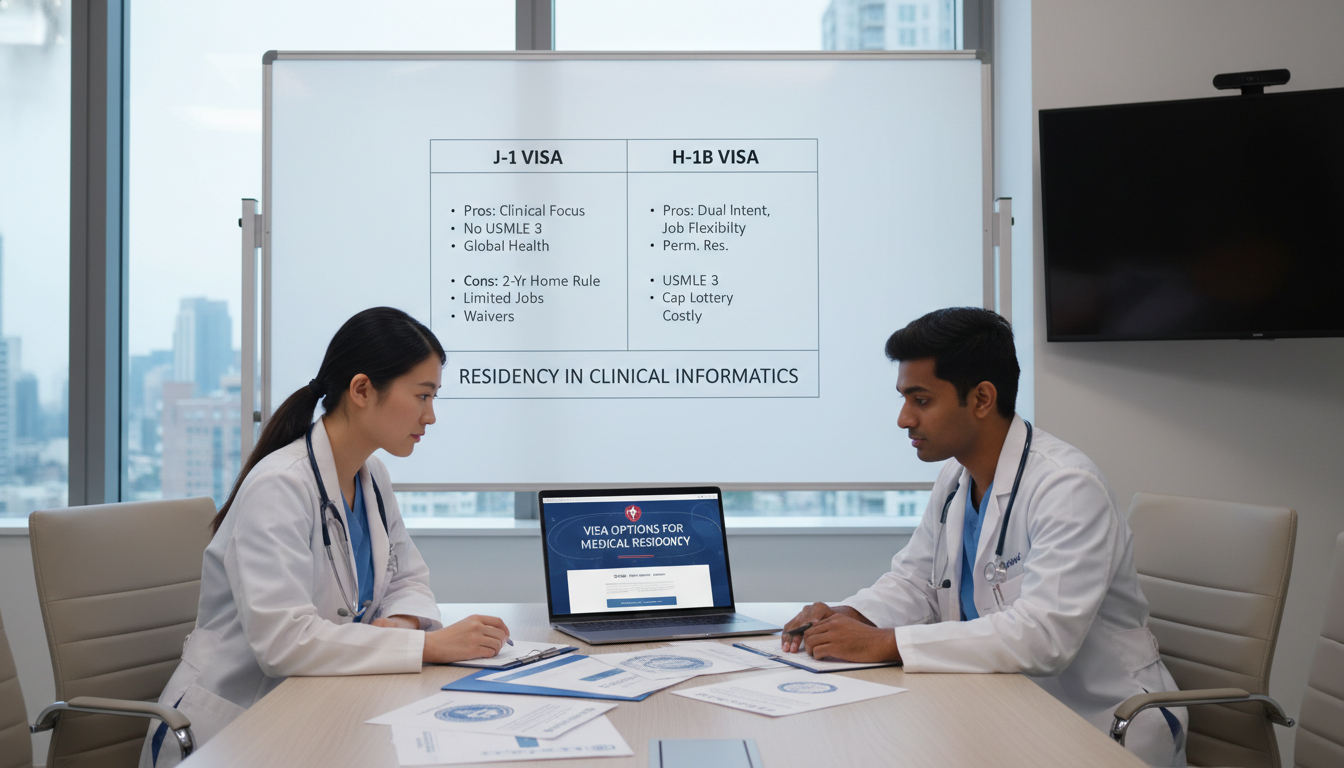
Training Path Flexibility
J-1:
- Easier to obtain for residency; many programs default to J-1 for IMGs.
- Typically can cover:
- 3 years Internal Medicine, Pediatrics, or Family Medicine
- 3–4 years in specialties like General Surgery or Anesthesiology
- Plus 1–3 years of fellowships (including clinical informatics) within the 7-year cap
- Good for those planning: Residency → Fellowship → Possibly return home
H-1B:
- Often more challenging to secure, but strategically powerful.
- Must fit all U.S. training within a 6-year H-1B cap, unless:
- You start your H-1B later in residency, or
- You extend through green card processes or specific exceptions
- Works well for:
- Shorter residency (e.g., 3 years Internal Medicine) + 2-year clinical informatics fellowship
- Strong candidates who can complete Step 3 early and target H-1B-friendly institutions
Long-Term Career in Health IT and Clinical Informatics
If your goal is to build a career in the U.S. as a physician–informatician, consider how visas affect your first attending role:
On J-1 + waiver:
- Your first job is often heavily clinical in an underserved setting
- You may still participate in hospital EHR committees, quality-improvement, or population health projects
- Purely non-clinical or low-clinical informatics jobs are less common in waiver-eligible roles
- After 3 years, you can transition more easily to informatics-heavy positions and possibly H-1B or green card
On H-1B:
- You can directly take an attending or hybrid role that blends:
- 0.5–0.8 FTE clinical care
- 0.2–0.5 FTE clinical informatics, analytics, or digital health leadership
- Employers may sponsor your green card while you work in a combined clinical + informatics capacity
- You can move more quickly into leadership roles in clinical decision support, EHR optimization, or health system innovation
- You can directly take an attending or hybrid role that blends:
Side Projects, Research, and Industry Collaboration
Many future clinical informatics physicians are excited by opportunities such as:
- Collaborating with startups on decision-support tools
- Building predictive models with industry partners
- Participating in health IT consulting or advisory boards
J-1 limitations:
- Strict rules about outside employment; even “side gigs” are generally not permitted
- Research and teaching must usually be part of your structured training program
- If you want to do informatics research at your training institution, ensure:
- It’s clearly recognized as part of your residency or fellowship
- It is documented within ECFMG’s framework and program policies
H-1B flexibility:
- Still employer-specific, but:
- You may have more legal pathways to formal collaborations if structured through your main employer
- Some institutions may allow defined roles (e.g., protected non-clinical time) as part of your contracted job functions
- Any external work still requires careful legal guidance—H-1B also does not freely allow outside “moonlighting” without proper authorization.
Typical Profiles: Which Visa Fits Whom?
Candidate A: “Clinician-Educator with Informatics Interest”
- Wants to become a great clinician, then add informatics on top
- May return to home country or is flexible geographically
- Priority: Match into strong clinical program, perhaps do fellowship later
→ Often fine with J-1, focusing on matching first and optimizing informatics exposure later.
Candidate B: “Health IT–Focused Future Leader”
- Sees themselves in a U.S. health system or tech company leading EHR, analytics, or digital transformation
- Committed to staying long-term in the U.S. if possible
- Willing to take extra steps (Step 3 early, selective program targeting)
→ H-1B is usually more aligned with this long-term plan, if you can secure it.
Practical Strategies: Planning Visas Around Clinical Informatics Goals
Your visa options are influenced by your academic strength, exam timeline, connections, and how early you begin planning.

Step 1: Clarify Your Training and Career Roadmap
Before focusing on specific IMG visa options, define:
- Your likely core specialty: Internal Medicine, Pediatrics, Pathology, etc.
- Whether you want a formal clinical informatics fellowship or just strong informatics exposure via electives and projects.
- Your ideal first attending job:
- Clinical-heavy with informatics on the side?
- Hybrid clinical + informatics?
- Mostly informatics/health IT with some clinic?
Writing this out in 1–2 paragraphs for yourself can make visa decisions more concrete.
Step 2: Decide How Much You Want to Prioritize H-1B
Ask yourself:
- “If it significantly reduces my list of target programs, am I still committed to pursuing H-1B?”
- “Am I realistically able to complete USMLE Step 3 early enough?”
- “Does my profile (scores, research, communication skills) make me competitive for the smaller pool of H-1B-sponsoring programs?”
If the answer is no, focusing primarily on J-1 possibilities and maximizing informatics within that framework may be the more practical choice.
Step 3: Align Exams and Application Strategy
For H-1B–oriented applicants:
- Take USMLE Step 3 early (ideally before Match or soon after the Match list deadline).
- In ERAS:
- Explicitly mention that you have completed or scheduled Step 3.
- Highlight any U.S. clinical experience, strong letters, and informatics-related projects.
- Use program websites, forums, and direct emails to identify which programs:
- Have historically sponsored H-1B for residents
- May be open to H-1B for highly qualified IMGs
For J-1–oriented applicants:
- Focus on:
- Strong Step 1/Step 2 CK scores
- U.S. clinical experience and letters
- Clear, coherent interest in your chosen specialty
- Understand ECFMG’s requirements and timeline for:
- Certification
- DS-2019 issuance
- J-1 visa interviews
Step 4: Target Programs with Clinical Informatics Strength
Regardless of visa type, you can strategically select programs that support your informatics growth:
- Look for residency programs that:
- Are at institutions with a clinical informatics fellowship
- Have faculty who are board-certified in clinical informatics
- Participate in health IT research, population health, or AI in medicine projects
- Use advanced EHR implementations or are Epic/other vendor development sites
When you interview:
- Ask how residents can:
- Join EHR optimization committees
- Participate in data analytics projects
- Work with the Chief Medical Information Officer (CMIO) or informatics teams
These opportunities exist independent of your visa, but being at an informatics-rich institution can also make them more open to creative roles later, including informatics-oriented fellowship positions and hybrid faculty roles on H-1B.
Step 5: Consider How Fellowship Will Fit Into Your Visa
If you intend to pursue a clinical informatics fellowship:
On J-1:
- Check total training years vs the 7-year cap
- Coordinate early with ECFMG if your combined residency + fellowship will approach the limit
- Understand that you remain in J-1 status and that your home-residency requirement applies after all J-1 training is complete
On H-1B:
- Confirm that:
- The fellowship institution can sponsor H-1B (many academic centers can)
- Your H-1B years for residency plus fellowship still fit within the 6-year cap
- If not, consider:
- Delaying H-1B start (e.g., initial J-1 then change later—very complex and rare)
- Starting green card processes early in an attending job to extend beyond 6 years
- Confirm that:
Coordination between GME offices, program directors, and immigration attorneys becomes especially important when planning a sequence of residency → clinical informatics fellowship → attending role on H-1B.
Special Considerations: Visa Issues Unique to Clinical Informatics Careers
Clinical informatics intersects with health systems, academia, and industry, which can create particular complexities for IMGs.
Health IT Training Outside Traditional GME
You may encounter opportunities like:
- Hospital-based analytics fellowships that are non-ACGME
- Health IT internships or quality-improvement roles
- Industry fellowships with EHR vendors or digital health start-ups
Be careful: these may not qualify as standard graduate medical education (GME) and might not be compatible with J-1 clinical training visas. Even on H-1B, switching to a purely non-clinical industry role can require:
- New H-1B petition (and possibly entering the general H-1B lottery if your new employer is not cap-exempt)
- Careful timing to avoid gaps in status
If you’re interested in such roles, discuss early with:
- Your program leadership (for academic integration or joint appointments)
- An experienced immigration attorney for planning your path
Telemedicine, Remote Work, and Cross-Border Health IT
Many clinical informatics physicians do some or all work remotely, particularly in analytics and decision-support design. Visa rules, however, are location- and employer-specific:
- J-1: You are restricted to approved training sites; remote work for external entities is effectively not allowed.
- H-1B: Your work location (including remote work sites) must be covered by the employer’s Labor Condition Application (LCA); casual cross-border remote work is not straightforward.
For IMGs, it is important not to assume that remote health IT jobs outside your sponsoring institution are automatically allowed under your residency visa.
Frequently Asked Questions (FAQ)
1. Is it realistically possible to get H-1B for residency as an IMG, or should I just expect J-1?
It is possible, but not common. Many IMGs successfully match and train on H-1B, especially in Internal Medicine, Pathology, and certain other specialties at large academic centers. The keys are:
- Completing USMLE Step 3 early
- Having a strong overall application
- Targeting programs that have a track record of H-1B sponsorship
However, a large portion of IMGs train on J-1 because more programs support it, and some institutions simply do not sponsor H-1B at the residency level. If your primary goal is to match somewhere solid rather than limit yourself to a smaller subset of programs, you may need to remain flexible and open to J-1.
2. If I do residency and clinical informatics fellowship on J-1, can I still eventually work in U.S. health IT?
Yes, but you’ll need to navigate the J-1 home requirement or a waiver first. A typical path might look like:
- J-1 for residency + clinical informatics fellowship
- Obtain a J-1 waiver job (usually a clinically focused role, often in an underserved location) on H-1B
- Work the required 3 years
- Transition to a more informatics-heavy role after the waiver obligation is complete
During the waiver period, you may still do informatics-related work through your employer (quality improvement, EHR design, analytics), but the primary job is usually clinical. Long-term, many physicians successfully move into predominantly informatics and health IT leadership roles.
3. Can I switch from J-1 to H-1B for my clinical informatics fellowship?
In most situations, not without addressing the J-1 two-year home requirement. If you have been in the U.S. for clinical training on J-1, you cannot change directly to H-1B (e.g., for fellowship) unless:
- You first obtain a J-1 waiver, or
- You fulfill the two-year home-country physical presence requirement
Because of this, most residents who start training on a clinical J-1 remain on J-1 for fellowship as well. If you’re certain you want an H-1B–based career path, it is better to aim for H-1B from the start of residency rather than planning a mid-training switch.
4. I’m an IMG highly focused on clinical informatics. Should I sacrifice program prestige to get H-1B?
This depends on your priorities and competitiveness. A balanced approach:
- Aim high: apply to excellent programs that also sponsor H-1B if you’re a strong candidate with early Step 3.
- Maintain flexibility: also apply to well-respected programs that only sponsor J-1, especially if they have robust clinical informatics fellowship or health IT activities.
- Consider this rule of thumb:
- For a borderline or modest applicant, it may be better to accept J-1 at a stronger program where you’ll get excellent training and robust informatics exposure.
- For a very strong applicant committed to long-term U.S.–based health IT leadership roles, prioritizing H-1B may make strategic sense, even if it narrows your program options.
Discuss options with mentors, and, if possible, connect with current IMGs in clinical informatics fellowships to learn how their visa choices impacted their paths.
Navigating residency visas as an IMG interested in clinical informatics requires more than just learning the difference between J-1 vs H-1B—it requires aligning your immigration strategy with your long-term clinical and health IT career goals. By planning early, understanding the structure of clinical informatics training, and targeting programs that support both your visa needs and informatics ambitions, you can build a sustainable pathway to a rewarding physician–informatician career in the United States.