
Community hospitals have long been doors of opportunity for international medical graduates (IMGs). They are often more flexible, more teaching‑oriented on the wards, and sometimes more willing to consider diverse applicants. Yet for many IMGs, the biggest barrier is not clinical ability—it’s navigating the complex world of U.S. visas.
This article walks you step‑by‑step through visa navigation for residency in community hospital programs, with a focus on J‑1 vs H‑1B, realistic IMG visa options, and practical strategies to improve your chances of securing both a position and the visa that fits your goals.
Understanding the Community Hospital Residency Landscape
Community hospitals occupy a unique space in U.S. graduate medical education. Understanding their structure and constraints will help you understand their visa policies.
What is a Community Hospital Residency?
A community hospital residency (or community-based residency) generally means:
- The primary training site is a non-university, often smaller or mid-sized hospital.
- Many are affiliated with a university medical school but are not the main academic/tertiary center.
- Patient population is often local, diverse, and “real-world” in terms of community pathology.
- Teaching faculty may split time between clinical care and teaching, often with a strong emphasis on service and continuity of care.
Why Visa Policies Differ in Community Settings
Community hospitals may be more constrained than large academic centers in several ways:
- Limited administrative infrastructure
Smaller GME offices; sometimes no in-house legal counsel for immigration matters. - Budget sensitivity
The cost of H-1B filing, attorney fees, and compliance can be a deterrent. - Risk aversion
Some sponsoring organizations (especially large health systems or religiously affiliated systems) take a conservative approach and limit to a single visa category (often J‑1 only). - Affiliation-driven rules
A community program tied to a particular university may follow the university’s GME and visa policies, even if the hospital itself is otherwise flexible.
These realities directly affect which IMG visa options are feasible and how aggressively programs will sponsor them.
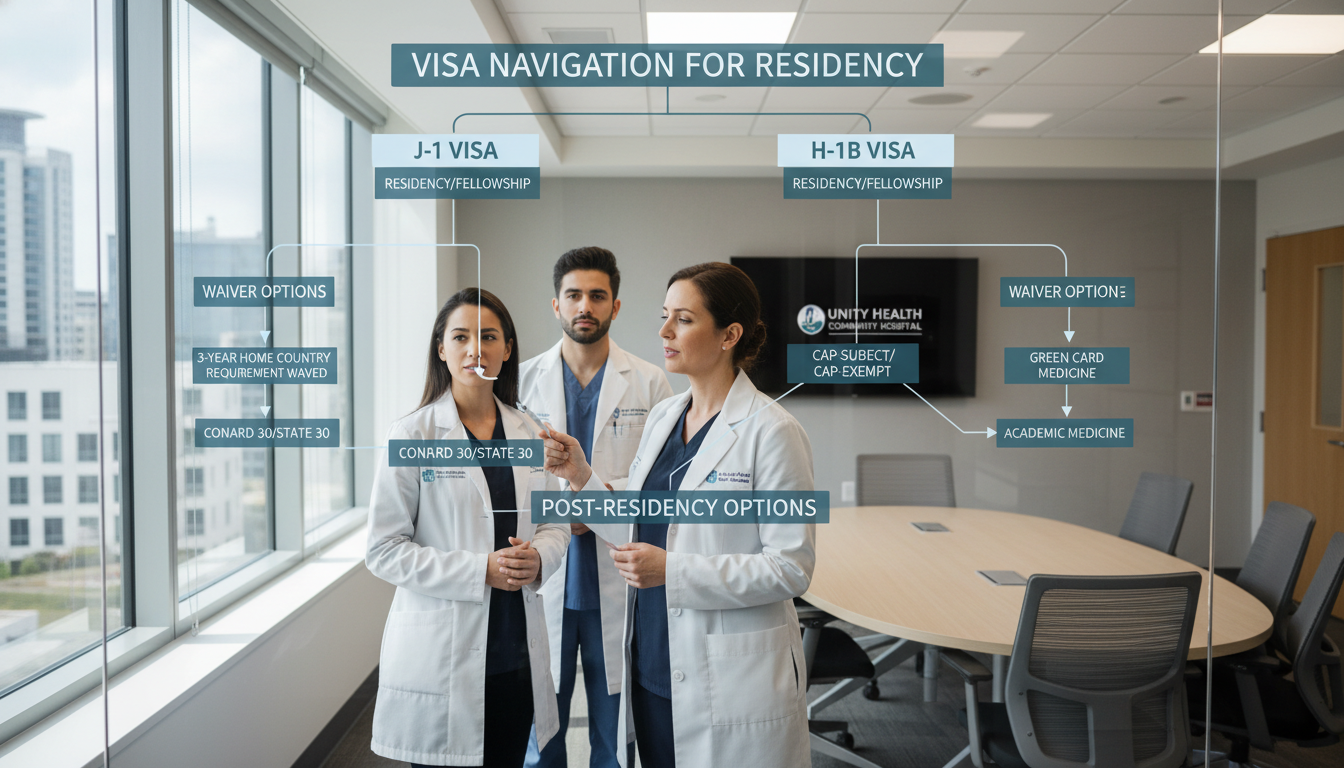
Core Visa Pathways: J‑1 vs H‑1B for Community Hospital Programs
For residency, the two dominant visa categories are J‑1 (Exchange Visitor – Physician) and H‑1B (Specialty Occupation – Physician). Some IMGs may also have eligibility for other statuses (e.g., green card, EAD via spouse), but for most applicants, the key question is: J‑1 vs H‑1B.
The J‑1 Physician Visa: The Default Pathway for Many IMGs
For the majority of IMGs, especially in internal medicine, pediatrics, and family medicine, the J‑1 visa is the most commonly available option.
Key features of the J‑1 visa for residency:
Administered via ECFMG:
ECFMG sponsors the visa; your community hospital program collaborates but does not carry full immigration burden.Requirements include:
- Valid ECFMG certification at the time of start date.
- A contract or official offer letter from an accredited residency program.
- Proof of financial support (usually your GME stipend).
- Adequate English proficiency (verified via USMLE/ECFMG processes).
- Home country residency and other ECFMG rules.
Duration:
- Generally granted in one-year increments for the length of approved training.
- Maximum eligibility depends on specialty and training duration; extensions require ECFMG approval.
Key restriction – 2-year home residence requirement (212(e)):
- Most J‑1 physicians must return to their home country for two years after completion of training before they can:
- Apply for H‑1B or L visas, or
- Apply for permanent residency (green card)
- This is often waived via a J‑1 waiver (e.g., Conrad 30, VA, or hardship/persecution waivers) in underserved areas, especially for primary care and psychiatry.
- Most J‑1 physicians must return to their home country for two years after completion of training before they can:
Why community hospitals like the J‑1:
- Lower institutional burden: ECFMG manages much of the immigration oversight.
- Clear, standardized process with established timelines.
- Predictable requirements and well-known to GME offices.
- Aligns well with service to underserved populations, which many community programs provide, facilitating later J‑1 waiver jobs in similar regions.
Common limitations:
- Cannot generally moonlight outside of the program’s training activities.
- Your spouse works under J-2 EAD (if applicable), which may take time to process.
- Future portability is more complex—you typically need a J‑1 waiver job after training before you can change to H‑1B or start a green card process.
The H‑1B Visa: Attractive but Often Less Accessible at Community Hospitals
The H‑1B is a work visa for specialty occupations and can be used for residency and fellowship. Many IMGs prefer this route because it avoids the J‑1’s two-year home requirement.
Key features of H‑1B for residency:
Employer-sponsored:
The community hospital (or university partner) must:- Act as the H‑1B petitioner.
- File a Labor Condition Application (LCA).
- Submit H‑1B petition with USCIS, often via an immigration attorney.
Requirements include:
- Passing USMLE Step 3 before the petition filing (a key timing challenge).
- Valid ECFMG certificate.
- State medical license or training license eligibility (varies by state).
- Employer’s willingness to manage costs (filing fees, attorney fees).
Duration:
- Initial approval up to 3 years, renewable up to a total of 6 years (sometimes more in green card processes).
- Time in H‑1B residency counts toward the 6-year cap.
Cap-exempt vs. cap-subject:
- Many residency programs (especially those affiliated with nonprofit educational institutions) are cap-exempt, meaning:
- They can file at any time of year.
- They are not subject to the national H‑1B lottery.
- Some independent community hospitals, if NOT nonprofit and not closely affiliated with an academic institution, may be cap-subject, which complicates timing and feasibility.
- Many residency programs (especially those affiliated with nonprofit educational institutions) are cap-exempt, meaning:
Advantages of H‑1B:
- No J‑1 2-year home residency requirement.
- Greater flexibility for long-term U.S. career planning (easier to transition directly to employment after residency).
- Spouse on H‑4 may obtain EAD in certain circumstances (e.g., if you are in a green card process), though this is more complex than J‑2 work authorization.
Why many community hospitals hesitate to sponsor H‑1B:
- Cost and administrative burden:
Filing fees and attorney costs can be significant, and small GME offices may not have bandwidth. - Step 3 requirement:
Many IMGs don’t have Step 3 completed early enough to meet residency start deadlines. - Institutional policies:
Some sponsoring organizations adopt a “J‑1 only” stance system-wide to keep processes uniform.
Comparing J‑1 vs H‑1B for Community-Based Residency Programs
Understanding J‑1 vs H‑1B in the specific context of community hospital residency will help you set realistic expectations and strategies.
Side-by-Side Comparison
| Factor | J‑1 (ECFMG Sponsored) | H‑1B (Employer Sponsored) |
|---|---|---|
| Who sponsors? | ECFMG as visa sponsor; hospital hosts | Hospital/university files with USCIS |
| Two-year home requirement? | Yes, in most cases | No |
| Step 3 required before start? | No | Yes (for petition) |
| Administrative burden on program | Lower | Higher |
| Common in community hospitals? | Very common | Variable, often limited |
| Moonlighting | Restricted | Depends on program/state; usually more flexibility with proper authorization |
| Long-term U.S. career path | Requires waiver or 2-year return | More direct route to job/green card |
Practical Takeaways for IMGs
Expect J‑1 to be the default in many community-based residency programs, particularly:
- Internal medicine, pediatrics, family medicine.
- Programs in smaller, non-university-owned hospitals.
H‑1B sponsorship is more likely if:
- The program is part of or formally affiliated with a major university system.
- The hospital is a nonprofit/educational institution (cap-exempt).
- The specialty is competitive and the program is highly motivated to recruit top candidates.
Your leverage matters:
- If you are an exceptional applicant (strong scores, U.S. experience, research, letters), programs may be more willing to consider H‑1B.
- For borderline or average profiles, insisting on H‑1B may significantly shrink your viable program list.
IMG Visa Options: Beyond J‑1 and H‑1B
While the primary focus is J‑1 vs H‑1B, some IMGs may qualify for other work-authorizing statuses that can influence residency visa discussions.
1. Green Card Holders and U.S. Citizens
If you are a lawful permanent resident (LPR) or U.S. citizen, you are treated like a domestic applicant:
- No need for a residency visa.
- No institutional visa sponsorship burden.
- Strong advantage in programs hesitant about immigration paperwork.
2. Other Work Authorization (EAD Holders)
You may already have an Employment Authorization Document (EAD) through:
- Asylum or pending asylum.
- DACA.
- Pending adjustment of status via spouse/family.
- Certain student/OPT situations with STEM extensions (less common for physicians).
In these cases:
- Clarify with each program whether they accept residents training on EAD only.
- Some GME offices prefer a classic J‑1/H‑1B framework; others are flexible.
- Document your status clearly in ERAS and be ready to send proof upon request.
3. O‑1 and Other Niche Categories
Rarely, highly accomplished researchers may qualify for an O‑1 (Extraordinary Ability) visa, especially at academic centers. This is less common in community hospitals due to:
- Limited research infrastructure.
- Less familiarity with O‑1 processes in smaller GME offices.
Most community-based programs will not pursue O‑1 unless they are closely tied to a major research institution.
Practical Strategy: How to Approach Visas as an IMG Applying to Community Programs
Knowing the theory is helpful, but success depends on how you plan and communicate during the residency application cycle.
Step 1: Clarify Your Own Priorities and Constraints
Before you apply, ask yourself:
Are you willing to accept a J‑1 visa if H‑1B is not available?
- If yes, your application pool can be much larger.
- If no, you must be prepared for fewer interviews and a more competitive matching process.
Can you realistically complete USMLE Step 3 before rank lists/interviews?
- If you aim for H‑1B, try to pass Step 3 by December–January of the application year.
- Some programs will still consider H‑1B if you are “scheduled for” Step 3, but approvals are easier when you already have your score.
Do you have long-term U.S. career plans that make J‑1 less ideal?
- If you plan to live in the U.S. permanently, you must factor in the 2-year home requirement or a J‑1 waiver.
- If you are comfortable returning to your home country or working in underserved U.S. areas post-residency, J‑1 may be acceptable.
Step 2: Research Community Hospital Programs’ Visa Policies Thoroughly
Not all community-based residency programs treat visas the same way. Use a structured approach:
ERAS & Program Websites:
- Look for sections titled “International Medical Graduates” or “Visa Sponsorship.”
- Pay attention to phrases like:
- “J‑1 only.”
- “J‑1 and H‑1B considered.”
- “No visa sponsorship available.”
FREIDA and program directories:
- Many list whether a program sponsors J‑1 or H‑1B.
- Remember: these fields are sometimes outdated—always confirm directly.
Email the program coordinator (brief and professional):
- State your status (e.g., ECFMG-certified IMG, current visa if any).
- Ask a very targeted question, such as:
- “Does your program sponsor J‑1 only, or would you consider H‑1B if Step 3 is completed before Match?”
Tip: Keep a spreadsheet tracking:
- Program name and specialty.
- J‑1 policy.
- H‑1B policy.
- Any notes (e.g., “prefers H‑1B for certain candidates,” or “affiliated with X University – likely cap-exempt”).
Step 3: Tailor Your Application to Your Visa Strategy
Visa navigation is not separate from the rest of your application; it’s integrated.
If you plan to be open to J‑1:
- Explicitly mention in your application or email:
- “I am fully prepared to train under an ECFMG-sponsored J‑1 visa.”
- This reassures community hospital programs that you will not require complex or costly sponsorship.
If you strongly prefer H‑1B:
- Emphasize:
- Completed Step 3.
- Any U.S. clinical experience showing you are “ready to start” without extra remediation.
- In communication:
- Use soft language, e.g.,
“I would prefer to train under an H‑1B visa if feasible; however, I understand that visa policies vary and I’m happy to discuss what may be possible within your institution’s framework.” - Avoid ultimatums (“H‑1B only or I won’t rank you”).
- Use soft language, e.g.,
If you have other work authorization (EAD/green card):
- Make it clear on your CV and ERAS:
- “Permanent resident – no visa sponsorship required,” or
- “Valid EAD for work authorization in the U.S. (documentation available upon request).”
Programs often prioritize candidates who require less immigration complexity, especially in small community settings.

During Interviews: How to Discuss Visas with Community Hospital Programs
Community-based residency interviews often feel more personal and conversational than at large academic centers. How and when you discuss visas can influence perceptions.
When to Bring Up Visa Questions
Do:
- Research beforehand so you are not asking basic questions already answered online.
- Ask about visas near the end of the interview or in a Q&A with the program coordinator.
- Use a respectful and concise tone.
Avoid:
- Leading with visa demands as your first topic.
- Pressuring faculty or coordinators for guarantees they cannot give before the Match.
Sample Scripts for Visa Conversations
For J‑1-accepting programs (you’re flexible):
“I understand from your website that your program sponsors J‑1 visas through ECFMG. That arrangement works well for me; I just wanted to confirm if there are any additional institutional requirements I should be aware of as an IMG.”
For programs that “may consider H‑1B” (you prefer H‑1B):
“I have already passed USMLE Step 3 and I’m eligible for H‑1B sponsorship. I saw that your program has sponsored J‑1 visas in the past; would H‑1B be an option for a strong candidate, or is your institution currently J‑1 only?”
For unclear policies or mixed signals:
“As an IMG, understanding visa policies is important for me as I finalize my rank list. Could you share how your program typically handles visa sponsorship for incoming residents in recent years?”
Red Flags and Positive Signals
Red flags:
- “We have not sponsored any visas in the last few years.”
- “We used to do H‑1B, but now we’re not allowed to sponsor anymore.”
- Vague or non-committal answers like “We’ll see if we can figure something out,” without clear institutional precedent.
Positive signals:
- Concrete examples: “Last year we had two J‑1 residents and one H‑1B.”
- Familiarity: Program coordinator knows ECFMG contacts and timelines.
- Clear institutional policies: “Our hospital system allows both J‑1 and H‑1B, but for residency we typically use J‑1 due to timing.”
After the Match: Visa Processing Steps with Community Hospitals
Once you match into a community hospital residency, the visa process will accelerate. Being organized is essential.
For Matched J‑1 Residents
- Receive your contract/offer letter from the program.
- Work with the GME office to initiate the ECFMG J‑1 sponsorship application:
- Complete ECFMG’s online application forms.
- Submit financial documentation (usually satisfied by contract).
- Provide passport, photos, and any requested background information.
- Wait for DS-2019 from ECFMG:
- This document is used for your visa interview and entry into the U.S.
- Schedule a visa interview at the U.S. embassy/consulate in your home country:
- Prepare documentation: DS-2019, SEVIS fee payment, program contract, proof of ties/home country, etc.
- Arrive in the U.S. within the allowed entry window (usually up to 30 days before the start date).
Common pitfalls:
- Late document submission leading to DS-2019 delays.
- Scheduling consulate interviews too late (especially in peak times or in countries with backlogs).
- Not checking the program’s specific start date, orientation schedule, and arrival deadlines.
For Matched H‑1B Residents
- Confirm your Step 3 result is available and valid.
- Program initiates H‑1B process:
- LCA filed with the Department of Labor.
- H‑1B petition prepared (often with immigration attorney assistance).
- Premium processing is often recommended due to tight residency start dates.
- Once approved, you:
- Attend your H‑1B visa interview at the U.S. consulate if outside the U.S., or
- Change status within the U.S. if already here in another status.
- Enter the U.S. in H‑1B status and start residency.
Key risks with community hospitals:
- Limited legal support may slow the process.
- Coordinators may have less experience with H‑1B, leading to more back-and-forth.
- If you delay Step 3 or document submission, you risk missing the program start date.
Long-Term Planning: Post-Residency Options from a Community Hospital Base
Your choice of visa for residency directly shapes your post-residency pathways.
If You Trained on a J‑1
You must plan for the 2-year home residency requirement, unless you obtain a waiver:
Conrad 30 Waivers:
- Each state gets 30 waiver slots per year.
- Typically for primary care, psychiatry, and sometimes medical subspecialties in underserved areas.
- Community hospital training is often viewed favorably by employers in these regions.
Other waiver routes:
- Federal agency waivers (e.g., VA, HHS).
- Hardship or persecution waivers (more complex and legal-intensive).
Strategic considerations:
- Choose residencies and fellowships that align with waiver-friendly specialties (e.g., FM, IM, pediatrics, psychiatry).
- Use your community-based training network to connect with underserved-area employers early.
If You Trained on an H‑1B
Your pathway often looks like:
- Continue in H‑1B for employment in the U.S. (within the 6-year cap).
- Pursue permanent residency via employer sponsorship or self-petition (e.g., NIW for physicians serving underserved populations).
- Community hospitals and regional health systems frequently sponsor green cards for stable attending physicians.
FAQs: Visa Navigation for Community Hospital Residency Programs
1. Are community hospital residencies less likely to sponsor H‑1B than university programs?
Often, yes. Many community-based residency programs default to J‑1 only because:
- They lack in-house immigration counsel.
- They are more concerned about the cost and complexity of H‑1B.
- Institutional policies may mandate ECFMG J‑1 sponsorship as the standard route.
However, some community hospitals affiliated with universities or large nonprofit systems do sponsor H‑1B, especially in high-need specialties or for exceptional candidates. Always verify program-by-program.
2. If I am open to a J‑1 visa, should I still take Step 3 before residency?
It’s wise to take Step 3 before or during residency even if you plan for J‑1:
- It strengthens your profile for fellowships and future job applications.
- It keeps the door open for H‑1B in fellowship or employment.
- Many J‑1 waiver jobs and hospital employers prefer or require Step 3 completion.
For pure residency visa eligibility, Step 3 is not required for J‑1, but it is an asset.
3. Can I switch from J‑1 to H‑1B during residency at a community program?
Generally, no, unless you resolve the 2-year home residency requirement (212(e)):
- Most J‑1 physicians are subject to 212(e) and cannot change to H‑1B inside the U.S. until:
- They complete the 2-year service in their home country, or
- They receive a formal J‑1 waiver.
- Most community-based residency programs do not support mid-residency J‑1 waivers to transfer to H‑1B.
Occasionally, if a physician is not subject to 212(e) (rare for standard J‑1 physicians), a change may be possible—but this is the exception, not the rule.
4. Does training in a community hospital residency hurt my chances for a J‑1 waiver job later?
No. In fact, it can help:
- Many J‑1 waiver opportunities are in community and rural settings.
- Employers appreciate residents who are used to:
- High service workloads.
- Broad clinical exposure.
- Working with underserved or diverse patient populations.
What matters most for J‑1 waiver jobs is your specialty, board certification, and willingness to practice in underserved areas—not whether your residency was in a community or university hospital.
Navigating visa options for IMGs in community hospital programs requires balancing your preferences with institutional realities. By understanding the differences between J‑1 vs H‑1B, researching each community-based residency carefully, and communicating clearly and professionally, you can position yourself for both a successful Match and a sustainable U.S. career path.