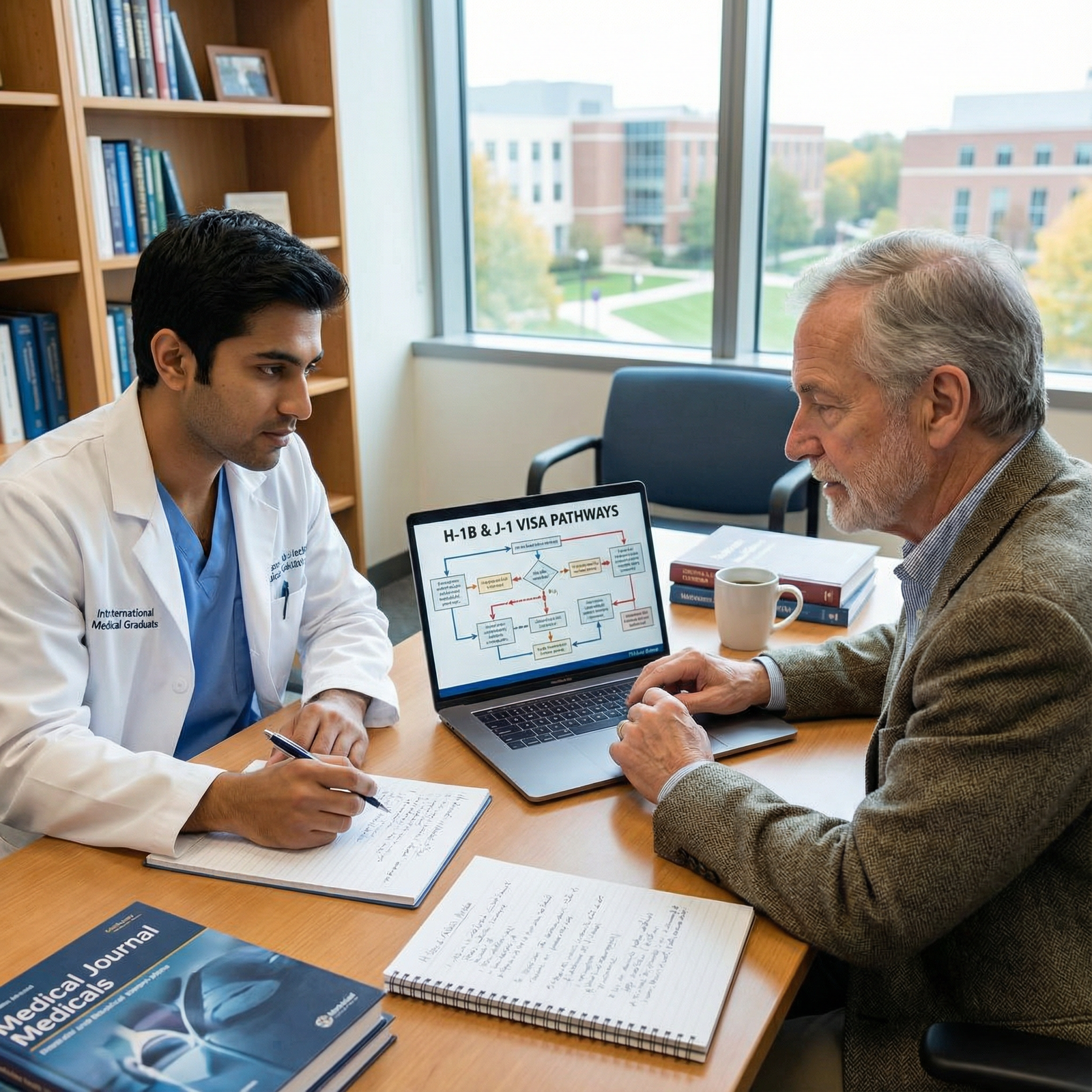
Understanding the Visa Landscape for Mountain West Residency Programs
International medical graduates (IMGs) considering a Mountain West residency—in states like Colorado, Utah, Wyoming, Montana, Idaho, Nevada, New Mexico, and Arizona—face two intertwined questions:
- Can I get a visa for residency?
- Which programs in this region actually sponsor or accept my visa type?
Visa navigation is often the biggest barrier between a strong application and a successful match. This article breaks down the key concepts and practical strategies you need, with special focus on the Mountain West region, including Colorado residency programs.
We’ll focus on:
- Core visa options (especially J-1 vs H-1B)
- How Mountain West programs typically approach visa sponsorship
- Strategic planning for IMG applicants
- Common pitfalls and how to avoid them
Core Visa Options for IMGs Entering Residency
Nearly all IMGs starting U.S. residency fall into one of these categories:
- J-1 Exchange Visitor (Alien Physician)
- H-1B Temporary Worker (specialty occupation)
- Other pathways (green card, EAD, other statuses)
1. J-1 Visa for Residency (ECFMG-sponsored)
For most IMGs, especially those outside the U.S. without another status, the J-1 physician visa is the default.
Key points:
- Sponsor: ECFMG (Educational Commission for Foreign Medical Graduates)
- Purpose: Graduate medical education (residency/fellowship)
- Duration: Length of the training program, with annual ECFMG renewals
- Work Restriction: Only at the approved training site(s) listed on the DS-2019
- Dependents: Spouse and unmarried children under 21 on J-2
Critical feature: 2-year home country requirement (212(e))
Most J-1 physicians are subject to a two-year home-country physical presence requirement after completing training. Before you can:
- Get an H-1B
- Get an immigrant visa (green card)
- Adjust status in the U.S.
…you must either:
- Spend 2 years physically in your home country, or
- Obtain a waiver of this requirement (e.g., Conrad 30 waiver, hardship, persecution)
This is particularly relevant in the Mountain West, where many states use Conrad 30 waiver programs to recruit J-1 physicians into underserved communities after residency.
Advantages of the J-1:
- Widely accepted: Many community and university programs in the Mountain West accept or prefer J-1
- Centralized process via ECFMG, which guides you and the program
- Often more straightforward for programs than H-1B sponsorship
Disadvantages of the J-1:
- Home-country requirement (and need for a waiver later)
- Limited moonlighting options (usually only if explicitly approved by ECFMG and program, and still restricted)
- No direct path to permanent residence without addressing the 2-year rule
For applicants asking about IMG visa options in the Mountain West, ECFMG-sponsored J-1 is the most common starting point.
2. H-1B Visa for Residency
The H-1B is a work visa for “specialty occupations,” which includes physicians. For residency and fellowship, some—but not all—programs are willing to sponsor H-1B.
Key points:
- Sponsor: The residency program (institution) files H-1B petition
- Requirements:
- USMLE Step 3 must be passed before H-1B petition filing in most states
- State-specific licensing or training license requirements
- Duration: Up to 6 years total (including any previous H-1B time in other jobs)
- Dependents: H-4 visas for spouse and children
Advantages of the H-1B:
- No J-1 2-year home residency requirement
- Easier transition to:
- Longer-term H-1B or
- Employment-based green card
- Often more flexible for post-residency job opportunities (e.g., hospitalist, academic roles) without needing a Conrad 30 waiver
Disadvantages of the H-1B:
- Fewer residency programs are willing or able to sponsor it—especially in smaller Mountain West communities with limited legal/HR infrastructure
- More paperwork and cost for the program (attorney fees, filing fees)
- Harder timeline: You must have Step 3 and licensing prerequisites early
Mountain West perspective:
Within Colorado residency programs and across the Mountain West, you’ll find:
- Large academic centers (e.g., in Denver, Salt Lake City, Phoenix, Albuquerque) are more likely to sponsor H-1B for exceptional candidates
- Smaller community or rural programs may only sponsor J-1 or may require J-1 only due to administrative and cost limitations
When comparing J-1 vs H-1B, think of H-1B as more flexible long-term but more competitive and logistically demanding, especially in this region.
3. Other Statuses and Less Common Pathways
A smaller subset of applicants may already be in the U.S. on another status:
- Green card holders (permanent residents): No visa issue—applies like a U.S. grad
- U.S. citizens / dual citizens: No residency visa concerns
- EAD-based (e.g., asylum, TPS, DACA, pending green card):
- Some programs accept; others have institutional limitations
- Requires careful disclosure and documentation
- O-1 “extraordinary ability”: Rarely used for residency; more common for faculty appointments
If you’re in one of these special categories, discuss your situation early with programs you’re applying to—including those in the Mountain West—to confirm whether they can support your status through residency.

How Mountain West Programs Approach Visa Sponsorship
The Mountain West residency environment is shaped by geography, workforce needs, and institutional resources. Understanding regional patterns can help you build a targeted strategy.
Academic Centers vs. Community Programs
Academic medical centers (e.g., University-affiliated programs in Denver, Aurora, Salt Lake City, Albuquerque, Phoenix, Tucson):
- More likely to:
- Sponsor both J-1 and H-1B, if institutional policy allows
- Have dedicated international office and legal support
- May offer:
- Clear documentation on their website: “We sponsor J-1 and H-1B for qualified IMGs”
- More subspecialty fellowships that also accept visa holders
Community-based and rural programs (e.g., in Wyoming, Montana, Idaho, New Mexico, rural Colorado and Utah):
- Often:
- Accept J-1 only, or
- Accept J-1 and ECFMG-certified IMGs but no H-1B sponsorship
- Reasons:
- Limited legal/administrative staff
- Budget sensitivities around H-1B costs
- Preference for J-1 due to eventual pipeline to Conrad 30 waivers and long-term rural retention
State-by-State Nuances in the Mountain West
Visa policies themselves are federal, but state licensing and workforce needs influence how programs behave in practice.
Colorado residency programs:
- Denver and Aurora academic centers:
- More likely to sponsor H-1B for high-priority specialties
- Strong history of hosting J-1 IMGs
- Community and smaller programs:
- Often J-1 friendly
- H-1B: variable, need to verify individually
Utah, Arizona, New Mexico:
- Major university programs (Salt Lake City, Phoenix, Tucson, Albuquerque):
- Typically accept J-1, may provide H-1B in select situations
- Many programs rely heavily on IMGs to meet workforce needs, especially in internal medicine, family medicine, and psychiatry—but may still limit sponsorship to J-1 only.
Wyoming, Montana, Idaho, Nevada:
- Fewer residency programs overall
- Programs more likely to:
- Take J-1 residents
- Rely on J-1 Conrad 30 waivers post-residency to fill long-term physician shortages
- H-1B sponsorship: less common, and often limited to larger hospital systems
How to Check a Program’s Visa Policy
Before spending money on applications, verify each program’s stance on IMG visa options:
Program website → “International Medical Graduates” or “Eligibility” section
- Look for language like:
- “We sponsor J-1 visas only”
- “We sponsor J-1 and H-1B visas”
- “We do not sponsor H-1B visas for residency”
- Look for language like:
FREIDA (AMA) and program directories
- Many list whether they accept/sponsor J-1, H-1B, or neither
- Always cross-check with official program website
Email the program coordinator
- Ask specific questions:
- “For the upcoming cycle, do you sponsor H-1B visas, or are you J-1 only?”
- “Do you consider IMGs on a J-1 visa for all tracks (e.g., categorical, prelim)?”
- Ask specific questions:
Virtual open houses and information sessions
- Ask politely in Q&A chat:
- “Can you clarify which visa types you currently sponsor for IMGs?”
- Ask politely in Q&A chat:
Strategic Planning: Choosing Between J-1 vs H-1B in the Mountain West
For IMGs targeting a Mountain West residency, visa strategy should be integrated into your overall match plan.
Step 1: Honestly Assess Your Competitiveness
H-1B slots are more limited and often reserved for:
- Applicants with:
- High USMLE scores
- Strong U.S. clinical experience (LORs from U.S. faculty)
- Research or advanced degrees (e.g., MPH, PhD, MS)
- Specialties/programs particularly seeking top candidates
If your profile is strong and you’re aiming for large academic centers (e.g., in Colorado, Utah, Arizona), you may reasonably aim for H-1B in addition to J-1–friendly programs.
If your profile is average but solid, or you’re open to rural and community-based programs, focusing on J-1 will open far more Mountain West options.
Step 2: Align Your Exam Timeline with Visa Choices
- If you want H-1B:
- Pass USMLE Step 3 early (ideally by early fall of the application year)
- Some state medical boards require Step 3 for H-1B petitions tied to training licenses
- For J-1:
- Step 3 is not required for visa issuance
- ECFMG certification (Step 1, Step 2 CK, OET, and other criteria) is essential
Step 3: Build a Targeted Program List
Segment your applications for the Mountain West region into:
- Programs that explicitly support H-1B
- Focus on academic centers in Colorado, Utah, Arizona, New Mexico
- Programs that accept J-1 only
- Many community and rural programs suitable for building a broad application base
- Programs that do not sponsor any visa
- Avoid these if you are not a green card holder or U.S. citizen
For example, a balanced strategy for a strong IMG might look like:
- 8–10 academic programs in Colorado, Utah, Arizona, and New Mexico that sponsor H-1B
- 15–20 J-1–sponsoring community or university-affiliated programs across the Mountain West
- 10–15 additional J-1–friendly programs in other regions of the U.S. (to ensure a wide safety net)
Step 4: Factor in Long-Term Goals (Post-Residency)
Ask yourself:
- Do I want to live long-term in the U.S., possibly in the Mountain West?
- Am I open to practicing in rural or underserved areas after residency?
If yes, J-1 is still workable, because:
- Every Mountain West state participates in the Conrad 30 waiver program
- Many underserved areas in Colorado, Utah, New Mexico, Arizona, Wyoming, Idaho, and Montana actively recruit J-1 waiver physicians
- Completing a 3-year J-1 waiver job in an underserved area can:
- Satisfy the 2-year home residency requirement
- Allow a transition to H-1B or a green card process afterward
If you prefer metropolitan practice only and want to avoid the 2-year rule completely, H-1B from the start may fit better—but such positions are more competitive and rarely guaranteed.

Practical Tips for Applying to Mountain West Programs as an IMG
1. Communicate Clearly About Your Visa Needs
In your ERAS application and during interviews:
- If you are flexible (can do J-1 or H-1B), say so:
- “I am eligible for J-1 sponsorship through ECFMG and am also prepared to pursue H-1B sponsorship, including completion of USMLE Step 3 before residency start.”
- If you require H-1B only (e.g., due to personal/legal reasons), be transparent:
- But understand this may significantly limit your program options.
2. Highlight Why You Fit the Mountain West
Programs in this region value:
- Genuine interest in their geography and lifestyle (mountains, outdoor activities, smaller communities)
- Willingness to serve rural and underserved populations
- Long-term commitment to the region
Examples of how to show this in your personal statement or interview:
- “I am particularly drawn to Colorado residency and the Mountain West because of my prior volunteer work in rural settings and my interest in practicing in underserved communities.”
- “I see myself staying in the Mountain West after residency, and I’m aware of the Conrad 30 opportunities in this region.”
Program directors may be more inclined to sponsor visas for applicants likely to remain in the region long-term.
3. Prepare Documentation Early
Have the following ready:
- Valid passport (with sufficient remaining validity)
- Translations of diplomas and transcripts (if not in English)
- ECFMG certification documents
- For H-1B:
- Early Step 3 score report
- Any state-specific forms or documentation requested by the program
Delays in providing documents can cause problems for both J-1 and H-1B processing, especially when start dates are immovable (usually July 1).
4. Use Your Interview Time Wisely
Visa questions you can ask (tactfully):
- “Can you share your recent experience hosting IMGs on J-1 or H-1B visas?”
- “Approximately how many residents in your program are currently on visas, and what types?”
- “If matched here, would there be institutional support for my visa process, and when would that typically start?”
These questions show you are informed and serious without sounding demanding.
Common Pitfalls and How to Avoid Them
Pitfall 1: Applying Broadly Without Understanding Visa Policies
Many IMGs apply widely, only to discover that:
- A significant portion of programs do not sponsor any visa, or
- Only accept J-1 when the applicant was counting on H-1B
Solution:
Before you add a program to your ERAS list, verify their visa stance via website or direct communication.
Pitfall 2: Aiming Exclusively for H-1B Without Backups
Especially in the Mountain West, the number of H-1B residency positions is limited.
Solution:
Even if you prefer H-1B, include a substantial number of J-1–friendly programs (in the Mountain West and elsewhere) unless you have a very strong reason not to.
Pitfall 3: Ignoring Post-Residency Obligations of J-1
Some IMGs accept a J-1 without understanding the two-year home-country requirement and its impact on:
- Fellowship options
- Immediate post-residency employment
- Green card timing
Solution:
Before you commit, read ECFMG’s J-1 guidelines and learn about Conrad 30 waiver programs in Mountain West states. Many IMGs complete residency in Colorado or nearby, then work in a rural or underserved area under a waiver and later transition to permanent residence.
Pitfall 4: Late Step 3 for H-1B Seekers
If you’re targeting H-1B but sit for Step 3 too late, programs may not be able to file petitions in time.
Solution:
Schedule Step 3 so that results are available by early fall or winter–spring at the latest, depending on program and state timelines. Ask programs about their internal deadlines for H-1B paperwork.
FAQs: Visa Navigation for Mountain West Residency Programs
1. Do most Mountain West residency programs sponsor J-1 or H-1B visas?
Across the Mountain West, J-1 is more common and broadly accepted.
- Large academic centers in cities like Denver, Phoenix, Salt Lake City, and Albuquerque may sponsor both J-1 and H-1B.
- Many community and rural programs accept J-1 only due to cost and administrative constraints.
- H-1B sponsorship is more selective and limited, typically reserved for highly competitive applicants and specialties.
2. Is it harder to get an H-1B visa for a Colorado residency program than a J-1?
Yes. H-1B is generally harder to secure than J-1, especially in the Mountain West. For Colorado residency programs:
- J-1 sponsorship through ECFMG is routine for many programs.
- H-1B requires:
- Program willingness and institutional approval
- Early Step 3 completion
- Additional legal and administrative steps
Because of this, Colorado programs may sponsor fewer H-1B residents compared to J-1 residents.
3. Can I switch from J-1 to H-1B after residency in the Mountain West?
You can, but only after addressing the J-1 2-year home country requirement. Options include:
- Completing two years physically in your home country, or
- Obtaining a J-1 waiver, most commonly through:
- Conrad 30 programs in Mountain West states (e.g., working in underserved areas in Colorado, New Mexico, or Wyoming)
- Hardship or persecution waivers (less common)
Once the requirement is waived or fulfilled, you can transition to H-1B or an immigrant visa as appropriate.
4. As an IMG, how can I maximize my chances of matching in the Mountain West given visa constraints?
Key strategies:
- Be flexible: Consider J-1 sponsorship if you can, as it opens more opportunities.
- Strengthen your profile:
- Strong USMLE scores, especially Step 2 CK
- U.S. clinical experience with strong LORs
- Any relevant research or advanced degrees
- Build a balanced list:
- A mix of J-1–friendly community programs and academic centers that may sponsor H-1B
- Show commitment to the region:
- Express genuine interest in living and working in the Mountain West long-term, including openness to underserved settings.
Visa navigation for residency in the Mountain West is manageable when you understand your IMG visa options, the realities of J-1 vs H-1B, and the specific tendencies of programs in this region. With early planning, honest self-assessment, and targeted applications, you can build a realistic path to a successful Mountain West residency and a sustainable long-term career in the United States.