Understanding the Visa Landscape for Neurology Residency
Navigating visas while applying for a neurology residency in the United States adds a complex legal layer to an already demanding process. As an international medical graduate (IMG), you’re balancing the neurology residency application, research, clinical experience, and the neuro match timeline—while also needing to understand residency visa, IMG visa options, and the implications of J-1 vs H-1B.
This guide breaks down what you need to know to strategically plan your pathway into neurology residency, with specific emphasis on how visa choices intersect with long-term career plans in neurology, including fellowship, research, and eventual practice.
We will focus on:
- How neurology programs view different visa types
- Core differences between J-1 and H-1B in the context of neurology
- The impact of visa type on fellowship training (stroke, epilepsy, neurocritical care, etc.)
- How to research programs and advocate for yourself as an IMG in the neuro match
- Practical timelines and documentation strategies
Disclaimer: This is educational information, not legal advice. Visa rules change. Always verify with an immigration attorney, ECFMG, and individual residency programs.
Core Visa Options for Neurology Residency: The Big Picture
Most IMGs entering neurology residency will use one of three main pathways:
- J-1 Exchange Visitor Visa (ECFMG-sponsored)
- H-1B Temporary Worker Visa (employer-sponsored)
- U.S. Permanent Residency or Citizenship (no visa needed)
Because the third category (green card or citizen) doesn’t involve a training visa, this article emphasizes IMG visa options focused on the J-1 vs H-1B decision.
Why Neurology-Specific Considerations Matter
Neurology is a specialty with:
- High rates of subspecialization (stroke, epilepsy, neuroimmunology, movement disorders, neuromuscular, behavioral neurology, neurocritical care, etc.)
- Strong ties to academic medicine and research
- Increased demand in underserved and rural areas, which impacts waiver and employment options after training
This means your visa choice can affect:
- Your ability to do fellowships (especially multiple fellowships)
- Where you can work after residency (urban vs rural, academic vs private practice)
- How competitive you are for academic neurology positions
Understanding these neurology-specific dynamics can help you make a more informed strategic decision about your visa trajectory.
J-1 Visa for Neurology Residency: Pros, Cons, and Strategy
The J-1 visa for physicians is sponsored by the ECFMG and is by far the most common visa used by IMGs in neurology residency.
Core Features of the J-1 for Neurology Residents
- Sponsor: ECFMG (not the program itself)
- Duration: Length of accredited training, plus short grace periods
- Specialty-specific: Your J-1 is issued for “graduate medical education” in a specific specialty (e.g., Neurology) and later for subspecialty fellowships
- Two-year home residency requirement:
- After completing all training in the U.S., you must either
- Return to your home country for a cumulative 2 years, or
- Obtain a waiver of this requirement (e.g., Conrad 30 waiver job, federal agency waiver)
- After completing all training in the U.S., you must either
Advantages of J-1 in Neurology
Broad Acceptance Across Neurology Programs
- Most neurology residency programs that take IMGs accept J-1
- Many academic neurology departments are familiar with J-1 procedures
- You are not limited to only those programs willing to sponsor H-1B
Streamlined, standardized process via ECFMG
- ECFMG handles much of the visa paperwork and guidance
- Programs usually have established workflows for onboarding J-1 residents
- Less legal cost and complexity for programs compared with H-1B
Training flexibility within GME rules
- Possible to extend J-1 status for neurology fellowships (e.g., stroke, epilepsy, movement disorders) once approved by ECFMG
- Typical pathway: Neurology residency (3–4 years) → 1–2 fellowships, all on J-1
Disadvantages and Constraints of the J-1
Two-Year Home Residency Requirement
This is the most significant issue for long-term planning:- After you finish all neurology training (residency + fellowship), you are subject to a two-year foreign residence requirement in your home country (or country of last permanent residence)
- You cannot change to H-1B or permanent resident status inside the U.S. (in most cases) until this requirement is satisfied or waived
- For many neurologists, this means either:
- Returning home to practice neurology for 2 years, which may or may not align with professional goals
- Or pursuing a J-1 waiver job in the U.S.
Dependence and Spouse Work Limitations
- Spouse/children usually on J-2
- J-2 spouses may apply for work authorization, but this involves a separate application and processing time
- Rules may shift over time; must check current regulations
Less Flexibility for Mid-Training Changes
- Switching from J-1 to H-1B during training is generally difficult/impractical
- Major changes in specialty or significant training breaks can be more complex
The J-1 Waiver Path for Neurology Graduates
Because neurologists are in demand, J-1 waiver options are often attainable, particularly in underserved settings.
Common waiver paths:
Conrad 30 Program (State-based)
- Each U.S. state can sponsor up to 30 J-1 physicians per year
- Typically requires work in a Health Professional Shortage Area (HPSA) or Medically Underserved Area/Population (MUA/MUP)
- Usually a 3-year contract in the designated area
- Neurology may or may not be prioritized depending on the state; some states prefer primary care, others accept specialists
Federal Agency Waivers
- Veteran’s Administration (VA), Department of Health and Human Services (HHS) for research roles, etc.
- Often aligned with academic neurology and research, especially if you have strong scholarly output and an established niche (e.g., neuroimmunology, basic neurobiology research)
Hardship or Persecution Waivers
- Based on personal or family circumstances
- More individualized and complex, require strong legal support
Neurology-specific angle:
Neurologists frequently find waiver positions in:
- Rural or smaller-market hospitals needing general neurologists
- Stroke center development
- Tele-neurology networks covering underserved regions
If your long-term goal is U.S.-based practice and you’re open to underserved or rural work initially, J-1 + waiver can be a very realistic path.
H-1B Visa for Neurology Residency: Pros, Cons, and Practical Barriers
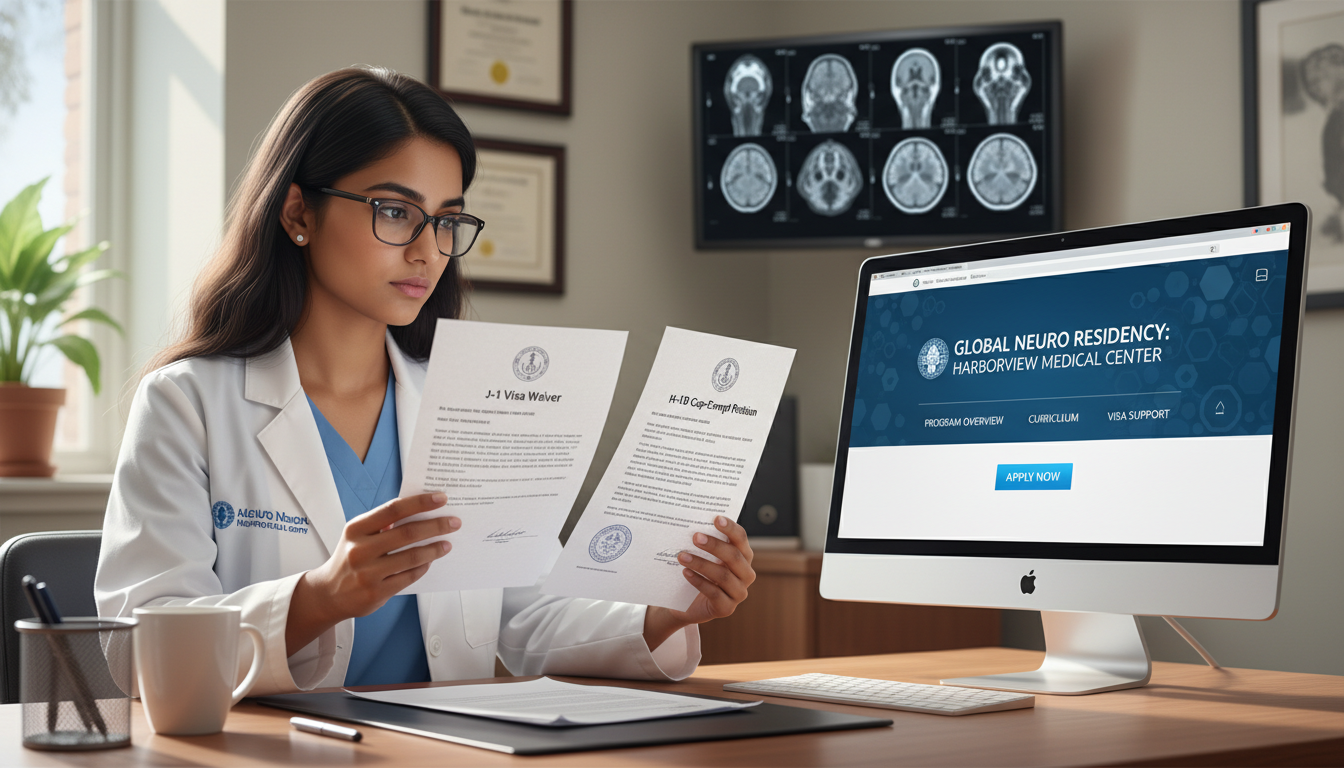
Whereas the J-1 is an exchange-visitor training visa, the H-1B is a temporary worker visa for “specialty occupations.” In the residency context, your employer (the hospital/university) petitions for you to work as a resident physician.
Core Features of H-1B for Neurology Residents
- Employer-sponsored (the neurology residency program/hospital is the petitioner)
- Dual intent: You can pursue permanent residency (green card) while on H-1B
- Typically valid up to 6 years total, including all H-1B employment (residency, fellowship, later jobs)
- Requires passing USMLE Step 3 before H-1B approval for GME in most states/programs
Advantages of H-1B in Neurology
No Two-Year Home Residency Requirement
- No automatic requirement to return to home country after training
- Greater flexibility to move directly into attending roles, academic positions, or fellowships within the U.S.
Dual Intent and Green Card Pathway
- You can pursue permanent residency while on H-1B
- Academically oriented neurologists may benefit if hired by a university that supports early green card sponsorship
Perception in Some Academic Settings
- Some institutions prefer H-1B for long-term faculty recruitment in neurology
- If your goal is to stay in U.S. academic neurology, H-1B may align better long-term
Disadvantages and Constraints of H-1B
Fewer Neurology Programs Offer H-1B Sponsorship
For neurology residency, this is often the largest barrier:- Many programs state explicitly: “We sponsor only J-1 visas.”
- Reasons include:
- Legal cost and administrative burden
- H-1B caps and complexities (though many teaching hospitals are cap-exempt)
- Preference for a standardized route (J-1) through ECFMG
Result: Your neuro match list is significantly shorter if you require H-1B sponsorship.
USMLE Step 3 Requirement and Timing Issues
- Most programs will not start H-1B processing until you pass USMLE Step 3
- Step 3 must be completed early enough so the program can file the H-1B petition in time
- For many IMG applicants, this makes matching directly into H-1B-funded neurology residency more difficult, especially if they are still abroad or recently arrived
Six-Year Limit and Fellowship Planning
- H-1B is typically capped at 6 years total
- Consider this timeline for neurology:
- 3–4 years of neurology residency
- 1–2 years of fellowship
- You may have little H-1B time left for your first job if you use most of it on training
- Extensions are possible, especially if a green card petition is in progress, but this requires strategy and early planning with immigration counsel and your employer
Spouse Work Authorization Constraints
- H-4 dependents (spouse/children) have limited work authorization options (H-4 EAD is restricted and tied to green card processing milestones)
- Often less straightforward than J-2 work options
Who Should Seriously Consider H-1B for Neurology Residency?
H-1B may be worth targeting if:
- You have already passed Step 3 before application season
- You're competitive for top neurology programs that are known to sponsor H-1B
- Your long-term plan is clearly U.S.-based with an emphasis on:
- Academic neurology
- Long-term specialist practice in the same region
- You want to avoid the J-1 two-year home requirement and the uncertainty of waiver jobs
However, for many IMGs, prioritizing H-1B means significantly reducing the number of programs to which they can apply, which can be risky in a competitive neuro match.
J-1 vs H-1B in Neurology: Strategic Comparison
When choosing between J-1 vs H-1B for neurology residency, think beyond just “which is better” and consider which aligns with your realistic options and long-term path.
Side-by-Side Summary (Neurology-Focused)
| Factor | J-1 | H-1B |
|---|---|---|
| Sponsorship | ECFMG | Program/hospital |
| Common in neurology residency? | Very common | Less common |
| Two-year home requirement | Yes, unless waived | No |
| Step 3 required before start? | Not necessarily | Usually yes |
| Path to green card | Requires waiver or home return first | Directly possible |
| Multiple fellowships | Often feasible with ECFMG approval | Limited by 6-year cap |
| Waiver/Service obligation | Often in underserved areas | Not inherent to visa |
| Spouse work authorization | Possible via J-2 EAD | Limited and conditional via H-4 EAD |
How the Choice Affects Neurology Subspecialty Plans
Most neurology residents pursue fellowship. Consider two typical scenarios:
Scenario 1: Aspiring Vascular Neurologist (Stroke)
- Goal: Neurology residency → Vascular neurology fellowship → Academic stroke center job
- J-1 Path:
- Use J-1 for both residency and fellowship
- Then seek a J-1 waiver job; if academic waiver not available, you may need to work in a less urban area initially
- Academic positions in large cities may be harder immediately post-fellowship if they don’t sponsor waiver positions
- H-1B Path:
- Use H-1B for residency (and ideally fellowship)
- Transition directly to an academic stroke job and begin green card process
- Requires early Step 3, H-1B sponsoring programs, and careful timing of H-1B years
Scenario 2: Aspiring Epileptologist or Movement Disorders Specialist
- Goal: Neurology residency → 1–2 fellowships → mix of academic and private care
- J-1 Path:
- More flexible for multiple fellowships during training
- After training, likely need J-1 waiver job (may or may not align with very subspecialized practice initially)
- H-1B Path:
- Multiyear subspecialty training may come close to 6-year H-1B limit
- You must plan immigration with anticipated job and green card sponsorship in mind
The core question: Are you willing to restrict your neuro match options to have a potentially smoother long-term U.S. immigration trajectory (H-1B), or will you prioritize matching broadly with J-1 and handle the waiver later?
For many IMGs in neurology, the practical reality is:
“Match first on J-1; optimize your visa and waiver strategy once you are securely in U.S. training.”
Practical Steps for Navigating Visas During the Neuro Match
You can’t control every aspect of U.S. immigration policy, but you can be strategic with your neurology residency application.
1. Clarify Your Personal and Professional Priorities
Before the ERAS season:
- Are you absolutely set on staying long-term in the U.S., or open to returning home after training?
- Is your primary goal to maximize chances of matching into neurology, or to protect future U.S. immigration flexibility even at the cost of fewer program options?
- Are you prepared (financially and logistically) to take USMLE Step 3 before applying, to keep H-1B options open?
Write out your priorities; refer back when deciding whether to focus on J-1, H-1B, or accept either.
2. Research Each Program’s Visa Policy Carefully
Program websites and NRMP/ERAS listings usually state:
- “We sponsor J-1 visas only”
- “We sponsor J-1 and H-1B”
- “We do not sponsor visas”
Action steps:
- Create a spreadsheet of neurology programs with columns for:
- J-1 sponsorship (Yes/No)
- H-1B sponsorship (Yes/No)
- Historical notes (“Has sponsored H-1B in the last 3 years?”, if you learn from residents)
- Cross-check information on:
- Program website
- FREIDA, ERAS, or NRMP data
- IMG forums or current residents (with caution; confirm directly with programs when needed)
If a program’s policy is unclear, email the program coordinator with a focused question:
“I am an IMG applying to neurology residency and will require visa sponsorship. Could you please confirm whether your program sponsors J-1, H-1B, or both for incoming residents?”
3. Decide on Your Visa Preference Strategy for Applications
Common strategies among neurology IMG applicants:
Flexible (J-1 or H-1B) Strategy
- You are open to either
- You apply broadly to all neurology programs that accept IMGs
- In interviews, you state your openness but may gently indicate your preference if the program offers both
J-1-Focused Strategy
- You prioritize maximizing match chances
- You don’t require Step 3 before applying
- You aim for strong programs that can support your fellowship ambitions, accepting that you’ll handle the J-1 waiver later
H-1B-Targeted Strategy
- You pass Step 3 early and intentionally
- You apply heavily to programs that explicitly sponsor H-1B
- You accept a smaller list of programs and potentially higher risk of not matching, in exchange for a clearer long-term immigration pathway if you do match
4. Use Interviews to Clarify Visa and Long-Term Support
During neurology residency interviews, it is appropriate to ask:
- “What is your policy on visas for IMGs?”
- “Have you sponsored H-1B visas for neurology residents in the past few years?”
- “Do graduating residents on J-1 commonly go into U.S.-based fellowships, or do they return home?”
- “Are there institutional resources to help with J-1 waiver jobs or immigration planning after residency?”
These questions show you’re informed, serious about your future, and thinking long-term—qualities neurology program directors often appreciate.
5. Think Ahead to Fellowship and Career from Day 1
Neurology training is relatively short (3–4 years), and immigration processes move slowly. Early in residency:
- Seek mentorship from senior residents/fellows who are IMGs
- Attend GME office sessions on visa and legal aspects
- If you’re on J-1:
- Understand how to apply for J-1 extension for fellowship
- Begin learning about Conrad 30 and federal waivers in states you might want to practice
- If you’re on H-1B:
- Track your H-1B year count carefully (residency + fellowship)
- Discuss green card timing with potential academic or private employers during fellowship interviews
Common Mistakes IMGs Make with Visas in Neurology Residency
Avoid these pitfalls as you plan your neurology career:
Ignoring Visa Policies Until Rank List Time
- Discovering a program cannot sponsor your required visa late in the process can waste interviews and limit options
- Clarify early, ideally before interviews or at the start of interview season
Assuming All Specialties and Programs Treat Visas the Same
- Neurology is often more IMG-friendly than some surgical fields, but less standardized than internal medicine
- Some top neurology programs that welcome IMGs still only sponsor J-1
Delaying Step 3 Without Understanding the Trade-Offs
- If you might want H-1B, Step 3 timing is critical
- If you are committed to J-1, Step 3 urgency is less, but still beneficial for fellowship and board eligibility planning
Underestimating the Impact of the Two-Year Home Requirement
- For some applicants, returning home is fine or even preferred
- For others, especially those from politically unstable countries, the requirement can be a major barrier to long-term goals
- Understand what it means for you, not just in abstract terms
Relying Solely on Online Forums for Legal Information
- Use forums and peers to gather experiences
- Verify rules and policies with:
- ECFMG
- Official program statements
- University GME offices
- Qualified immigration attorneys
FAQ: Visa Navigation for Neurology Residency
1. Do most neurology residency programs sponsor J-1 or H-1B?
Most programs that accept IMGs will sponsor J-1 visas through ECFMG. A smaller subset will sponsor H-1B for residents, often with specific conditions (such as Step 3 completed before starting residency). If you require H-1B, your list of neurology residency programs will be more limited.
2. Is it realistic to complete neurology residency and fellowship on an H-1B?
Yes, it can be done, but it requires careful planning. You typically have 6 years of H-1B time. A 3- or 4-year neurology residency plus a 1- or 2-year fellowship can use almost all of this. You’ll need employers (residency, fellowship, and first job) who understand these constraints and may initiate green card processing early to allow H-1B extensions.
3. Can I switch from J-1 to H-1B during or after neurology residency?
During residency, switching is usually challenging because of the two-year home residency requirement that attaches to J-1 physician status. To move to H-1B after J-1, you typically must either:
- Fulfill the 2-year home-country requirement, or
- Obtain a J-1 waiver and then have an employer file H-1B for you
You cannot simply change from J-1 to H-1B without addressing the home requirement.
4. As an IMG, should I prioritize a program’s visa type or its neurology training quality?
You need to balance both. Training quality matters for your future fellowship and career, but if the visa situation makes it impossible for you to stay in the U.S. where you intend to practice, that’s also a major issue. In practice, many neurology IMGs choose to prioritize matching at a strong, J-1-sponsoring program and then work through waivers later, while applicants with very specific long-term U.S. immigration goals may accept more risk to pursue H-1B positions.
Visa navigation is an integral part of your neurology residency journey. By understanding the differences between J-1 and H-1B, researching program policies early, and aligning your visa strategy with your long-term neurology goals, you can approach the neuro match with clarity and confidence.