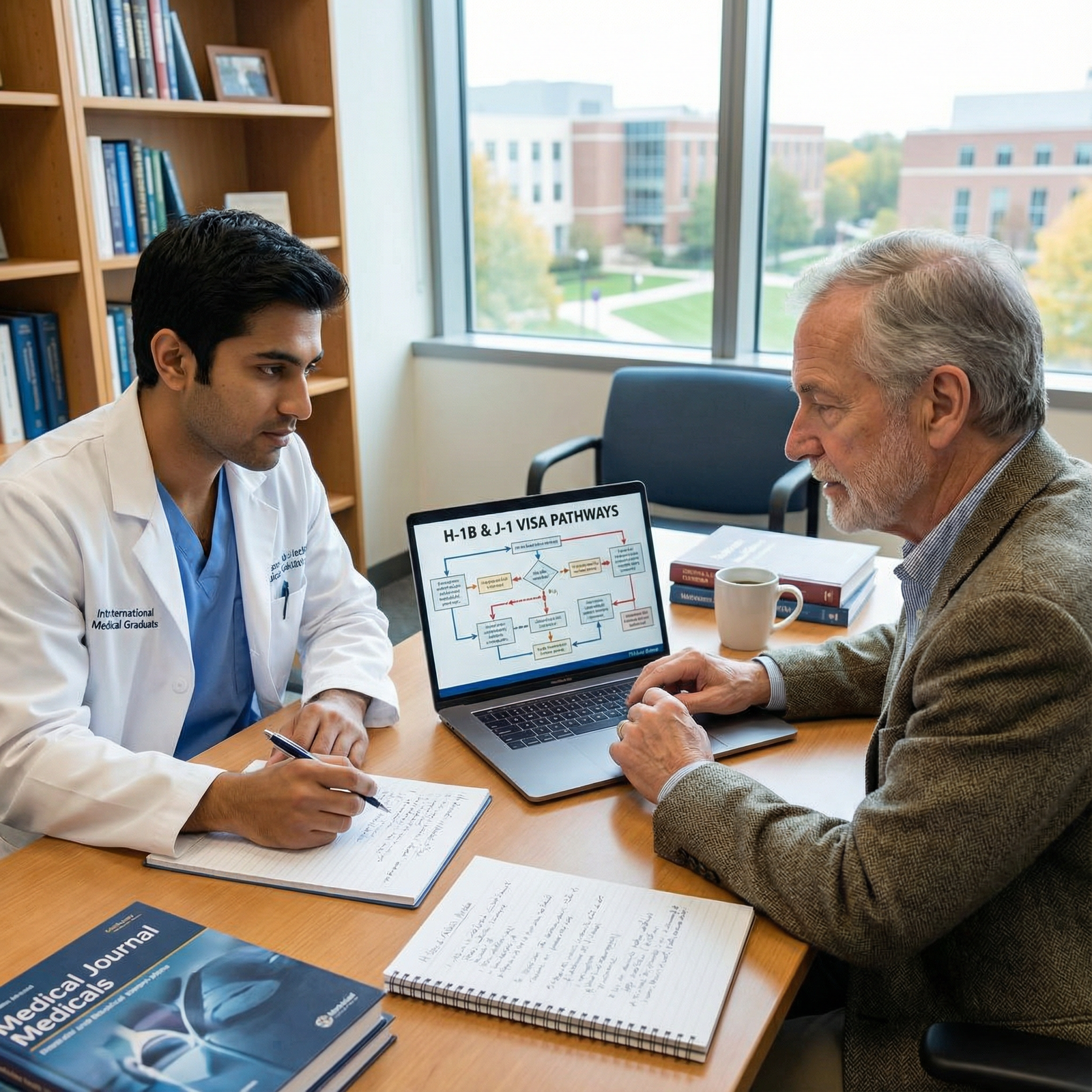
Understanding the Visa Landscape as a Non‑US Citizen IMG
For a non-US citizen IMG, securing a residency position at a community hospital program in the United States is not just an academic and clinical challenge—it is fundamentally an immigration challenge as well. Community-based residency programs can be excellent training environments, but they often have fewer institutional resources (including legal and immigration support) compared with large academic medical centers. That makes it especially important for you to understand visa options and strategies early.
You will be navigating three interlocking systems at once:
- Graduate medical education (ERAS, NRMP, program requirements)
- Immigration law (visa categories, maintenance of status, long-term plans)
- Individual program policies (what each community hospital is willing and able to sponsor)
This article focuses on visa navigation for the non-US citizen IMG and foreign national medical graduate applying to community hospital residency and community-based residency programs. You will learn:
- The main IMG visa options for residency training
- How J-1 vs H-1B compare in real life
- How to research and prioritize community hospital programs based on visa policies
- How to plan strategically for waiver jobs, fellowship, and long-term immigration goals
- Practical steps, timelines, and frequent pitfalls to avoid
Core Visa Options for Non‑US Citizen IMGs in Residency
Most non-US citizen IMGs in US residency will be on one of two visa categories:
- J-1 Exchange Visitor (Alien Physician)
- H-1B Temporary Worker (Physician in Graduate Medical Education)
Some applicants may already be in, or consider, other statuses (F-1, O-1, pending green card, etc.), but for most, residency itself will require choosing between J-1 vs H-1B.
1. J‑1 Visa for Physicians (ECFMG-Sponsored)
The J-1 physician category is the most common residency visa for IMGs.
Key features:
- Sponsor: ECFMG, not the hospital directly
- Purpose: Graduate medical education or training (residency, fellowship)
- Duration: Up to 7 years total (with documented educational need)
- Full-time training required: Generally must be in a structured program, not part-time work
- Two-year home residency requirement (212(e)):
Most J-1 physicians must return to their home country (or country of last legal permanent residence) for a total of two years after completion of training before they can:- Change to H status (e.g., H-1B) within the US
- Obtain an immigrant visa (green card)
- Adjust status to permanent resident
Why community hospital programs favor J‑1:
- Administrative simplicity: ECFMG handles most of the paperwork and compliance.
- Lower cost: The hospital does not need expensive immigration attorneys for sponsorship.
- Predictable process: Well-established, standardized forms and steps.
As a result, many community hospital residency and community-based residency programs only sponsor J-1 for non-US citizen IMGs. This is not necessarily because they dislike H-1B, but because they may lack the budget, expertise, or institutional policy framework to handle H-1B.
2. H‑1B Visa for Residency
The H-1B is a temporary worker visa for specialty occupations. Some residencies, including a subset of community hospitals, will sponsor H-1B for residency.
Key features:
- Sponsor: The residency program/hospital (employer) directly
- Duration:
- Initial approval often 3 years
- Maximum typically 6 years total (including prior H-1B time, if any)
- USMLE requirement:
- Most states require USMLE Step 3 for H-1B sponsorship in residency
- You must pass Step 3 before the H-1B petition is filed
- No automatic two-year home requirement:
The H-1B itself does not impose a 2-year home requirement. - Dual intent:
H-1B allows you to pursue a green card while maintaining H-1B status.
Why many community hospitals do not offer H‑1B:
- Costs: Legal fees, filing fees, and ongoing compliance are higher.
- Complexity: More involvement from HR and legal departments.
- Timelines: Need to file and obtain approval before the residency start date; delays can be risky for small programs.
However, some community-based programs—especially those integrated into larger healthcare systems—do sponsor H-1B, particularly when they want to recruit highly competitive IMGs or retain graduates long-term.
3. Other Statuses (Special Situations)
Less common but relevant:
- F-1 with OPT or STEM OPT:
Some foreign national medical graduates in US PhD or master’s programs may be on F-1. Clinical residency is typically not allowed on F-1/OPT alone; you will still need J-1 or H-1B for residency. - O-1 (Extraordinary Ability):
More relevant for established researchers or senior physicians; rarely used for standard residency training. - Pending or Approved Green Card:
If you already have permanent residency or are close, visa navigation simplifies significantly, but you must still disclose your immigration status accurately.
For the majority of non-US citizen IMGs, the real choice is: J‑1 vs H‑1B.
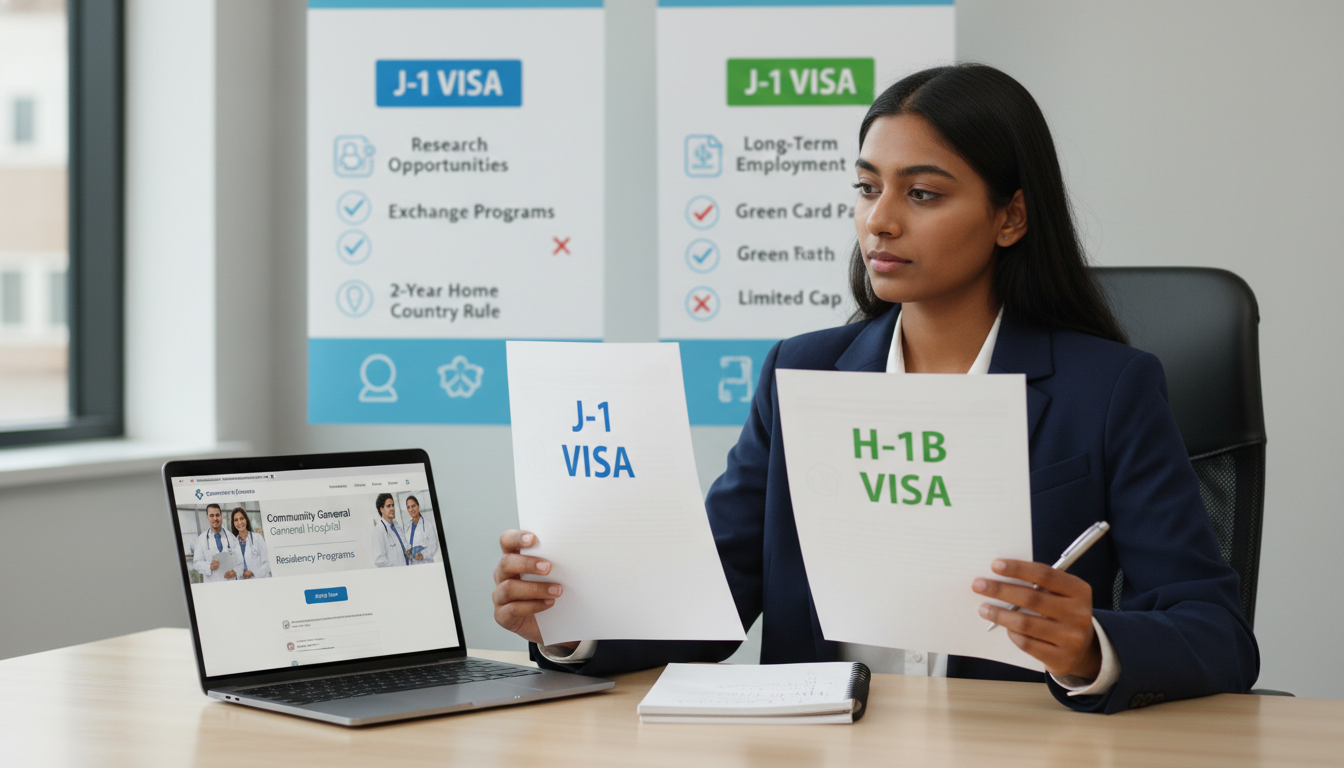
J‑1 vs H‑1B: Practical Pros, Cons, and Myths
Understanding how these visas affect not only residency, but also your career trajectory, is essential.
Advantages of J‑1 for Residency
Higher availability in community hospital programs
- Many community-based residency programs are “J-1 only.”
- ECFMG sponsorship makes it administratively easier for small and mid-sized institutions.
No Step 3 requirement before Match
- You can start residency with just Step 1 and Step 2 CK passed and ECFMG certification.
- This is especially advantageous if you are still working on Step 3 or cannot schedule it before Match.
Faster and more standardized processing
- ECFMG has clear timelines and well-defined application steps.
- Reduced risk that a small hospital’s HR/Legal department delays your start date.
Widely recognized pathway for IMGs
- US healthcare systems and employers are familiar with J-1 histories and waiver paths.
Disadvantages of J‑1
Two-year home country physical presence requirement
- You are generally required to spend two years in your home country (or country of last permanent residence) after training unless you:
- Obtain a J-1 waiver job (e.g., Conrad 30, VA, or hardship/persecution waiver),
- Or actually spend two years abroad.
- You are generally required to spend two years in your home country (or country of last permanent residence) after training unless you:
Limited duration for training
- Maximum of 7 years can be restrictive for lengthy pathways (residency + multiple fellowships).
Less flexibility for moonlighting
- Rules vary, but moonlighting outside your approved program is usually not allowed.
Harder direct transition to green card from training
- You must resolve the 2-year requirement before most employment-based immigrant visa categories.
Advantages of H‑1B for Residency
No J‑1 two-year home requirement
- You can later move directly to employment-based green card pathways if you secure a sponsoring employer.
Dual intent
- H-1B recognizes that you can have temporary work intent and immigrant intent simultaneously.
Potentially smoother continuation into post-residency employment
- If you find a job that can continue H-1B sponsorship, you may avoid J-1 waiver constraints.
Easier alignment with long-term US career plans
- Particularly attractive if your goal is permanent US settlement and academic or subspecialty practice.
Disadvantages of H‑1B
Limited availability in community hospital residency programs
- Many community-based residencies will explicitly state “No H-1B sponsorship.”
- Some say “H-1B considered only for exceptional candidates” or “only for internal candidates.”
USMLE Step 3 required before filing
- You must pass Step 3 early (often by January–March of the Match year) so the program can file on time.
- Delayed Step 3 results can jeopardize starting residency on time.
Higher costs and more paperwork for the program
- Attorney fees, USCIS filing fees, and LCA (Labor Condition Application) compliance.
Six-year maximum H‑1B time
- Extended training (long residencies plus fellowships) can use up H-1B time quickly.
Common Myths and Clarifications
“J‑1 is always worse than H‑1B.”
Not necessarily. J-1 may be the only realistic path into US residency for many non-US citizen IMGs, especially at community hospitals. Also, J-1 waiver jobs can be excellent stepping stones in underserved areas with strong job security.“H‑1B is guaranteed if the program ‘offers’ H‑1B.”
Even if a program lists “H-1B sponsorship possible,” they may still:- Prioritize J-1 for some candidates
- Limit H-1B to certain specialties or top-ranked applicants
- Require proof of passing Step 3 before offering H-1B
“I can convert my J‑1 to H‑1B during residency to avoid the 2-year rule.”
For most J-1 physicians in GME, the 212(e) requirement still applies even if you later change to H-1B. You must satisfy or waive 212(e) separately.“Community hospital residencies don’t offer any visas.”
Many do; you just need to identify which ones and what they sponsor. Some smaller community programs may be J-1 only, but a growing number are comfortable with H-1B, especially in high-need specialties like Internal Medicine or Family Medicine.
Researching Visa Policies in Community Hospital Residency Programs
Visa navigation starts long before Match Day. For the non-US citizen IMG or foreign national medical graduate, your application list must be aligned with realistic IMG visa options.
Step 1: Use Public Databases Strategically
FREIDA (AMA Residency & Fellowship Database):
Many programs list:- Whether they accept IMGs
- Whether they sponsor visas
- What visa types (J-1, H-1B) they support
Always treat this as preliminary, not definitive; program policies can change yearly.
Program websites:
Look for pages titled “Eligibility,” “International Medical Graduates,” or “Visa Information.” They may explicitly state:- “J-1 only”
- “J-1 and H-1B”
- “No visa sponsorship”
- “H-1B considered only for current residents or exceptional candidates”
Step 2: Clarify Ambiguous or Outdated Information
If a program’s policy is unclear or contradictory:
Email the program coordinator with a concise, polite question. Example:
Dear [Coordinator Name],
I am a non-US citizen IMG interested in applying to your Internal Medicine residency. Could you please confirm whether your program sponsors visas for international graduates, and specifically whether you accept J‑1 applicants and/or sponsor H‑1B visas?
Thank you for your time and assistance,
[Your Name, Credentials]Keep track of answers in a spreadsheet (Program name, Visa types, Notes, Date of response).
Step 3: Categorize Programs by Visa Policy
For more strategic planning, divide your list into:
- J-1 only programs
- J-1 and H-1B programs (both considered)
- H-1B-friendly programs (actively sponsor and frequently use H-1B)
- No visa sponsorship / US citizens & permanent residents only
For a non-US citizen IMG focused on community hospital residencies, your list will likely be heavy in category (1) and (2), with a smaller but valuable subset in (3).

Strategizing Your Application as a Non‑US Citizen IMG
Visa navigation isn’t only about choosing between J‑1 vs H‑1B; it’s about aligning your scores, profile, and long-term goals with realistic program options.
1. Be Honest About Your Competitiveness
Community hospital programs vary widely—some are very IMG-friendly; others are highly competitive.
Stronger profiles (high scores, US clinical experience, publications) may:
- Have more leverage to pursue H‑1B-friendly programs
- Be more likely to secure an H‑1B offer from a community program that “occasionally sponsors H‑1B”
Moderate profiles may:
- Maximize chances by heavily applying to J-1 accepting programs
- Add some H‑1B options but not rely on them exclusively
Most non-US citizen IMGs should treat J-1 as the baseline realistic path, with H‑1B as an added bonus when feasible.
2. Timing USMLE Step 3 if You Want H‑1B
If you are targeting H‑1B:
Plan Step 3 early enough so that:
- Results are available by January–February of your Match year.
- Programs can feel confident about filing H‑1B in time for a July 1 start.
Discuss Step 3 timing in interviews:
- If asked about visa preference, you can say:
- “I am open to both J‑1 and H‑1B. I have scheduled Step 3 for [date] to keep H‑1B as an option if your program supports it.”
- If asked about visa preference, you can say:
3. Communicating Visa Preferences During Interviews
When interviewing at community-based residency programs:
If they ask about visa type:
- Show flexibility unless you have a very strong reason not to:
- “I am open to J‑1 or H‑1B, and I understand many community hospital programs prefer J‑1. My long-term plan is to practice in the US, and I am prepared to pursue a J‑1 waiver pathway if needed.”
- Show flexibility unless you have a very strong reason not to:
If they state policy clearly (e.g., J‑1 only):
- Acknowledge and avoid arguing:
- “Thank you for clarifying. I would be very happy to train under a J‑1 visa, and I understand the post-training obligations and waiver pathways.”
- Acknowledge and avoid arguing:
If you strongly prefer H‑1B and the program sponsors it:
- Clarify requirements (Step 3 timeline, any institutional limits).
- However, avoid appearing rigid; programs favor candidates who can adapt.
4. Balancing Short-Term vs Long-Term Goals
Ask yourself:
- Is my absolute priority to enter US residency, even if it involves a J-1 and a later two-year waiver job?
- Or is my priority to keep maximum flexibility for future academic positions, subspecialties, or green card timing, making H-1B more attractive?
For many non-US citizen IMGs, especially those without strong US contacts or backup plans, securing any solid residency (often on J-1) is the critical first step. Long-term strategies (J‑1 waiver jobs, fellowship, green card) can be planned once you are in training.
Life After Residency: Waivers, Jobs, and Long-Term Immigration Planning
Your visa choice in residency directly affects what happens after graduation.
If You Train on a J‑1 Visa
You must address the two-year home-country requirement:
J‑1 Waiver Jobs (Most Common Path)
- Many IMGs join underserved or rural areas under:
- Conrad 30 Program (state-based)
- VA hospitals (Veterans Affairs)
- Other federal or state programs
- These jobs:
- Convert your future status to H-1B while you fulfill the waiver conditions.
- Usually require 3 years of service in a qualifying area.
- These are frequently in community hospitals, FQHCs, and community clinics, which need physicians and value IMG experience.
- Many IMGs join underserved or rural areas under:
Hardship or Persecution Waivers
- Less common; based on:
- Exceptional hardship to a US citizen/LPR spouse or child, or
- Fear of persecution if you return home.
- Require legal support and are more complex.
- Less common; based on:
Fulfilling the Two Years Abroad
- Some physicians do return home or to another eligible country for the full 2 years, then reapply for US visas or green cards later.
- Less common for those aiming for permanent US careers, but possible.
Once you complete your waiver job and/or resolve 212(e), you can transition into employment-based green card pathways.
If You Train on an H‑1B Visa
Post-residency steps may look different:
Direct Transition to Employment
- You can seek an attending job on H‑1B (often at hospitals, academic centers, or large groups).
- No J-1 waiver obligation.
Green Card Sponsorship
- Employers may sponsor you via EB-2 or EB-3 (PERM process) or other categories.
- Your prior H‑1B status supports dual intent, easing the process.
Fellowship Considerations
- If doing fellowship on H‑1B, total H‑1B time (including residency) must stay within the 6-year limit unless:
- You extend H‑1B beyond 6 years with an approved I-140 and backlogged priority date, or
- You switch to another category.
- If doing fellowship on H‑1B, total H‑1B time (including residency) must stay within the 6-year limit unless:
For Both J‑1 and H‑1B Paths: Role of Community Hospital Experience
Community hospital training can be an asset:
- Broad clinical exposure and autonomy in underserved or resource-limited settings.
- Appreciated by waiver employers and community-based practices.
- Often aligns well with the mission of Conrad 30 and similar programs seeking physicians committed to community care.
As a non-US citizen IMG, demonstrating adaptability and commitment to community service can strengthen your case for both waiver jobs and later immigration processes.
Practical Checklist and Timeline for Visa Navigation
Pre-Application (12–24 Months Before Match)
- Clarify your long-term goals (US-based career? Return home? Academic vs community practice?).
- Decide whether aiming for H‑1B is realistic:
- Can you take and pass Step 3 early?
- Are you competitive enough for H‑1B-friendly programs?
- Research community hospital and community-based residency programs:
- Identify visa policies and categorize your list.
- Start or complete US clinical experience and prepare for strong LORs.
ERAS & Application Season (6–12 Months Before Match)
- Tailor your personal statement and CV to:
- Highlight flexibility and understanding of J‑1 vs H‑1B.
- Emphasize interest in community-based training.
- If targeting H‑1B:
- Schedule Step 3 and plan study time realistically.
- Email unclear programs for visa clarifications and track answers.
Interview Season
- Be ready to discuss:
- Your visa openness: “I understand many community programs sponsor J‑1, and I am willing to pursue that path.”
- Your understanding of post-residency obligations for J‑1.
- Your long-term interest in community or underserved practice (aligns with waiver paths and community hospitals).
After Match
- Coordinate promptly with GME office and ECFMG (for J‑1) or the program’s immigration counsel (for H‑1B).
- Submit all documents quickly; missing or delayed paperwork can jeopardize your residency start date.
- Keep copies of everything: DS-2019, I-797 approvals, I-94s, passport stamps.
FAQs: Visa Navigation for Non‑US Citizen IMGs in Community Hospital Programs
1. As a non-US citizen IMG, should I insist on H‑1B or accept J‑1 if offered?
Most applicants should remain flexible. If your profile is very strong and you can pass Step 3 early, you can prioritize H‑1B-friendly programs. However, for many foreign national medical graduates, accepting a J‑1 at a solid community hospital residency is a practical and successful entry into US training. You can later pursue a J‑1 waiver job and transition to H‑1B and permanent residency.
2. Do all community hospital residency programs sponsor visas for IMGs?
No. Some community-based residency programs:
- Sponsor only J‑1 through ECFMG
- Sponsor J‑1 and occasionally H‑1B
- Sponsor no visas at all, restricting positions to US citizens and permanent residents
You must verify each program’s policy via FREIDA, official websites, and (if needed) direct emails to program coordinators.
3. If I train on a J‑1 visa, can I still get a US green card later?
Yes. J‑1 does not permanently block you from a green card. However, you must first address the two-year home-residency requirement (212(e)) either by:
- Completing a J‑1 waiver job (e.g., Conrad 30 in an underserved area), or
- Spending two years in your home country, or
- Obtaining a hardship or persecution waiver
After resolving 212(e), you can transition to employment-based green card pathways, usually through an employer that values your experience (often in community or underserved practice).
4. I already have an interview at a community hospital that sponsors only J‑1. Should I still take Step 3?
If time and resources allow, taking Step 3 is still beneficial:
- It strengthens your application overall.
- It may be required for state licensure, future fellowship, or attending positions.
- If your plans change or you later pursue H‑1B in a post-residency job, having Step 3 completed is a major advantage.
However, do not delay other critical steps (applications, USCE, LORs) solely for Step 3 if your target programs clearly state J‑1 only.
By understanding IMG visa options, especially the nuances of J‑1 vs H‑1B, and by strategically targeting community hospital residency and community-based residency programs that align with your goals, you can navigate the residency visa landscape more confidently as a non-US citizen IMG. Thoughtful planning now will open doors not only to residency, but to a sustainable, fulfilling career in US medicine.