
Navigating visa options as a non-US citizen IMG pursuing a Transitional Year (TY) residency can feel like learning a second language while you’re already trying to master the Match. Yet your visa plan is just as important as your Step scores, personal statement, or letters of recommendation—especially for a one-year program like a transitional year residency.
This guide breaks down the visa landscape in clear, practical terms, tailored specifically for foreign national medical graduates applying to Transitional Year programs.
Understanding the Transitional Year and Why Visa Strategy Matters
A Transitional Year residency is a one-year, broad-based clinical year that often precedes an advanced specialty such as radiology, anesthesiology, neurology, PM&R, dermatology, or radiation oncology. For a non-US citizen IMG (international medical graduate), this structure creates unique visa challenges:
- The TY program is only one year by design.
- Many advanced programs and transitional year programs have different visa policies.
- Your visa choice for the transitional year may affect your options for advanced training, fellowship, or long-term practice.
Two Levels of Planning
Immediate Goal:
Secure a visa and successfully complete your Transitional Year residency.Downstream Goal:
Preserve or maximize visa options for your advanced residency (e.g., Diagnostic Radiology, Anesthesiology) and potential fellowship or employment.
That’s why you cannot think about your TY program in isolation. Your visa strategy should consider:
- What visas your TY program sponsors
- What visas your desired advanced specialty programs sponsor
- Your long-term plan: return home vs. stay in the US vs. keep options flexible
Core Residency Visa Options: J-1 vs H-1B for Transitional Year
For GME training, the main visa pathways for a foreign national medical graduate are:
- J-1 Exchange Visitor (ECFMG-sponsored)
- H-1B Temporary Worker (employer-sponsored)
There are a few others (e.g., O-1, TN for Canadians/Mexicans, some rare E-3 situations), but for almost all non-US citizen IMGs in Transitional Year programs, the key decision is J-1 vs H-1B.
Overview of J-1 vs H-1B for Residency
| Feature | J-1 (ECFMG-Sponsored) | H-1B (Institution-Sponsored) |
|---|---|---|
| Main purpose | Graduate medical education (training) | Specialty occupation (employment) |
| Who sponsors? | ECFMG via training program | Individual residency hospital/program |
| USMLE requirement | At least Step 1 & Step 2 CK passed | Usually all Steps including Step 3 required |
| Duration | Up to 7 years (total for GME) | Typically up to 6 years (in 3-year increments) |
| Home-country requirement | 2-year home return requirement for most IMGs | No automatic home return requirement |
| Program burden | Lower admin burden | Greater legal/administrative cost & complexity |
| Portability between programs | Easier within J-1 framework | Requires new H-1B petition with new employer |
For a Transitional Year residency, your IMG visa options must fit within both the one-year structure and your future advanced training. Let’s break down each.
J-1 Visa for Transitional Year
For many non-US citizen IMGs, the J-1 is the default pathway for GME training.
Key characteristics:
- Sponsored by ECFMG:
Your TY program must be in ACGME status and recognized by ECFMG as a training site. - Program length flexibility:
It’s straightforward to obtain a one-year J-1 for a Transitional Year and then extend (with proper approvals) for your advanced residency. - Training limit:
Typically up to 7 years total of J-1 GME. Enough for a TY plus most advanced specialties and fellowships. - 2-year home residency requirement (INA 212(e)):
Most IMGs on a J-1 for GME are subject to a 2-year home-country physical presence requirement after training, unless they secure a waiver.
Pros of J-1 for TY:
- Widely accepted: Many TY programs only sponsor J-1, not H-1B.
- Streamlined: ECFMG is experienced and structured for training visas.
- Relatively easier to coordinate transitions between Transitional Year → Advanced Program if both are J-1-compatible.
Cons of J-1 for TY:
- If you complete all your training on J-1 and don’t get a waiver, you must return home for 2 years or meet one of the rare exceptions before you can:
- Get H-1B
- Get permanent residency (green card) in the US
- Your future employment options may depend on obtaining a J-1 waiver job (e.g., Conrad 30, VA, or federal facility).
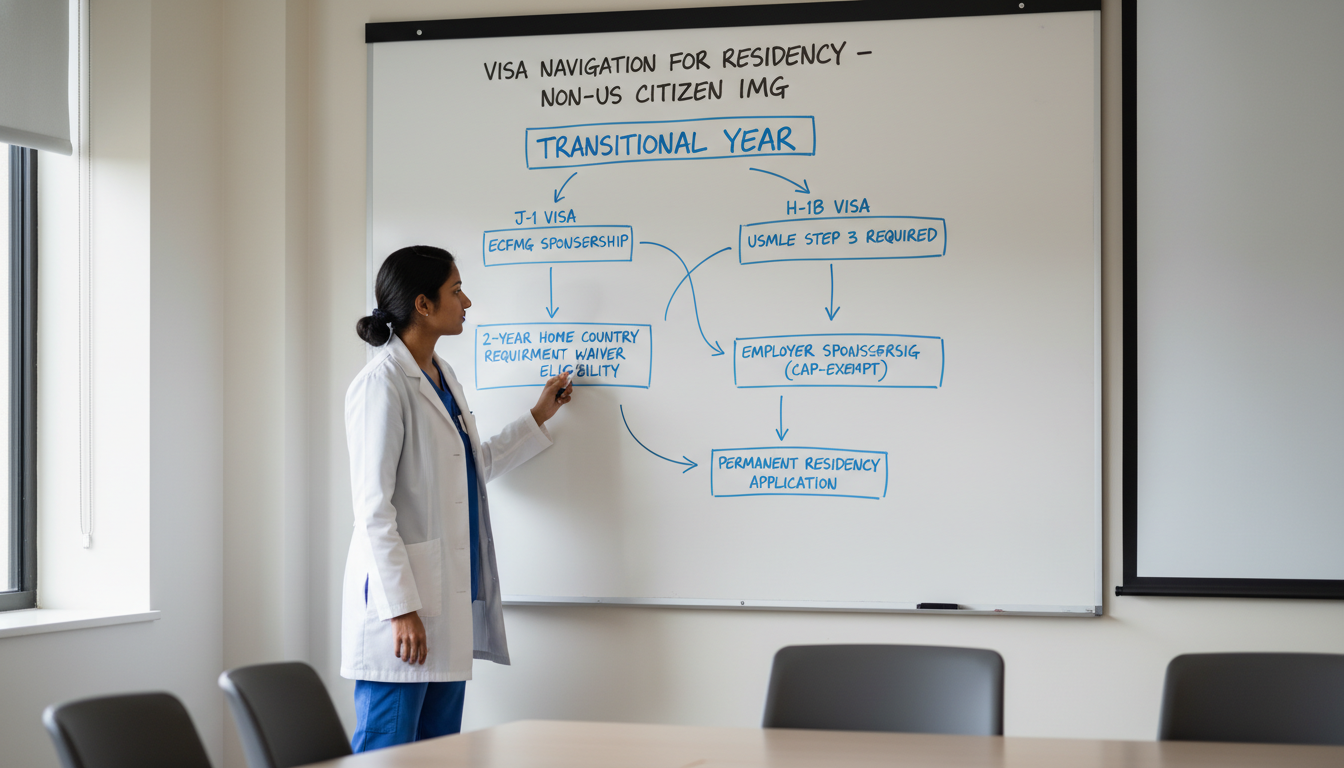
H-1B Visa for Transitional Year
The H-1B is a temporary worker visa for specialty occupation roles, including resident physicians.
Key requirements for H-1B in residency:
- USMLE Step 3 typically required at the time of petition filing.
- The program must be willing to sponsor and pay legal and filing fees.
- Prevailing wage requirements must be met.
- The TY program must be ready to assume employer responsibilities for you.
Pros of H-1B for TY:
- No automatic 2-year home return requirement like with J-1.
- Can sometimes transition from TY → advanced residency → employment more directly.
- Can be dual intent (simultaneously pursue permanent residency).
Cons of H-1B for TY:
- Many Transitional Year programs do not sponsor H-1B, especially for such a short (one-year) term.
- You need USMLE Step 3 cleared early, often before Match season deadlines.
- The program faces higher administrative burden and costs, making it less attractive to them.
- Changing employers (e.g., from TY program to advanced program) requires a new H-1B petition; timing can be tight.
- In some cases, you may fall under H-1B cap, though many academic institutions qualify as cap-exempt.
For Transitional Year specifically, the short program duration makes H-1B less common. Some programs will only consider H-1B if you are also accepted into their linked advanced program and thus staying for multiple years.
How Your Transitional Year Visa Impacts Future Training
Visa navigation for a Transitional Year residency is not just about Year 1—it’s about the chain of steps that follow.
Typical Pathways for a Non-US Citizen IMG in TY
- TY (1 year) → Advanced Residency (3–4 years) → Fellowship (1–2 years)
- Preliminary or Transitional Year → Categorical switch (if you reapply in Match)
- Direct employment (less common immediately after TY unless in home country)
Your residency visa during the TY year sets constraints on these steps.
Path 1: J-1 for TY and J-1 for Advanced Residency
- Most common scenario for foreign national medical graduates.
- You complete:
- 1-year Transitional Year on J-1
- 3–4 years of advanced residency on J-1
- Optional fellowship on J-1, staying within the 7-year limit
- After training, you must:
- Return to home country for 2 years, or
- Obtain a J-1 waiver (e.g., Conrad 30, HHS waiver, VA waiver, etc.).
Practical tip:
If you foresee needing fellowship training (e.g., Interventional Radiology, Cardiac Anesthesia), check how many years total you will require. Plan your J-1 years accordingly to avoid hitting the limit.
Path 2: H-1B for TY and H-1B for Advanced Residency
- Less common, particularly for a stand-alone Transitional Year program.
- More feasible when:
- The same institution offers both TY + Advanced training.
- The institution is cap-exempt and used to sponsoring H-1Bs.
- Allows a smoother path to:
- Employment on H-1B.
- Potential green card process without dealing with a J-1 waiver.
Risks and considerations:
- If your advanced residency match is at a different institution that does not sponsor H-1B, you may be forced to:
- Switch to J-1 for the advanced program, or
- Decline the position and limit your options.
- Timing USMLE Step 3 becomes critical—without it, you cannot start on H-1B.
Path 3: J-1 for TY, then H-1B for Advanced (or Vice Versa)
- J-1 → H-1B:
If you start on J-1 for TY, in almost all cases you become subject to the 2-year home-country requirement. This will block H-1B (and many other statuses) unless:- You complete the 2-year physical presence in your home country, or
- You secure a J-1 waiver first.
- H-1B → J-1:
Moving from H-1B in TY to J-1 in advanced residency is technically possible, but:- You would then become subject to J-1’s 2-year home-country rule at the end of all J-1 training.
- Some programs might hesitate to sponsor J-1 if you already hold or held H-1B.
Bottom line:
For most non-US citizen IMGs in Transitional Year programs, starting J-1 often keeps more residency positions open, but it also commits you to dealing with the J-1 waiver process later if you intend to stay and work in the US.
Step-by-Step Visa Planning for Transitional Year Applicants
Step 1: Clarify Your Long-Term Career Plan
Before you decide on J-1 vs H-1B, ask yourself:
- Do I ultimately want to return to my home country to practice?
- Do I strongly want to remain in the US long term (practice + possible permanent residency)?
- Is my priority to maximize the number of residency programs I can apply to, or to avoid the J-1 home residency requirement?
If your plan is to return home, J-1 may be perfectly aligned with your goals.
If you strongly want US long-term practice, H-1B can be attractive—but may reduce your options for Transitional Year and advanced residency spots.
Step 2: Research Visa Policies of Transitional Year Programs
As a foreign national medical graduate, you should systematically evaluate each TY program’s visa policy:
- Check the program’s website (usually under “Eligibility & Visa” section).
- Look at FREIDA or program directories for:
- “Sponsoring J-1”
- “Sponsoring H-1B”
- “No visa sponsorship”
- Email or call the program coordinator if policies are unclear.
Questions to ask:
- Do you sponsor J-1 visas for Transitional Year residents?
- Do you sponsor H-1B visas, and if so, for TY or only for categorical/advanced positions?
- Is USMLE Step 3 required by a certain date for H-1B sponsorship?
- If your TY program is part of an institution with advanced specialties:
- Does the institution extend H-1B beyond the transitional year when matched to an advanced residency there?
Create a spreadsheet tracking:
- Program name
- City/State
- Visa types sponsored
- Advanced specialties and whether they sponsor the same visa
- Special notes (e.g., Step 3 deadline, exceptions)

Step 3: Coordinate TY and Advanced Program Visa Strategies
If you are applying for Transitional Year + Advanced positions in the same Match cycle (common in radiology, anesthesiology, etc.):
- List your target advanced programs.
- Check their visa sponsorship policies:
- Many competitive advanced programs sponsor only J-1.
- Some sponsor both J-1 and H-1B.
- A minority sponsor only H-1B.
- Look for alignment:
- Ideal: TY and Advanced program both sponsor the same visa type you prefer (usually J-1).
- Acceptable: TY sponsors J-1 and Advanced sponsors both (so you can stay J-1).
- Risky: TY only sponsors H-1B, but your dream advanced programs only sponsor J-1; or vice versa.
Example scenario:
- You want to do Diagnostic Radiology.
- Your preferred advanced DR programs mostly accept J-1 only.
- A TY program you like sponsors H-1B but not J-1.
In this case:
- If you choose H-1B for TY, you may not be eligible for J-1-only DR programs.
- Opting for J-1 TY programs might expand your advanced match opportunities.
Step 4: Time Your Exams Strategically (Especially Step 3)
For an H-1B residency visa, US programs usually require:
- Step 1
- Step 2 CK
- Step 3 PASSED before they file the H-1B petition.
Because H-1B petitions can take months, programs often need Step 3 done before Rank List deadlines or even before interviews.
For a Transitional Year residency, this is particularly challenging if:
- You are still in medical school abroad.
- You are just finishing your internship at home.
If H-1B is your goal:
- Plan to take Step 3 early, preferably:
- During a post-graduate year at home, or
- In a gap year focused on exams and USCE.
- Confirm with programs their exact Step 3 deadlines for H-1B sponsorship.
If your Step 3 timing is uncertain, targeting J-1-friendly TY programs may offer a more realistic and flexible route.
Step 5: Factor In Dependents and Family Considerations
If you have a spouse or children, visa choice affects them too:
- J-1 dependents (J-2):
- Spouse can usually apply for work authorization (EAD), subject to processing times and conditions.
- Children can attend school.
- H-1B dependents (H-4):
- Spouse generally cannot work (with limited exceptions tied to green card process).
- Children can attend school but also face long-term immigration constraints.
For some non-US citizen IMGs, the ability of a spouse to work on J-2 can outweigh other downsides. For others focused on long-term US permanent residency, H-1B’s dual-intent nature is a higher priority.
Step 6: Consult Professionals Early
Visa navigation for residency is complex and high-stakes. While this article gives a structured overview, individual cases differ.
Consider:
- Contacting your ECFMG advisor or using their official J-1 resources.
- Asking program coordinators about institutional immigration counsel.
- If you have a complicated case (previous visa denials, overstay, multiple statuses), talk to an immigration attorney with GME experience.
Common Pitfalls and How to Avoid Them as a Non-US Citizen IMG
Pitfall 1: Applying Blindly Without Checking Visa Sponsorship
Some applicants spend months crafting applications, only to discover:
- The program does not sponsor any visa, or
- It only sponsors a visa type they cannot or do not want to use.
Solution:
Make visa policy one of the first filters when building your program list, especially for your Transitional Year.
Pitfall 2: Ignoring Future Advanced Program Requirements
Another frequent mistake: focusing only on getting into any TY program, without checking whether your desired advanced programs:
- Accept your visa type
- Are within your J-1 time limit
- Are compatible with your exam timeline
Solution:
Plan your full path: Transitional Year + Advanced Residency + (optional) Fellowship. Cross-check visa compatibility at each step.
Pitfall 3: Missing Step 3 Timing for H-1B
Many IMGs hope for H-1B but fail to schedule or pass Step 3 in time.
Solution:
- If serious about H-1B, work backwards from:
- Program application deadlines
- Rank list deadlines
- Typical H-1B petition filing windows
- Build in buffer for test scheduling, travel, and potential retake.
Pitfall 4: Not Understanding the J-1 Home Residency Requirement
Some IMGs assume they can easily switch from J-1 to H-1B or green card later without issues.
Reality:
- Once you train on J-1 in GME, you are usually subject to the 2-year home-country requirement.
- This affects:
- H-1B
- L-1
- K visas
- Permanent residency (green card)
- You need either:
- 2 years back home, or
- A formal J-1 waiver (not guaranteed, and subject to location/service requirements).
Solution:
Before accepting a J-1 for your Transitional Year, understand how you might fulfill or waive the 2-year requirement if you aim to stay in the US.
FAQs: Visa Navigation for Non-US Citizen IMGs in Transitional Year Programs
1. As a non-US citizen IMG, is it realistic to get an H-1B for a one-year Transitional Year residency?
It is possible but not common. Many transitional year programs prefer J-1 visas because:
- The program is only one year, and H-1B involves higher legal and administrative costs.
- USMLE Step 3 timing limits the pool of H-1B-eligible applicants.
- Institutions may reserve H-1B sponsorship for longer, categorical programs.
You are more likely to see H-1B sponsorship if:
- The TY is integrated with an advanced residency at the same institution.
- You match into both and stay there for several years.
- You have already passed Step 3 and the program routinely handles H-1Bs.
2. If I start my Transitional Year on J-1, can I switch to H-1B for my advanced residency?
In most cases, no—not without addressing the J-1 home-country requirement. Once you participate in GME on J-1 under ECFMG sponsorship, you typically become subject to the 2-year home-country physical presence requirement (212(e)). This requirement blocks H-1B and permanent residency unless:
- You complete 2 years in your home country, or
- You obtain a J-1 waiver.
So, starting J-1 for TY essentially commits you to either:
- Completing training on J-1, then seeking a waiver and J-1 waiver job, or
- Returning home for 2 years after training.
3. Do all Transitional Year programs sponsor visas for foreign national medical graduates?
No. Transitional Year programs vary widely:
- Some sponsor J-1 only.
- Some sponsor both J-1 and H-1B (less common).
- Some sponsor no visas at all and only accept US citizens/green card holders.
As a non-US citizen IMG, you must verify each program’s visa policy before applying. Use FREIDA, program websites, and direct communication with program coordinators.
4. I am a non-US citizen IMG planning to apply TY + Diagnostic Radiology. Which visa strategy is usually safest?
From a matchability standpoint, most IMGs in this scenario:
- Apply broadly to J-1-friendly Transitional Year and Advanced Radiology programs.
- Accept J-1 for both TY and advanced residency.
- Plan early for:
- J-1 waiver options (e.g., Conrad 30) if they want to work in the US after training, or
- Returning home to fulfill the 2-year requirement.
If you:
- Have Step 3 early,
- Target institutions that sponsor H-1B for both TY and DR, and
- Are comfortable with fewer program options,
then an H-1B pathway may work, particularly for those focused on long-term US immigration goals. But for most non-US citizen IMGs entering competitive specialties through a TY, J-1 remains the most accessible and widely accepted route.
By understanding your IMG visa options, weighing J-1 vs H-1B carefully, and planning beyond just the Transitional Year, you can align your immigration pathway with your residency and long-term career goals. Thoughtful preparation now will make your path through the Match, your Transitional Year, and your advanced training much smoother and more predictable.