Understanding the Visa Landscape for Non-US Citizen IMGs in Seattle
For a non-US citizen IMG (international medical graduate), securing the right visa is just as important as achieving a strong USMLE score or a solid set of letters of recommendation. In Seattle and across Washington state residency programs, your visa category can affect:
- Which programs will consider you
- How you are funded and supervised
- Your long-term career options in the United States
Seattle is home to highly competitive academic and community programs—most notably anchored around the University of Washington (UW), one of the largest and most influential training institutions in the Pacific Northwest. For a foreign national medical graduate targeting Seattle residency programs, understanding residency visa options early can prevent last-minute surprises and strengthen your application strategy.
This guide focuses on practical, step-by-step navigation of J-1 vs H-1B decisions, timelines, and common pitfalls specifically for non-US citizen IMGs who want to match in Seattle.
Core Visa Options for Residency: Big Picture Overview
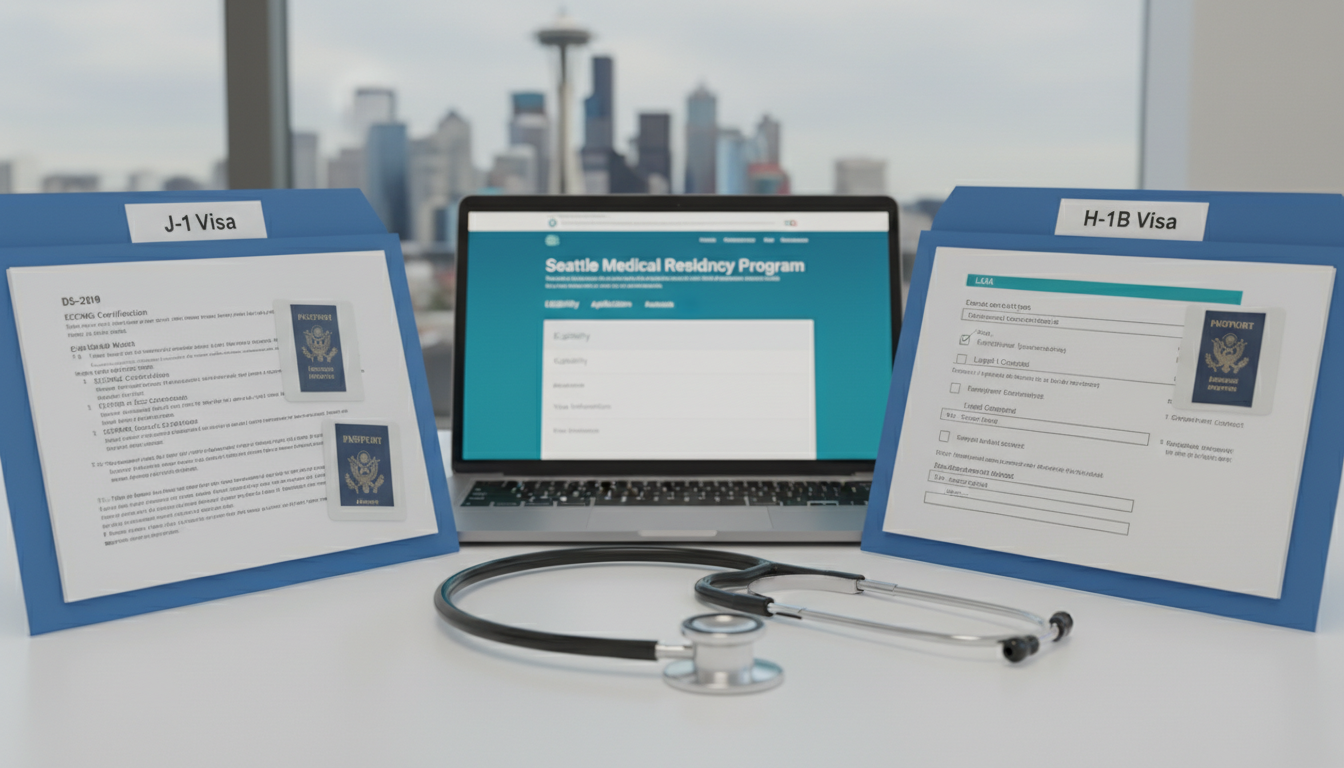
Most non-US citizen IMGs in US residency programs train under one of two visa categories:
- J-1 Exchange Visitor (ECFMG-sponsored physician visa)
- H-1B Temporary Worker (specialty occupation)
There are other less common paths (e.g., green card, EAD through family-based or other status), but for most foreign national medical graduates applying from abroad, the J-1 vs H-1B decision is central.
J-1 Exchange Visitor Visa (ECFMG-Sponsored)
This is the most common visa for IMGs doing residency and fellowship training.
Key features:
- Sponsor: ECFMG (Educational Commission for Foreign Medical Graduates)
- Purpose: Graduate medical education (residency and fellowship)
- Duration: Typically up to 7 years total for clinical training (with category-specific rules)
- Employment: You are sponsored for training at a specific program and institution
- Funding: Usually your salary comes from the hospital/department, but the visa itself is sponsored by ECFMG
Two-year home-country physical presence requirement (212(e))
Most J-1 physicians are subject to a two-year home-country return requirement after completing training. This means:
- You must return to your home country for a total of 2 years, or
- Obtain a waiver of this requirement (e.g., through a Conrad 30 or federal agency waiver) before you can:
- Get an H-1B or L-1 visa
- Apply for permanent residency (green card)
- Change status to many other non-immigrant categories in the US
In practice, many J-1 physicians transition to working in underserved areas under J-1 waiver programs after residency/fellowship.
Pros of J-1:
- Widely accepted by Seattle residency programs and across Washington state
- Straightforward, standardized process through ECFMG
- No USMLE Step 3 required before the Match
- Often easier to secure for new graduates directly from abroad
Cons of J-1:
- Two-year home-country requirement unless waived
- Limited flexibility if you want to change institutions or non-clinical pathways
- Future employment often tied to working in underserved or rural sites (for waiver jobs)
H-1B Specialty Occupation Visa (for Residents)
The H-1B is a dual-intent work visa that some programs use to sponsor residents and fellows.
Key features:
- Sponsor: Residency program / institution (e.g., UW Medicine or affiliated hospitals)
- Purpose: Employment in a specialty occupation (physician)
- Duration: Typically up to 6 years total (can be extended in some green card processes)
- USMLE requirement: Step 3 is required before H-1B petition filing in almost all cases for residency
Pros of H-1B:
- No two-year home-country requirement
- Dual intent: Easier to transition to permanent residency (green card) during or after training
- Often more flexible for long-term US career planning
- No need for J-1 waiver if you later move into an attending role
Cons of H-1B:
- Not all Seattle or Washington state residency programs sponsor H-1B for residents
- Requires USMLE Step 3 before the visa petition—this affects your timeline
- Sometimes involves higher administrative costs and more complex institutional review
- Annual cap issues can apply for some employers (less often for large academic centers, but must be clarified)
Visa Sponsorship Culture in Seattle and Washington State
Seattle and greater Washington state host a mix of academic, community, and hybrid residency programs. The largest anchor is the University of Washington (UW), but there are also multiple community-based programs around the Seattle metro area and beyond (Tacoma, Everett, Spokane, etc.).
From a visa perspective, your focus should be:
- Which programs sponsor J-1 only
- Which programs sponsor both J-1 and H-1B
- Which (few) programs may not sponsor any residency visa for IMGs
Typical Patterns in Seattle Residency Programs
While each program is unique, some general patterns apply in the Seattle area:
Large Academic Centers (e.g., UW Medicine)
- Often sponsor J-1 routinely
- May sponsor H-1B selectively, especially for highly competitive specialties or senior residents/fellows
- Usually have an institutional GME office and international scholars office with clear policies
Community-based Programs (suburban or regional hospitals)
- Many sponsor J-1 only due to simpler administration
- Some may be open to H-1B but have limited experience or specific conditions (e.g., internal candidates only)
Smaller or Newer Programs in Washington State
- May rely heavily on the J-1 route
- Sometimes have no IMG visa options if they do not have international sponsorship infrastructure
How to Research Visa Policies for Seattle Programs
To target your application effectively:
Use FREIDA and Program Websites
- Search for Seattle residency programs and Washington state residency programs in your specialty.
- On FREIDA and the program’s website, look for:
- “Accepts J-1”
- “Accepts H-1B”
- “Requires US citizenship or permanent residency”
Evaluate Visa Language Carefully
- “We sponsor J-1 visas only” → J-1 is your only route there.
- “We sponsor J-1 and H-1B visas” → Confirm conditions (e.g., internal candidates, no first-year H-1B, Step 3 by rank list deadline).
- “We do not sponsor visas” → As a non-US citizen IMG without other status, you cannot match there.
Email the Program Coordinator for Clarification
When information is unclear, send a concise email. Example:Dear [Coordinator Name],
I am a non-US citizen IMG interested in your [Specialty] residency program. Could you please confirm whether your program sponsors residency visas for foreign national medical graduates, and if so, whether J-1 and/or H-1B visas are supported for PGY-1 applicants?
Thank you for your time,
[Your Name, Credentials]
This simple step can save you from wasting ERAS applications on programs that cannot sponsor your needed visa.
J-1 vs H-1B: Strategic Decisions for a Non-US Citizen IMG
Choosing between J-1 and H-1B is not just a visa question—it’s a career planning decision.
When J-1 May Be the Better Fit
J-1 is often the default for non-US citizen IMGs, especially those applying from abroad. J-1 may be advantageous when:
- You are early in your career and primarily focused on matching into any strong residency program in the US.
- You are flexible about potentially returning to your home country for a few years or practicing in an underserved US area through a J-1 waiver job.
- You do not yet have USMLE Step 3 and the timeline to take and pass it before rank list deadlines is unrealistic.
- The majority of Seattle residency programs in your specialty sponsor J-1 but not H-1B.
Example scenario:
You are a non-US citizen IMG currently in your home country, with strong Step 1 and Step 2 CK scores but no Step 3. You aim for Internal Medicine in Seattle and find that most programs in the area routinely sponsor J-1. You decide:
- To apply widely to J-1-sponsoring programs in Washington state and the broader West Coast.
- To focus on strengthening US clinical experience (USCE) and letters rather than rushing Step 3.
- To plan for potential J-1 waiver options (e.g., Hawaii, Alaska, rural Washington) if you want to stay in the US after training.
When H-1B May Be Worth Pursuing
H-1B can be highly valuable if your long-term goal is to stay in the US without the J-1 home-country requirement. H-1B may fit you if:
- You already have or can obtain USMLE Step 3 before the program’s H-1B cutoff (often before ranking deadlines).
- You are committed to a long-term US career and want to minimize immigration constraints after residency.
- You are applying to specialties or specific Seattle programs known to offer H-1B visas (e.g., some Internal Medicine, Neurology, or subspecialty tracks at large academic centers).
- You are comfortable with a more complex application process and communication with program coordinators and institutional legal offices.
Example scenario:
You are a foreign national medical graduate currently in the US on an F-1 visa, finishing a Master of Public Health. You have completed USMLE Step 3. You want an Internal Medicine residency in Seattle and eventually plan to pursue a physician-scientist career and a green card. You:
- Prioritize programs that explicitly support H-1B for residents.
- Mention in your ERAS personal statement or at interviews that you have Step 3 completed and are open to H-1B sponsorship.
- Ask targeted, professional questions to program leadership about H-1B policies during interviews.

Application, Match, and Visa Timing: Step-by-Step
Residency applications and visa timelines intersect in specific ways. For a non-US citizen IMG, careful planning is critical to avoid delays that could jeopardize your start date.
1. Pre-ERAS Planning (12–18 months before Match)
- Clarify your visa goals: J-1, H-1B, or both as possibilities.
- Check Seattle and Washington state residency program requirements:
- Do they accept foreign national medical graduates?
- Do they sponsor J-1, H-1B, or both?
- Schedule USMLE exams:
- Step 1 and Step 2 CK must be done before ERAS submission.
- Step 3 is essential if you want realistic H-1B chances for PGY-1.
For H-1B aspirants, target finishing Step 3 no later than December–January of the application cycle, though earlier completion (before interviews) is even better.
2. ERAS Application Season (September–January)
In your ERAS and communications:
- Indicate that you are a non-US citizen IMG and specify your visa preferences if the system allows (J-1 vs H-1B).
- If you have Step 3:
- Highlight this in your CV and personal statement.
- Mention it in responses to supplemental applications and emails.
During interviews, ask carefully:
- “Does your program support H-1B visas for residents?”
- “Are there any additional requirements (such as timing of Step 3 or institutional restrictions) that I should be aware of as a non-US citizen IMG?”
Keep questions polite, focused, and brief.
3. Rank List and Match (February–March)
By rank list time, you should:
- Have a clear understanding of each program’s visa policy.
- Know whether each ranked program can realistically support your residency visa category (at least J-1; H-1B if you are pursuing it).
- Consider ranking J-1-friendly Seattle programs higher if H-1B options are few or uncertain.
After Match Day, you will know your program and work with:
- The GME office or international office
- ECFMG (for J-1)
- Or the institution’s immigration counsel (for H-1B)
4. Post-Match: Visa Processing and Deadlines
For J-1 visa (ECFMG-sponsored):
- Your program submits a statement of need and appointment letter to ECFMG.
- You complete the EVSP (Exchange Visitor Sponsorship Program) application with ECFMG.
- Once approved, you receive Form DS-2019.
- You schedule a US embassy/consulate interview in your home country.
- Upon visa issuance, you can enter the US up to 30 days before your program start date.
For H-1B visa:
- The program’s GME or HR department initiates the H-1B request with the institution’s legal team.
- You must provide:
- Evidence of USMLE Step 3
- Valid ECFMG certification
- Medical diploma and translation (if needed)
- The institution files a Labor Condition Application (LCA) and then the H-1B petition (Form I-129) with USCIS.
- Upon approval, you obtain an H-1B visa stamp at a US consulate abroad (if outside the US) or change status (if already in the US in another non-immigrant category).
Because there are multiple layers (internal approvals, USCIS, consulate), H-1B timelines are tight. It is not unusual for the process to take 3–5 months from initiation to visa issuance, so early coordination is vital.
Long-Term Planning: After Residency in Seattle
Your residency visa will influence your options after training in Washington state or elsewhere in the US.
Pathways After a J-1 Residency
If you complete residency in Seattle on a J-1:
J-1 Home Country Return (212(e)):
- You may return to your home country and practice or pursue academic positions for at least two years.
- After fulfilling the requirement, you can re-apply for other US visas or immigrant status.
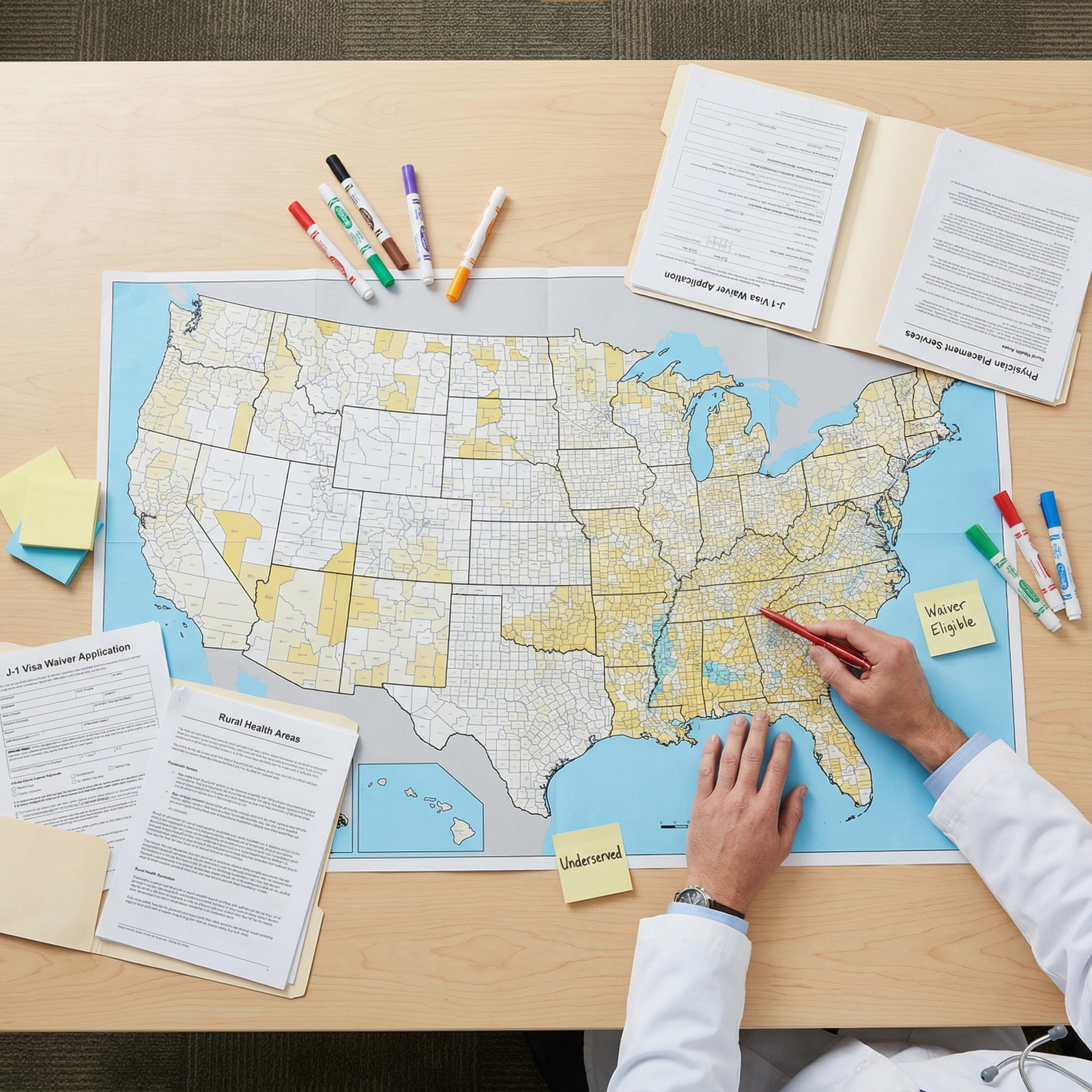
J-1 Waiver Jobs (Conrad 30 & Federal Waivers):
- Many states, including Washington, participate in the Conrad 30 program, which offers up to 30 J-1 waiver slots per year for physicians willing to work in underserved areas.
- You must secure a job offer in a designated underserved region and have your employer and state health department support your waiver.
- After the waiver job (usually a 3-year commitment under H-1B), you can pursue a green card or other long-term status.
Academic or Research Positions with Waivers:
- Certain federal agencies (e.g., VA, HHS, DoD) can also sponsor J-1 waivers for physicians.
- Seattle, as a major medical and research hub, may have such roles at UW affiliates or VA hospitals.
Pathways After an H-1B Residency
If you complete residency in Seattle under H-1B:
- You can often continue on H-1B for a fellowship or attending job, subject to the 6-year clock and cap issues.
- You may pursue employer-sponsored green cards (e.g., EB-2, EB-2 NIW), especially if you engage in research or serve in shortage areas.
- You avoid the J-1 two-year home-country return requirement, though you must still manage H-1B time limits.
For many non-US citizen IMGs, H-1B offers a more straightforward pathway to long-term US practice, but accessing that pathway depends heavily on your Step 3 timing and program sponsorship policies.
Practical Tips and Common Pitfalls for Non-US Citizen IMGs
1. Start Visa Planning Early
- Begin researching IMG visa options during your USMLE preparation phase.
- Align your Step 3 timing with H-1B possibilities if you want that route.
2. Be Honest and Clear with Programs
- Disclose your true status (non-US citizen IMG, foreign national medical graduate) in ERAS.
- Don’t assume that a program will “figure it out later”—visa issues can derail onboarding if not addressed early.
3. Don’t Over-Restrict Yourself to H-1B Programs
- Many strong Seattle residency programs only sponsor J-1.
- Over-focusing on H-1B may significantly reduce your chances of matching at all, especially in competitive specialties.
A balanced approach is often best: apply broadly to J-1-sponsoring programs, and selectively to strong H-1B-sponsoring programs if you have Step 3.
4. Monitor Policy Changes
- Visa policies (J-1 vs H-1B rules, US immigration climate) can change.
- Keep up-to-date via:
- ECFMG announcements
- Program GME office communications
- Official USCIS and Department of State updates
5. Seek Expert Guidance
- Use your school’s international office, mentors, and IMG advisors.
- When in doubt about legal specifics, consult a qualified immigration attorney, especially if your case involves complex history (previous US visas, overstays, status changes).
FAQs: Visa Navigation for Residency in Seattle for Non-US Citizen IMGs
1. Do Seattle residency programs prefer J-1 or H-1B for non-US citizen IMGs?
Most Seattle and Washington state residency programs are very familiar with the J-1 physician visa and use it as their default for IMGs. Some large academic programs and certain community programs will sponsor H-1B, but often with additional criteria (Step 3 completion, internal candidates, or specific specialties). As a non-US citizen IMG, you should assume that J-1 is the more widely available pathway, and then identify a subset of programs that might consider H-1B.
2. Can I switch from J-1 to H-1B during or after residency?
If you are subject to the J-1 two-year home-country physical presence requirement, you generally cannot switch to H-1B inside the US until you:
- Fulfill the two-year requirement by living in your home country, or
- Obtain a J-1 waiver (e.g., through Conrad 30 or a federal agency).
Many J-1 physicians complete residency and then move into H-1B waiver jobs in underserved areas. Direct switching mid-residency from J-1 to H-1B without dealing with the two-year requirement is usually not allowed.
3. Is USMLE Step 3 mandatory to get a residency visa in Seattle?
For J-1, Step 3 is not required to enter residency; ECFMG certification is sufficient.
For H-1B, Step 3 is effectively mandatory for residents, because state medical boards and USCIS require evidence that you are fully qualified for licensure in that jurisdiction. If you want realistic chances at H-1B sponsorship in Seattle, you should plan to pass Step 3 before the program’s H-1B filing deadlines, ideally before or during interview season.
4. As a non-US citizen IMG, how should I list my visa preference in ERAS?
If ERAS or supplemental applications ask about visa preferences, you can usually indicate:
- “J-1 only” if that is your only feasible option
- “J-1 or H-1B” if you have Step 3 or expect to get it in time
- “H-1B only” rarely makes sense unless you know your target programs strongly prefer H-1B and you already hold Step 3 and meet all criteria.
In interviews, it is reasonable to say:
“I am a non-US citizen IMG and I am open to J-1 sponsorship. I also have Step 3 completed and would be grateful if the program is able to consider H-1B, but I understand institutional policies may vary.”
This signals flexibility and realism while still expressing your H-1B interest.
By understanding how J-1 vs H-1B works in practice, how Seattle residency programs approach sponsorship, and how timing and documentation fit into the Match cycle, you can design a visa strategy that supports—not limits—your goal of training and building a medical career in Washington state.