Pathology is one of the most IMG-friendly specialties in the United States, but successful visa navigation is often the critical step that determines whether an offer in the pathology residency match can turn into an actual training position. Understanding your visa options early—especially J-1 vs H-1B—and planning strategically around exam timelines, contracts, and long‑term career goals is essential.
This guide walks you through the visa landscape for pathology residency, tailored specifically to international medical graduates (IMGs). It focuses on residency visa pathways, what programs really look for, and how to avoid common pitfalls that can derail an otherwise strong application.
Understanding the Visa Landscape for Pathology Residency
Visa planning should start before you apply to pathology programs, not after you match. Many residency directors report that a strong applicant can become “unrankable” if they require a visa type the program cannot sponsor.
Why Visa Planning Matters More in Pathology
Pathology has some unique characteristics relevant to visas:
- Relatively IMG-friendly: Many pathology programs, especially community and mid-sized university programs, rely heavily on IMGs and are accustomed to visa sponsorship.
- Data-driven, documentation-heavy field: Program coordinators and GME offices often have structured processes and deadlines for visa documentation; missing these can delay or jeopardize your start.
- Subspecialty aspirations: Many pathology residents pursue fellowships (e.g., hematopathology, cytopathology, molecular pathology). The visa you choose now can heavily influence your fellowship and future job options.
Two Main Residency Visa Categories: J-1 vs H-1B
For most IMGs entering pathology residency, the practical choices narrow down to:
- J-1 Exchange Visitor (ECFMG-sponsored)
- H-1B Temporary Worker (institution-sponsored)
Other visa types (F-1 OPT, O-1, TN, Green Card) may be relevant in niche situations but are not primary pathways into pathology residency.
Key point: Many pathology programs sponsor only J-1, some sponsor J-1 and H-1B, and a minority sponsor no visas at all. Knowing this before applying can save you time and money.

Deep Dive: J-1 vs H-1B for Pathology Residents
J-1 Visa for Pathology Residency
The J-1 physician visa, sponsored by ECFMG, is the most common visa type for IMGs in residency across all specialties, including pathology.
Core Features
- Sponsor: ECFMG (not your hospital directly)
- Purpose: Graduate medical education (residency/fellowship)
- Duration: Up to 7 years total of clinical training, with yearly renewals
- Home residency requirement: 2-year home-country physical presence requirement after training completion, unless you obtain a waiver
Advantages of the J-1 in Pathology
Broad acceptance among programs
Many pathology departments are structured to take J-1 residents; their GME dockets, deadlines, and HR systems are set up around J-1 rules.Predictable framework
ECFMG has clear criteria:- Valid ECFMG certification
- A confirmed pathology residency position
- Contract/offer letter meeting specific requirements
- Proof of adequate funding and health insurance
Relatively straightforward renewals
As long as your program supports you and you remain in good standing, J-1 renewals are typically routine.Flexible for pathology fellowships
Within the 7-year cap, it’s usually possible to:- Complete 3–4 years of pathology residency (AP, CP, or AP/CP)
- Then 1–3 years of subspecialty fellowship (e.g., surgical pathology, hematopathology, GI, cytopathology, molecular)
Disadvantages and Constraints
2-year home-country return requirement
After finishing training, you must either:- Return to your home country for at least 2 years, or
- Obtain a J-1 waiver allowing you to stay and work in the U.S.
For pathology, securing a waiver job can be more challenging than in primary care because:
- Waiver positions are often designed around patient-facing specialties
- Pathology jobs qualifying for waivers exist but are more geographically and institutionally limited
No moonlighting for immigration purposes
J-1 status is tied to your training program. Off-site or outside work is highly restricted and usually not permitted.Dependents (J-2) work authorization is allowed but requires a process
Your spouse on J-2 can apply for an EAD (Employment Authorization Document), but:- It takes time to process
- Employment is not guaranteed; they must find their own job
Limited path to permanent residency without a waiver
Switching directly from J-1 to Green Card is not generally possible until the home residency requirement is addressed via return or waiver.
H-1B Visa for Pathology Residency
The H-1B is a temporary work visa for “specialty occupations” and can be used for residency and fellowship, though fewer programs sponsor it.
Core Features
- Sponsor: The residency institution directly
- Purpose: Employment in a specialty occupation (here, physician resident)
- Duration for residency: Up to 6 years total, including any H-1B time used previously (research, prior jobs, etc.)
- Exam requirements: Requires passing USMLE Step 3 before H-1B petition filing (in most states/programs)
Advantages of H-1B in Pathology
No 2-year home-country return requirement
When residency or fellowship ends, you can:- Move directly to an attending H-1B job (if employer sponsors)
- Transition to a Green Card path without dealing with J-1 waiver issues
More straightforward transition to employment
Many pathology practices and academic institutions are comfortable hiring on H-1B, especially:- Academic centers
- Large private pathology groups
- Hospital-based pathology services
Moonlighting sometimes allowed
Depending on your program and visa structure, limited moonlighting may be possible if:- Your H-1B petition includes those work locations or
- A concurrent H-1B is filed (this is complex and not common in residency)
Disadvantages and Constraints
Not all pathology programs sponsor H-1B
Many explicitly accept only J-1 due to:- Institutional policy
- Legal costs and administrative burden
- Limited H-1B slots or concern about long-term employment commitments
USMLE Step 3 timing pressure
To start residency on H-1B:- Step 3 must be passed early enough to allow petition filing and approval before your start date
- This typically means taking Step 3 well before Match Day if you want to market yourself as “H-1B ready”
Limited total duration
With a 6-year cap including all prior H-1B time, long training paths may not fit. For pathology this usually works (3–4 years residency + 1–3 years fellowships), but:- If you already used H-1B time for research or other employment, you must calculate carefully
- Delays or repeating a year could tighten your total time
Dependents (H-4) generally cannot work (unless H-4 EAD eligible)
Unlike J-2, H-4 dependents:- Usually cannot work during residency
- May get EAD only if your H-1B sponsor has an approved I-140 and certain conditions are met
J-1 vs H-1B: How to Choose for Pathology
Your choice depends on priorities:
Choose J-1 if:
- You primarily want to match as broadly as possible
- You are flexible geographically after training
- You are comfortable with the idea of a J-1 waiver job or returning to your home country for two years
- You do not have Step 3 yet or cannot realistically pass it before residency contract processing
Choose H-1B if:
- You want to maximize chances of staying in the U.S. post‑training without a home residency return
- You have Step 3 passed early and strong scores
- You are willing to limit your application list to pathology programs that support H-1B
- You have a long-term plan for a Green Card (e.g., academic career, pathology group willing to sponsor you later)
In reality, many IMGs apply broadly, stating they prefer H-1B but are willing to take J-1, then decide case-by-case if they receive multiple offers.
Practical Timeline: Visa Strategy Across the Pathology Match
Visa navigation interacts with every stage of your pathology residency application.
Pre‑Application (12–18 Months Before Match)
Key tasks:
Clarify your visa history and eligibility
- Have you ever been on a U.S. visa (F-1, J-1, H-1B, B1/B2)?
- Did you hold a prior J-1 with a 2-year requirement?
- Any prior H-1B time used?
Research program visa policies early
- Use FREIDA, program websites, and emails to coordinators
- Look for:
- “We sponsor J-1 visas only”
- “We sponsor J-1 and H-1B”
- “We are unable to sponsor visas at this time”
Decide Step 3 strategy if aiming for H-1B
- Book Step 3 so the result arrives before:
- Rank list deadlines (to reassure programs)
- Contract issuance (often Feb–April after Match)
- If Step 3 timing seems unrealistic, consider J-1 as primary visa path
- Book Step 3 so the result arrives before:
Craft a visa-aware application narrative
- Personal statement: You don’t need a paragraph on visas, but avoid contradictions (e.g., saying you must stay in the U.S. forever if you’re clearly a J-1 applicant)
- CV: Note any research positions held on prior visas
Application and Interview Season (ERAS to Rank List)
Goals during this phase:
Know each program’s stance before the interview
- If the website is unclear, politely email the coordinator:
- “Does your program sponsor J-1, H-1B, or both for pathology residents?”
- Document answers to help inform your rank list.
- If the website is unclear, politely email the coordinator:
Discuss visa status transparently—but strategically
- If you prefer H-1B:
- Mention that Step 3 is passed or scheduled
- Clarify you’re also open to J-1 if true (many PDs like flexibility)
- If you are J-1 only:
- Show you understand the implications and are still committed long-term to pathology (PDs worry less if you have a realistic plan)
- If you prefer H-1B:
Avoid red flags
- Do not appear uninformed about basic J-1 vs H-1B differences
- Don’t suggest you’re expecting the program to “fix” a complex prior visa issue without groundwork
Post‑Match and Pre‑Start (March–July)
Once you match into a pathology program:
Respond immediately to visa-related emails
- Programs often send:
- A list of documents needed
- Deadline for providing passport, ECFMG certificate, Step 3 score (if H-1B), etc.
- Delays can risk late starts or, in rare cases, lost positions.
- Programs often send:
For J-1 applicants:
- Complete ECFMG’s online J-1 application promptly
- Provide:
- Signed contract
- Statement of need from your home country (for some countries)
- Proof of funding (program salary letter often suffices)
- Evidence of health insurance or plan to enroll
- Track SEVIS fee payment and DS-2019 issuance; schedule your visa interview early
For H-1B applicants:
- Coordinate closely with GME/legal:
- Provide diploma, ECFMG certificate, Step 3 score report, CV, passport
- Confirm:
- Whether a cap-exempt H-1B is being filed (most academic hospitals are cap-exempt)
- Expected USCIS processing time
- Discuss start date flexibility if there is any risk of delays
- Coordinate closely with GME/legal:
Plan travel and contingencies
- Don’t book non-refundable flights until you have a visa stamp
- Have backup plans if interview availability is limited in your country
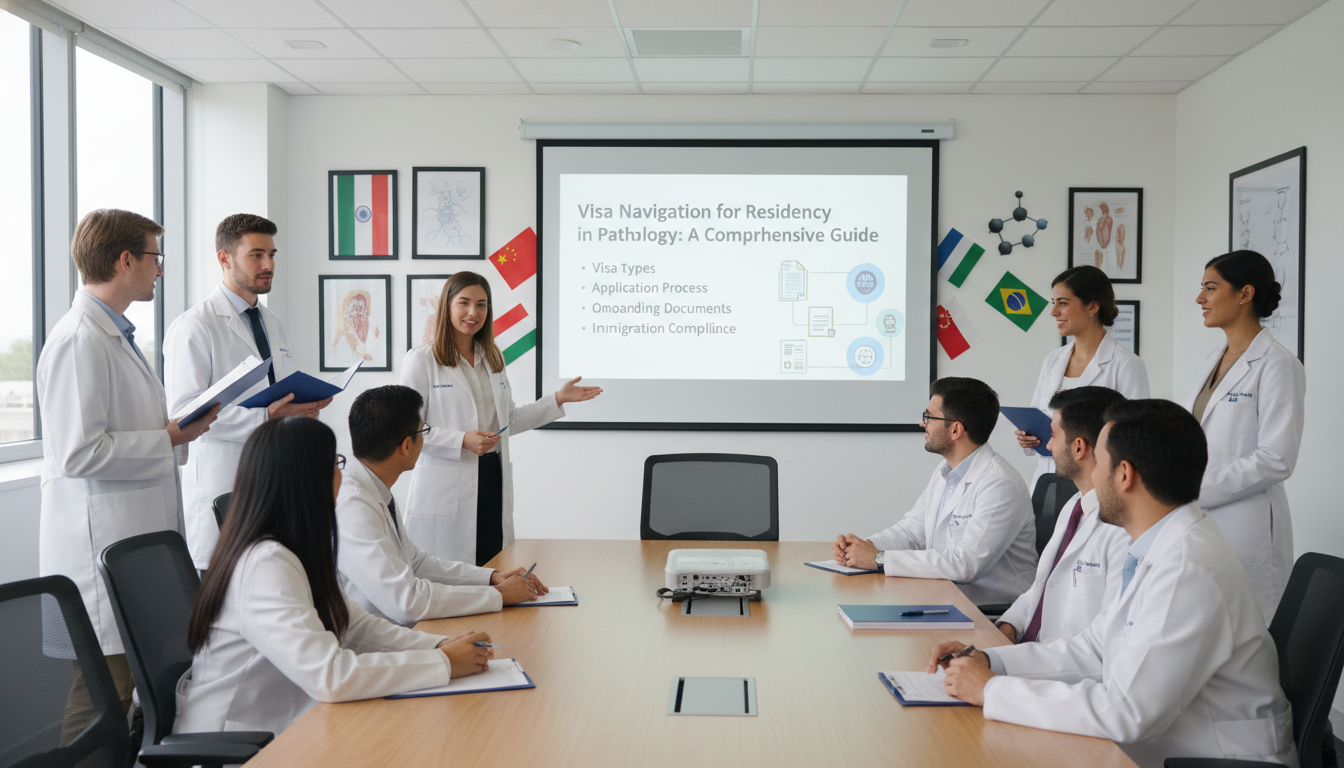
Special Considerations for IMGs in Pathology
IMG Visa Options: Beyond the Basic J-1 vs H-1B
While J-1 and H-1B dominate, some IMGs enter pathology via other paths:
F-1 Visa with OPT (Optional Practical Training)
- Common if you completed a U.S. degree (e.g., MPH, research MS) before residency
- You might start residency under F-1 OPT for a few months and then:
- Transition to J-1, or
- Transition to H-1B
- Coordination is complex; discuss early with GME and your school’s international office.
O-1 Extraordinary Ability Visa
- Rare for residents but occasionally used by highly accomplished researchers
- More common for faculty-level positions after fellowship than for residency
TN (for Canadian and Mexican citizens)
- Historically less used for residency; details vary and must be confirmed with each institution’s legal team
Permanent Resident (Green Card) Applicants
- If you already hold a Green Card:
- Visa issues are largely separate from your pathology match
- You compete like a U.S. graduate in terms of work authorization
- If you already hold a Green Card:
J-1 Waivers After Pathology Training
If you train on J-1 and want to stay in the U.S., you’ll likely look at a J-1 waiver job.
Common waiver routes:
Conrad 30 programs (state-level)
Focused mostly on direct patient care specialties, but some states and institutions may allow pathology roles if they can justify community need.VA (Veterans Affairs) positions
Occasionally sponsor waivers for pathologists, especially in underserved regions.Federal agencies (e.g., HHS)
Very specific and usually research-oriented positions.
For pathology, waiver jobs can be competitive and geographically limited; planning ahead during residency (networking, attending national meetings like USCAP or CAP) is critical.
Long-Term Career and Green Card Implications
If you train on J-1:
- Pathway usually involves:
- J-1 residency/fellowship → J-1 waiver H-1B job → Employer-sponsored Green Card (PERM → I-140 → I-485)
If you train on H-1B:
- Common sequence:
- H-1B residency → H-1B fellowship → H-1B attending job → Green Card sponsorship
- Be mindful of the 6-year H-1B limit and leverage:
- I-140 approval to extend H-1B beyond six years when eligible
Discuss these plans with potential employers early. Many pathology groups are familiar with sponsoring Green Cards for IMGs but expect you to show basic understanding of your visa trajectory.
Program Selection Strategy: Matching Visa Reality with Pathology Goals
Designing your application list around visas is just as important as STEP scores and letters.
Step 1: Classify Programs by Visa Policy
Create a spreadsheet for pathology programs with, at minimum:
- Program name
- Location
- J-1 policy (Yes/No)
- H-1B policy (Yes/No)
- Preference stated (e.g., “J-1 preferred”)
- Notes from emails or websites
Filter programs into:
- J-1 only
- J-1 and H-1B friendly
- No visa sponsorship
Step 2: Align with Your Profile
If no Step 3 or marginal scores:
Prioritize J-1-friendly programs; consider a few H-1B programs but don’t base your whole strategy on them.If strong scores and early Step 3:
You can more confidently target H-1B programs, but still maintain a substantial list of J-1 programs to ensure a match.
Step 3: Be Explicit (But Flexible) in Communication
Email examples:
If Step 3 passed and you want H-1B:
- “I have completed USMLE Step 3 and would be eligible for an H-1B visa. I understand your program sponsors both J-1 and H-1B, and I am open to either, but would prefer H-1B if possible.”
If J-1 is your only viable option:
- “I am planning to apply on a J-1 visa through ECFMG and have reviewed the requirements. I would be grateful to train in a program that routinely supports J-1 physicians.”
This clarity helps programs understand your situation and avoids confusion late in the process.
Frequently Asked Questions (FAQ)
1. Is pathology an IMG-friendly specialty in terms of visa sponsorship?
Yes. Pathology historically has a high proportion of international medical graduates, and many programs are familiar with J-1 sponsorship. A reasonable subset also supports H-1B visas, especially at academic centers and some larger community programs. Compared with highly competitive specialties (like dermatology or plastic surgery), pathology offers more options for IMGs requiring a residency visa.
2. Should I delay applying for pathology residency until I pass Step 3 to get H-1B?
It depends on your circumstances:
- If you are early in your timeline and can realistically pass Step 3 before application or rank list deadlines, taking it can strengthen both your candidacy and H-1B eligibility.
- If delaying would mean skipping an entire match cycle or if your Step 1/2 scores are modest, it may be wiser to apply now and focus on J-1 programs rather than postponing your career for a year.
- Remember, J-1 remains the most widely available option, and securing a good pathology residency with J-1 is often preferable to waiting an extra year just to aim for H-1B.
3. Can I switch from J-1 to H-1B during my pathology residency?
In most cases, no. Once you begin clinical training on a J-1 physician visa:
- You incur the 2-year home-country residence requirement
- This requirement must be fulfilled or waived before you can change to H-1B or permanent resident status within the U.S.
Switching mid‑residency is generally not a straightforward option and should not be relied upon as part of your strategy. Plan as if your whole residency and fellowship training will be on J-1 if you start with it.
4. Does my choice of J-1 vs H-1B affect my chances of getting a pathology fellowship?
Indirectly, yes, but not usually at the point of fellowship selection:
- Fellowship directors primarily care about your training performance, letters, and fit.
- However, some institutions are reluctant to handle complex J-1 waiver issues or may have limited H-1B capacity.
- Most pathology fellowships can be done on J-1 within the 7-year limit, and many institutions are accustomed to J-1 fellows.
The bigger impact of your initial visa choice is after fellowship, when you’re applying for attending positions, especially if you need a J-1 waiver or continued H-1B sponsorship. Planning fellowship training in institutions that might eventually hire and sponsor you for a waiver or Green Card can be a strategic move.
Visa navigation is a central part of your journey to a pathology residency, not a side detail to handle after Match Day. By understanding the J-1 vs H-1B landscape, researching IMG visa options for each program, and aligning your exam and application timing with your chosen pathway, you can unlock the broad opportunities pathology offers IMGs—both in the residency match and in your long-term career.