
Understanding the Visa Landscape for Pediatrics-Psychiatry Residency
Pursuing a residency in Pediatrics-Psychiatry—especially in a combined or triple board program (Pediatrics, General Psychiatry, and Child & Adolescent Psychiatry)—already requires strategic planning. For international medical graduates (IMGs), adding visa navigation to the mix can feel overwhelming. Yet, with good preparation, it is entirely manageable and can even become a competitive strength in your application.
This guide focuses on:
- How visas intersect with peds psych residency and triple board training
- Comparing J-1 vs H-1B in the context of Pediatrics-Psychiatry
- Practical IMG visa options and timelines
- What program directors look for in visa-dependent applicants
- Long-term planning for fellowship, waiver jobs, and beyond
Throughout, assume the most common path: entering U.S. residency as an IMG and targeting Pediatrics-Psychiatry or a triple board program.
Core Visa Types for Pediatrics-Psychiatry Residency
1. Overview of Common Visa Categories
For medical residency, three visa categories are most relevant:
- J-1 Exchange Visitor (ECFMG-sponsored)
- H-1B Temporary Worker (Specialty Occupation)
- U.S. Permanent Resident or Other Status (e.g., green card, EAD via other routes)
For most IMGs, J-1 and H-1B are the principal options. Understanding them early helps you choose programs that realistically align with your situation and long-term career plans.
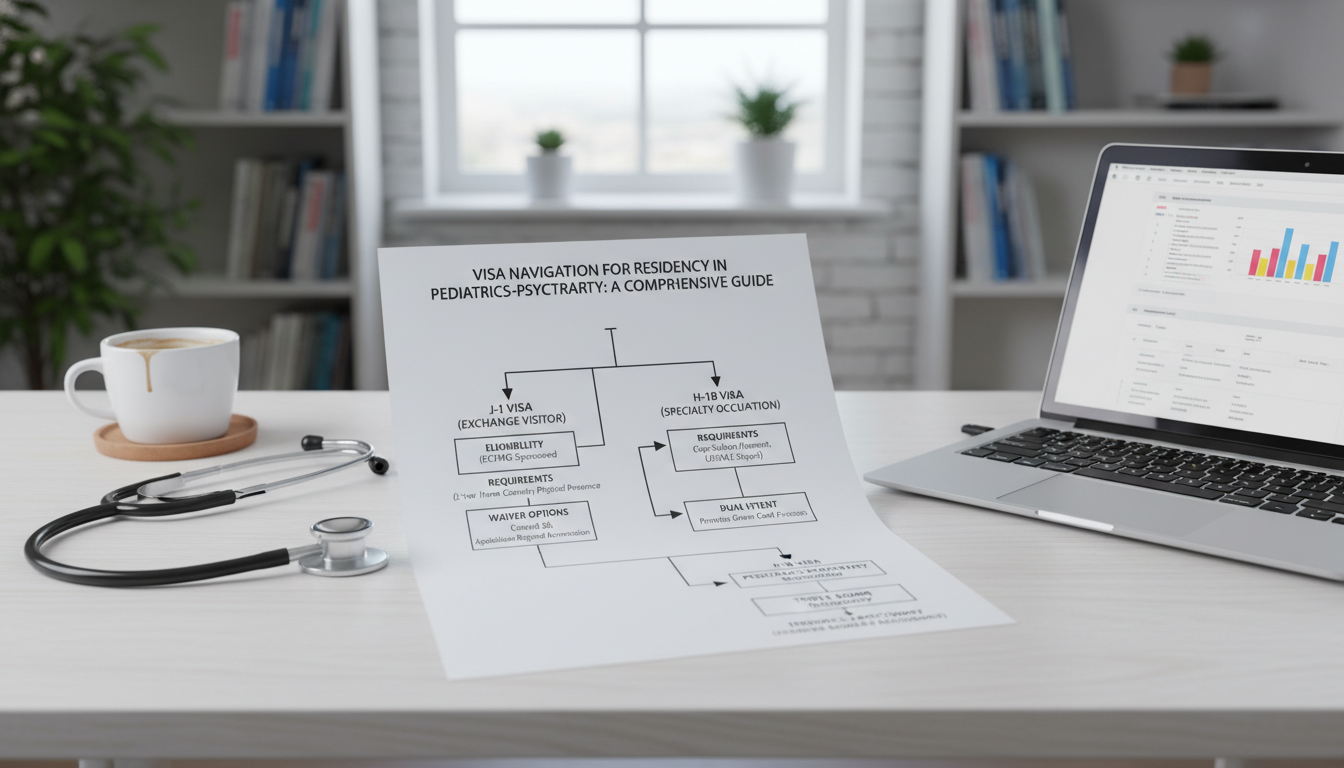
Key distinctions at a glance
J-1 (ECFMG-sponsored)
- Most common for residency and fellowships
- Requires return-home 2-year rule (Section 212(e)) for most physicians
- No need for USMLE Step 3 for initial sponsorship
- Time-limited, typically sufficient for full training including extended programs like triple board
H-1B (employer-sponsored)
- Less common, but attractive to some IMGs
- No automatic 2-year home residence requirement
- Requires USMLE Step 3 + state licensure eligibility
- Complex for longer training tracks and may need multiple petitions
If you’re targeting a peds psych residency or triple board program (5 years total), the visa structure over time becomes critical.
How Visa Type Impacts Pediatrics-Psychiatry and Triple Board Training
1. Program Structures and Visa Duration
Standard Pediatrics-Psychiatry Combined Programs
Some institutions offer combined Pediatrics and Psychiatry programs (usually 5 years). These differ from the classic “triple board” pathway but share similar complexity:
- 3-4 years of Pediatrics and Psychiatry core rotations
- Additional elective, child psychiatry, and continuity experiences
- Often lead to board eligibility in both Pediatrics and Psychiatry
Triple Board Programs (Pediatrics / Psychiatry / Child & Adolescent Psychiatry)
- Typically 5 years of integrated training
- Graduates are board-eligible in:
- Pediatrics
- General Psychiatry
- Child & Adolescent Psychiatry
Visa considerations for both are similar: you must ensure sufficient visa time and continuity for the full 5 years.
Visa implications for longer training tracks
On J-1:
- ECFMG can sponsor you through the entire structured program, as long as it’s ACGME-accredited and you progress successfully.
- No annual H-1B cap issues, easier to extend year to year.
- Most triple board and integrated programs are familiar with J-1 logistics.
On H-1B:
- You will likely need a petition that covers multiple years, or extensions.
- If you continue into separate fellowships (e.g., Child & Adolescent Psychiatry outside integrated triple board), you may require new or amended H-1B petitions.
- Some institutions cap H-1B support only at categorical residency, not integrated or extended tracks.
2. J-1 vs H-1B for Peds Psych and Triple Board
J-1 for Pediatrics-Psychiatry
Pros
- Most universities and teaching hospitals are accustomed to J-1 residents, including in psychiatry and pediatrics.
- ECFMG handles many administrative details; programs know the process.
- Easier to support long, structured programs like triple board or combination tracks.
- Flexible when moving into subsequent J-1 fellowships (for those not subject to or who resolve 212(e)).
Cons
- Typically triggers the 2-year home-country physical presence requirement (212(e)) after training.
- To stay in the U.S. and practice, many must pursue a J-1 waiver job in a shortage area (often primary care, but many states and federal programs are increasingly open to Psychiatry and Child & Adolescent Psychiatry).
- Can delay transition to permanent residence.
H-1B for Pediatrics-Psychiatry
Pros
- No automatic 2-year home residence requirement.
- Potentially smoother transition into long-term U.S. employment and permanent residency if you secure employer sponsorship.
- Attractive to institutions that anticipate hiring you as faculty/attending after training.
Cons
- Many peds psych residency and triple board programs do not sponsor H-1B for residents. You must check program policies.
- Requires USMLE Step 3 passed and eligibility for a training license/state license before H-1B filing—often a tight timeline for IMGs.
- H-1B is tied to a specific employer and role; changing programs or adding fellowships may require new petitions.
- Some GME offices limit H-1B for “shorter” programs (3-year internal medicine, pediatrics) and are more hesitant for 5-year integrated programs due to cost and admin complexity.
IMG Visa Options: Strategic Planning for Pediatrics-Psychiatry
1. Choosing Programs with the Right Visa Support
Because Pediatrics-Psychiatry and especially triple board programs are few, you cannot afford to waste applications on programs that cannot support your visa needs.
Action steps:
Create a program list
- Identify all ACGME-accredited Pediatrics-Psychiatry, child psychiatry tracks with integrated pediatrics time, and triple board programs.
- Include traditional Pediatrics + Psychiatry categorical paths as backups if you are flexible.
Check official program websites
- Look for a specific statement about J-1 vs H-1B sponsorship.
- Some will say: “We sponsor J-1 only,” “We sponsor J-1 and H-1B,” or “We do not sponsor visas.”
Email program coordinators early
Especially for smaller combined or triple board programs where websites may be outdated.
Sample email language:
I am an international medical graduate interested in your Pediatrics-Psychiatry / Triple Board residency. Could you please confirm which visa types (J-1 vs H-1B) you sponsor for residency training, and whether your GME office supports these visas for the full duration of the integrated program?
Document responses in a spreadsheet
- Column fields: Program name, State, Tracks offered (Peds-Psych, Triple Board, Categorical), Visa types supported, Last date confirmed, Any conditions (e.g., Step 3 required for H-1B).
This targeted approach ensures your IMG visa options align with your training goals.
2. Timing and Exams: Aligning with Visa Requirements
For J-1 (ECFMG):
- USMLE Step 1 & Step 2 CK: Must be passed for ECFMG certification.
- Step 3 is not required for J-1 sponsorship.
- Ensure all documentation is ready well before the GME onboarding deadlines (often April–June for a July start).
For H-1B:
- You must have:
- Passed USMLE Step 3
- Met state-specific requirements for a training license
- H-1B petitions have processing times, even with premium processing.
- Programs may have internal cut-offs: they may only consider H-1B if your Step 3 score is available by a certain date.
Practical example:
- You are an IMG graduating in June 2026 and targeting a triple board program.
- If you want to be H-1B-eligible:
- You should plan to take Step 3 no later than mid-2025 or early 2026, leaving a buffer for score reporting.
- If this is unrealistic, leaning into J-1 for residency may be more practical.
3. Matching Strategy for Pediatrics-Psychiatry and Triple Board
Because combined Pediatrics-Psychiatry and triple board positions are limited, your visa needs amplify competition. Plan tiers:
- Tier 1: Programs that sponsor your preferred visa (J-1 or H-1B) in triple board or integrated peds psych
- Tier 2: Programs that sponsor your acceptable visa in categorical Pediatrics with a strong Child/Adolescent Psychiatry or Behavioral Pediatrics focus
- Tier 3: Psychiatry programs with robust child/adolescent training that can be paired with future Pediatrics exposure through electives or post-residency work
Tell your story clearly in your personal statement: why you want the intersection of pediatrics and psychiatry, and show an understanding of the longer training path and visa realities. Programs value applicants who have thought about feasibility.
Residency Visa Logistics: From Match to Start Date
1. After the Match: Visa Processing Steps
As soon as you match into a peds psych residency or triple board position, the clock starts.
If you are J-1 bound:
Receive instructions from your program and ECFMG
- ECFMG outlines documents required for J-1 sponsorship (Form DS-2019 issuance).
Complete ECFMG’s online application
- Upload contract/offer letter, proof of funding (usually your salary), passport, etc.
Secure DS-2019
- Once issued, you pay the SEVIS fee and schedule a U.S. consulate interview.
Attend visa interview
- Prepare to answer questions about your training plan, intent to comply with 212(e) rule, and return-home requirement.
If you are H-1B bound:
Program’s GME office files H-1B petition (Form I-129)
- Requires your Step 3 result, educational credentials, and state licensing endorsement.
- Employer may use premium processing to ensure approval before July 1.
Consular stamping (if outside the U.S.)
- Once H-1B approved, attend consular interview and obtain the visa stamp.
Start date
- You enter the U.S. in time for orientation, typically late June.
2. Common Pitfalls and How to Avoid Them
Pitfall 1: Late exam completion for H-1B
- Solution: If you are not certain you can pass Step 3 early enough, do not rely solely on H-1B-supporting programs. Keep J-1-friendly programs in your primary list.
Pitfall 2: Misunderstanding program policy
- Some programs will say “We support visas” but mean J-1 only, not H-1B.
- Solution: Always ask explicitly: “Do you sponsor J-1 only, or both J-1 and H-1B for residents?”
Pitfall 3: Underestimating consulate wait times
- In some countries, interview slots can be delayed.
- Solution: Once DS-2019 or I-797 is ready, schedule your appointment immediately and monitor embassy announcements.
Long-Term Planning: After Pediatrics-Psychiatry or Triple Board Residency
1. J-1 Waivers for Peds Psych and Child Psychiatry
If you train on a J-1, the 2-year home-country physical presence requirement (212(e)) usually applies. Many physicians resolve this through a J-1 waiver job instead of returning home.
For Pediatrics-Psychiatry and triple board graduates, good news:
- Psychiatry and Child & Adolescent Psychiatry are in high demand, especially in underserved and rural areas.
- Many Conrad 30 programs and other waiver mechanisms increasingly value child psychiatry expertise.
Key J-1 waiver routes:
Conrad 30 (State-based)
- Up to 30 waivers per state annually
- Historically focused on primary care, but many states include Psychiatry and sometimes child psychiatry roles.
- You agree to work full-time in an underserved area for a specified period (often 3 years).
Federal programs
- e.g., VA, Appalachian Regional Commission, Delta Regional Authority
- Some include mental health and pediatric behavioral health roles.
Triple board graduates may offer a particularly attractive profile for waiver employers:
- Ability to manage complex developmental, behavioral, and medical needs in children
- Skill set that fits children’s hospitals, integrated behavioral health clinics, and rural health systems trying to cover broad pediatric and psychiatric needs
2. H-1B to Green Card Transitions
If you are on H-1B, you might:
- Transition from residency H-1B to attending/faculty H-1B at a hospital or university
- Have your employer sponsor you for permanent residency (e.g., EB-2 NIW, standard PERM-based green card)
For peds psych or triple board graduates:
EB-2 National Interest Waiver (NIW)
- Your expertise in child and adolescent behavioral health, combined with service in high-need regions, may support an NIW petition.
- Many child psychiatrists and pediatric subspecialists use this route, particularly if working in underserved settings.
Academic jobs
- Triple board–trained physicians may be attractive faculty candidates at children’s hospitals and academic centers; these employers often have strong immigration support.
3. Planning for Fellowships and Subspecialty Training
Some applicants choose:
- Categorical Pediatrics or Psychiatry first
- Then separate Child & Adolescent Psychiatry or Developmental-Behavioral Pediatrics fellowships
Visa-wise:
- On J-1, ECFMG can continue sponsorship for recognized fellowships, within overall limits.
- On H-1B, every new training role may require a new or amended H-1B.
- When committing to multiple sequential training programs, consider the cumulative timeline and possible immigration strategy (e.g., doing residency on J-1, then waiver job, then fellowship on H-1B later, etc.).
For triple board residents, integrated child psychiatry training during residency may reduce the need for additional fellowships—but you may still pursue subspecialty paths or academic fellowships, each with visa implications.
Practical Scenarios and Advice for Different Applicant Profiles
Scenario 1: IMG Without Step 3, Strong Interest in Triple Board
- Best-aligned route: J-1
- Application strategy:
- Target all triple board programs and peds psych combined programs that accept J-1.
- Clarify in your personal statement that you understand long training and are prepared for the J-1 process and potential waiver obligations.
- Back up with Pediatrics or Psychiatry programs strong in child mental health.
Scenario 2: IMG With Step 3 and Strong Research Background
- You may be competitive for H-1B in higher-resourced academic centers.
- Strategy:
- Identify triple board/peds psych programs and institutions with a history of H-1B sponsorship.
- Highlight your research, publications, and aspirations for academic or child mental health leadership.
- Consider long-term: H-1B to faculty position to green card (potential EB-2 NIW or employer-sponsored).
Scenario 3: IMG Already on J-1 in Another Status (e.g., Research)
- If you are currently on a non-clinical J-1 in the U.S., moving into residency on an ECFMG-sponsored J-1 may layer additional complexities.
- Critical step: Consult an experienced immigration attorney
- Determine if you are or will be subject to 212(e) multiple times.
- Explore strategies to avoid compounding requirements, or consider transitioning to another status before residency if possible.
Frequently Asked Questions (FAQ)
1. Is J-1 or H-1B better for a Pediatrics-Psychiatry or triple board residency?
There is no universally “better” option. For most IMGs, J-1 is more accessible and more widely supported by programs, especially given the 5-year length of many triple board and integrated peds psych tracks. H-1B can be advantageous if:
- You already have Step 3
- Your target program and institution routinely sponsor H-1B for residents
- You prioritize avoiding the 2-year home-residence requirement and plan to stay long-term in the U.S.
However, the bottleneck is often program policy, not your preference.
2. Do all triple board or Pediatrics-Psychiatry programs sponsor visas?
No. Because these programs are relatively small and specialized, visa policies vary widely. Some triple board programs sponsor J-1 only, a few may sponsor both J-1 and H-1B, and a small number may not sponsor any visas. You must confirm program by program, ideally via email, before finalizing your application list.
3. How does the J-1 2-year home requirement affect my career as a peds psych or triple board graduate?
If you complete residency and/or fellowship on a J-1, you are usually subject to the 2-year home-country presence requirement (212(e)). To work in the U.S. afterward, you typically must:
- Return to your home country for 2 cumulative years, or
- Obtain a J-1 waiver, often by working in an underserved area for a set period (commonly 3 years), or through other qualifying routes
For Pediatrics-Psychiatry and especially child/adolescent psychiatry, there are many underserved regions actively seeking specialists, which can make waiver jobs more available than in some other fields.
4. Can I switch from J-1 in residency to H-1B later for a fellowship or job?
If you are subject to 212(e), you normally cannot change status to H-1B in the U.S. or obtain an H-1B visa abroad until the requirement is fulfilled (either by going home for 2 years or obtaining a waiver). Some physicians:
- Complete residency on J-1
- Obtain a J-1 waiver job in an underserved area
- Then transition to H-1B status with that employer
- Later, pursue permanent residency
Complex transitions and exceptions should always be discussed with an experienced immigration attorney familiar with medical training visas.
Visa navigation for a peds psych residency or triple board program is highly manageable if you start planning early, align your target programs with your IMG visa options, and understand the implications of J-1 vs H-1B across your entire training and early career. With thoughtful strategy, your unique skill set at the intersection of pediatrics and psychiatry can be in high demand—and your visa path can support, rather than limit, your long-term goals.