
Residency in preliminary medicine (prelim IM) plays a critical role for many international medical graduates (IMGs), especially those aiming for advanced specialties such as neurology, anesthesiology, radiology, dermatology, or physical medicine and rehabilitation. Yet one of the most stressful and confusing aspects of planning a preliminary medicine year is understanding your residency visa options and how they affect your future training.
This guide provides a detailed, practical roadmap to visa navigation for residency in preliminary medicine, with a focus on J‑1 vs H‑1B, long‑term planning, and common pitfalls for IMGs.
Understanding the Role of a Preliminary Medicine Year
Before diving into visa strategy, it helps to clarify what a preliminary medicine year is and why its visa structure matters so much.
What is a Preliminary Medicine (Prelim IM) Year?
A prelim IM position is a 1‑year internship in internal medicine. It differs from:
- Categorical Internal Medicine residency: a full 3‑year training program leading to board eligibility in internal medicine.
- Transitional year: a broad-based internship that is often more flexible in rotation composition.
Prelim IM positions are usually:
- Required as the first year for certain advanced specialties, e.g.:
- Neurology
- Anesthesiology
- Radiology (Diagnostic and Interventional)
- Radiation Oncology
- Dermatology
- PM&R (Physical Medicine and Rehabilitation)
- Sometimes used by IMGs to:
- Gain US clinical experience
- Strengthen their CV for future categorical applications
- Enter a second match cycle with US training on their record
Why Visa Strategy is Different for Prelim IM
For a categorical residency, visa planning is relatively straightforward: you need a visa for 3+ years at one institution. For a preliminary medicine year, your training path almost always involves at least two institutions:
- The hospital where you do your preliminary medicine year
- The hospital where you complete your advanced or categorical residency
This structure means:
- You may need multiple visa sponsors in sequence.
- You must pay careful attention to visa maximum durations (e.g., J‑1 limits).
- You need to ensure your visa choice during prelim IM does not block your ability to:
- Move on to your advanced specialty
- Pursue a later fellowship
- Meet career goals (including future US immigration plans)
Because of this, selecting between J‑1 vs H‑1B for a prelim IM year is a strategic decision, not just a box to check on ERAS.
Core Visa Options for IMGs in Preliminary Medicine
For most IMGs seeking a preliminary medicine year, the primary residency visa options are:
- J‑1 (ECFMG-sponsored Exchange Visitor) – the most common route
- H‑1B (Temporary Worker – Specialty Occupation) – available at some programs
Other visa types exist but are rare or usually unsuitable for GME (e.g., F‑1 with OPT, TN for certain nationalities, O‑1 for extraordinary ability). For the majority of IMG residency applicants, the meaningful decision is J‑1 vs H‑1B.
J‑1 Visa for Prelim IM
The J‑1 physician visa is sponsored by ECFMG, not by the residency program. Programs still play a role, but the legal sponsor is ECFMG.
Key characteristics for preliminary medicine:
- Duration: Up to 7 years total of J‑1 clinical training time.
- Coverage: Can include:
- 1 year of prelim medicine
- 3–4 years of categorical or advanced specialty
- 1–3 years of fellowship (depending on specialty)
- Two-year home residency requirement (INA 212(e)):
- After finishing all J‑1 training, you usually must return to your home country for 2 years or obtain a waiver before:
- Changing to H‑1B or L‑1 status
- Applying for permanent residency (green card)
- This is often manageable via a J‑1 waiver job in an underserved area, but it requires planning.
- After finishing all J‑1 training, you usually must return to your home country for 2 years or obtain a waiver before:
Advantages for prelim IM:
- Widely accepted: Many prelim programs only sponsor J‑1.
- Predictable process through ECFMG.
- Flexible enough for a chain of training: prelim → advanced → fellowship.
- Does not require USMLE Step 3 (though some programs still prefer you’ve passed).
Disadvantages and cautions:
- You accumulate time toward the 7-year J‑1 cap. If your specialty + fellowship is long, prelim year counts against your total.
- Two-year home residency requirement kicks in after all training, which impacts long-term immigration strategy.
- Switching from J‑1 to H‑1B for a later stage of training commonly requires completing the 2-year home requirement or a waiver.
H‑1B Visa for Prelim IM
The H‑1B is an employment-based visa where the hospital is the sponsor.
Key characteristics:
- Duration: Typically allowed for up to 6 years total in H‑1B status.
- Requirements:
- USMLE Step 3 must be passed before filing.
- Program must be willing and able to sponsor an H‑1B, which includes legal fees, institutional policies, and sometimes union or HR constraints.
- Not subject to the 2-year home residency requirement tied to J‑1.
Advantages for prelim IM:
- No automatic 2-year home residency requirement.
- Can sometimes be a favorable starting point if:
- You anticipate needing H‑1B for future residency or employment.
- You have long-term plans for US immigration and want a smoother path to a work-based green card.
Disadvantages and cautions:
- Many prelim IM programs do not sponsor H‑1B, especially for only 1 year.
- Short 1-year duration can make the legal/administrative burden less attractive to programs.
- You must have Step 3 passed early enough for your institution to file the petition.
- If your future advanced program is J‑1-only, an H‑1B prelim year may not align with your next step.
- Time used during prelim counts toward the 6-year H‑1B limit, which could be relevant for later employment or fellowship.
Choosing Between J‑1 and H‑1B for a Preliminary Medicine Year
Your choice of visa for a preliminary medicine year must consider multiple layers: what your prelim program offers, anticipated advanced program requirements, long-term career plans, and timing of exams.

Step 1: Clarify Program Sponsorship Policies Early
When researching and applying to prelim IM programs, identify:
- Does the program sponsor J‑1 only?
- Does it also sponsor H‑1B for prelim positions?
- Are there additional eligibility rules, such as:
- Step 3 required by a certain date
- Limits on graduation year
- Institutional restrictions on visa types
Use:
- Program websites
- FREIDA listings
- Direct email to program coordinators (polite, concise inquiry)
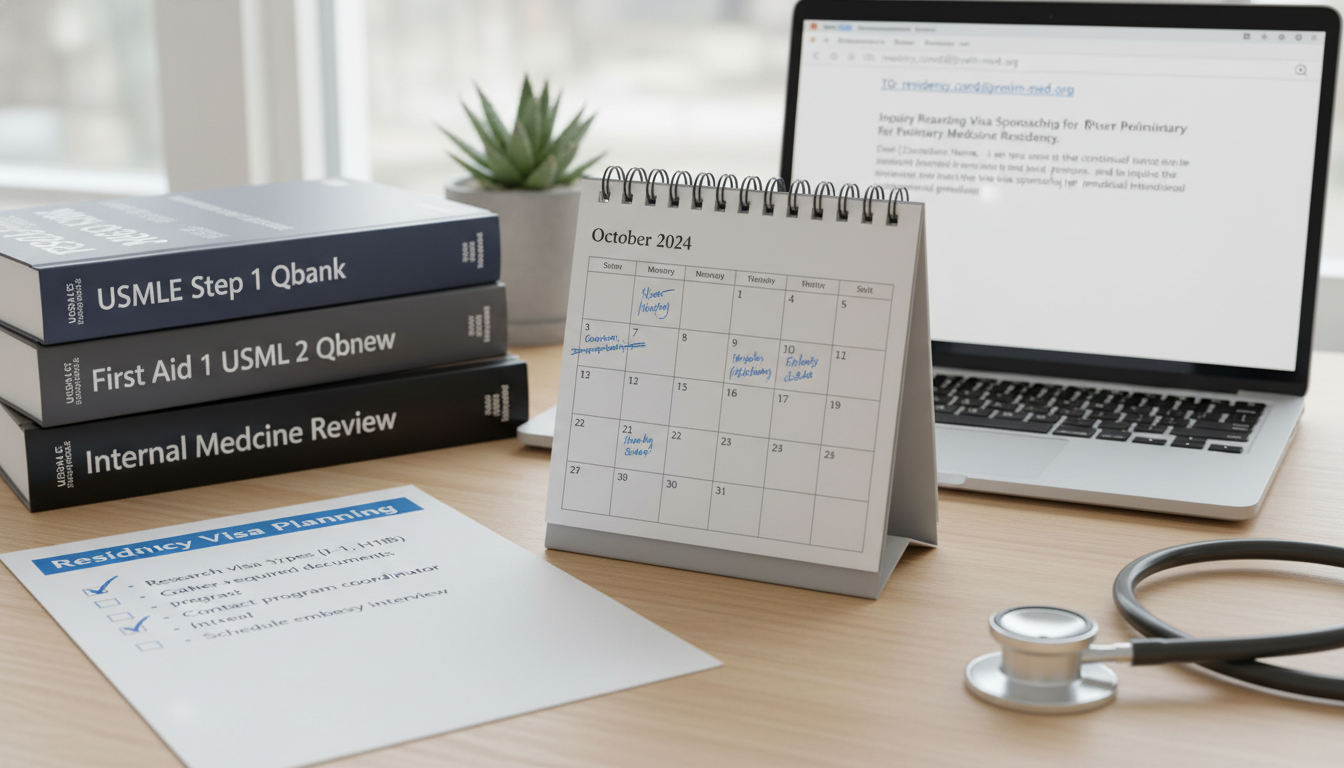
Example of a concise email:
Dear [Program Coordinator Name],
I am an international medical graduate planning to apply for a preliminary internal medicine position in the upcoming Match. Could you please let me know which visa types your program sponsors for preliminary medicine residents (e.g., J‑1 only, H‑1B, or both)?
Thank you for your time and assistance.
Sincerely,
[Your Name], MD
Step 2: Map Out Your Anticipated Training Path
Ask yourself:
- Am I already matched to an advanced position (e.g., Neurology PGY‑2)?
- If not, what specialties am I realistically targeting?
- How long is the full training track likely to be?
Example training sequences and visa impact:
Neurology Pathway
- Prelim IM: 1 year
- Neurology: 3 years
- Total: 4 years
- On J‑1: Very feasible within the 7‑year limit, leaving room for a 2–3 year fellowship if desired.
- On H‑1B: Also feasible within 6-year limit, but you must align all institutions on H‑1B sponsorship.
Radiology + Fellowship
- Prelim IM: 1 year
- Diagnostic Radiology: 4 years
- Fellowship (e.g., IR, Neuroradiology): 1–2 years
- Total: 6–7 years
- On J‑1: You’re nearing the 7-year J‑1 ceiling, so adding a second fellowship may be difficult.
- On H‑1B: Also close to the 6-year cap, particularly if you expect a long post-training H‑1B employment before green card.
Prelim IM → Reapply for Categorical IM
- Prelim IM: 1 year
- Categorical IM: 3 years
- Fellowship (Cardiology/GI): 3 years
- Total: 7 years
- On J‑1: This nearly uses the entire 7-year allowance, leaving little room for a second fellowship or extended research year.
- On H‑1B: Uses the full 6-year standard limit; requires efficient planning for immigration or status changes afterward.
Step 3: Align Visa with Future Program Likelihood
You will be training in at least two different institutions (prelim + advanced). Consider:
- If most neurology programs you are targeting are J‑1 only, then:
- Starting with J‑1 for your prelim year may be logical.
- Taking an H‑1B prelim for one year, then needing J‑1 later can complicate your sequence.
- If your target advanced specialty/program is known to be H‑1B-friendly (e.g., some university hospitals with strong IMG representation), you could:
- Attempt H‑1B from the start if your prelim program also supports it.
- Ensure you have Step 3 completed early.
Step 4: Evaluate Personal and Family Immigration Goals
Visa choice isn’t only about training—it's also about your long-term life plan:
- Are you hoping to pursue long-term practice in the US?
- Do you have a spouse or dependents whose status and career are tied to your visa (J‑2 vs H‑4)?
- Are you aiming for a faster path to permanent residency through employment?
Key differences:
J‑1
- Dependent status: J‑2 (may apply for work authorization).
- Two-year home requirement can delay or complicate permanent residency.
- Typically requires a waiver job in an underserved area after training if you want to stay in the US.
H‑1B
- Dependent status: H‑4 (work authorization depends on spouse’s green card process stage; often more limited early).
- No automatic 2-year home requirement; generally more straightforward path to employment-based green card.
- Training institutions may or may not sponsor green cards; often you need a later employer to do this.
Practical Strategies for IMG Visa Navigation in Prelim IM
Once you understand the broad principles, you can apply them in a step‑by‑step strategy during your application and match process.
1. Plan USMLE Timing with Visa in Mind
For J‑1:
- Step 3 is not required for J‑1 sponsorship, but:
- Completing it early enhances your application and:
- Increases your future flexibility to switch to H‑1B for later training or jobs.
- Completing it early enhances your application and:
- If you can, aim to have Step 3 done by the end of prelim year at the latest.
For H‑1B:
- Step 3 is mandatory.
- For a prelim IM start in July:
- Aim to complete Step 3 no later than fall of the preceding year, so the program can file your H‑1B on time.
- Some institutions have strict internal deadlines; confirm these with the program.
2. Build a Targeted Application List
When building your application list for a preliminary medicine year:
- Categorize programs into:
- J‑1 only
- J‑1 + H‑1B
- No visa sponsorship
- For each category, consider:
- Where your profile is competitive.
- Where your desired advanced specialties are also strong.
- Whether the institution has a history of matching IMGs into your target advanced fields.
Practical tip: Use a simple spreadsheet:
| Program | City/State | Visa types | Step 3 required | IMG friendly? | Advanced specialties at same hospital? |
|---|
This helps you clearly visualize where certain residency visa options are realistic.
3. Coordinate Prelim and Advanced Positions (When Possible)
If you are applying for:
Linked prelim + advanced positions (ranked as one track in NRMP):
- Try to understand the visa policy of the entire chain.
- Example: If the neurology program is J‑1 only and the prelim program can do both J‑1 and H‑1B, it may still be safer to choose J‑1.
Prelim and advanced separately:
- There is more risk of misalignment.
- When interviewing, ask tactfully:
- “What visa types does your program typically sponsor for IMGs?”
- “How often do your IMGs in prelim positions successfully transition to advanced specialties within your institution or elsewhere?”
4. Anticipate the J‑1 7-Year Limit
If you suspect your total training might approach or exceed 7 years, think carefully before committing to J‑1 for prelim IM.
Scenarios where this matters:
You might:
- Do a prelim year.
- Then match into a categorical program in another specialty.
- Then pursue a long fellowship.
Or you may:
- Be interested in research years during residency or fellowship (these can also count toward J‑1 duration depending on structure).
In these cases:
- Consider whether using J‑1 for only the prelim year is optimal, or if:
- Delaying J‑1 until you start the main specialty could preserve more time.
- An H‑1B prelim year is realistic and aligns with your advanced plans.
Note: Changing from H‑1B prelim → J‑1 advanced is possible, but you must ensure compliance with all requirements and timing. Always plan with an immigration attorney if your case is complex.
5. Use Professional Guidance When Needed
Given the stakes and complexity, IMGs should not hesitate to seek:
- Program GME office guidance:
- They can outline institutional policy and typical timelines.
- Professional immigration counsel:
- Especially if you have:
- Multiple prior visas
- Previous J‑1 research time
- Family and long‑term immigration plans to consider
- Especially if you have:
Keep in mind: Program staff will help with institutional policy, but they cannot provide personal legal immigration advice. An immigration attorney can.
Common Pitfalls and How to Avoid Them
Understanding typical mistakes can help you navigate your preliminary medicine year more safely.
Pitfall 1: Assuming All Programs Sponsor the Same Visa Types
Reality: Visa policies vary widely.
- Some community programs are J‑1 only.
- Some large academic centers offer both but only for categorical, not prelim positions.
- A minority provide H‑1B for prelims.
How to avoid it:
- Confirm each program’s policies in writing or via an official source before ranking.
- Keep notes organized so you don’t confuse policies between programs.
Pitfall 2: Ignoring the Impact of the J‑1 7-Year Limit
IMGs sometimes:
- Accept a J‑1 prelim without considering that:
- They may later want a long subspecialty fellowship or multiple fellowships.
- They might pursue research years that could also count.
Prevention:
- Roughly map out:
- Prelim + main residency + possible fellowships + any planned research time.
- If your total could exceed 7 years, discuss alternatives with:
- Potential programs
- An immigration attorney
Pitfall 3: Taking Step 3 Too Late
Waiting until mid‑PGY‑1 to start thinking about Step 3 can:
- Block you from H‑1B opportunities for your next training step.
- Limit your ability to switch visas if circumstances change.
Prevention:
- Schedule Step 3 in the final year of medical school or the gap period before residency when possible.
- If not, schedule it as soon as feasible during your prelim year—with program’s support.
Pitfall 4: Not Considering Your Spouse and Dependents
Your visa choice directly affects:
- Whether your spouse can work (J‑2 vs H‑4 EAD rules).
- Schooling, travel, and long‑term plans of family members.
Prevention:
- Before deciding, research:
- J‑2 employment authorization process and typical timelines.
- H‑4 work authorization rules (often depend on green card process).
- Factor these into your decision, especially if your spouse intends to work in the US.
Pitfall 5: Misunderstanding the J‑1 Waiver Process
Many IMGs think:
- “I will just get a J‑1 waiver after training—no big deal.”
But in reality:
- Waiver positions are usually:
- In underserved rural or inner‑city areas.
- Tied to Conrad 30 or other federal/state programs.
- The process is time-sensitive and competitive in some states.
Prevention:
- Learn the basics of:
- Conrad 30 J‑1 waiver program in states where you might live.
- Federal waiver options (e.g., VA, HHS).
- Start exploring potential waiver employers before finishing fellowship, ideally 12–18 months in advance.
FAQs: Visa Navigation for Preliminary Medicine Residency
1. Is it easier to match into a prelim IM position on J‑1 or H‑1B?
For most IMGs, it is easier to match prelim IM on a J‑1 visa because:
- Many prelim programs only sponsor J‑1.
- H‑1B requires Step 3 and extra institutional effort, which programs may be reluctant to undertake for a 1‑year position.
- J‑1 is the standard route for GME and is well-understood by most institutions.
However, if you already have Step 3 and target a small number of H‑1B‑friendly prelim programs, H‑1B may be realistic. The key is aligning your exam timeline and program list with the visa you want.
2. Can I switch from J‑1 during prelim IM to H‑1B for my advanced residency?
It is sometimes possible, but there are important caveats:
- The 2-year home residency requirement (212(e)) usually applies once you receive a J‑1 for clinical training.
- To move from J‑1 to H‑1B, you typically must:
- Complete your 2-year home residency requirement, or
- Receive a J‑1 waiver.
- Without meeting these, a direct change from J‑1 clinical to H‑1B can be blocked.
Because of this, starting on J‑1 often means staying on J‑1 for all of your training, then seeking a waiver job afterward.
3. If I am unsure about my future specialty, which visa is safer for a prelim IM year?
When your specialty plans are uncertain:
- J‑1 is “safer” in terms of:
- Being widely accepted by prelim and advanced programs.
- Providing flexibility across multiple specialties and fellowships.
- H‑1B is “safer” in terms of:
- Long‑term immigration path and avoiding a 2‑year home residency requirement.
Because many advanced programs are J‑1 only, and many prelim positions don’t offer H‑1B, most undecided IMGs end up using J‑1 for prelim IM. Later, once your path is clearer, you can consider waiver and alternative options strategically.
4. Does doing a preliminary medicine year improve my chances of getting a visa for a categorical or advanced residency?
A prelim IM year can strengthen your overall application, but it does not automatically improve your visa options. It helps by:
- Providing:
- US clinical experience
- US letters of recommendation
- Evidence of performance in the US system
- However, visa sponsorship policies for your next program remain:
- Institution-specific
- Sometimes rigidly defined (J‑1 only or J‑1/H‑1B options)
Your prelim performance may make you more attractive to programs overall, but you still must fit into their existing IMG visa options and policies.
Navigating visa options for a preliminary medicine year requires you to think not just about the year in front of you, but also the entire arc of your training and early career. By understanding the implications of J‑1 vs H‑1B, clarifying program policies early, and aligning your exam timeline and long-term plans, you can make informed choices that support both your residency goals and your future in the US healthcare system.