

International medical graduates (IMGs) are increasingly drawn to the Sun Belt for graduate medical education—attracted by large academic centers, growing populations, and diverse clinical exposure. But understanding visa navigation for residency, especially in southern residency programs across the Sun Belt, can be one of the most confusing parts of the process.
This guide focuses on what you need to know about visa options for IMGs, how J-1 vs H-1B works in practice, and how to strategically target Sun Belt residency programs with your career goals and immigration plans in mind.
Understanding the Sun Belt Landscape for IMGs
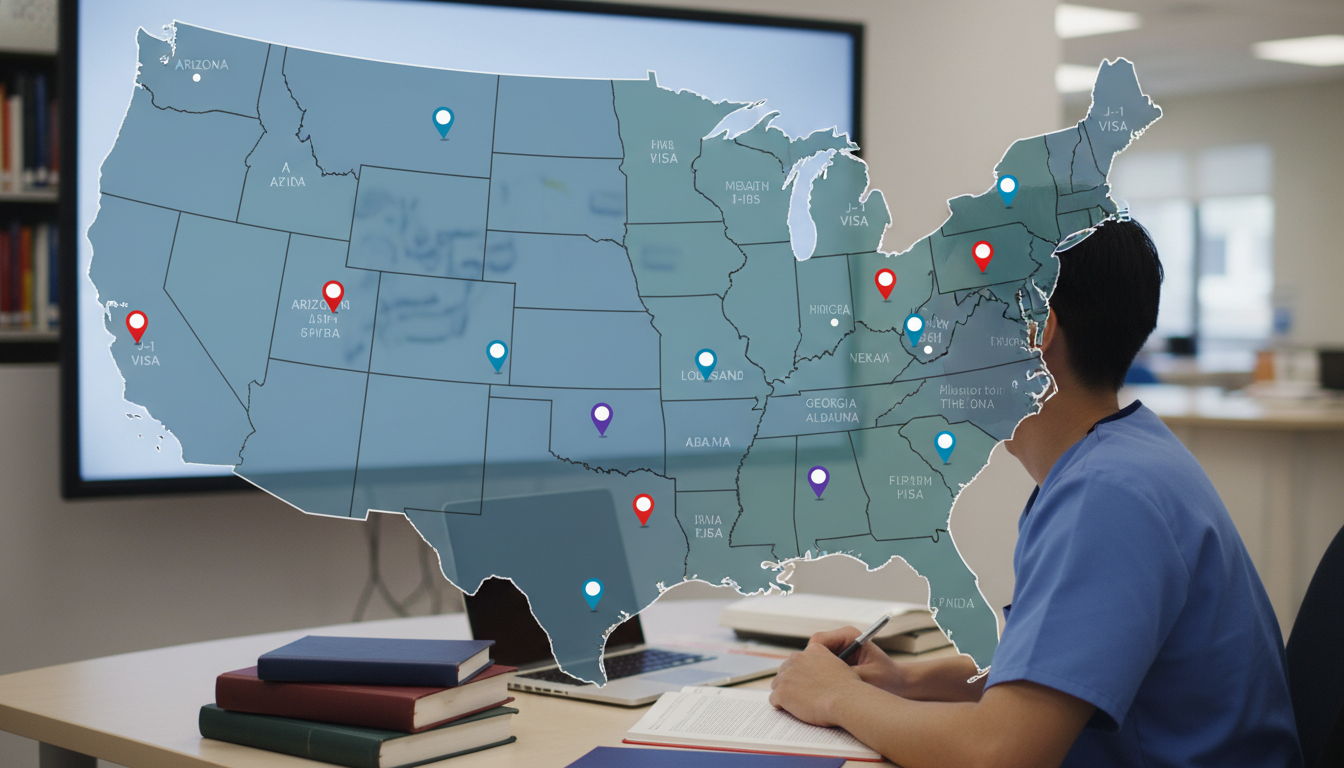
The “Sun Belt” region generally includes southern and southwestern states stretching from California to Florida:
California, Arizona, New Mexico, Texas, Louisiana, Mississippi, Alabama, Georgia, Florida, and often extending to Nevada, Arkansas, Tennessee, South Carolina, and North Carolina. These states host a large number of southern residency programs with significant IMG representation.
Why Sun Belt Residency Programs Are Attractive to IMGs
High volume of residency positions
- Texas, Florida, and California alone account for a large share of US residency slots.
- Rapidly growing populations drive expansion of internal medicine, family medicine, pediatrics, emergency medicine, and psychiatry programs.
IMG-friendly institutions
- Many Sun Belt academic centers and community programs historically rely on IMGs, particularly in primary care and internal medicine subspecialties.
- Some of these programs have established infrastructures for residency visa sponsorship and are familiar with both J-1 and H-1B processes.
Diverse patient populations
- High ethnic, linguistic, and socioeconomic diversity provides broad clinical experience and research opportunities.
- Bilingual or multilingual IMGs (Spanish, Portuguese, Arabic, Hindi/Urdu, etc.) are often valued.
Growing need for physicians in underserved areas
- Many Sun Belt states have rural and underserved regions, which later can tie directly into J-1 waiver opportunities (e.g., Conrad 30 programs) if you train on a J-1 visa.
Visa Culture Varies by State and Institution
Though the Sun Belt is generally IMG-friendly, visa policies differ widely:
- Some large academic centers in Texas or Florida may sponsor both J-1 and H-1B visas.
- Smaller community programs might accept only J-1 due to simpler administration.
- Certain California and Arizona programs may limit H-1B sponsorship because of institutional or state policies.
- A few institutions (especially Veterans Affairs–affiliated programs) may require US citizenship or permanent residency.
Action step:
Before applying, check each program’s website and contact program coordinators if needed. Look for explicit statements on “Visa sponsorship,” “IMG visa options,” or “J-1 vs H-1B” preferences.
Core Visa Options for IMGs in Sun Belt Residency Programs
When you apply to southern residency programs, you’ll almost always be considering two primary categories:
- J-1 Exchange Visitor (ECFMG-sponsored physician category)
- H-1B Temporary Worker (specialty occupation)
Both can be pathways to a Sun Belt residency, but the implications for your career and long-term immigration plans are quite different.
J-1 Visa for Residency: Structure, Benefits, and Limitations
The J-1 physician visa is sponsored by the Educational Commission for Foreign Medical Graduates (ECFMG). It is the most commonly used visa for IMGs in US residency.
Key features
- Sponsor: ECFMG (not the hospital directly).
- Purpose: Graduate medical education (residency and fellowship).
- Duration: Typically valid for the length of training, renewable annually; maximum usually 7 years for clinical training (with specific rules).
- Employment: Tied to your specific training program and specialty.
Advantages in the Sun Belt context
Widely accepted
- Most IMG-friendly programs in Texas, Florida, Georgia, and other Sun Belt states accept J-1 residents.
- Simpler for hospitals since ECFMG handles much of the compliance.
Predictable pathway for residency
- Well-established process; programs are familiar with ECFMG timelines and requirements.
Fellowship opportunities
- Many Sun Belt academic centers accept J-1s for subspecialty training (e.g., cardiology in Texas, GI in Florida, critical care in Arizona).
Clear route to underserved practice via J-1 waiver
- States like Texas, Florida, Georgia, and Arizona actively use the Conrad 30 program for J-1 waiver jobs.
- Rural and medically underserved Sun Belt areas often recruit heavily for J-1 waiver physicians.
Disadvantages
Two-year home-country physical presence requirement
- After training, J-1 physicians are generally required to return to their home country for at least two years or obtain a J-1 waiver.
- This requirement significantly impacts long-term immigration planning.
Limited “moonlighting” flexibility
- Any additional work usually requires ECFMG and program approval; restrictions can be tighter than with H-1B.
Less flexibility in switching specialties
- Changing fields or extending beyond allowed time may be more complex.
H-1B Visa for Residency: Structure, Pros, and Cons
The H-1B is an employer-sponsored work visa for specialty occupations that some Sun Belt residency programs offer to IMGs.
Key features
- Sponsor: The hospital or institution (not ECFMG).
- Purpose: Employment in a specialty occupation (e.g., resident physician).
- Duration: Initially up to 3 years, extendable to a maximum of 6 years (with some exceptions tied to green card processes).
- Requirements:
- USMLE Step 3 usually required before H-1B petition filing.
- Valid state license or training license (requirements vary by state).
Advantages in the Sun Belt context
No automatic two-year home-country requirement
- H-1B does not carry the J-1 home-residency obligation.
- This is attractive if you plan to remain in the US long-term without needing a J-1 waiver job.
Generally more flexibility for future employment
- You can potentially transition from residency to H-1B employment in hospital or academic positions in the Sun Belt while a green card is in process.
Better suited for long-term US immigration plans
- For those aiming for permanent residency via employer sponsorship, H-1B is often more straightforward than transitioning from a waived J-1.
Disadvantages
Not all programs sponsor H-1B
- Many southern residency programs only sponsor J-1 because H-1B is more administratively burdensome and costly.
- Some institutions have blanket policies against H-1B for residents, reserving it for attending-level positions.
USMLE Step 3 timing
- You typically must pass Step 3 early (ideally by December–January of application year) so the program can file in time.
- This can be challenging if you’re still a final-year student or very recent graduate.
Six-year maximum (including fellowship)
- If you do a 3-year residency plus a 3-year fellowship, you may reach the 6-year cap without green card progress, though there are exceptions if you’re in an advanced stage of employment-based immigration.
Numerical caps and exemptions
- Many teaching hospitals are cap-exempt, but not all; understanding your future job’s cap status is crucial.
J-1 vs H-1B in Sun Belt Residency: Strategic Comparison
Choosing between J-1 vs H-1B is not only about what is available—it is about aligning your visa with your career goals and where you may want to practice after residency.
Decision Factors for Sun Belt–Bound IMGs
Your long-term immigration goal
- If you are certain you want to remain in the US long term and avoid a home-country return, H-1B may be more aligned.
- If you are open to rural or underserved work in the Sun Belt or potentially returning home, J-1 could be acceptable or even advantageous.
Specialty choice and competitiveness
- Highly competitive specialties (e.g., dermatology, plastic surgery, radiation oncology): many programs may not sponsor H-1B at the resident level; J-1 is more common.
- Primary care and internal medicine subspecialties: more Sun Belt programs are open to both J-1 and H-1B, especially in Texas, Florida, and Georgia.
Your Step 3 timeline
- Strong H-1B candidates typically:
- Have passed USMLE Step 3 by early in the application season.
- Can provide proof to programs when ranking decisions are made.
- If you cannot realistically pass Step 3 in time, targeting primarily J-1 programs may be more practical.
- Strong H-1B candidates typically:
Willingness to work in underserved areas post-residency
- If you train on a J-1 visa, you will likely need a J-1 waiver job. Many of these are in rural or underserved Sun Belt communities—for example:
- Rural Texas, Mississippi, Alabama, or Louisiana.
- Smaller cities and border areas in Arizona or New Mexico.
- Rural or inner-city underserved areas in Florida and Georgia.
- If this career path appeals to you, J-1 can be a strong option.
- If you train on a J-1 visa, you will likely need a J-1 waiver job. Many of these are in rural or underserved Sun Belt communities—for example:
Institutional policy and culture
- Some flagship academic centers in Texas or Florida openly state that they sponsor H-1B “for exceptional candidates only.”
- Others may have uniform J-1-only policies but offer robust support with J-1 waiver placement after training.
Practical example
Candidate A:
- High USMLE scores, strong US clinical experience, specialty: internal medicine.
- Passed Step 3 already.
- Wants to build a long-term academic career in the US.
- Action: Target Sun Belt internal medicine programs that explicitly sponsor H-1B, while also applying to a subset of J-1 programs as a backup.
Candidate B:
- Competitive but still building profile; specialty: family medicine or psychiatry.
- Step 3 not yet taken.
- Interested in serving in rural Texas or Georgia after training.
- Action: Focus on J-1–friendly programs across the Sun Belt, aiming later for a Conrad 30 waiver position in those states.

Practical Steps to Navigate Visas for Sun Belt Residency
1. Clarify Your Visa Eligibility Early
Before you build your residency application strategy, determine:
- Are you a non-US citizen, non-permanent resident?
- Do you currently hold another US status (F-1, J-1 research, etc.)?
- Have you ever held a J-1 before, especially in another category?
If you previously held a J-1 with a home-residency requirement you have not fulfilled or waived, this might affect your eligibility for a new J-1 or for H-1B.
Action:
Discuss your situation with an immigration attorney if your history is complex or includes previous US visas.
2. Build a Target List of Sun Belt Programs By Visa Type
When researching Sun Belt residency options:
Use program websites and FREIDA/ERAS filters
- Note which programs list:
- “J-1 only”
- “J-1 and H-1B”
- “No visa sponsorship”
- Note which programs list:
Create three categories in a spreadsheet:
- Group A: H-1B + J-1 sponsors
- Group B: J-1 only sponsors
- Group C: Unclear/needs confirmation
Email or call coordinators for Group C
- Ask concise, specific questions:
- “Do you sponsor J-1 visas for residency training?”
- “Do you sponsor H-1B visas for residents, provided we have Step 3 by the time of match?”
- Ask concise, specific questions:
3. Time Your Exams Strategically
If you aim for H-1B:
- Schedule USMLE Step 3 as early as feasible, ideally before December of your application cycle.
- Have a clear plan:
- Prep timeline aligned with your Step 2 CK.
- Register for Step 3 considering state-specific eligibility rules (some states require certain documents).
If relying on J-1:
- Step 3 is not required for J-1, but can still strengthen your application, especially for competitive Sun Belt academic centers.
- Focus on strong Step 2 CK and robust US clinical experiences in the region.
4. Prepare Visa-Relevant Documents Early
For J-1 (via ECFMG), you will eventually need:
- Valid passport (with expiration well beyond your anticipated training end date).
- ECFMG certification.
- Signed contract or appointment letter from the residency program.
- Proof of adequate health insurance and financial support (often through the program contract).
For H-1B, your program’s legal office will require:
- Proof of USMLE Step 3 pass.
- Proof of medical degree and ECFMG certification.
- State training license eligibility (varies by state).
- Detailed CV and completed institutional forms.
Tip:
Keep notarized copies and certified translations (if applicable) for all your degrees and documents—useful for both visa and licensing processes.
5. Communicate Clearly With Programs
When you receive interview invitations or offers, you can:
- Politely clarify visa policies if unclear:
- “I am an IMG requiring visa sponsorship. May I ask whether your program is able to sponsor J-1, H-1B, or both for residency positions?”
- For programs that list “H-1B considered,” mention your Step 3 status:
- “I have successfully passed USMLE Step 3 and am eligible for H-1B sponsorship if your institution offers it.”
Avoid making visa demands early in the process; frame your questions as information-seeking, not as conditions.
6. Understand Post-Residency Pathways in the Sun Belt
Once you complete residency in the Sun Belt, your visa will significantly shape your career options.
If you train on J-1
You will face the two-year home-country requirement unless you secure a J-1 waiver. Common waiver pathways:
Conrad 30 State Waiver Programs
- Each state (including Texas, Florida, Georgia, Arizona, etc.) can sponsor up to 30 J-1 waiver physicians per year, usually requiring:
- Full-time employment in a designated Health Professional Shortage Area (HPSA) or Medically Underserved Area (MUA).
- 3-year service commitment.
- Many Sun Belt states prioritize primary care, psychiatry, and certain specialties.
- Each state (including Texas, Florida, Georgia, Arizona, etc.) can sponsor up to 30 J-1 waiver physicians per year, usually requiring:
Federal Programs
- Veterans Affairs (VA), Department of Health and Human Services (HHS), and others can sponsor waivers for specific roles.
Hardship or persecution waivers
- Less common, requiring strong evidence of hardship/persecution if you return to your home country.
After obtaining a waiver and completing your service obligation, you can often transition to H-1B and/or start permanent residency (green card) sponsorship.
If you train on H-1B
Your main considerations:
- Count your total H-1B time (residency + fellowship) towards the 6-year cap.
- Seek cap-exempt positions in academic or nonprofit institutions (many Sun Belt academic centers qualify).
- Coordinate with future employers for green card sponsorship, ideally starting early in your attending job.
State-Specific Considerations in the Sun Belt
While policies change, certain patterns tend to hold:
Texas
- Large number of southern residency programs and IMG-friendly institutions.
- Strong Conrad 30 program with high demand for J-1 waiver physicians, especially in rural and border communities.
- Several academic centers sponsor both J-1 and H-1B for residency (but always confirm).
Florida
- Significant number of community and academic programs with established J-1 pathways.
- Active J-1 waiver recruitment in primary care and psychiatry.
- Some major university programs sponsor H-1B selectively.
California
- Highly competitive for residency spots overall.
- More variability in visa sponsorship; some programs may have J-1-only or even more restrictive policies.
- Waiver positions can be highly sought after, especially in coastal/urban regions; more opportunities in Central Valley and rural areas.
Arizona, New Mexico, and Border States
- Increasing need for physicians in underserved and border communities.
- J-1 waiver opportunities often available in rural/remote regions and community-based systems.
- Mix of J-1 and H-1B sponsorship depending on institution size and resources.
Deep South States (Alabama, Mississippi, Louisiana, Georgia, South Carolina)
- Many underserved areas and strong need for primary care, psychiatry, and general internal medicine.
- Often rely heavily on IMGs and may be supportive of J-1 waivers after training.
- Some academic centers sponsor H-1B; community programs may focus on J-1 only.
FAQs: Visa Navigation for Sun Belt Residency Programs
1. Do most Sun Belt residency programs sponsor J-1 or H-1B?
Most Sun Belt residency programs that accept IMGs will sponsor J-1 visas. H-1B sponsorship is available but less common and more concentrated in larger academic centers or well-resourced community programs. Always confirm each program’s current policy, as it can change year to year.
2. Is it realistic to aim only for H-1B as an IMG applicant?
It can be risky to apply only to H-1B-sponsoring programs, especially in competitive specialties or states. A more strategic approach is:
- Prioritize H-1B-capable programs if your profile and Step 3 timing are strong.
- Include a substantial number of J-1 programs as part of your overall application list to preserve match chances.
3. Can I switch from J-1 to H-1B after residency without a waiver?
In most cases, no. If your J-1 carries the two-year home-country requirement (which is standard for physician J-1s), you must either:
- Fulfill the two years physically in your home country, or
- Obtain a J-1 waiver (e.g., Conrad 30 or other route)
before you are eligible for H-1B or permanent residency in the US.
4. How early should I start planning my visa strategy for residency?
Ideally, begin 12–24 months before your target Match cycle:
- 18–24 months prior: Understand J-1 vs H-1B and your long-term goals.
- 12–18 months prior: Plan Step 3 (if aiming for H-1B) and shortlist visa-friendly Sun Belt programs.
- 6–12 months prior: Confirm program visa policies, organize your documents, and prepare to discuss visa needs professionally during interviews.
Navigating visa options for IMGs in the Sun Belt requires combining legal awareness, career planning, and practical research on each program’s policies. By understanding J-1 vs H-1B, aligning your exam timeline, and targeting the right southern residency programs, you can build a path that not only gets you into residency but also supports your long-term clinical and immigration goals in the United States.


