Understanding the Visa Landscape for Pacific Coast Residency Programs
Visa navigation can feel like a second full-time job for international medical graduates (IMGs), especially when aiming for highly competitive west coast residency programs. Academic centers and community hospitals in California, Oregon, and Washington are attractive for their reputation, lifestyle, and subspecialty opportunities—but policies for a residency visa vary widely across institutions.
This article breaks down the key concepts and practical steps IMGs need to match successfully in Pacific Coast programs, with special attention to California residency programs and the J-1 vs H-1B decision. While rules are federal (and thus apply nationwide), how hospitals implement those rules on the West Coast has some important patterns you should understand early.
Key goals of this guide:
- Clarify your main IMG visa options for residency training
- Explain how Pacific Coast (California, Oregon, Washington) programs differ in practice
- Help you make strategic decisions about J-1 vs H-1B in the context of your long-term plans
- Provide a step-by-step roadmap to manage timing, documents, and communication with programs
Core Residency Visa Options for IMGs
When U.S. citizens and permanent residents talk about “visas,” they usually mean licensing or paperwork. For IMGs, “visa” is literally a gatekeeper for access to residency. Nearly all IMGs will train on one of two visa categories:
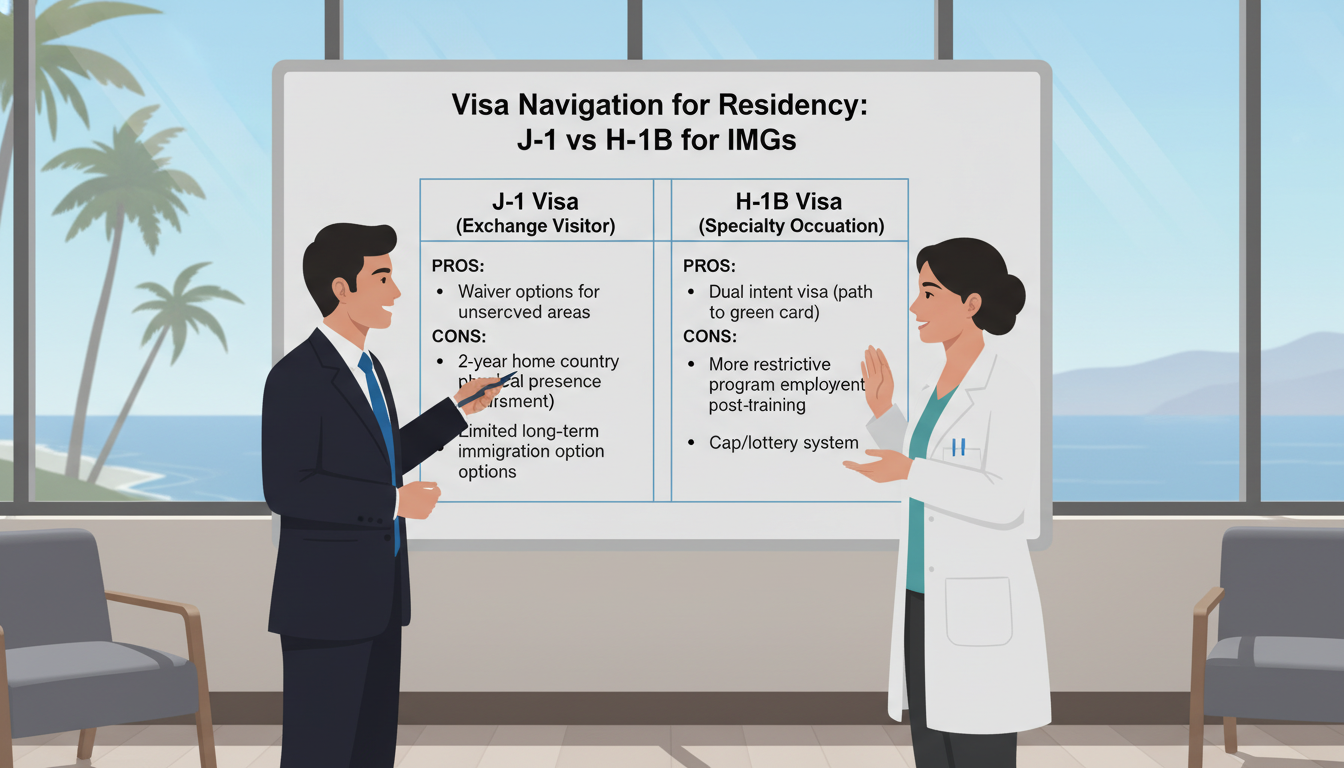
- J-1 (ECFMG-sponsored) Exchange Visitor Physician
- H-1B Temporary Worker (Specialty Occupation)
J-1 Exchange Visitor Physician Visa
The J-1 is the most commonly used residency visa for IMGs in the U.S. and is sponsored centrally by ECFMG, not by individual hospitals.
Key features of the J-1:
- Purpose: Graduate medical education (residency and fellowship)
- Sponsor: ECFMG (you don’t need program-specific USCIS filings, but the program must agree to train you on J-1)
- Duration: Typically issued for 1 year at a time, renewable annually up to the official duration of training
- USMLE requirement: Usually at least Step 1 & Step 2 CK passed; Step 3 is not required for J-1 sponsorship
- Funding: Must have an approved residency/fellowship position with appropriate salary
The 2-Year Home Residency Requirement (212(e))
The major “catch” of the J-1 is the 212(e) home residency requirement:
- After completing training, you must return to your home country (or country of last permanent residence) for an aggregate of 2 years before you are eligible for:
- H-1B
- L visas
- Permanent resident status (green card)
- This is a legal requirement and taken very seriously by immigration authorities.
However, many IMGs avoid physically returning for 2 years by obtaining a J-1 waiver.
J-1 Waiver Basics (Post-Residency)
Most IMGs who train on J-1 and wish to stay in the U.S. will pursue a J-1 waiver job after residency/fellowship. Common pathways include:
- Conrad 30 Waivers (state-level programs)
- Federal programs (e.g., VA, HHS clinical waivers in underserved areas)
- Hardship or Persecution waivers (more complex and individualized)
For Pacific Coast states:
- California has a very competitive Conrad 30 program, with strong preference for primary care and psychiatry in underserved areas.
- Oregon and Washington also use Conrad 30, often with emphasis on rural or frontier areas.
Planning for this while in residency is essential, especially if your ultimate goal is to stay on the West Coast.
H-1B Visa for Residency
The H-1B is a work visa for “specialty occupations” and is the main employment-based visa alternative for IMGs in residency.
Key features of H-1B for residency:
- Sponsor: The hospital or health system (not ECFMG)
- Purpose: Employment, not exchange; you’re an “employee” rather than an “exchange visitor”
- USMLE requirement: USMLE Step 3 is mandatory before H-1B petition approval
- Costs: Filing, legal, and related fees must be paid by the employer, not the applicant
- Cap-exempt status: Many academic teaching hospitals are cap-exempt, so they are not limited by the annual H-1B lottery that applies to many private employers
For residency:
- Many West Coast academic centers limit or decline H-1B for interns (PGY-1) because there is not enough time for candidates to complete Step 3 before rank lists are due.
- Some programs will sponsor H-1B only for advanced positions (e.g., PGY-2 in specialties like neurology or anesthesia where training starts later).
Advantages of H-1B for Residency
- No 2-year home residency requirement
- Potentially easier transition to long-term employment and later permanent residency (green card)
- Can be extended up to 6 years (and longer in some green card processes)
Disadvantages for IMGs
- Requires Step 3 passed early, often before rank list deadlines
- More expensive and administratively complex for the program
- Some California residency programs and West Coast institutions have internal policies not to sponsor H-1B for residents due to cost and compliance burden
How Pacific Coast Programs Handle Visa Sponsorship
While immigration law is federal, there are regional patterns in how programs approach IMGs, particularly across the Pacific Coast.
1. California Residency Programs
California is one of the most desirable states for residency because of:
- Prestigious academic centers (UCSF, UCLA, Stanford, UCSD, UCI, UC Davis, etc.)
- Large, diverse patient populations
- Major community and county hospitals with high clinical volume
- Attractive lifestyle on the West Coast
This demand shapes their visa behavior.
Typical patterns in California:
- Many large academic centers accept J-1 but not H-1B for residency.
- Some smaller community programs may be more flexible, but often:
- J-1 is favored for categorical IMGs
- H-1B may be considered for:
- Highly competitive candidates
- Advanced standing positions
- Critical shortage fields
California-specific considerations:
- Licensing timelines: California’s medical board has specific document and verification requirements; delays in licensing can complicate H-1B timing.
- Some California programs explicitly state “no visa sponsorship” on their websites or ACGME profiles—always verify before applying.
- For long-term planning, remember:
- California’s Conrad 30 is competitive and typically prioritizes primary care and psychiatry.
- Specialists who trained on J-1 may need to be flexible about leaving California temporarily to secure a waiver job in another state.
Example: Two Hypothetical California Programs
University-Based Internal Medicine (San Francisco Bay Area)
- Visa policy: “J-1 sponsorship only; no H-1B”
- Practical outcome: An IMG with USMLE Step 3 may still only be offered J-1 if matched.
Community Hospital Family Medicine (Central California)
- Visa policy: “J-1 and H-1B considered on a case-by-case basis”
- Practical outcome: A strong IMG with Step 3 completed and clear interest in rural primary care might be able to secure H-1B sponsorship here.
2. Oregon and Washington Residency Programs
Oregon and Washington have fewer total residency positions than California, but they are important gateways to Pacific Northwest careers.
General trends:
- Major academic centers (OHSU, UW, major health systems in Portland, Seattle, Spokane) typically:
- Are comfortable with J-1 sponsorship
- May or may not offer H-1B for residency; policies vary by department
- Some community programs, particularly in rural or underserved areas, may be more flexible, especially if they struggle with recruitment.
There is often a slightly higher likelihood of program-level flexibility in Oregon and Washington compared to the busiest California centers, but every program is different.
Conrad 30 in Oregon and Washington:
- Both states use Conrad 30 extensively to address physician shortages.
- They often encourage recruitment to:
- Rural areas
- Tribal health centers
- Community health centers and safety-net clinics
If your long-term goal is to build a career in the Pacific Northwest, training on J-1 with a plan for a Conrad 30 waiver in Oregon or Washington can be a realistic and strategic pathway.
J-1 vs H-1B: Strategy for West Coast–Focused IMGs
Deciding between J-1 vs H-1B is rarely straightforward. The right choice depends on:
- Your geographic priorities (must you stay on the West Coast?)
- Your specialty (primary care vs procedure-heavy specialty)
- Your timeline (do you realistically have time for Step 3 before applications?)
- Your long-term immigration goals (green card timing, family considerations)
When J-1 Often Makes More Sense
- You haven’t passed Step 3 before applying or ranking.
- Your dream programs (e.g., top California residency programs) offer only J-1.
- You are open to doing a J-1 waiver in a different state after training, possibly returning to the West Coast later.
- Your priority is maximizing chances to match, not optimizing immediate post-residency immigration options.
When H-1B Might Be Worth Targeting
- You already have Step 3 completed well before the application cycle.
- You are applying to programs that clearly state H-1B sponsorship (many IMGs underestimate how few of these exist on the West Coast).
- You have strong reasons to:
- Avoid the J-1 2-year home residency requirement, or
- Move more directly towards employment-based permanent residency.
Caution: Don’t Limit Yourself Too Early
A common mistake among IMGs targeting west coast residency programs is to:
- Decide “H-1B only,”
- Apply mostly or exclusively to H-1B-sponsoring programs,
- Then end up with few interviews and no match.
For most applicants, a hybrid strategy works better:
- Prioritize match probability:
Apply broadly to programs that at least sponsor J-1, especially in California, Oregon, and Washington. - Include a subset of H-1B-friendly programs:
Particularly:- Some community internal medicine, family medicine, or psychiatry programs
- Institutions explicitly supporting H-1B in their publicly available policies
- During interviews, ask tactful, informed questions about visa options (more on this below).
Practical Timeline and Action Plan for Visa Navigation
Managing a residency visa is largely about timing and documentation. Here is a practical, step-by-step outline for IMGs applying to West Coast programs.
12–18 Months Before Match
1. Clarify Your Overall Strategy
- Decide your top geographic priorities:
- Is your first priority California residency programs? Or is securing any west coast residency position (including Oregon/Washington) acceptable?
- Decide how strongly you want to pursue H-1B vs being open to J-1.
2. USMLE Planning
- Target schedule:
- Step 1 and Step 2 CK: Completed before ERAS opens.
- Step 3:
- If you want H-1B for PGY-1, you should ideally pass Step 3 before rank list submission (often by January–February of the Match year).
- If timing is tight, be realistic:
- It’s safer to plan for J-1 than risk no match while chasing H-1B.
9–12 Months Before Match (Application Season)
3. Research Program Visa Policies Thoroughly
- Use multiple sources:
- Program websites
- FREIDA
- ECFMG/NRMP data
- Look for:
- “We sponsor J-1 only”
- “We sponsor J-1 and H-1B”
- “No visa sponsorship”
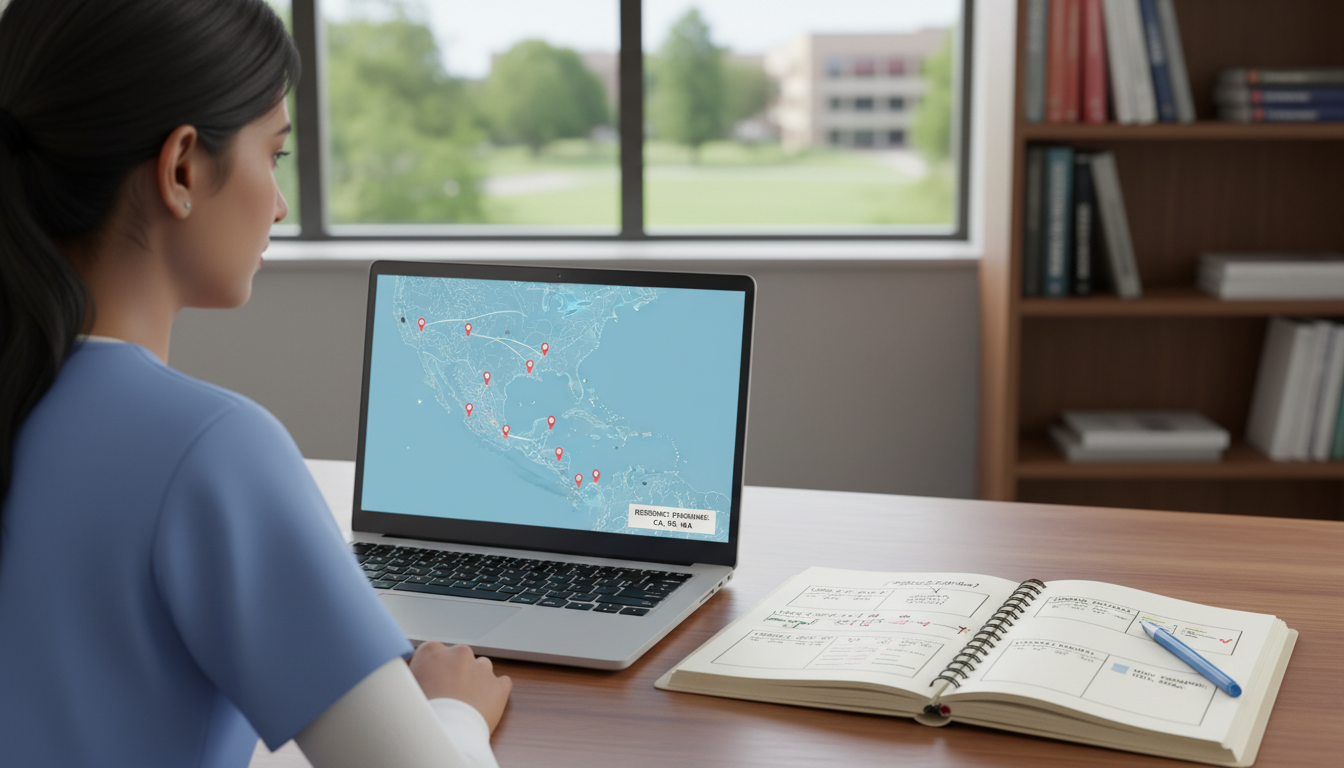
- Create a spreadsheet tracking:
- Program name
- State (CA/OR/WA)
- Visa policy
- Historical IMG match (if available)
- Any notes (e.g., prefers primary care, historically matched many IMGs, etc.)
4. Build a Balanced Application List
- Include:
- A reasonable number of California residency programs that sponsor J-1
- Some west coast community programs (particularly in OR/WA) that may be somewhat more IMG-friendly
- Some H-1B-sponsoring programs if you have Step 3 done
Prioritize overall interview yield, not just location or visa type.
Interview Season (October–January)
5. How to Ask About Visa Policies During Interviews
You want clarity without sounding like you’re only interested in immigration. Consider questions like:
- “Could you tell me what types of visas your program is currently able to sponsor for residents?”
- “Do your current international residents train on J-1, H-1B, or both?”
- “If someone joins on J-1 and later passes Step 3, would the program ever consider transitioning to H-1B, or do residents typically remain on J-1 throughout training?”
Pay attention to:
- How confident the program is when answering (firm internal policy vs case-by-case)
- Any hints about hospital-level vs department-level restrictions
Match to Onboarding
Once you match:
6. If You Will Be on J-1 (ECFMG Sponsorship)
- Complete the ECFMG “J-1 Sponsorship Application” promptly (your program must provide certain documents).
- Prepare:
- Valid passport
- ECFMG certification
- Contract or official offer letter
- Financial documentation (usually your residency salary suffices)
- Coordinate travel plans with expected DS-2019 issuance and consular appointment (if outside the U.S.).
7. If You Will Be on H-1B
- Program will typically connect you with:
- Institutional HR
- Immigration counsel or legal office
- You must provide:
- USMLE Step 3 pass result
- Valid ECFMG certification and diplomas
- Passport, CV, license or limited permit documents
- Timing is critical:
- H-1B petition and approval must be in place before your start date (often July 1).
- Begin this process as early as possible after Match.
Long-Term Planning: Beyond Residency on the Pacific Coast
Your choice of residency visa affects your first job, especially if you aim to stay in California, Oregon, or Washington.
If You Trained on J-1
You must address the 2-year home residency requirement via:
J-1 Waiver Job (most common path)
- Typically 3 years in a designated underserved area
- Often on an H-1B visa
- Conrad 30 is state-run but federally based
Returning Home for 2 Years
- Less common for those planning a U.S. career, but an option
Other Waiver Types
- Hardship or persecution, requiring complex legal work and strong evidence
West Coast Implications:
- California Conrad 30 is very competitive. Many IMGs find waiver jobs more readily in:
- Midwestern or Southern states
- Less densely populated regions
- Oregon and Washington have more opportunities relative to their population size but still may favor:
- Rural communities
- Community health centers
Therefore, an IMG who trains at a prestigious California residency program on J-1 may need to:
- Complete residency/fellowship in California
- Move to another state for a 3-year J-1 waiver job
- Potentially return to the Pacific Coast after waiver completion as a permanent resident or long-term employee
If You Trained on H-1B
- No 2-year home requirement.
- You can:
- Seek jobs anywhere in the U.S., including the Pacific Coast
- Have your employer initiate a green card process directly
However:
- You must maintain valid H-1B status or another appropriate status.
- Your long-term ability to remain on the West Coast still depends on:
- Job availability
- Employer willingness to sponsor
Frequently Asked Questions (FAQ)
1. Do most Pacific Coast residency programs sponsor H-1B or only J-1?
Most west coast residency programs that sponsor visas at all will primarily sponsor J-1. A smaller subset, often including some community or certain academic programs, may also sponsor H-1B. California residency programs, in particular, tend to favor or exclusively use J-1 for residents due to internal policy, cost, and administrative reasons. Always check each program’s current statement; policies can change year to year.
2. If I really want H-1B, should I skip J-1-accepting programs?
Usually no. Limiting yourself only to H-1B-sponsoring programs significantly reduces your chances of matching—especially on the West Coast where competition is high. A more effective strategy is to apply broadly to J-1 and H-1B programs, then explore H-1B possibilities where feasible, while keeping J-1 as a realistic and common pathway.
3. Can I switch from J-1 to H-1B during or after residency without a J-1 waiver?
In general, no. If you are subject to the J-1 2-year home residency requirement (which most exchange visitor physicians are), you cannot change to H-1B or obtain a green card until you either:
- Fulfill the 2-year requirement abroad, or
- Obtain a formal J-1 waiver.
Switching from J-1 to H-1B without addressing 212(e) is not allowed as a simple status change.
4. What can I do now to improve my visa options for West Coast residency?
Key steps:
- Finish USMLE Steps 1 and 2 CK with strong scores.
- If possible, complete Step 3 early—this keeps H-1B as an option.
- Research California, Oregon, and Washington programs’ visa policies and create a detailed spreadsheet.
- Prioritize strong clinical experiences, letters of recommendation from U.S. physicians, and a compelling personal statement that ties your goals to underserved care or regional interests.
- Consider a flexible mindset about J-1 vs H-1B, focusing first on matching into a solid training program, then planning post-residency immigration steps strategically.
By understanding how IMG visa options, particularly J-1 vs H-1B, are implemented by west coast residency programs, you can design a realistic and informed strategy for your Pacific Coast career. Your goal is not just to choose a visa type in theory, but to align your exam timing, application list, and long-term plans with the immigration pathways that West Coast institutions are actually willing to support.