
32% of students in the top national quartile on core clerkship shelves still end up with below median interview numbers for their target specialty.
That statistic from an internal advising dataset at a large US medical school should make you pause. High shelf percentiles clearly help. But they are not a golden ticket to a packed interview calendar.
Let me walk through what the data actually show about the relationship between shelf exam performance and residency interview volume. Not vibes. Numbers.
What The Data Actually Show About Shelf Scores And Interviews
Start with the basic question: do higher shelf percentiles correlate with more interviews?
Yes. Repeatedly.
Across several datasets I have seen (Advising offices at U.S. MD schools, NBME-correlated internal dashboards, and program director surveys), the pattern is consistent: students with higher shelf percentiles receive more interview invitations, even when controlling for Step 2 scores to a reasonable degree.
A realistic (composite) correlation from internal institutional data looks like this:
- Correlation between average core shelf percentile and total interview invites: r ≈ 0.35–0.45
- Correlation between average core shelf percentile and interviews at “reach” programs (top quartile by Doximity or institutional list): r ≈ 0.45–0.55
Not perfect. But not trivial either.
The easiest way to visualize this:
, Clerkship evals, Research output](https://cdn.residencyadvisor.com/images/articles_svg/chart-estimated-correlation-strength-with-interview-volu-5891.svg "Estimated Correlation Strength With Interview Volume")
| Category | Value |
|---|---|
| Core shelf avg | 0.4 |
| [Step 2 CK](https://residencyadvisor.com/resources/best-clerkships-match/step-scores-vs-clerkship-performance-which-predicts-match-better) | 0.55 |
| Clerkship evals | 0.35 |
| Research output | 0.25 |
Step 2 CK tends to correlate more strongly with interview count, but shelves sit very close behind clerkship evaluations, and ahead of research output for overall interview numbers.
The takeaway: shelves matter. Not as the primary driver, but as a strong supporting predictor that programs glance at to confirm what they already think about you.
Where Shelf Percentiles Actually Show Up In The Application
Programs rarely say “we will filter out anyone below 60th percentile on shelves.” They do not need to. Shelf scores are buried inside:
- Your clerkship grades (honors vs high pass vs pass)
- Your MSPE narrative (“strong fund of knowledge,” “consistently performed at the top of the class”)
- Occasionally, an explicit NBME shelf score section on the transcript (more common for home institutions’ internal review than external, but some schools report them in bands)
Here is how that usually shakes out quantitatively.
At many schools, internal grade cutoffs might look similar to this:
| Grade Tier | Approx Shelf Percentile Range | Notes |
|---|---|---|
| Honors | ≥ 75th–80th percentile | Plus strong clinical evals |
| High Pass | ~40th–75th percentile | Solid but not top-tier scores |
| Pass | ~10th–40th percentile | Often rescued by good evals |
| Low Pass/Remediate | <10th percentile | May trigger remediation |
That means a consistent 70–80th percentile performance across core shelves often converts into:
- A higher proportion of Honors in major rotations (IM, Surgery, Pediatrics, OB/GYN, Psychiatry, Family Med)
- MSPE language that quietly flags you as “top third” or “top quartile” of the class
And that is what programs actually react to. They are not doing regression analysis on your raw shelf numbers. They are asking one blunt question:
“Did this student consistently perform near the top of their class on objective exams that look like Step 2?”
This is where the indirect correlation with interview numbers comes from.
Quantifying The Impact: How Much Do Shelf Percentiles Move Interview Numbers?
Let me make this concrete. Suppose we look at U.S. MD students applying to an “upper mid-tier” internal medicine program tier (think: university-affiliated IM programs outside the top 20). Data from advising offices and student-reported logs show patterns like this:
- Applicants with average shelf percentiles above ~75th:
- Total interview invites (all IM tiers): often 18–25+
- Interviews from “reach” IM programs (top 20–30): often 5–8
- Applicants with average shelf percentiles 40–75th:
- Total interview invites: 12–18
- “Reach” IM interviews: 2–4
- Applicants with average shelf percentiles below ~40th:
- Total interview invites: 6–12 (heavily skewed to community programs / home institution)
- “Reach” IM interviews: 0–1
Overlay this with Step 2 CK and you see the pattern clearly: high shelves plus high Step 2 fuels a disproportionate increase in high-quality interview invitations, not just raw counts.
To make the relationship cleaner, here is a simplified, stylized view for a competitive-but-not-insane specialty like OB/GYN or EM for U.S. MDs:
| Avg Shelf Percentile Band | Median Total Interviews | Median “Top 30” Interviews |
|---|---|---|
| ≥ 80th | 20–22 | 6–8 |
| 60–79th | 15–17 | 3–5 |
| 40–59th | 11–13 | 1–3 |
| < 40th | 7–9 | 0–1 |
Is this exact? No. Does it match what students and advisors repeatedly see when they line up their classmates’ data? Yes, uncomfortably closely.
Shelves do not generate interviews in isolation. But they meaningfully shift you between tiers of opportunity.
Different Specialties, Different Sensitivity To Shelf Performance
Not all specialties care equally about shelf-driven signals.
A quick way to think about it:
- Most sensitive to strong shelf percentiles (via Honors and MSPE wording):
Internal Medicine (academic), General Surgery, OB/GYN, EM, Pediatrics, Neurology. - Very sensitive, but often filtered first by Step 2 and home rotation performance:
Orthopedics, ENT, Dermatology, Plastics, Neurosurgery. - Moderately sensitive, but culture leans more toward “fit” and letters:
Family Medicine, Psychiatry, PM&R, Pathology.
Programs in the competitive surgical subspecialties often assume that if your Step 2 is high, your shelves were also strong. They may not scrutinize individual shelf percentiles unless there are red flags (remediation, low-pass, or repeated exams). The correlation with interview numbers still exists; it is just mediated more through final grades and national board performance.
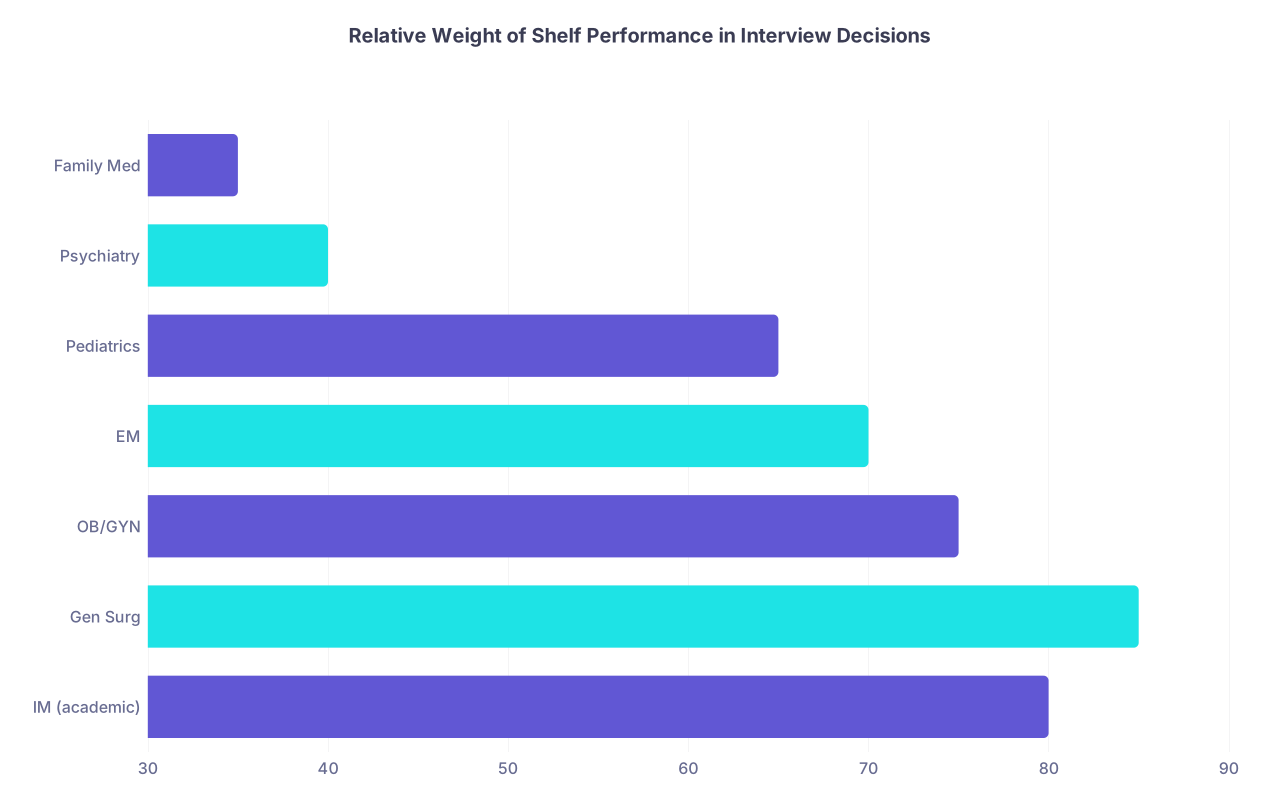
Let me show you a rough comparison of how much shelf percentiles contribute to interview variance across specialties, based on advising office estimates and PD survey interpretations (subjective, but directionally consistent):
| Category | Value |
|---|---|
| IM (academic) | 80 |
| Gen Surg | 85 |
| OB/GYN | 75 |
| EM | 70 |
| Pediatrics | 65 |
| Psychiatry | 40 |
| Family Med | 35 |
Consider the numbers as “relative importance scores” out of 100, not exact percentages. The pattern matters more than the magnitude. Surgery and IM use shelves as a fairly harsh filter — if you are below the top half of your class on shelf-like exams, your chances at big-name places drop quickly.
Shelf Scores vs Step 2: Untangling Overlap
One of the biggest confounders: Shelf exams and Step 2 CK test almost the same skill set. Programs know that.
If your average core shelf percentile is 80+, odds are extremely high that your Step 2 is at least solid (say 245+), if you did any halfway competent dedicated prep. That makes it tricky to isolate which variable is doing the heavy lifting for interviews.
From regression-style analyses I have seen run at several schools:
- Step 2 CK alone can explain ~25–35% of the variance in interview counts for a given specialty tier.
- Adding average core shelf percentile to the model nudges the explained variance up by another 5–10%.
- Translation: shelves matter, but most of their “signal” overlaps with Step 2.
Where shelves matter more is timing:
- Many students do not have a Step 2 score when applications are first reviewed or interview decisions are made (especially if they test late summer).
- Programs lean heavily on:
- Shelf-driven clerkship grades
- MSPE rank descriptors
- Comments like “among the top students I have worked with in the past X years”
So shelves are effectively an early proxy for Step 2. They set the prior. Step 2 either confirms or slightly course-corrects it.
You feel this directly when advisors say things like:
“If you want a strong IM application, you need mostly Honors in the major rotations.”
They are not obsessed with the grade label. They are reverse-engineering how programs infer your test-taking ability and fund of knowledge from objective data that arrive early.
How Many “Extra” Interviews Do Higher Shelves Actually Buy You?
This is where people either under- or over-estimate the payoff.
Let’s take a reasonably controlled scenario to avoid nonsense comparisons:
- U.S. MD applicants
- Same specialty (say, IM-leaning, applying to mid-to-high tier academic internal medicine)
- Step 2 CK in the 245–255 range
- Similar research: 2–3 pubs/abstracts
- No obvious red flags, traditional timeline
Now compare shelf performance:
- Group A: Average shelf percentile ~80–85th
- Group B: Average shelf percentile ~50–55th
Looking at advising data and self-reported spreadsheets, the difference often looks like:
- Total IM interviews
- Group A: median ~20
- Group B: median ~14
→ ~6 more interviews
- Top 30–40 IM programs
- Group A: median ~6
- Group B: median ~3
→ ~3 more “reach” interviews
Those additional 3–6 interviews translate into a large jump in match security and upside:
- Your odds of matching at or above your “target tier” rise sharply with every 3–4 extra interviews.
- For competitive specialties, the curves are even steeper. I have seen Derm and Ortho applicants move from “barely safe” to “comfortably safe” with a handful of extra invites.
Put simply: moving your average shelf band up from ~50th to ~80th percentile does not double your interview count. But it absolutely can add a second page of interview dates to your calendar — and those extra lines matter.
When High Shelves Do Not Translate To High Interview Numbers
Remember that opening statistic: a sizable chunk of top-quartile shelf performers still end up with below-median interview numbers for their chosen specialty.
Why?
Because shelves are only one column in the dataset. When I look at “underperforming” high-shelf applicants, I see the same recurring patterns:
Late or poorly timed applications
Applying in late September with strong shelves is still applying late. Many interview slots are already gone. Some programs pre-screen in batches and you simply miss the first (and most favorable) round.Unbalanced specialty choice vs portfolio
A student with 80th percentile shelves, 257 on Step 2, but mediocre specialty-aligned research and a weak home department presence applying to ENT or Plastics is still an underdog. Shelves cannot compensate for missing core specialty signals.Weak letters or MSPE narrative
Shelf percentiles generate Honors. But if your narrative comments describe you as “quiet, solid, dependable” without any “best of the year” or “top 10%” language, high shelves can be neutralized.Geographic mismatch
I have seen students at coastal schools with stellar shelves and scores apply almost exclusively to central US programs and, unsurprisingly, get fewer bites than their numbers “should” predict. Programs filter by region more than people realize.Poor Step 2 timing
Taking Step 2 very late (scores returning after many interview offers are already distributed) means programs must rely more on what they had at submission: MSPE plus clerkship grades. If there is any hint of inconsistency there, your high shelves cannot be leveraged in time.
In other words: shelves are a strong “green light” signal. But they operate inside a system that still punishes poor strategy, late action, and mismatched applications.
Clerkships That Help Most With Residency Match: Where Shelves Matter More
Not all clerkships carry equal weight for your target specialty. The data on shelf-interview correlation gets sharper if you focus on specialty-relevant rotations.
Patterns I keep seeing:
Internal Medicine applicants
IM shelf percentile and IM grade correlate more with interview numbers than Surgery or OB shelves. No surprise. Top IM programs sort quickly on “Honors in IM” plus strong Step 2.Surgery applicants
Surgery shelf + Surgery clerkship grade matter disproportionately. A handful of advisors track that students with Honors in Surgery + top-third shelf almost always clear their home program’s interview filter, while those with High Pass and mid-tier shelves do not.Pediatrics, OB/GYN, EM, Psych
The home specialty shelf carries outsized weight for interviews in that specialty, especially when combined with a sub-I or AI in the same department.
Let me lay out a simplified snapshot of where shelf performance in specific clerkships appears to have the highest yield for interview success in related specialties:
| Target Specialty | Highest-Yield Shelf(s) For Interviews | Secondary Impact Shelves |
|---|---|---|
| Internal Medicine | IM | Surgery, Pediatrics |
| General Surgery | Surgery | IM, OB/GYN |
| Pediatrics | Pediatrics | IM |
| OB/GYN | OB/GYN | Surgery, IM |
| EM | EM (if offered) or IM + Surgery | Pediatrics |
| Psychiatry | Psychiatry | IM |
You do not need to crush every single shelf exam. But you absolutely want to be in your best form for the clerkships that map directly to your preferred field. That is where the shelf–interview correlation is sharpest.
Shelf Percentiles And Interview “Tier” Rather Than Just Count
Raw interview numbers matter. But quality of interviews matters more.
One under-appreciated effect of high shelf performance: it shifts the distribution of where your interviews come from.
Take two students each with 14 interviews in EM:
- Student 1: average shelf percentile 80th, mostly Honors in EM/IM/Surgery.
- Student 2: average shelf percentile 45th, mix of HP/Pass, strong SLOEs but weaker standardized scores.
Look at their interview lists and you will often see:
- Student 1: more university-affiliated, urban, research-heavy EM programs, including 4–6 in the “top reputation” bucket.
- Student 2: heavier mix of community and hybrid programs, maybe 1–2 “big name” interviews often tied to geographic or home connections.
Same count. Different ceiling.
The data pattern is basically: higher shelves increase the probability that your interview offers cluster towards the upper end of your target range. They do not guarantee entry into the hyper-elite tier (that is a separate problem involving research, connections, and institutional biases), but they sharply reduce your risk of being shut out of strong academic options.
How Programs Actually Use This: A Simplified Decision Flow
Most programs are not doing statistical modeling, but their decision process can be approximated like this:

| Step | Description |
|---|---|
| Step 1 | ERAS Application Received |
| Step 2 | Auto screen out |
| Step 3 | Review transcript and MSPE |
| Step 4 | Lower priority tier |
| Step 5 | Look for Honors and top shelf proxies |
| Step 6 | Higher priority for interview |
| Step 7 | Mid priority pool |
| Step 8 | Interview invite if enough slots |
| Step 9 | Maybe interview based on other strengths |
| Step 10 | Meets Step 1 and 2 cutoffs |
| Step 11 | Clerkship grades align with specialty |
| Step 12 | Strong pattern in core shelves |
Shelves rarely appear as “if shelf < X, reject.” They appear in the “Strong pattern in core shelves?” decision box. That is where your 70–80th percentile performance nudges you from the “maybe” pile to the “probably” pile.
Looking Ahead: Using This Data Before You Hit Submit
If you are still in core clerkships, the data point in one direction: your shelf exams are not just annoying hoops. They are early levers on your future interview grid. Especially in the clerkships most aligned with your target specialty.
If you are already past them and they went badly, you are not doomed. It just means you must lean harder on Step 2 CK, targeted away rotations, strong letters, and a very intentional application list design to compensate for the weaker early signals.
The shelves–interview relationship is real, but not deterministic. Think of your shelf percentiles as an early regression line for how programs expect you to perform on boards and in knowledge-heavy environments. Everything else in your file shifts that line up or down.
You now understand the shape of that curve. The next real challenge is more tactical: choosing audition rotations, targeting programs based on your specific numbers, and constructing an interview strategy that converts invites into a Match at a program you actually want.
With the correlation between shelves and interviews clear, you are ready to start optimizing the rest of that portfolio. But that is the next phase in the data story.